
HG Wells lived in three houses in Sandgate between 1899 and 1909. He initially moved to the seaside because of poor health and rented houses in Castle Street and Granville Road. He clearly liked Sandgate and following his earlier literary success he commissioned the architect CFA Voysey to design a house for himself and his family. The Wells family moved in on Saturday 8 December 1900 [ 1 ].
Voysey had been influenced by Pugin and shared his ideas of ‘ornament and decoration confined to the structural necessities of the building’. He was also inspired by Ruskin (whom he met as a child) and his belief that artists and architects should look to nature for inspiration.
Voysey is seen by some as incorporating both Arts and Crafts and Modernism; his influence was widespread and included Frank Lloyd Wright and Bauhaus. Voysey was known as a complete designer (as was Pugin), working to harmonise the architecture of the building with the interior design itself through a holistic approach. Pevsner described him as the twentieth century successor to William Morris. He produced around sixty domestic houses and they have provided a pattern which has been repeated in suburban housing around the world. Of his work he said;
‘Our reference to the past should be only to learn the possibilities and limitations of the material we propose to use. We are in the midst of life, and must concern ourselves with living things, thoughts and feelings’.
The house which Voysey produced for Wells came to be known as Spade House. Voysey wished to use a heart as a symbol, Wells said no, protesting that he did not wish his heart to be displayed in such a way. The heart was turned upside down, the spade was born.
It was at Spade House that Wells continued his extraordinary literary output. Not only were his books original, covering a range of genre, they dealt with social issues and the big and small questions of the day.
While living in Spade House he wrote The Sea Lady, Kipps, Tono Bungay, In the Days of the Comet and the Suffragette novel, Anne Veronica. Many of these works had local references. The Sea Lady comes ashore at Sandgate and the Folkestone of Mr Polly and Artie Kipps and Ann Pornick can still be traced along the Leas and in the streets and shop fronts.
Anne Veronica caused great scandal and coincided with the growth and development of the militant Suffragette movement. One wonders how many young women read this book of female desire and sexual emancipation and were influenced to becoming involved in the wider political struggles which were taking place.
Wells was also a political activist, speaker, lecturer and writer of pamphlets and newspaper articles. He wrote This Misery of Boots in Sandgate which remains a powerful argument for socialist change.
For a while he was involved with the Fabians and Beatrice and Sydney Webb visited him in east Kent. He debated with George Bernard Shaw. He caused outrage with his advocacy of ‘free love’ and in particular, his affair with Amber Reeves. For a while he was associated with the Romney Marsh Group of writers which included Edith Nesbit, Henry James, Joseph Conrad, Ford Maddox Hueffer (later Ford) and Stephen Crane. His writing was always direct and accessible with clever twists and turns; his private and public lives full of complexity.
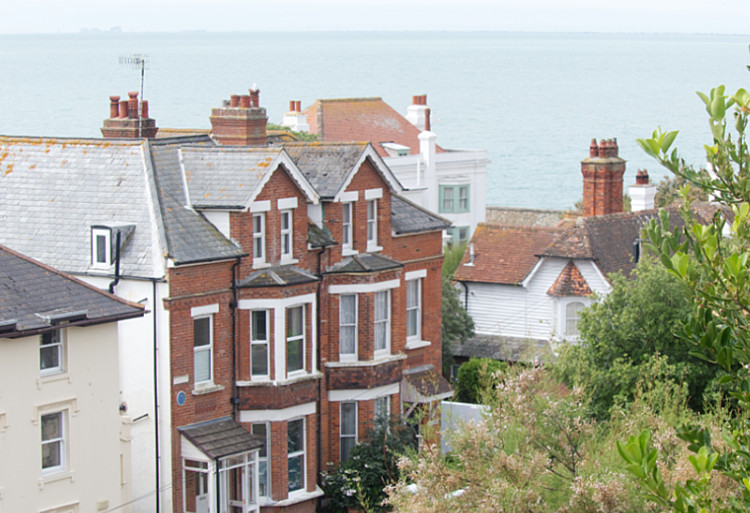
The house rented by Wells in Castle Street (above).
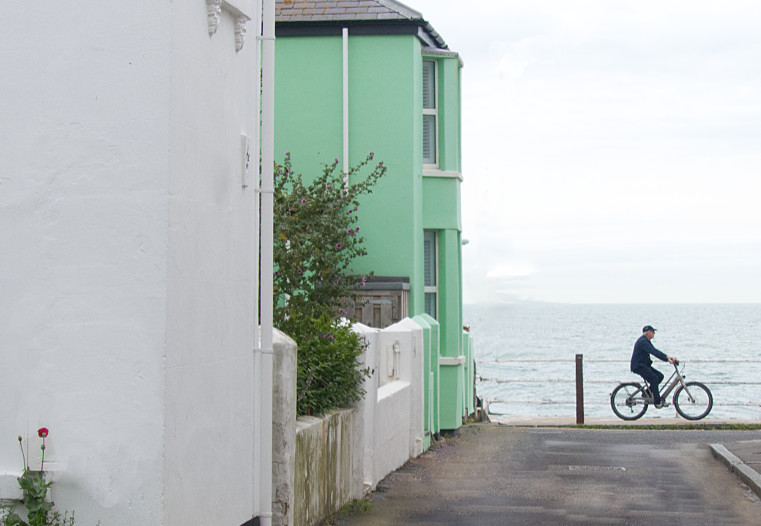
The house rented in Granville Road – ‘Beach House’ (in green) which overlooks the channel. Wells was a keen cyclist. He moved there on 29 September 1899.
This is more or less the view from Well’s house on the sea front. On the day I visited a rowing regatta was taking place.

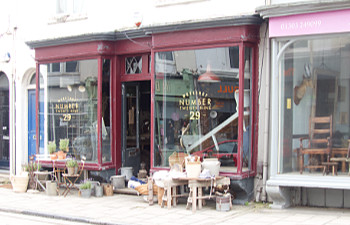

Sandgate High Street still has many good buildings. These would all have been familiar to Wells. The shop might the very same that Mr Polly worked in.

But today Sandgate suffers the plague of motorism. The High Street is dominated by motor vehicles. Very few are likely to be using the local shops or services.
It’s strange how this is seen as ‘normal’. While I was walking along it was easy to spot people driving while texting on their mobile phones, sharply accelerating toward the car ahead of them, revving up modified exhausts to make excessive noise.
Wells was a great lover of technology but I can’t imagine him thinking much of this. The overall ambiance of this is horrible.
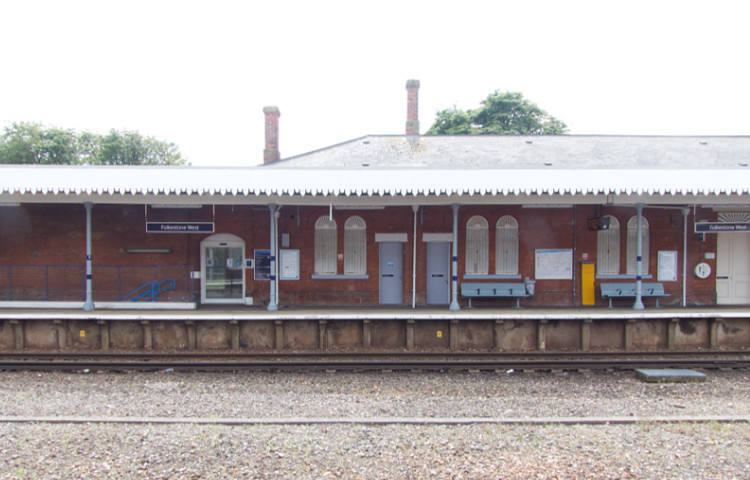
I had taken the train to Folkestone West and then walked to Sandgate. There used to be a station at Sandgate itself, and perhaps Wells had used that to travel back and forth to London.
Today much of the station is boarded up and only partially staffed. It creates a sense of neglect. Once, it would have been full of staff; porters, ticket clerks, station master and so on. People create life and places full of life are generally better places. Now there’s CCTV and the never ending inane announcements of ‘See it, say it, sorted’. But no one feels safe. And if you are lonely in the morning you will stay lonely all day. Because while waiting for the train, there’s no one to talk to.
There was also once more trains. If you visit Folkestone West look for the where the four sets of tracks would once have been. Two sets have now been removed; these were used by the boat trains.
I left Folkestone West and walked towards Spade House along Coolinge Lane, with a couple of detours along the way.
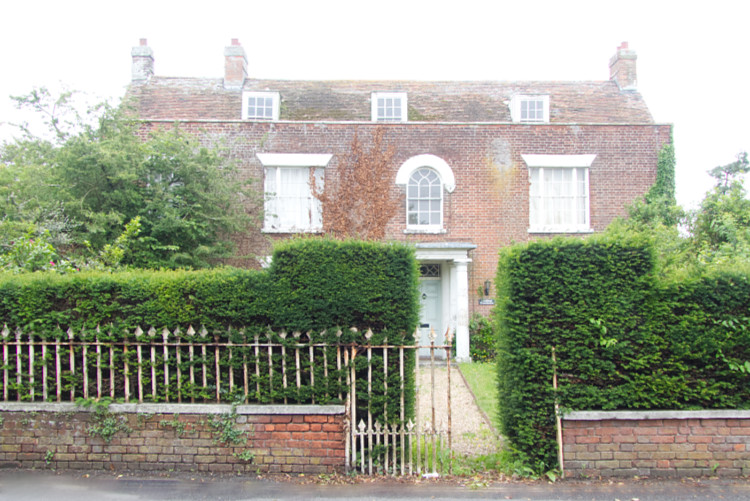
Past Coolinge farmhouse a late eighteenth century building; from the time of the beginnings of the industrial revolution, great changes in the relations of production in agriculture, a period of intense enclosures of land throughout England.
Did Wells once walk this way? I would like to think so.
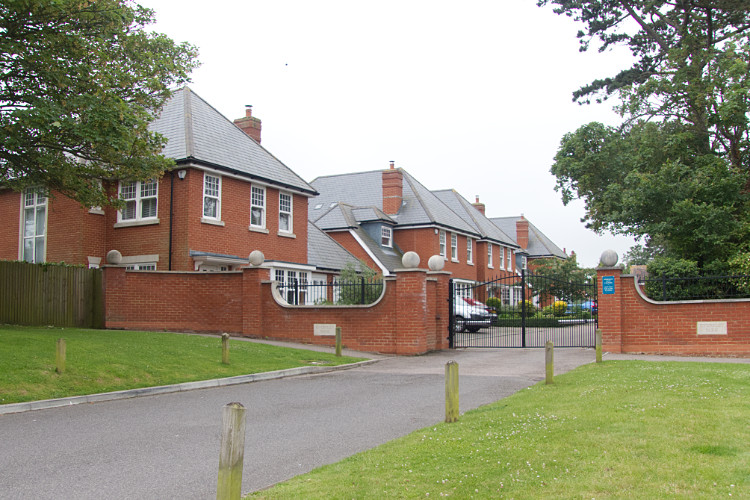
Further along, I pass a gated community. But does gated and community work? It cannot be known from these surface appearances. It requires talking to people who live there. There is no one around to ask what it’s like. And it’s not possible to enter because of the automated gate that requires a security key.
And I find the architecture rather weird.
The question I would ask is: what I want to live here? And I answered myself in the negative. But it may be ok. One’s first impressions are often wrong.
Opposite the gated community is a more open, public community. It’s a low rise estate which looks as if it was built and once owned by the local authority. A lot of local authority housing built between 1900 and 1980 was well designed, of excellent build quality and low cost to the tenants.
The blocks that make up the estate are surrounded by open space and well established trees. It is now owned by Southern Housing Group and one can’t help wondering what chicanery was involved in that.
And it is difficult to see who these two housing types; both undoubtedly claiming to be community, sustainability and opportunity, could become integrated with each other. But perhaps that’s the point I’m missing. There is no intent for such a thing to happen.

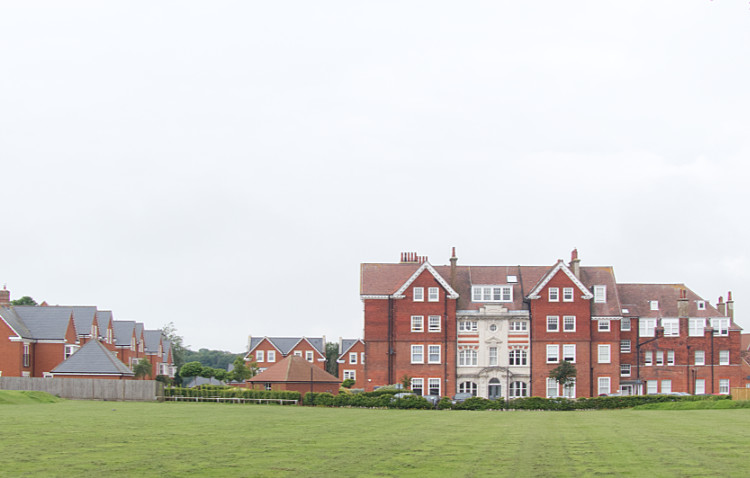
The centre of the gated community, or gated development, is this former boarding school. It is now luxury flats and was developed by Quinn Estates who state, ‘Delivering major community gains is in our DNA’.
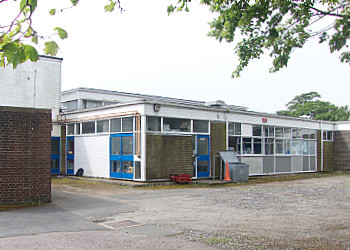

This is in contrast to part of a nearby primary school which is served by a dilapedated panel building with rusty pipes. The nursery age children are served by a pre-fabricated building.
This may seem an obvious question, which undoubtedly makes it a subversive and revolutionary question; but why couldn’t the former boarding school building still be used as a school? I must be missing something.
It was a good day out. And not only was a little of HG Wells discovered, but something distinctly Wellsian was discovered too.
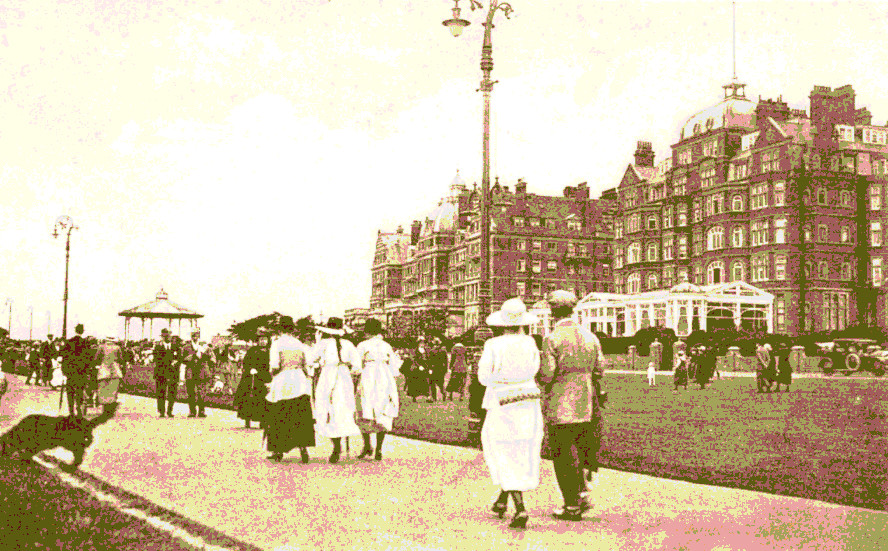
The Leas in Folkestone in the early 1900s. To reach Spade House, continue walking west and you will find a footpath that takes you down to Sandgate and the world of HG Wells.
[1] An HG Wells Chronology – J.R.Hammond
 Commodity Fetishism
You must be logged in to post a comment.