Eastbourne has a lovely sea front and some glorious sea. It’s easy to understand why Engels liked to spend his holidays here. When he died Eleanor Marx helped row a boat out into the channel to scatter his ashes upon the water. The town has some good architecture, varied and of a range of styles and times.
At the moment the town is covered with union flags and one wonders about the relationship between this tacky nationalism and the increasing poverty, hungry children and ongoing crisis in health, housing and education. The worse it gets, the more flags and dog whistling. It is unclear how this plays out. The recent coronation allegedly cost £250 million. Even this didn’t seem to be enough to please a dull and dour looking king.
It’s a broken attempt to create unity. A great number of people were indifferent, increasing number of people are republican and rather than unite, it helped reveal the vast inequalities that we live in. Increasingly I feel like a second, third and fourth class citizen. But I’m not even a citizen; that basic right and freedom is denied.
We are all subjects of the Crown. Our very consciousness and will is taken from us. Some people say they don’t ‘get’ the Society of the Spectacle. Is it really so hard to understand? Part of the Spectacle is an unreal sense of reality; a dissonance in perceptions. Rips in the dominant ideology, which we briefly see through, only to be confronted with distorted mirrors. The image changes again, but what do we really see?
This is the context to the conference ‘Engels in Eastbourne’, over the first few days in June. I wasn’t paying attention when the programme was published and was not aware of the large delegation of academics (and others) from China. Some of the academics give presentations, some are in English and others are simultaneously translated. There is a fascination with these presentations. I listen carefully to every word. How exactly does the Chinese Communist Party interpret Marx and Engels, or Lenin, Lucas, Timpanaro, Colletti, Hegel, Gramsci, Luxemburg and others? It all feels very abstract but an abstraction I can’t quite make out.
It sets off an enormous stream of questions in my head and reveals great spaces of ignorance. I realise that I know very little about the Chinese Communist Party, or indeed, China. But this encounter was like finding a golden key shining on a hidden city street, a street where people rarely go and the houses are strange and cannot be easily comprehended or dated.
The key is near the door of a building that might be used by an unusual and difficult to determine individual. It is worth trying the key in the lock. It opens the door and one steps into the gloomy hall but as one’s eyes adjust a new world is slowly revealed, and a dull light becomes a sharper illumination. The colours, sounds and auras are new and without previous experience, the objects lack familiarity and it is an interior design which cannot be described because the language to describe it has not yet been learnt, and existing vocabularies lack the necessary words.
I ask one of the speakers if they are in the Communist Party. I’m not sure how to do this. It feels too abrupt and I am conscious that I lack a map to help navigate the etiquette. They look slightly defensive; but that could be for many reasons. I would really like to get to know these people much more. That in itself would reveal a great deal.
It was just that time was short and there was pressure to be quick and concise. All assumptions about the Chinese Communist Party have to be suspended here. The public record can be read. But what do the academics at the schools of Marxism in the universities really think? And how is Marxism taught in the schools? And how is there a ‘Marxist’ explanation of how China has become the world’s largest economy, producing over 30 percent of global manufactured goods; all within the last thirty or forty years? I would so much liked to have asked all of this and more. But there was the issue of etiquette; and I didn’t want to make anyone feel uncomfortable. And it wasn’t clear who these ‘others’ were.
The whole delegation was smartly dressed in a business casual style, elegant and courteous. And yet….it felt as if there was something else going on. About interactions, conversations, what could and could not be said. What is the content of the hidden transcripts in this country? And we know that the CCP can be, and is, viscous and repressive. But what about the cadre? We know the British government can be, and is, violent and oppressive. There are wars all over the place that successive British governments have been involved in and millions of people have been killed in those wars. The British government treats masses of people with contempt. That doesn’t mean everyone in Britain thinks like the government or supports what it does.
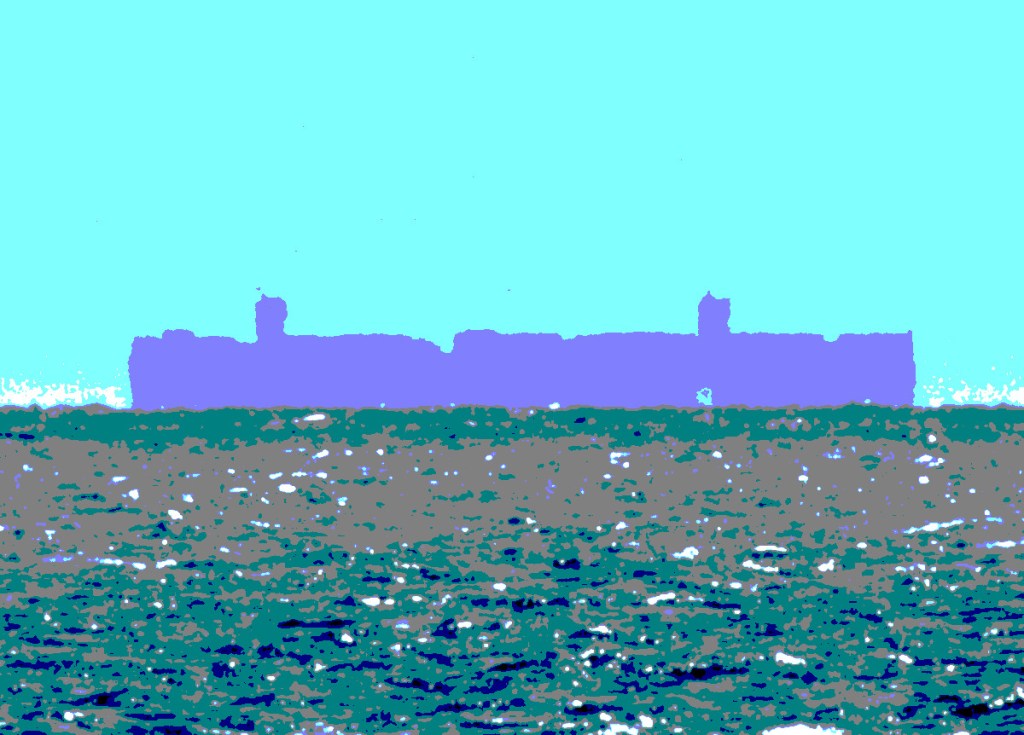
In one of the lunch breaks I walk along the sea front. There are two giant size container ships on the horizon. Masses of goods manufactured in China and being exported around the world.
I ask one of the speakers about the huge advance in the productive forces in China. They laugh and don’t really answer. Again, I don’t want them to feel uncomfortable; but again, I wonder whether there is a sense of defensive reservation here. Is it possible to study Marxism in an abstract way in China but less possible to study the political economy of the contemporary world? And if the latter is possible, how is the theory of surplus value explained? Alienation? Capital accumulation? Competition? Exploitation?
I buy an ice cream from a kiosk. The woman who is serving has her phone on speaker mode so I can hear the conversation she is having with a friend. It’s one of those machines that squirts the ice cream out of a nozzle into a cornet. While she is holding the cornet to receive the lump of fatty cream she tells her friend that her rent has just gone up by £135 a month. I very much doubt that her wages have.
‘Here you are’, she says, putting a flake in the side and handing it to me. It’s just a sugary concoction but sitting near the beach and watching the blue waves roll over into white caps and listening to the slap of water and the hiss on the shingle, it’s delicious.
Each few yards of the sea is different. The depth, the underlying geology, the currents, the subtle differences in the way the tidal movement impacts upon the shoreline. The ships are further out in the sea lanes here. The drift of the sand and gravel is different. Sea bass live in this water a hundred yards from land, lobsters over there.
One of the speakers points out that without Engels, Marx would probably have never written Capital. ‘In fact’, he adds, ‘without Engels, Marx might not have written anything at all’.
Terrell Carver gave the key note speech on the opening day of the conference and makes a convincing argument that based on the analysis of various texts, Engels is the most likely author of Part 1 and Part 2 of The Communist Manifesto.
Johann G Koenig gives a great presentation on Engels in Bremen. It is full of picture-word anecdotes and delivered with warmth and humour. The first question after he finishes speaking is something about Engels and the stock exchange in Havana. Later the speaker says to me, ‘what on earth was that question about?’
I was much less keen on the two Stalinists who spoke. It is dogmatic, sectarian, authoritarian and narrow. There is something creepy and oppressive about it all. A great deal is made of ‘totality’ which I do not find at all convincing. And if there is a totality then how does it look when gulag, political prisoners, show trials, exploitation, alienation, capital accumulation are added in?
I go along with Terry Eagleton on this sort of approach. Marx and Engels are the go to theorists for the commodity and capital; but not for marriage guidance or how to care for tropical fish. Or medical advice, or how to fix a bicycle; and so on. And to just keep saying there is a totality isn’t really saying anything at all. Yes, we live in the same time and space (relatively) as the universe, but that doesn’t explain why I have to sell my labour power each week or why London has become a repository for surplus capital from Saudi Arabia, Qatar, Kuwait…oh, and China.
Who is living in a bubble here? Sometimes I wonder what it would be like. Would it be easier to just learn a dogma? But I think I might prefer a Catholic one with all the colour and its ritual and promises of ever lasting life. Even political bubbles, despite the dogma, are frail and prone to unexpectedly burst. And a great deal of soap and lather is needed to create a bubble and to keep it floating in the air. And who wants soapy Marxism?
I am talking to someone and it’s not clear whether they are a speaker a delegate or something else. While I’m talking, one of the delegation arrives and, I think, talks to this person in quite a sharp way. These are only observations. The person looks at me and I think looks a little flustered. Something curious then happens. I am effectively coerced in a ‘friendly’ way to have my photograph taken. First with the person I’ve been talking to, and then the person who spoke sharply to them. Rather oddly someone comes up quickly and without asking me, turns my name badge round so it can be read in the photograph. All I experience is an atmosphere. Perhaps I’ve just misunderstood.
I accept I may have read all this in a way that was not intended. But it felt a little peculiar. The coda to this is that for reasons best known to myself, it wasn’t actually my real name on that badge. If I’m being recruited as a spy, I already have an alias.
Watching, being watched, being careful, free speech, free thought, the expansion of the spectacle into Beijing, the accumulation of capital in the Pearl River Delta, the competition of Chinese capital with US capital, secrets, treaties and military expenditure. The alienation and atomisation of the Chinese workers in the factories that never stop, hours and hours a week, wages which are withheld, police attacks on protestors. The memories and echoes of the Chinese Revolution, the Cultural Revolution, the humiliations of the British and Japanese imperial regimes.
I left the conference and walked along the sea front again. The evening was cool and the sea in a buoyant playful mood. It’s a deception. The sea will change in an instance into a menacing and murderous force. Any political party which can do the same must be treated with great care. It is like engaging with a multi-headed creature; some of these heads are benign; but some have sharp teeth and spit fire. Perhaps the creature will try to devour itself; the workers pulling at its tail and the Central Committee trying to hold it by its horns.
On the seafront a band was rehearsing the Queen song ‘Radio Ga Ga’. Suddenly that felt real and the conference full of illusions and abstractions. Odd. Because if Marx and Engels tried to do anything, it was to put the world on its feet; and once the world was the right way up, the world could learn to use it’s head.
 Commodity Fetishism
You must be logged in to post a comment.