There was an opportunity to go to a seminar. Something along the lines of ‘the Future of London’, that sort of thing. The speaker is at the top of what they do. This makes them clever; in a knowing sort of way. I imagined: the content will be framed within certain ideological parameters.
There will be a great deal of appearance, but much less content on what lies hid beneath. The expansion of capital, the exploitation of labour, the atomisation of society, the split of people into two primary classes, the role of the state, the rule of the bourgeoisie. All that will be missing. Perhaps I should have gone just to listen.
That was the intended starting paragraph. And then, I surprised myself and did go. That’s where I am now. It’s absurd to write stuff without either studying or experiencing it.

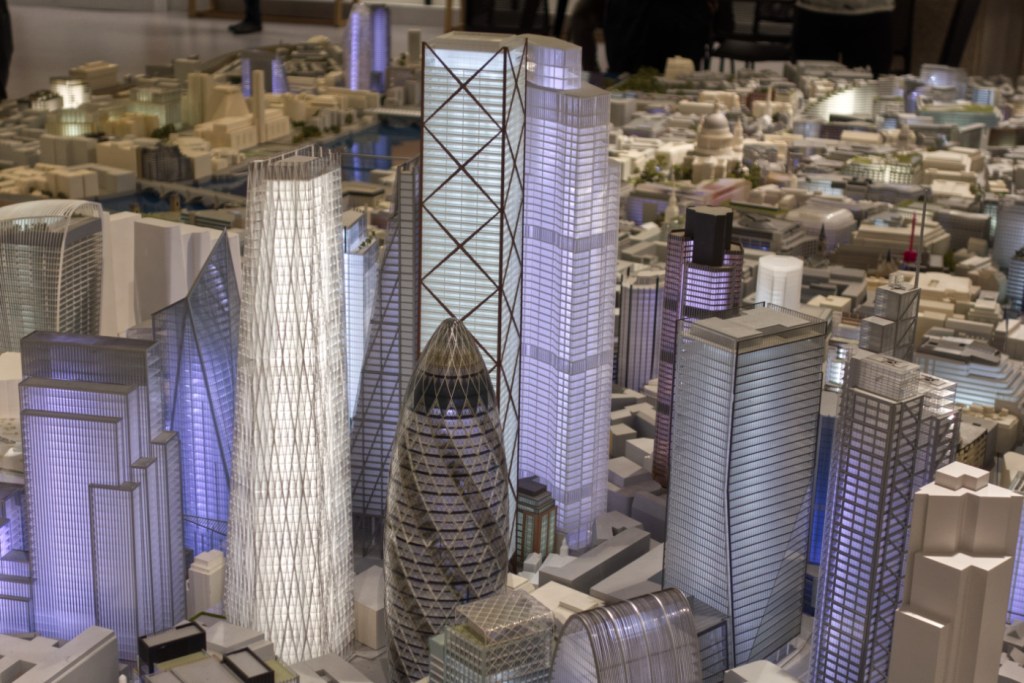
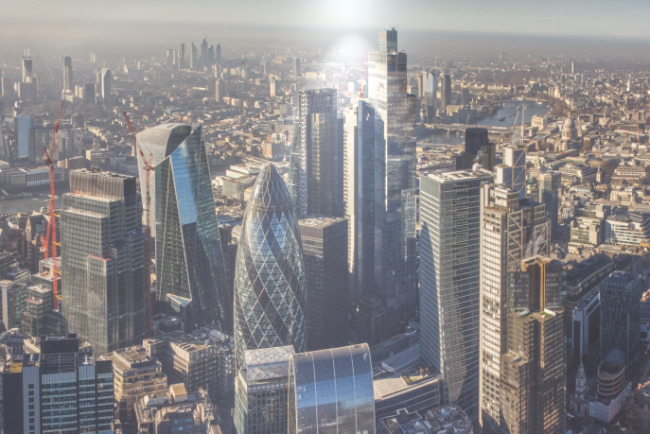
There are big models of London in the space. They are fascinating and it was worth coming just to see those. We (we?) assume that construction-capital-real-estate-investment dominates London, but when the clusters of office-luxury apartment-retail-capital is seen in relation to the rest of the city, it’s actually much smaller than imagined. Perhaps capital is not as powerful as we thought? That it could be beaten. The model provided the basis of an unexpected optimism.

It is these clusters of construction-capital which are in competition with each other; although there is a certain level of collaboration. They must all buy-in to the ideas and practice of capitalism, even though they are in mortal combat. That’s how wars begin.
I’m making notes on what the speaker says
‘building trust’, (or ‘building’ trust)
‘clarity’
‘trust’
There are several references to MIPIM with no explanation, let alone analysis of what it is.
‘Business, local authorities – want to shape a better city -‘
….don’t we all. On what lines, what principles, what ethics, what underlying political ideas? Autonomy? Coercion? Control? Liberation? There’s a lot of options.
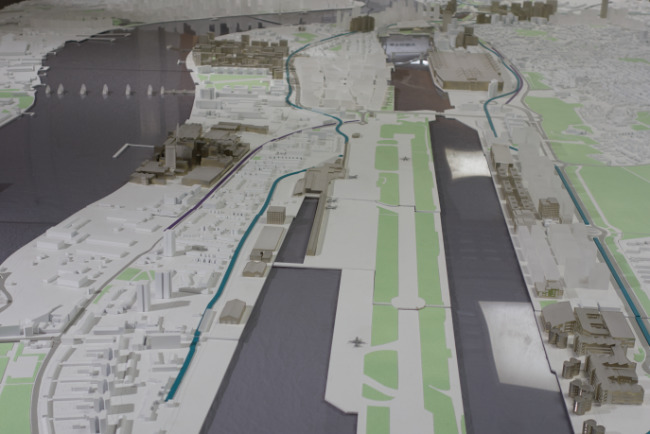
Here is a model of the Royal Docks. Perhaps before too much is said about all the jobs that are going to be created, it might be worth considering about what jobs there used to be, and are now gone.
The jobs that used to be here were basically the movement of consumer goods, distribution and storage. Now those jobs are in giant warehouses on the outskirts of London and in giant distribution centres in the Midlands and near Glasgow (and elsewhere). And involve a lot more vans and lorries, more environmentally damaging than ships and lighters coming up the river and using wind and water.
‘collective responsibility’
(…what is the history of the unions in the construction industry?)
‘clarity’
‘trust’
(repeated)
These apparently are the ‘three baskets’. What Socrates or Seneca would have made of this is left unsaid. Not even a mild speculation.
‘plan for the long term’
‘diversity’
‘partnership’
Unfortunately, the seminar was exactly as I imagined it. I accurately predicted that none of this would be mentioned:
‘The expansion of capital, the exploitation of labour, the atomisation of society, the split of people into two primary classes, the role of the state, the rule of the bourgeoisie’.
The other things I should have added is the military-industrial complex, permanent war, climate crisis, poverty and profit.

I left as soon as the speeches ended. As soon as I did it felt like a mistake. I should have stayed. I know what I think about it; but what about the others? I wasn’t in the mood and the pressure of a train time pushed me through the door.
As I walked to the tube station it felt as if I hadn’t exhausted the moment, that there might have been more drops, tiny ones perhaps, but drops all the same. There might have been something unexpected. Surely that’s one of the dynamics that a city might bring? Unless the city is homogenised so that the whole city comes to represent little more than the endless reproduction of capital. Swirling colours, loud noises, flashing lights, sensory deprivation to disguise, hide, sweep aside the emptiness.
Two images occurred simultaneously. Some conversation was one. Listening to sludge slide slowly down the mountain side of corporate culture was the other. I wasn’t in the mood to proselytize or explain the Theory of the Four Movements or why Nine Elms is nothing really but the expansion of capital. In the context it would appear cranky and eccentric.
That tells us something in itself. Where capital dominates Fourier and Marx are discouraged, actively disdained, consciously disavowed. The ‘bourgeoise’ ideology isn’t just a thing in books, or how conversations are manufactured, it is an atmosphere of approval and disapproval. A framework of attempted mind-control and the policing of ideas.
That train pressure is annoying in itself. There are times when I would dearly like to live in London once again. But it is an impossibility. Let’s just repeat that; it is impossible. I cannot afford the rent, certainly not a mortgage. I suppose I could live in a shed or rent a room in a shared house with a shared kitchen and a shared bathroom and the ever present threat of eviction. I wouldn’t have enough room for my books and papers and bicycles and stuff like that. I like my privacy, I’d lose that too. I could live under a bridge, or in a cardboard box. Within capitalism there are always options.
London is out of bounds to me now. Fenced off by interest rate rises, rent rises, a cost of living crisis, a drop in real wages, an investment crisis, an under-investment crisis, right to buy, the erosion of tenants rights, the increase of land values (helped along with public money).
It’s ok for the murderers and torturers of the Assad regime in Syria. They can live in London and they do. Putin’s little henchmen with their bloated stomachs and constipated brains; they can live in London, secretly and not so secretly, funding the criminal mercaneries who kill children in Ukraine.
Plenty of wealthy people from the Middle East can afford to live in London. They support the regimes of Saudi Arabia and Qatar and Kuwait and others. With their miserable autocratic, patriarchal, hierarchical ideas and disregard for human rights. Yep, London’s good for them. The rich sons from the Petro-dollar countries fly their expensive cars to London, race around the streets, immune from prosecution, and then a few days later they’re off to New York or some other rich man’s playground. Man being the operative word, because women are not allowed to drive.
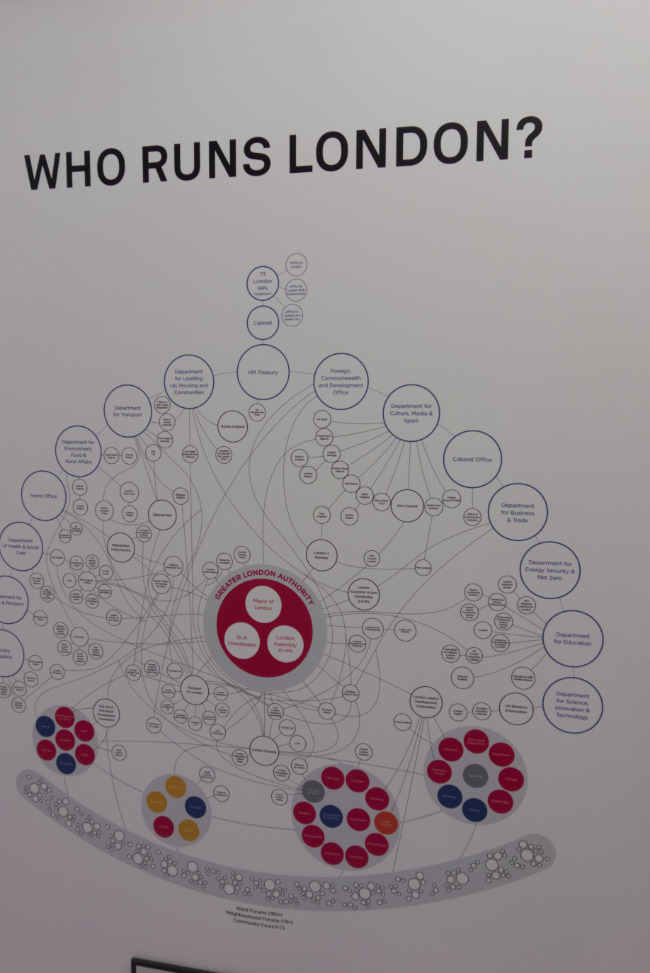
One of the lines of the speaker was about trust. ‘And how do we gain trust?’ they asked in a rhetorical way. ‘By listening to people’.
Can’t you hear that howling rage I wished to ask? I don’t get the sense that anyone’s listening much at all.
No one seems happy here in England. For the rich, England is but a source of profit or investment or it’s both. And as the rich, they never have enough. Never. They have places to live in London, Dubai, Paris, New York, a Caribbean island. But that won’t do. Are those curtains expensive enough? This flat cost £30 million. Remember those people we met in Cannes? Their flat cost £31 million. Are these the right shoes? Does this diamond ring look like it cost £10 million? So much money, but it seems to only buy narcissism and arrogance and a disregard for human life.
How can the luxury senses be measured? What is the exact weight of comradeship and camaraderie and friendship? How many wads of five pound notes does trust cost? How many ounces of gold can measure love and intimate closeness? Where everything is given, with no expectation of return?
The middle class rail and moan and groan. The terrible climate crisis; but they must have an SUV, and regular trips to the mountains. There they can carry their carbon footprint in their top notch rucksacks. ‘I must be in the mountains’, ‘I must have my retreat in India every spring’, ‘I must remember to sort the recycling out’, ‘I must remember to book that next trip to Nepal’. ‘My god, look! California’s burning with wild fires! We saw it from the aeroplane as we flew to our holidays in the Rockies!’
Don’t get me wrong, this isn’t prolekult envy. I don’t mind living here with the hard-up people. In fact I’d recommend it. I can live without the SUV and detached house in the country. But perhaps, some on the left, could be a bit less angry, and instead of moral outrage, some Marxist understanding.
The working class. Really? There was nothing obviously working class about any of the people at the seminar. The alchemy of diversity seems to exclude class. I’m not sure why? But actually, I know full well.
This is unfair. There may have been people there who came from working class backgrounds. Anyway, personally I can’t stand this fetishism with working class that assumes something sociological. Working class is not just a relationship with the means of production, it’s also a political attitude, a call to arms, a category which is currently most unsatisfactory. There has always been a cohort of people from middle class and upper class backgrounds who have become working class politically.
Perhaps the revolutionary party side need a new type as well; friendly, confident and open, with a nod and a wink, some sly and cunning correspondences, and the ability to think with strategy and tactics. Instead of angry moralistic rigid dogma. Such a turn off, so boor-ish and unattractive.
In fact, I would suggest that most people who have joined the revolutionary left in Britain since the 1880s have come from middle class backgrounds. In which case, why the propaganda at the workers? Why not aim recruitment drives at well to do towns and garden suburbs?
As socialists we should never accept working class ‘as is’ but working class as ‘could be’. And as such, this must be a philosophical oscillation (perhaps a quantum state) and category of utopia as much as an economic one. But endlessly going on about the working class without much, if any connection to real people, that seems to miss the point.
I’m still not sure whether I should have stayed for more conversation. Something propelled me out. The sum of the parts must have done that. Although that could have been read entirely the wrong way. This is one of the problems with self-criticism and self-awareness; what are the measures of ‘success’?
Janan Ganesh recently argued in the Financial Times (I’ve just signed up for a subscription, I hesitated and they gave me a further 25 percent off, we had different theories of consumer bargaining), that ‘Diverse is not the same as Cosmopolitan’. I rather like this. I don’t warm to ‘diversity’. (It has the cold stale air of management confusion about it. People in power who don’t understand Hegel, let alone his dialectics. A terrible combination). From the biggest hedge fund to the institutional brutality of the police and everyone inbetween, they can all claim to be diverse.
Cosmopolitan is a neat counterpoint to that. It occurred to me during the speech that what we should collectively really aim for is Harmony. And thus back to Fourier. Harmony suggests something very different to me than diversity.
Diversity can exist within class society, hierarchy, coercive labour-relations of exploitation, inequalities of poverty and wealth. Cosmopolitanism is a sort of liberal life style choice. But harmony; that’s only possible by smashing up the state and corporate structures, destroying the capital-labour relationship, eliminating oppression, getting rid of pay scales and hierarchical relations of production. It will only be achieved by an extension of democracy and a status of collective self-autonomy for each and everyone of us.
Now I wish I had stayed.
I know why I should have stayed longer at that meeting. Not because it was an opportunity for me to talk, my god, save us all from that, but because I simply wanted human company. I really wanted to listen to people, I wanted to hear their quirky ideas and observations, I wanted a heads-close conversation where other people told me their theories and dreams, watching people up close as they speak, smile, laugh, raise their eyebrows and roll their eyes, mild flirtation, serious demeanour, awkwardness and boldness all combined, confidence and shyness. All that human stuff. That was the stop in the mind, the hurdle at the time, that I couldn’t jump over or through.

Three people get on the train, one sits opposite me. They all have a profusion of enamel poppy badges. It’s July. The person who sits opposite me looks crushed, defeated, demoralised, kept alive by imagined past glories of empire. That’s what I’m thinking, it may be wrong. There is however a type; who spit out a fury about ‘illegals’ and ‘oxygen thieves’ and demand artillery and machine guns to deal with small boats in the channel. If you’ve not heard this stuff your life is sheltered. They are already with the counter-revolution.
They are the first litter-scum of the hooligan mob. This is why they have a symmetry with the likes of B. .Johnson, and that other one, the really loathsome one, Mogg Rees or something. They both laugh loudly and cruelly at working class Tories.

Who can resist looking through the windows of the neighbours. I’ve never spoken to them. Two young women, who wear the uniforms of a local care home. They always seem to be going, or coming back from work. Every day it seems, including Saturdays and Sundays. I’ve never spoken to them because there has never been an opportunity to. Occasionally they cause all the houses in the vicinity to shake with 110 decibel brain damaging techno music. And then it stops as suddenly as it started. And I take the pictures by their frames and realign them with the wall.
Tonight the curtains were open, and inside a scene of candles on the table and a sense of occasion. They come from that mysterious land of Eastern Europe. I drew out much from the scene, of continuity with European culture and a sense of displacement and dislocation on top of the general alienation caused by the sale of one’s labour power. That this was a certain tradition there this evening; and that the tradition might be something lovely full of memories and charm. But this is all supposition, a writer’s licence. One must be careful, dear reader; writer’s have a habit of making a great deal up.
The sea is a perfect colour for my mood. Steel grey. The sky is as still as the moment before the beginning of time. It as if nothing will ever happen. For an infinity and more. On the horizon line, two red lights flash on and off. They must be half a dozen miles out to sea. They are automated, machines, robots, managed through computerised control systems. In the months after the coming nuclear war, they will still flash on and off. And then the batteries will run down and the nuclear wind and the radioactive dust will coat the sea and the earth and all its life will be dead.
The warning signs are all around us. Too few pay any heed.

 Commodity Fetishism
You must be logged in to post a comment.