
Did London once feel like a more proletarian city? There are still many proletarians. But where is the new working class in the new proletarian city? There are no large organised industries in manufacturing or warehousing. The public sector retains some union organisation, universities too; and transport. But there is little sign of organisation or visible rebellion in the private sector office blocks. And there are a lot of those.
There are 570,000 people working in offices in the City of London alone. I don’t have the figures to hand for the Canary Wharf area and the rest of London. It’s certainly a diverse workforce. Diversity has become a management keyword and great care must be taken with it because it has become loaded with the inequalities of class power (of which the ruling class are clearly in the ascendancy).
I’m not sure ‘diversity’ tells us anything at all, other than raw ‘facts’ of gender, ethnicity, sexual preference, stuff like that.
It would be more interesting to know the detail of pay rates, the number of hours worked each day, what unions, if any, exist within the collection of office blocks across the capital.
In terms of the London working population, the revolutionary left is miniscule with little, if any influence.

And yet, so much of what Marx & Engels set out in The Communist Manifesto, Grundrisse, Capital are on display all over London. Expressed in the streets and in the office blocks and department stores and warehouses and transport depots. The accumulation of capital, competition of units of capital, the expansion of nodes of capital, constant revolutionising of the means of production, endless revolutions in the instruments of production.
Marxism should not be abandoned any time soon; but surely there is much to cast aside with current left thinking? For how else to explain the miniscule size of the revolutionary left, and how useless it’s been in recruiting the young people of urban areas, let along the proletarian intellectuals and the misfits and the oddballs? In fact how ineffective it’s been in recruiting any one at all. Let alone admitting to that failure.
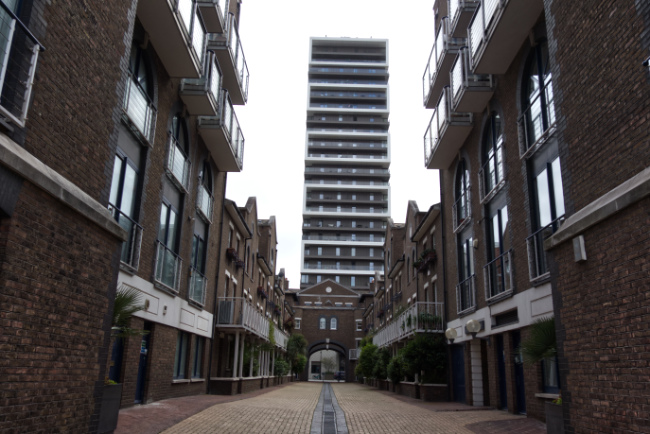
And yet sometimes the underlying currents that might well up to form a revolution can be almost be physically felt. There are moments when great swelling waves of discontent and raw inarticulate belligerence threaten to rise up from the beach beneath the street to sweep all ancient venerable prejudices away. Or something like that. Revolution cannot be formed through moral outrage. Otherwise it would have happened centuries ago.
A study of labour processes would be more rewarding. And tell us more about capitalism in our time. Shop assistant takes goods from conveyor belt, scans, takes next good (a commodity), scans, adds to the area behind where they sit so consumer can put in their shopping bag.
Person building air conditioning ducts in high rise building lifts aluminium section above their head. Holds it in place while second worker screws it into place. Repeat throughout the day.
Bus driver moves left and right hands together watches mirror, watches real-time film that’s running on a screen above their head, flicks indicator switch, checks position again in mirror and real-time film and flicks the indicator switch off.
Fast food worker takes order, flips burger, while it fries for the regulation 120 second time quickly scoops up chopped salad.
Admin worker takes various figures and adds to spreadsheet in the relevant rows and columns.
Road repair worker holds pneumatic drill and breaks up asphalt. Second worker takes shovel and moves the broken fragments. The pneumatic drill starts again.
Plumbing, electrical and mechanical worker refers to operation and maintenance manual and follows relevant instructions.

I was walking along the Thames from my temporary base in Battersea. It’s not thought of as a ‘walk’, certainly nothing such as ‘psycho-geography’ (whatever that means). It was one of those occasions when there was a single intention, in this case to visit the house that William Morris once lived in.
Time disappeared, goodbye, it’s just a measure.
It feels like miss and hit gentrification. A coffee shop here, a general convenience shop there. The pavement feels too narrow, the roads too full of cars.
The one-dimensional narcissist ’10 Foot’ had made his incoherent half baked mark, like a weird beast in a Bruegel painting that can’t stop shitting. There’s a lot of narcissism about. I’m not sure whether the internet and social media have made it worse. There is something here about global capital and individualism. But it will have to wait for a later date.
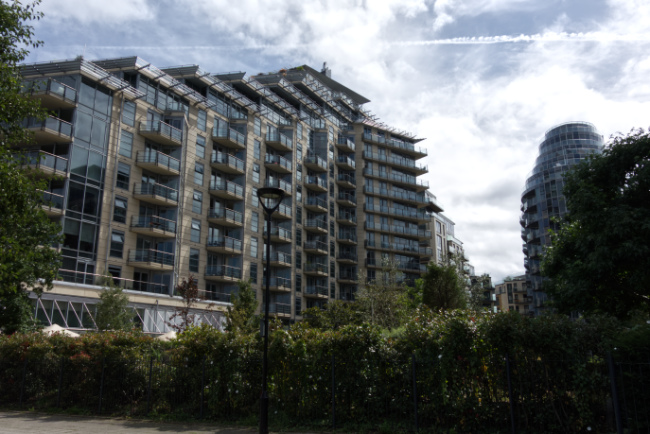
Then it’s wandering until Battersea High Street and along to the south side of the river proper.
I make some notes about ‘bland landscape’ and try to think of some defining phrase (so important in the world of instant commentary and immediate amplification and attention seeking). I came up with ‘the New Sterility’. And then I thought, actually, I don’t know much about this at all. And so instead of answers, large numbers of new questions appeared. How to describe this? And particularly without cliche?
Much of the housing is expensive and it’s not all buy to leave or second homes. To understand London now it’s now just the working class that demands study, but the middle classes too.
It could be because I don’t know enough about architecture and the principles of planning (which I don’t). But the more I tried to engage with it without being subsumed by the dominant cliches in my head (and where do they come from?) the more complex it all became.
I wanted to write ‘soul-less’ and then noticed that some of the balcony’s were full of play houses and children’s toys. And realise now that I seemed to consciously not photograph such scenes. They didn’t fit the cliche and so were omitted. And now I wish I had taken photographs of the balconies because they indicated life and something different.
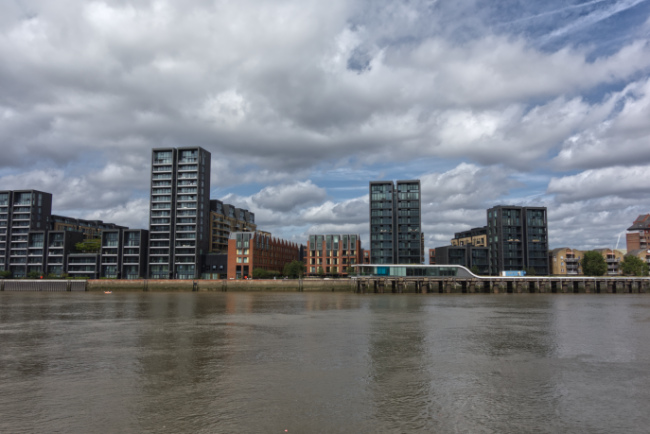
Then I was going to write ‘there are no people’, but actually there were quite a lot of people, and besides it’s Friday early afternoon, quite a lot of people will be at work. And there were no people in the streets of terraces housing I walked through later.
Perhaps a defining criticism could be ‘there are no shops’. However there are shops and some restaurants and cafes.
I now tried to rise to a higher level of abstraction. ‘This housing represents the expansion of capital’. Wow! So it does! This is the underlying political economy but it doesn’t completely explain the design, quality or planning. Capital can expand in many different ways. The expansion of capital is not a one-trick process.
Housing is more than houses; so without knowing anything about the quality of the build or what the experience of the residents is like all I can vaguely think is based on the immediate appearance. And what sort of Marxism is that?
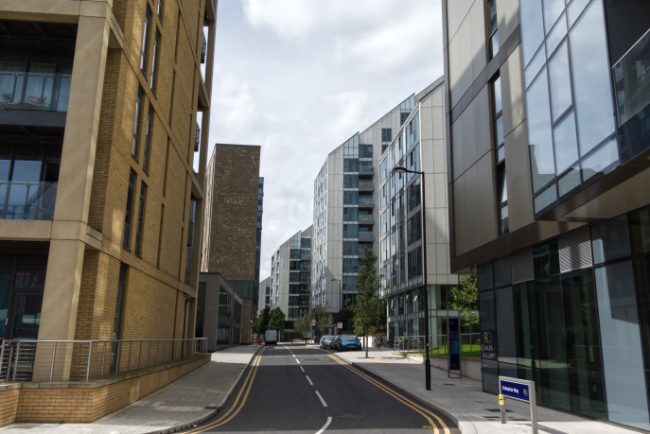
Yes, oppose the high costs of the rents and the mortgages and the lack of tenants rights and the domination of property management companies. But these are social relations which surround the bricks and mortar (and glass and steel). What of the material built objects themselves?
This relationship is tricky to understand and even harder to explain. There has been no communist or communistic society in the past 5,000 years and yet a large amount of good quality and aesthetically pleasing buildings, not to mention fine arts, music, literature and so on have been produced. Capitalist production is responsible a lot of shoddy building and poor quality commodities. But production within capitalist relations of production has also produced some spectacular buildings and high quality commodities.


I stopped and spoke to a banksman who was leaning on a metal barrier. He explained that the different blocks were of different price because of their proximity or distance from a waste disposal plant. The stench of the place was evident from where we were chatting.
He told me he was from Ghana and outlined the character of the corruption there.
The overseer on the other side of the road, a thin Irishman, shouted something about paying attention. The man from Ghana looked up with all the hurry of a hedgehog crossing a moonlit forest track on a fine cool summer evening.
He looked at me and smiled. I didn’t want him to get into trouble. He raised a finger to the foreman in the sense of ‘I heard you and I will now look up the road to check for moving vehicles’.
‘See you later mate’, he said and smiled and we exchanged a thumbs up.
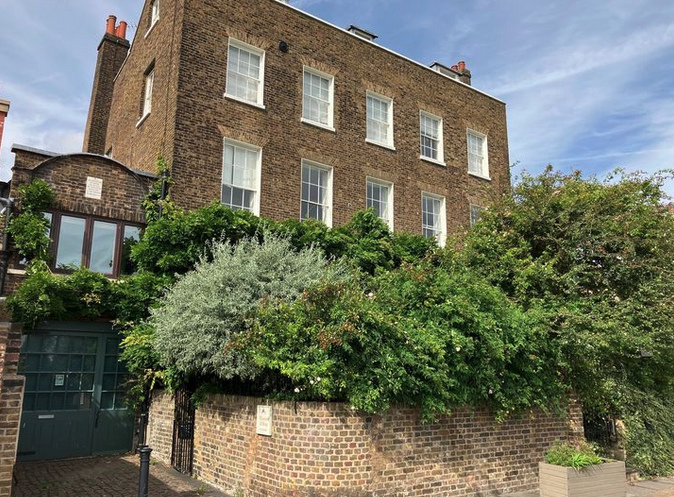
The walk ended at William Morris’s house just west of Hammersmith Bridge on the north side of the river. Morris was a medievalist and I’m still unsure what his medieval thought represented.
In London he lived in a mercantile-capitalist house. All symmetrical windows and London vernacular brick form. It’s the English yeomanry’s idea of classicism rather than gothic. The principles of such buildings are aligned to Enlightenment values of geometry, order, slavery and reason. The style is in opposition to medievalism.
And then I left the dreamy imagination of the day and walked under the Hammersmith flyover, next to a family who might have once lived in Somalia. They wore brightly coloured clothes and spoke with loud voices into mobile phones, all connected up with satellite communications, fibre optics, TCP/IP and packet switching.
At Marks & Spencer in Hammersmith I bought a bottle of lemonade, sparkling water, a four-pack of beer, a bottle of red wine. There would be two or three of us for supper.
A comely Black woman was overseeing a set of automatic check outs. A small child presented a bag of sweets upwards. The woman in her shop uniform asked ‘are these for me?’ she had the air and authority to potentially be a great teacher to humanity.
A loud bell rang as an indicator that there needed to be an age check for the alcohol.
‘Are you over eighteen?’ she asked as she ambled over. She stood very close to me.
‘Only just over’, I replied, ‘you might be surprised at how close’
She smiled in a way that drew her red lipstick lips over her teeth in a broadly naughty smile. This was off the pre-arranged customer services script. If she wasn’t chained here through capitalist relations of productions I would have said, ‘come on, l bet you’ve had a long day and a hard week, I’ll buy you a drink’.
I would have liked to have gone with her to one or two, or five or six, of those bawdy pubs that command attention in the disjointed muddle between the two separate Hammersmith tube stations.
Just then, for the spontaneity of it all.
 Commodity Fetishism
You must be logged in to post a comment.