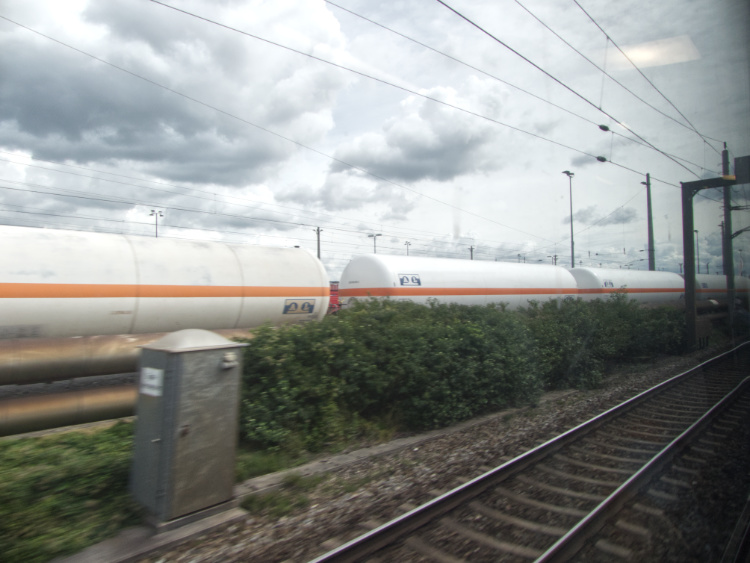
(Let us be clear – I am not against chemicals and chemistry…I am against the exploitation of chemicals and chemistry by the capitalists for the purpose of making profit at the expense of the general interests of people and the planet).
The woman who walked through Karlplatz was wearing a t-shirt with the slogan, ‘Support Your Local Planet’. It’s a radical slogan where ever it appears, but here in Wien, it somehow became a time-machine that pulled me back 100 years ago to 1923. I could hear slogans on the streets. Socialist newspapers being sold. Posters on the walls; ‘No Viennese Child Will be Born on Newspaper!’ This is creative, subject idealism (we hope it was like this, we wish to the future to be like this).
But the trajectory of history did not develop into socialism in the 1920s and 1930s; the counter-horror of fascism was politically and violently triumphant. Small children in 1920s, playing with toys in the streets, men and women in the parks and gardens on a Sunday morning, proud and happy, just getting on with life; smashed morally and physically a few years later in the concentration camps and mass executions and gas chambers.
We could show these images to the far right of today; but it is pointless. That is what they want. They want the Hitler association. This is what they want; the moral and physical destruction. This is why Putin, Trump, Assad – and actually to some extent a layer of the Tory Party – can align.
The masses? The working class? There is a great deal of factory socialism thinking. That applied to in the period from the 1880s onwards. But one of the biggest single group of workers in Germany in the 1920s was office workers. I think Claudin outlines this in The Communist Movement but I don’t have the book with me.
Office workers are a large group of workers in England in the 2020s. Outside local and central government I am not aware of any strikes by those office workers. What is their political consciousness? How does the left influence this?
There are certainly more office workers than factory workers in England. And a layer of factory workers are relatively well paid and want that monthly salary to pay for an SUV and a badly built orange brick house on a new housing estate. Even the built topography of the working class has changed. The topography of two ups and two downs in endless rows within walking distance of docks, factories and steel works has gone. Many workers are now tied into the infrastructure of motorism; in relation to work, leisure, domestic life and so on.
This is all sociological, and I’m not sure about the overall influence of these sociological factors. But they have some weight.
Vienna feels different from London and I’m not sure why. I’ve only just arrived. I’m a visitor here in time and space. Slowly the impressions of the day are able to form.

Saying good bye to the lovely landlady who looked after me in Munich. She had the most wonderful accent. We talked in the evening as she fried up fish and chips in an old frying pan in the kitchen. It was all about immigrants and too many people and refugees and no-one in Germany wants to work. It was a complex conversation; but it was a conversation. I made general points about people yelling and shouting, and that we need temperate discussion. That helped to draw out the heat.
And war and why people want safety. I hesitated to mention the experience of Germany from 1933 to 1945.
But the conversation moved on in an intensive and fraternal way. It felt that the reference might work. I halted, waiting to see what the reaction would be. The conversation moved in a different way. Into the world of real life rather than the bilge of rich-man’s newspaper propaganda.
Now we could talk about real life and the manufactured hatred was pushed away. We became closer together in what we were discussing. These conversations are not easy, but they are possible; but we must be ready for a wide range of tactical points, high-falutin’ philosophy, instincts of people-solidarity, letting stuff just wash over us without shouting, patience and much else.
The right wing have the whole weight of capitalist ideology on their side and that weight is backed up with multi- trillion dollar money power. The socialist side doesn’t have that and therefore we are always waging asymmetrical idea warfare; only some people on the left don’t realise that. Thus they become stuck with ‘correct slogans’ that are often quite useless.
And I will add, I liked my temporary landlady. And, ah, this will sound old and from a different world, but if you like someone it’s going to be easier to disagree, and it’s going to be more productive in having an argument that might change someone’s ideas. And you never know, one’s own ideas might change. And for some people that would be no bad thing.
At Salzburg I spoke to a group of people from the United States. What do we call them? Americans? But they are only one type of Americans. The whole classification of the people of the world needs an update.
‘Sprechen sie English?’ I asked
‘Yes, we do speak English’, a big guy with a baseball cap and brown t-shirt and black shorts said.
There was about ten of them.
‘Well we didn’t understand about the trains and didn’t get off on time’, he explained, ‘so ended up in a town an hour away from where we should have been’.
‘But we’ve learned that lesson’.
‘We’re going to Wels’, the woman standing near me said. She showed me the ticket as if I was the ticket inspector. ‘And then to Passau’, she then showed me that ticket too. There were nods from others in the group.
They were so lovely I nearly got on their train. It felt as if they carried half the world with them.
Here they are in Salzburg but somewhere else they live in San Diego or Washington or Detroit and they spend their lives as teachers and civil engineers and software developers and construction project managers.
But on that platform on Salzburg station they were momentarily free. And to introduce ‘jobs’ and ‘professions’ and ‘how much do you get paid’ would have been the greatest crudity and coarseness. These separations of person and wage labour must be closely studied. Perhaps if I had joined them on that slow train to Vienna they might have explained what their jobs were, but never would we have told each other what we get paid.
We share our thoughts on immigration, population density, refugees. But not about our wages. There; that explains a great about capitalism in just a sentence or two.

I would like a t-shirt with ‘Support Your Local Planet’ slogan. I shall look out for one in Wien.
Sometimes it feels as if something is crystallising on our side, but I’m not sure anyone quite knows what it is…
 Commodity Fetishism
You must be logged in to post a comment.