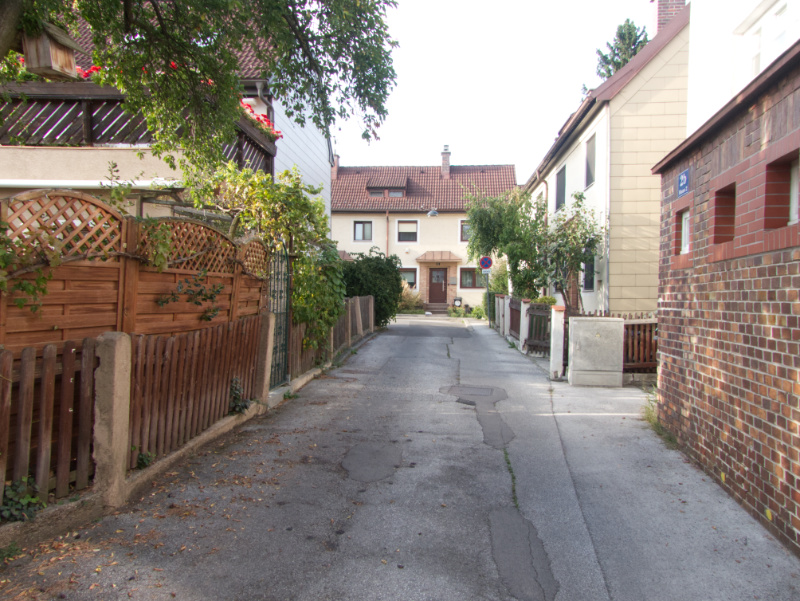
From as early as 1915 onwards the people of Vienna began to appropriate land to grow their own food. By the time the Austro-Hungarian Empire collapsed at the end of October 1918 it was estimated that there were over 100,000 people living in makeshift shelters and working towards being self-sufficient.
The empire was bought down by the groaning weight of it’s own lazy contradictions and mass action from below. Soldiers’ mutinies, food riots, mass demonstrations, intense political discussion, posters on the walls, hurriedly printed newspapers and leaflets, huge shifts in public opinion. The ruling class could no longer govern and the mass of soldiers and workers had experienced more than enough of war, pomp, ceremony, jingoism and nationalistic bombast and fantasy to wish for authoritarian and imperial rule to continue.
There were rapid changes in the political governance of what became known as Austria. A new socialist dominated council came to municipal power on 4 May 1919, led by the Social Democratic Workers’ Party of Austria (Sozialdemokratische Arbeiterpartei Österreichs, SDAPÖ). This was a party that contained Marxist theoriticians alongside worker activists, trade unions and community leaders.
The party had consciously socialist ideas about building good quality low cost housing, providing universal health care, improving education and much more. Despite the great strains on the economy, political and financial tumult and the external pressures of the world economy, a huge amount was achieved and the built legacy survives to this day.
It is a complex story and these notes are only going to deal brieflly with the wild settlment movement and the emergence of a garden city approach in Vienna.
The initial wild settlements have been described as shanty towns. Self made housing, tool sheds, pig styles, chicken coops and so on. The land was directly appropriated and included parks and open spaces which had until recently belonged to the Habsburgs.
The settlers were ex-service men, many disabled, unemployed workers, intellectuals and anyone who couldn’t find somewhere to live or enough to eat in a city facing immense social strains .
Both housing and food were immediate problems and it was agreed by councillors, architects and the city housing authorities that a combination of good quality housing with substantial gardens for food growing would be a workable solution. They were also aware of the need to do something from ‘the top’ as people at ‘the bottom’ were literally taking land into their own hands.
There were two large demonstrations of the settlers which put political pressure on the social democratic councillors to act more boldly and meet the settler movement demands. The first, in September 1920, involved more than 50,000 people. As they marched through the streets they chanted:
‘Give us land, wood and stone, we will make bread out of it!’
The architect, designer and critic Adolf Loos marched with them and declared: ‘Hut ab vor den Siedlen!’ (‘Hats off to the settlers!). Many other artists, writers, intellectuals marched too, including Margarete Lihotzky who was the first woman to quality as an architect in Vienna (in 1919) and was to play a significant role in the spatial design of both the housing and functional elements such as the kitchens.
The second demonstration in April 1921 was larger and better organised. The settlers were more effectively forming into cooperatives and other organisations. Trade unions and socialist councillors now came out in open support.
On the day of the demonstration itself, Loos published an article, ”Der Tag der Sielder’ – ‘The Day of the Settlers’. He argued that workers should be given land to grow food, and that land should be near their housing.
It was time to ‘transform the home from a place of retreat into a centre of production’. This would be a ‘working-garden house’ where the ‘working class family could thereby become the autonomous subject of this economy’.
Through the dry dust and old bones of history we get the facts and figures. What would be helpful is some eye witness accounts, say of the calibre of Trotsky and in the style of his History of the Russian Revolution.
Readers of that book will remember how Trotsky describes the demonstrations in February 1917 when one of the cossacks winks at a member of the crowd, another allows hungry women to pass under his horse so they could join protestors on the other side of the police lines.
These tiny actions are the real atomic energy of history. An accumulation of seemingly small deeds and brief words changes atmosphere, and atmosphere at times can very much be a force in its own right. Was this energy present on the settlers demonstrations? Or generally on the streets of Vienna at this time?
Something was going on. Following the demonstration in April 1921 a law was passed to develop housing on the settlement land. To all intents and purposes the settlers had won.
What followed was a quite extraordinary and ingenious practical development which operated in many different levels. The settlers themselves became involved in the building of their own homes, digging trenches, making bricks, carrying raw materials, completing the basic elements of the construction process.
The average number of hours contributed by each settler was 1,500 hours which made up around 80 percent of the construction costs. Trade union labour was contracted for particular skilled and specialist labour processes.
To get some idea of what was going on at ground level, it’s worth considering the observations of a Lieutenant Morgan who wrote, in an unpublished monograph Notes on Land Settlement – Austria:
‘The work of building is slow and labourious….They first built a road, then began the digging of foundations, according to splendid blueprint plans. The bricks were hauled by wheelbarrows from the fortress, some cement was purchased and mortar made with nearby sand.
The screening of the sand and mixing of the mortar is done by the women who are able to contribute more hours than the men. They may be seen on any day and all day building roads, shovelling in the foundations, carrying bricks and helping almost every phase of work.
Nothing stops these settlers. Many ex-soldiers with both legs gone would ask for sympathy and richly deserve it, but there is none to be given in Austria. These soldiers work under all conditions, and to see a man with two wooden legs carrying an armful of bricks up an improvised ladder is but one example of the many” – (quoted in Blua, p91)
Peter Marcuse has described this as ‘probably the most widespread example of physical self-help in housing in the twentieth century in an industrialised nation’.
The city council supported the building through tax concessions on the house building and the introduction of progressive city taxes. In effect, the rich subsidised the funding of good quality public housing.
Hugo Brietner the chief finance officer of the council (a committed socialist and former bank director) was firm in his policy that the housing would not incur debts, loans or mortgages. If this happened, he argued, taxes and rents would constantly have to increase. Brietner was disliked by the right who used anti-semitism as a political weapon against him. But everyone – right and left – agreed he was a financial genius.
The initial phase of house building supported by the city council and a broad alliance of architects was in favour of a garden city approach. In turn, the garden city theory and practice was influenced by the ideas of socialism, trade unionism and the cooperative movement.
These ideas were broad ranging. About how housing might help overcome the general alienation caused by the accumulation of capital through the exploitation of labour; what the ground plans of buildings should be in relation to light and air, the most effective design for a kitchen, how good quality housing could help people to realise their potentials.
The discussions spilled over into aesthetics and design. Arts and crafts, modernism and Biedermeier influences can still be seen.
Workers with a range of building skills, theorists from a range of disciplines (architecture, planning and design) and Marxist and socialist intellectuals discussed and collaborated in developing ideas of what the housing and its function and design should be. There was not always agreement; why should there be?
Thirty such developments were built in Vienna in the 1920s and they are mostly still extant today.
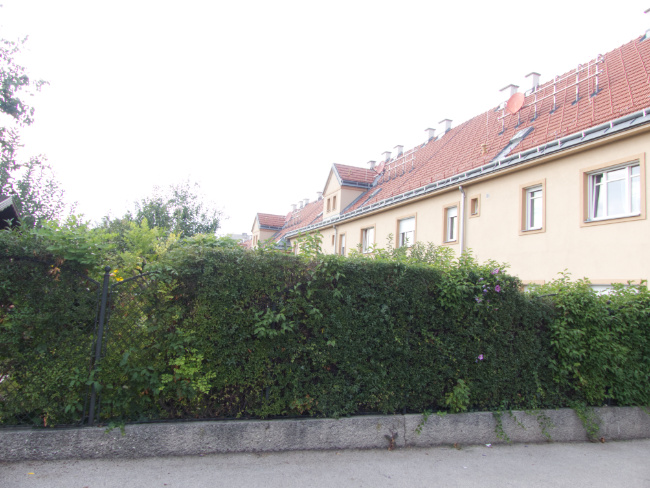
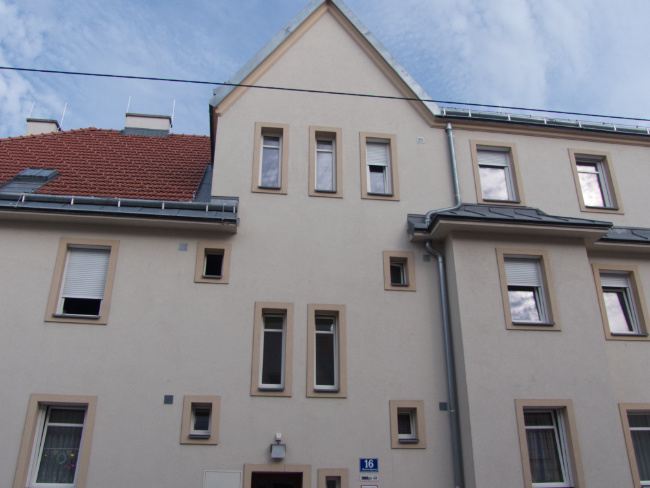
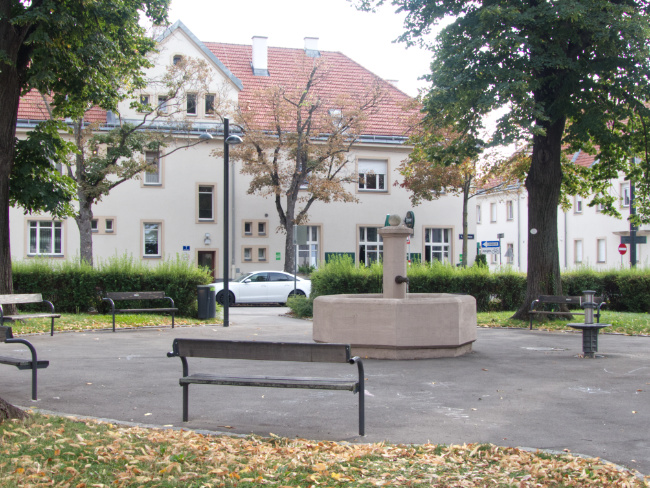
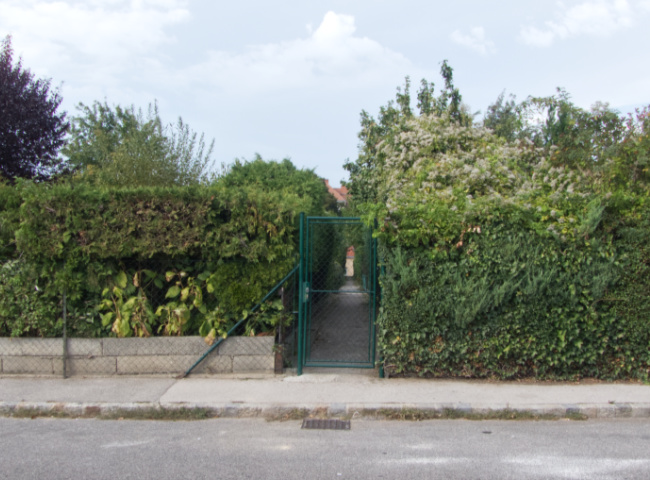
Here is a brief overview of four of them.
Just a note of caution: I have put these notes together on the basis of walking the streets, reading through Eve Blau’s book The Architecture of Red Vienna 1919 – 1934 and various websites. It is much harder to do this than might be imagined and it all needs to be peer reviewed, or tested against further authoritive sources. But it’s a start. Please contact me if you have any comments or suggestions (you can use the comments link above).
Friedensstat Siedlung – Peace City
The land was a former hunting ground appropriated by war veterans as one of the original wild settlements.
The original plan was created by Adolf Loos but that was rejected and the plan that was implemented was ‘piecement and uncoordianted’. That is the feeling today and it is also difficult to work out what is original.
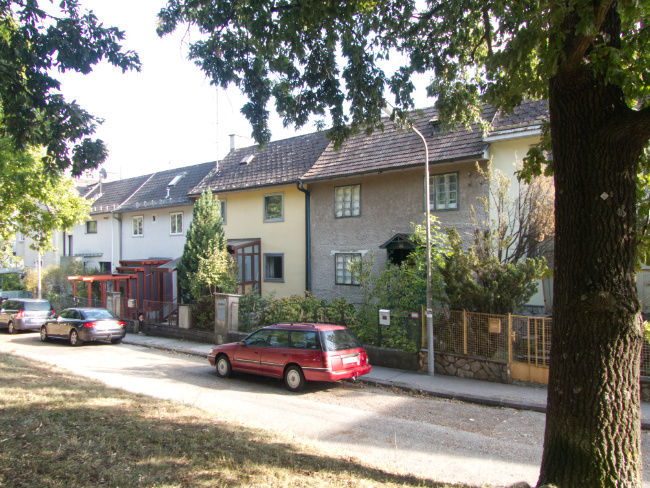
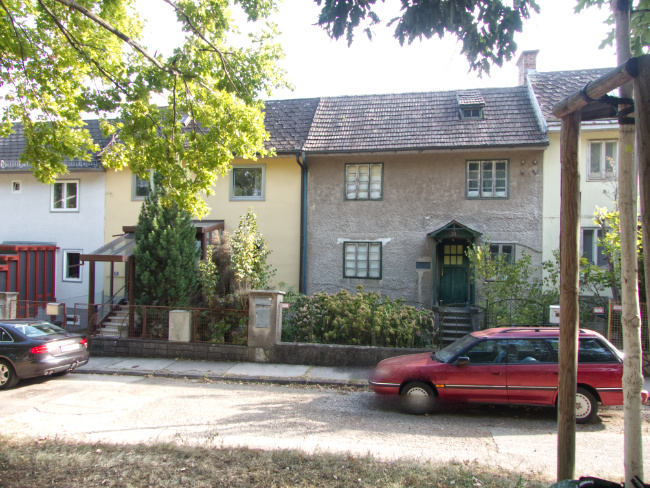
There is one row of eight houses by Loos at 85 – 99 Hermesstrasse built between 1922 – 24. The house plan is of a full basement, ground floor Wohnküche, work and washrooms, second floor main bedroom, two children’s bedrooms (to allow for seperation of the sexes), attic.
These have gable roofs and are constructed with stucco. There are standard mullioned cement windows and wood floors and stairs.
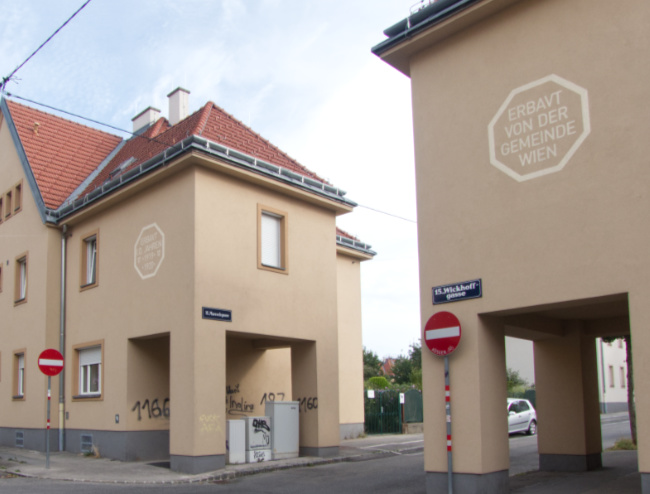
Mareschbau
The first phase of construction was between 1919 – 1920 and was based on the idea of the settlement movement. ‘It is considered the first municipal terraced house residential building in Vienna’.
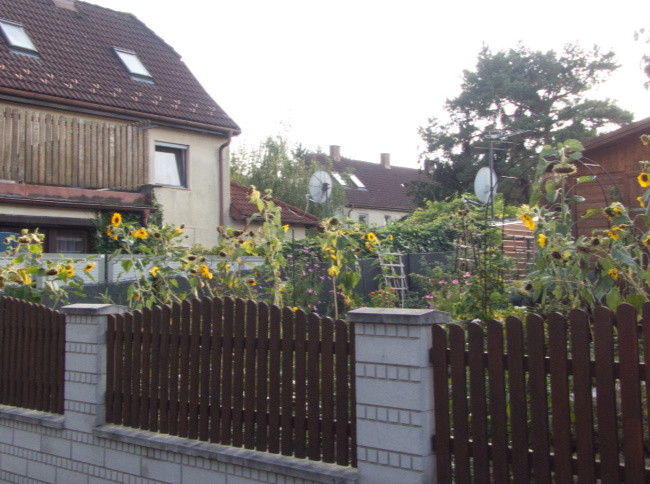
The gardens were designed so that the resident could grow their own food, as was the case in all (?) the early settlements.
Rosenhügel Siedlung
The settlement plan was developed by Hugo Mayer with support from the Altmannsdorf-Hetzendorf Association. It was the organisations first siedlung development.
The settlers produced their own bricks from cinder, ash and cement and called the Pax Ziegel – peace bricks.
There was a large and active socialist presence on the estate and many different social, political and cultural organisations including singing groups, gymnastic clubs, a mandolin orchestera and a free thinkers society. There was also a company of the Schutzbund, the socialist militia.
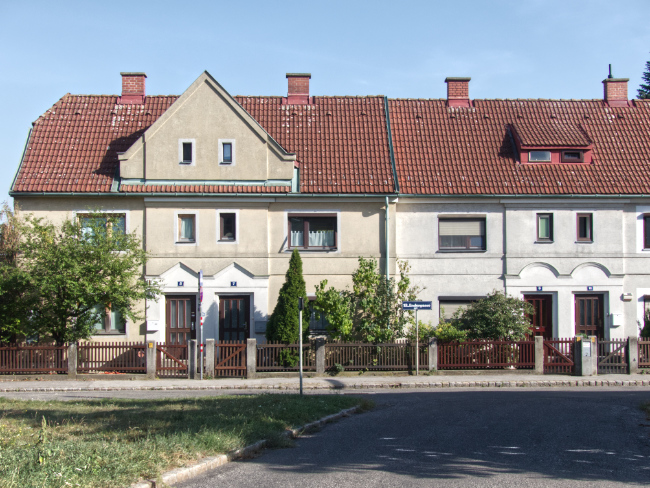
Endergassestrasse in Rosenhügel Siedlung. It means ‘Rose Hill’
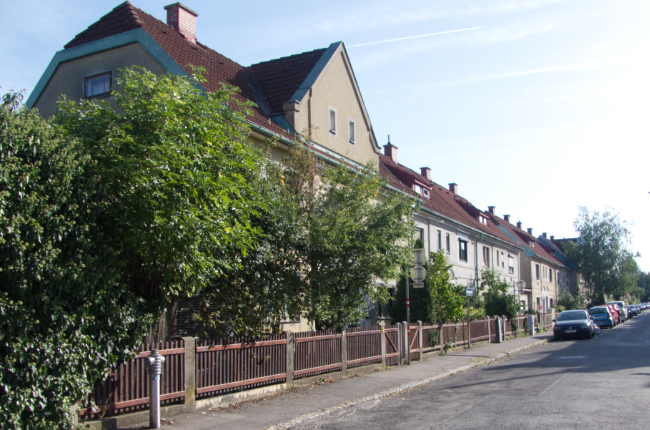
Hermeswise Siedlung
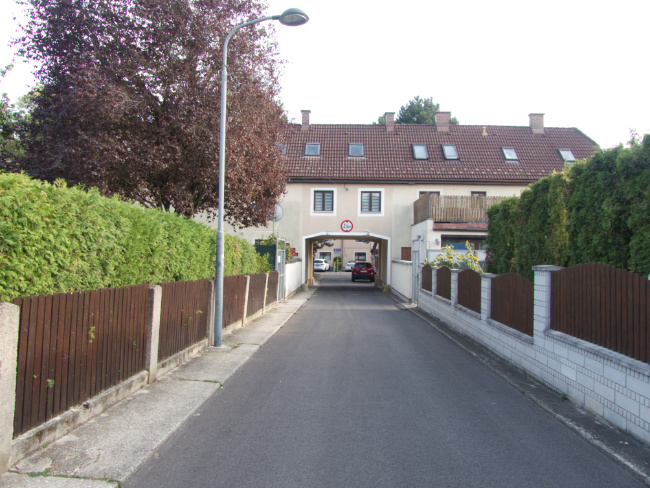
Built between 1923 – 24, the architect was Karl Ehn who later designed the Karl Marx Hof (and later still worked for the fascists). It was expanded in 1928 – 29 with houses in Trabergasse and Neukommweg. The initial plan was for the development of a complete housing entity.
Prospective residents, Baugenossenschaft had to become a member of the building society and commit to at least 1000 hours of manual labour. The Vienna state council guaranteed the funds for the land and materials.
Here again, the garden city was the result of a collective building effort.
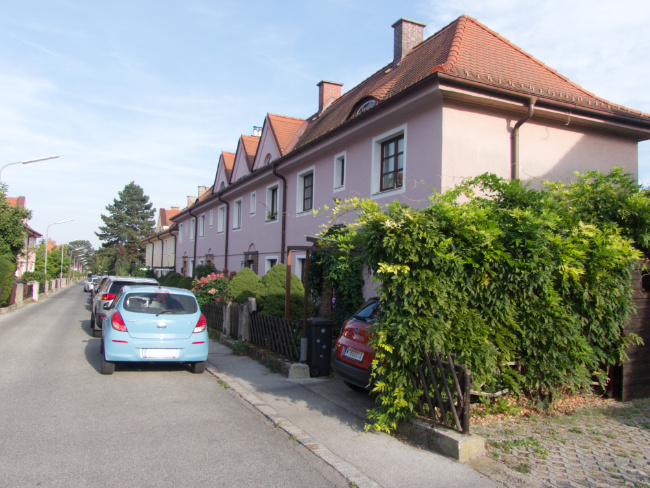

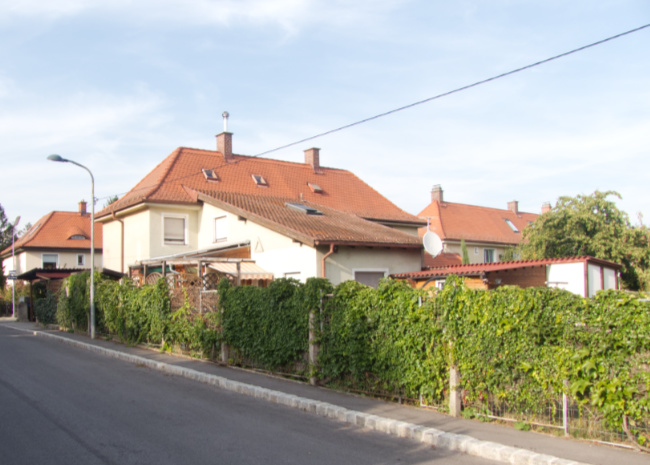
This is a useful resource (in English) to discover more.
Eve Blau’s book The Architecture of Red Vienna 1919 – 1934 is essential reading to understand the period.
 Commodity Fetishism
You must be logged in to post a comment.