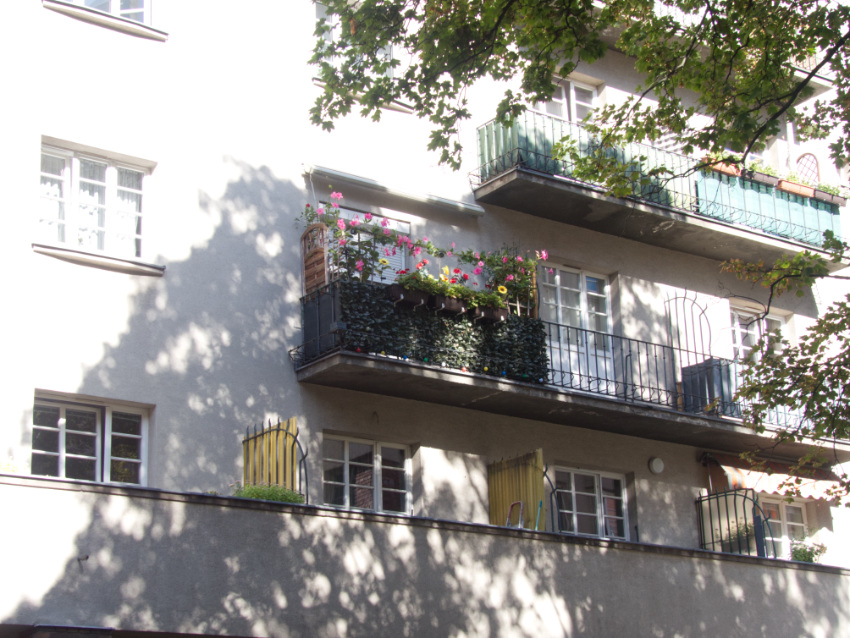
To walk around Rabenhof is to step into an imagined world of what London could have been. Instead, London has been taken over by big capital; capital from the Saudi Arabia Public Investment Fund, the Kuwaiti Sovereign Wealth Fund, Chinese companies, and a whole layer of global criminals that use the London property market to launder money.
Is this domination by capital and money one of the reasons why parts of London now feel so heavily alienated, strange pseudo spaces, covered with CCTV and shouting warning notices, endlessly patrolled by low paid ‘private security operatives’ ?
The hoardings that fence off the construction areas display posters promising life-style enhancing massage, bars, costly fitness centres, pixelated images of people with perfect teeth, drinking cool white wine (but just a glass or two), smiling at the world from the dizzy heights of penthouse apartment suites.
London is far below and none of its revolutionary ideas can be heard through the triple glazed windows.
One day in Nine Elms I spoke to a security guard and asked him what he thought of it, ‘I cannot even dream to live here, even in my dreams I could not live here’.
I noticed a woman coming out of one of the expensive tower blocks, wearing a flower patterned trouser suit and a big floppy hat. ‘Do you live here?’ I asked, interested in some vox pop. She looked at me from under the straw brim of her hat, blue eyes flashing and lipstick smiles. ‘No’, she said, with a forlorn edge that tore sadly at her lovely presence, ‘I’m just a cleaner’.
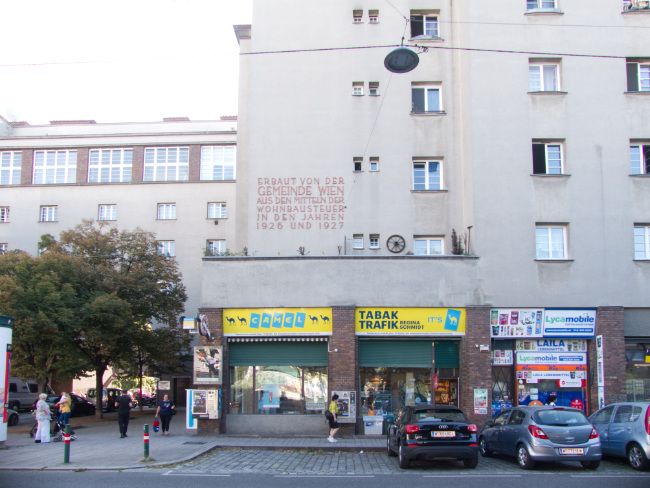
All built environments have atmosphere. London, Nine Elms; Vienna, the Rabenhof Gemeindebau. Atmosphere can be difficult to describe. We experience it in different ways and it can depend on what we know, what we think we know, our mood, whether there is rain or sunshine and a great deal of conscious and unconscious workings of the mind. How can I try to convey the atmosphere of the Rabenhof estate?
By chance, on this particular morning, I opened up Eve Blau’s The Architecture of Red Vienna 1919 – 1934 and the first thing I read was,
‘When Hugo Brietner presented the Social Democrat’s first five year building programme to the city council on 21 September 1923….
Well it’s the 21 September 2023 today. An 100 years anniversary. A lovely bit of serendipity.
And Rabenhof was next on my list of places to visit. So I caught the U3 and then the U4 underground trains, and there I was.
There were so many people everywhere. Walking dogs, sitting in twos and threes on the benches talking to each other, a group drinking outside the Raven pub which is part of the estate. Their slightly boozy laughter could be heard as they supped away at mid-afternoon beers and chasers. But it was that merry sort of cheery laughter of enjoyment, not shouting bites of male aggression.
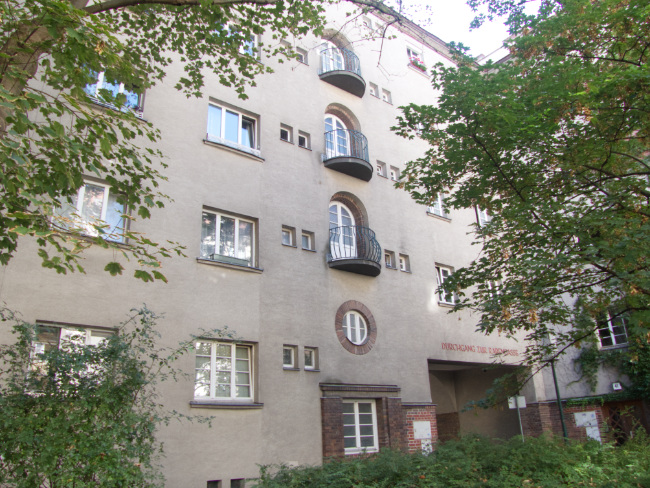
There were groups of children playing exciting and intricate games of the imagination. What fantastic ideas where they conjuring up? Three would run and crouch near a tree, another two would run across the grass and dive behind a bush, another circled round and round on a scooter, acting as choreographer of these wild adventures.
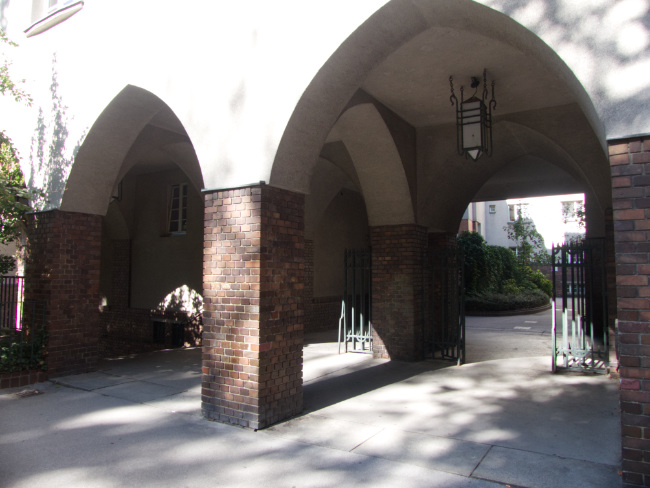
Two women wearing headscarves, one a gorgeous shade of silk pink, rocking a pram.
A kid on a scooter, a dad yelling at him to come back, or something.
Two children eating ice creams walk past and one opens their mouth to show me how much ice cream she has managed to squeeze in. They are proper raggedy city kids, cheeky and funny, full of curiosity and confidence.
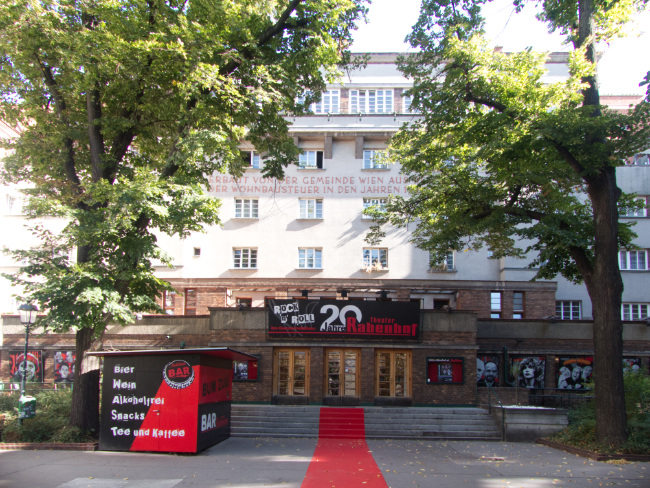
I walked into the library and asked if I could have a look around. I got the sense that the librarian couldn’t quite understand the question. For the whole time I was in there she never stopped talking to the endless people who came to return a book, or borrow some new ones, or ask questions in relation to their homework. I would have liked to have asked her the history of the library but she never stopped working and I didn’t want to interrupt her.

On the shelf, a book about the Austrian Civil War. I looked through the photographs and read a line or two. It seemed immediate and alive, as if the civil war had just ended.
I have never experienced this feeling in London because the last time there was a Revolution or Civil War was in the seventeenth century.
But there will be people still alive in Vienna who would have been children at the time and there will still be living memories of that time. It puts a city into perspective.

In the library, there is a poster of Red Vienna, framed, upon the wall. Maybe it was just my imagination, but this object seemed to have a great deal of magnificent pride. There was something in my eye that made it water, perhaps dust from all these books, but it affected the other eye as well.

I sat on the wall and drew a picture of three of the buildings. It was ok, most things were in the right place and in proportion. No extra windows left over or doors too far out of place. The only bit that needed improving was the space between two large blocks. When I looked more closely, I realised that the space was bigger than it seemed.

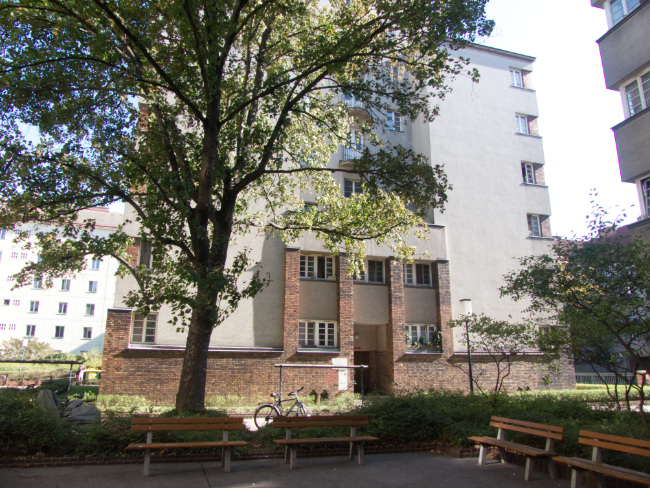
Space, light, air, sunshine, greenery; all principles of the Red Vienna building programme and I had experienced it directly. That sense of space. Just by sitting on a wall and drawing.
And there is something more here. These spaces, consciously designed, are free, open, equitable public spaces. It is here anyone can sit and watch the world go by. It’s here that people phone their friends. It’s here that children play. It’s here that you can sit and draw the people and the buildings.
Perhaps a person sits here just for the pleasure of feeling the sun and appreciating the day. And a friend goes by that they haven’t seen for a while and they laugh and speak and exchange all the news and gossip.
This stuff is never understood in the world of developers and capitalist housing. But it is immensely important in people’s lives. It has great value, but has no price. Christopher Alexander describes it as ‘the quality without a name’. And I bet he would have loved this.

A black women with a scooter sat next to me on the wall and started talking to a friend on her mobile phone. Then she put it onto speaker mode so I could hear their conversation. But I could not understand the words. My knowledge of African languages is non-existent and I have no idea where this woman and her friend might be from.
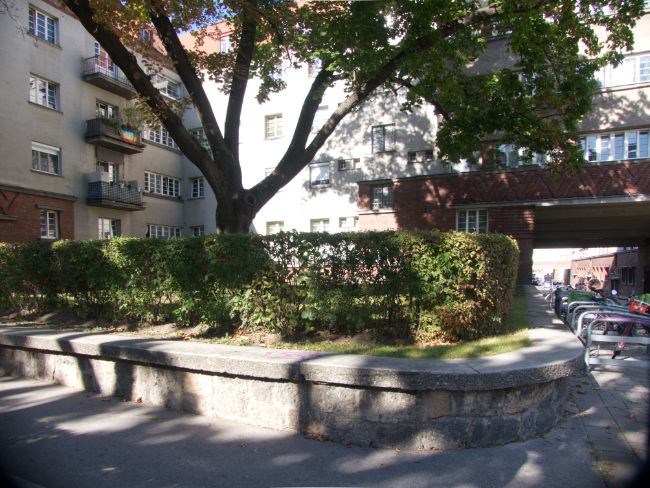
On speaker mode however I could hear the friend speaking and in the background the sounds of a city and traffic, and a great hub of conversation, shouting, greetings, laughing, arguing, a vast city, with huge roads and sky scrapers and aircraft taking off and landing at some enormous airport.
There were neon lights in the streets and millions of people working in the factories and the workshops and the sweatshops. A million more driving the trains and trams and buses and taxi cabs and all the bicycles piled high with fruit and vegetables and bales of cloth and long planks of wood. That’s where her friend was. I just knew.

The architects of the Rabenhof estate were Heinrich Schmidt and Herman Aichinger, both of whom had been pupils of Otto Wagner at the Academy of Fine Arts in Vienna. The estate was built in two phases between 1925 – 27 and 1926 – 28. This was partly because the city council never had compulsory purchase powers and the land was bought in segments.
Part of the site had once been the Krimsky barracks and a parade ground, another part had been a slum. The slow piecing together of the site partly explains the sense of organic development of the estate which gives it great charm.
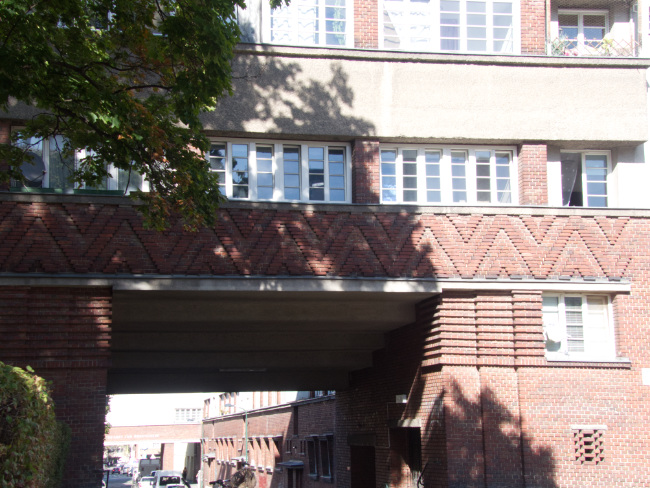
When the estate was first built, there were 1,100 residential units, or rather, homes. Around 38 percent of the land of the estate was built on; the other 62 percent was left open, as communal gardens, paths and play areas.
This creates a greater density of housing than say the Karl Marx Hof where 20 percent of the land was built on and 80 percent left open. But it’s worth pointing out that the Rabenhof estate is much closer to the centre of Vienna and is more inner-city. Demand for housing, and costs of land, were higher.
It still feels very spacious. And there are no plans to carry out any ‘in-fill’ building that is now becoming more frequent in London.

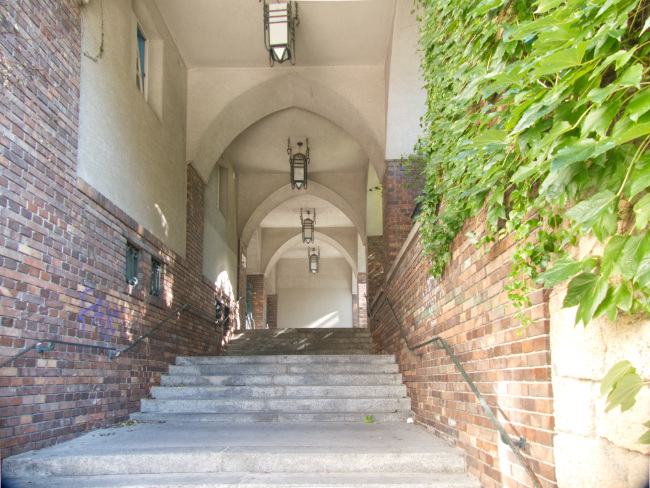
There is a mood of Arts & Crafts about the estate; partly created by the use of brick pattern and an artisanal touches of iron work and sculpture.
And then there are balconies and fittings influenced by Constructivism and playful touches which reference the cosy homeliness of Beiedermeyer. It’s a combination that works well as a confident and understated boldness.
The features and ornamentation don’t shout and jump about demanding attention; they are there to be slowly savoured and gently noticed; and are all the better for their unassuming and yet aesthetically pleasing attitudes.

The original name of the estate was Austerlitz hof, named after Friedrich Austerlitz who was the editor of Arbeiter Zietung, a member of Parliament and a member of the Social Democratic Workers Party of Austria (SDAPÖ).

There must be some nominative determinism about anyone called ‘Austerlitz’, all beating drums and clash of arms, and this socialist politician was no exception. He had a fearsome temper.
He is one of the first people Leon Trotsky met when he arrived in Vienna in 1902 after escaping from Siberia. He managed to find the offices of the Arbeiter Zeitung the main socialist newspaper. Here he hoped to find a way to Victor Adler, one of the founders of the SDAPÖ, and who had helped to unite the Austrian socialist movement.
Trotsky knocked on the door of the Arbeiter Zeitung offices and this is how he recalled what happened next in his autobiography, My Life.
“Do you know what day it is?’ he asked me sternly.
I did not know; in the train, in the cart, in the house of the commercial traveller, in the Ukrainian’s barn, in the midnight struggle with the rooster, I had lost track of time.
”To-day is Sunday,“ the old gentleman announced, and tried to pass by me.
”No matter – I want to see Adler.“
At this, my interrogator answered me in the voice of one giving orders to a battalion of troops in a storm: ”I am telling you, Dr. Adler cannot be seen on Sundays.”
”But I have important business with him,“ I persisted.
”Even if your business were ten times as important – do you understand!’
”Even if you had brought the news – you hear me ? – that your Czar had been assassinated, that a revolution had broken out in your country – do you hear ? – even this would not give you the right to disturb the Doctor’s Sunday rest.”
(Trotsky persisted and the man gives him Adler’s address. He goes there and knocks on the door).
”I am Russian.“
”You need not tell me that, I have had enough time to guess it.“
I told the Doctor, while he studied me with swift glances, about my conversation at the entrance to his office.
”Is that so? Did they tell you that? Who could it have been? A tall man? Shouts? Oh,
that was Austerlitz. You said he shouted? Oh, yes, it was Austerlitz. Don’t take it too seriously. If you ever bring news of a revolution in Russia, you may ring my bell, even at night. Katya, Katya,“ he called out suddenly. His Russian daughter-in-law came out.
”Now we shall get along better,“ he said”.
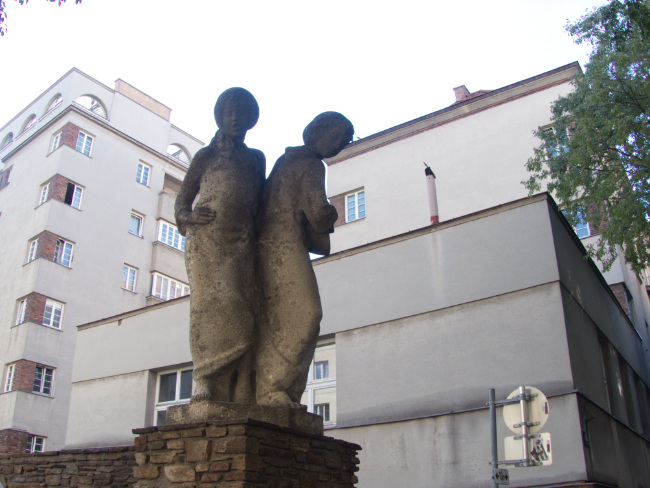
During the period of the fascists the block was renamed Rabenhof and after the war it retained the name.
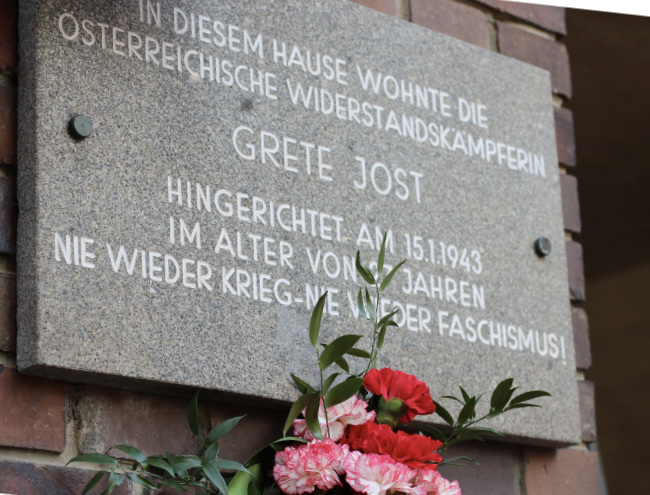
One of the leaders of the communist resistance during the fascist period, Grete Jost, lived in the estate and there is a plaque to commemorate her.
She was murdered by the Gestapo on the 15 January 1943.
Her last words were “Es lebe die Freiheit!” (“Long live freedom”)
And it was a freedom that I felt in the Rabenhof that afternoon. But freedom is precious and must not be assumed, or taken for granted. Now, again, it must be defended.
I’m organising a Radical Walk around the Rabenhof estate and surrounding streets on Sunday 28 September 2025. Meet at 14.00 outside the Rabenhof Theatre.
More details here
 Commodity Fetishism
You must be logged in to post a comment.