
Nature has had enough. There’s been plenty of warnings but the endless line of SUVs never stops, the dumping of waste in the sea, the smoke-stack chimney chemicals into the air, plastics everywhere, in the deepest parts of the oceans, in the highest part of the mountains, in the food, in the bodies of the fish, in the lungs of humanity.

The cities will be drowned the motor cavalcades stilled the oil industries shut down. The water levels are rising in the sodden fields, the rivers burst their banks, the ice caps melt. It will rain for forty days, it will rain for four hundred days it will rain for four thousand years.

A train flashes by at Ebbsfleet International. The international to where is unclear. Carriages full of people from Paris, I wish to be heading towards Europa, but London will do on a cold, wet Saturday morning.
If I had the money I would spend my day in London and catch the last train to the Gare de Nord, take a taxi to Montparnasse, find a cheap hotel to sleep in, a bottle of wine from a supermarket and tomorrow, Sunday take the train to Chartres for the service in the cathedral. Begone the world of toil, and then west to Angers and a day or two studying The Apocalypse Tapestry and Le Chant du Monde
After that, who knows, perhaps I’d go to Italy or Spain, slowly and without purpose, other than to absorb the intriguing art of the Renaissance. But that’s London on the horizon, grey and blurred, slowly waking up, stretching its limbs, rubbing its million eyed CCTV systems and preparing for a great surge in electrical power demand.
Blue, blue that’s the colour of my room, where I will live….waiting for the gift of Sound and Vision….drifting into my solitude

Capital is wearing itself out and thus enters its most dangerous phase. Capital isn’t just money, raw materials and labour-power; it’s predicated on spite and malice and exploitation. Such a system will not simply dissolve like salt in the rain.
Such a system will only be broken by the application of millions of sledgehammers; the hardest part to break will be in our heads, the invisible chains that cannot be seen or weighed but that tie us up in a thousand ways. The man opposite me on the train is reading an tattered blue Pelican book. I wish I could see the title and the contents. It might have the answers held within. The next phase of capitalism is already built. It’s looking grim, more oppressive, faceless, full of digital control, they kill kids, don’t they?

There is plenty of time, there could always be plenty of time, but that requires a different organisation of the world. In this world now there is never enough time. Alarm clocks throw people out of bed each morning, the constant measurement of raw materials extracted, the exact amount of packaging needed for this Amazon parcel, the never stopping conveyor belts in the world’s factories.
Only the post-modernists really denied the global working class and what became of them? Disappeared, split apart not by contradictions but by the denial of contradictions. It’s a fitting end.
The global working class is still at the machines, still digging, still lifting, still driving the lorries and trains, always on the seven seas aboard the oil tankers and container ships, deeper into the earth mining the rare earths, frantically trying to plant the seed for next year’s crops, but the soil is too dry, the soil has been flooded, the soil has been blown away. But who listens to the poor farmers, who pays any attention to those who are the closest to the earth, and feel the immense stress that the earth is now under, who listens to the earth at night in the rain forests and the deserts and the dark woods? Why the poor farmers do, but who listens to them?
There is time enough this morning for me to emerge from the underground at Warren Street and walk to Oxford Street. Memories here, in these bricks and stones and plaster cast doorways. Doorways from the eighteenth century, the time of slavery, butchery, falseness and corruption. What if God was one of us, just a slave like one of us?

The area was heavily bombed during the Second World War. Nearby is Goodge Street Station. During the Blitz the authorities deemed that the station should be closed to prevent the local working class people from sheltering deep in the ground where they would be safe. What would happen if they refused to come out again? The gates were duly locked. Until a crowd turned up with crow bars and bolt croppers and sledgehammers and chisels; all tools that the local working class knew how to use. Organised members of the Communist Party were involved. The station was forced open and remained open.
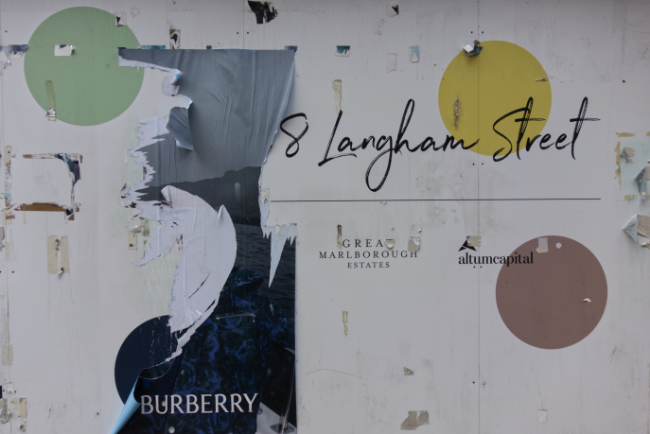
There are bomb craters in the streets, a child covered in blood staggers from the smashed front of a house, a figure that walks but has no arms, a bloody mass that might have been a head. The bombs are still falling, tanks are on the streets the machine gun sound never ends. No wait, this is Gaza City, move on, wrong war, lest we forget.
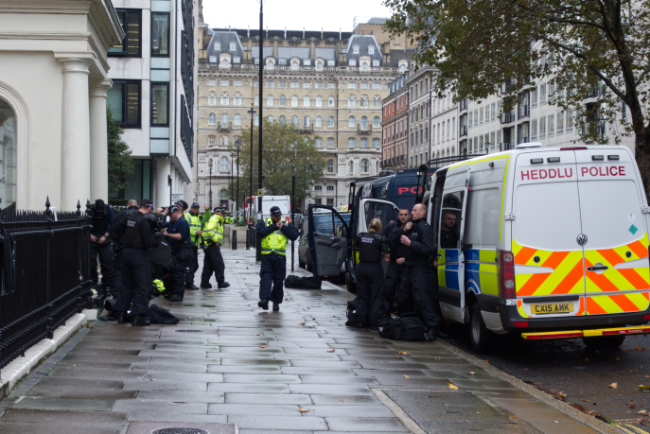
The police hate being photographed. What do they have to hide?
Earlier this week I’d been talking to a young woman wearing a head scarf – is this really so bad? – it was a technical conversation. I wanted to say to her, ‘don’t listen to the politicians, ignore the Tory press, I am on your side’, it felt that the whole question that we should have been discussing was in the Middle East. But something held us both back. When, whatever that something is, breaks down in the next phase then the opposition to war movement is going to become just that tiny little bit stronger. New bonds are being formed at ground level.

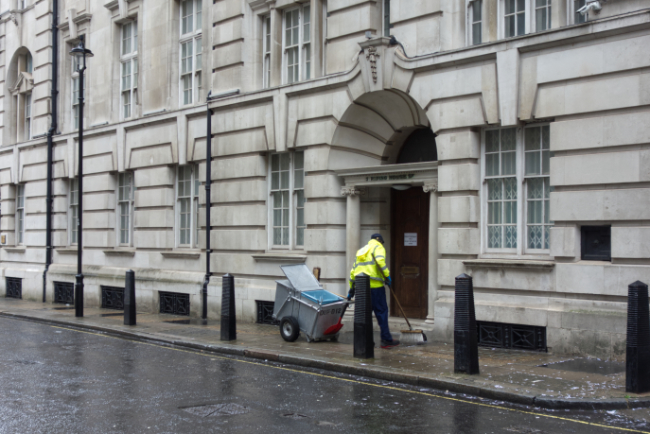
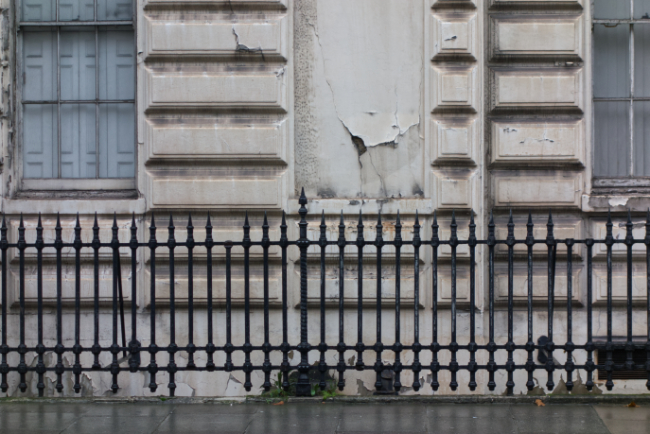
Here in Warren Street in the early morning. The central communications of the tower (once known as the Museum Radio Tower – I like rather like that). Almost speed of light communications, messages to the world, data packet switching, one of the great inventions of the twentieth century. London is just right. The dirty brick work has just the correct layer of dust of two hundred years upon it. The paintwork is faded and scrapped, it has a thousand times more character and suggestion than the endless glass facades, there are cobble stones beneath my feet, they are glistening wet in the intermittent rain.
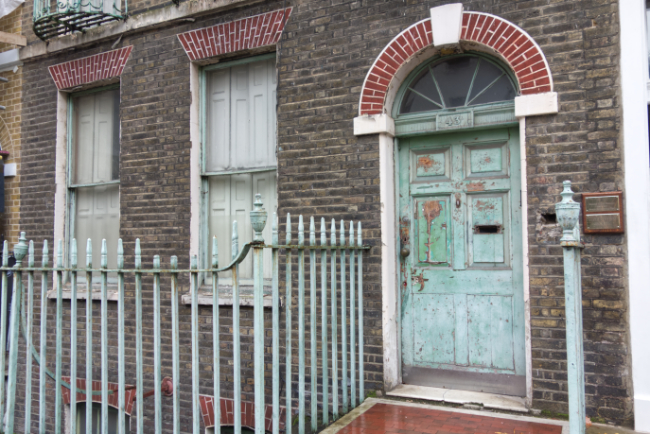
I walk to Bond Street via John Lewis were I stop to have my breakfast in the cafe. Last night I dreamed I was eating a fried breakfast, and here I am, eating a fried breakfast. Some dreams at least come true.
On the underground, the Jubilee Line to London Bridge. People moving in all directions a huge mass. Here and there a Palestinian flag, in the London crowd. A declaration of support, solidarity, humanity. Now the movement is coming together again. Where have we all been?

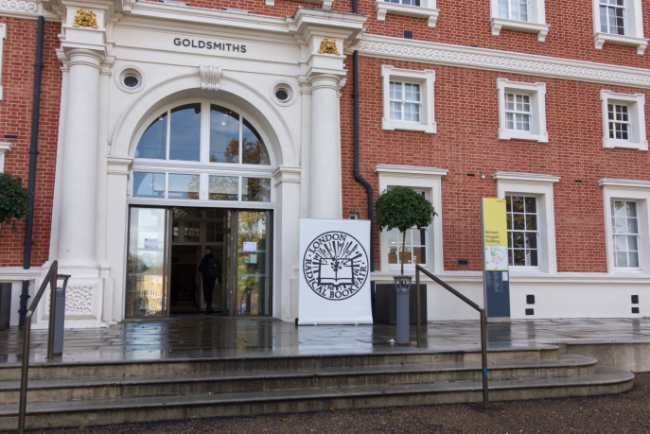
I get a little lost coming out of New Cross Station, but eventually I find Goldsmiths college building on Lewisham Way, which is where I want to be for the London Radical Book Fair. I can’t find my stall, oh, it’s ok, the Lambeth Housing Action Group have taken it over, that’s ok, I’ll go and pitch up over there, in the gap between those other stalls. I put my Radical Walks and Red Vienna talk leaflets on the table and some sheets for people to sign up for the monthly newsletter.
The whole world goes by, the odd balls and misfits, freaks and dreamers, the disposed and those fighting the oppression, radicals, socialists, revolutionary communists, anarchists and the non-aligned of a hundred different hues.
‘Take a leaflet’
‘Radical Walks – they’re free with a hat passed around at the end’.
‘There are 570,000 people working in the City of London and 51 percent of office workers say their work is meaningless’.
‘If the dockers could organise in the 1880s when they faced conditions where they had to fight each other for work, we can organise now’.
‘It’s estimated that around 50 percent of the flats in the Nine Elms Development are empty’
‘Fourier argued that society should be organised around the enjoyment of food, aesthetics and sex’.
‘My dad said it’s easy to get in with a bad crowd, very had to get out’.
This went on for the best part of five hours. I left exhausted and elated. There is a future after all. The potential is all around us. I wish I could feel this alive each day.
I walked from Cannon Street to Blackfriars station. Three young women, again wearing headscarves, these details are important, are walking towards me, again, the Palestinian flag.
People are going home after the demonstration, after the Radical Book Fair, crossing the bridges over the river, back to the workers’ districts. The night is inky black with yellow and white lines of neon light.
There’s a fire burning; first in the heart and mind and soul, then at the computer docking stations in the offices, in the corners of the warehouses where the workers talk in whispers, in the hospital corridors at 3am when the management is missing, in the bus and train depots, on the construction sites, in the pubs and clubs, in people’s houses and flats, on social media, the lines are open, the wires are humming.
There are embers scattered here and there, they smoulder in the night when people cannot sleep with rage and tears of frustration at the feeling of powerlessness and being silenced. The immediate task of the revolutionaries is to blow upon those embers, as one would a fire that might yet die, to blow in a certain way, not barking orders but with breath and words of solidarity and unity.
Here and there a flame licks up, momentarily, against the walls of the palaces. Now the flame is extinguished but the embers smoulder still. Again, the revolutionary breath. A flame now takes hold.
 Commodity Fetishism
You must be logged in to post a comment.