
Waking up too early with the flickering remnants of a cinematic dream. A replication of an earlier version. Dreams become part of our memories and like all memories are deeply within our conscious and unconscious mind. I have experienced this particular dream many times before. It’s about loss. It always has the same ending. The loss remains. It is part of a dream moment collection that I can easily recall.
I couldn’t find the book I was looking for to read on the train, Returning to Reims by Didier Eribon. The book has arrived at an opportune moment. I’m trying to understand the high level category of ‘class’, and in particular, ‘the working class’ and left-wing definitions and understandings of this socio-psychological-political-economic phenomena. The way the term is lazily used is beginning to annoy me in some left-wing publications. ‘The working class this’, and ‘the working class that’. This is just a formula and not really socialist nor revolutionary political leadership.
Standing on the station platform on a cold, bright blue sky winter’s day. The sound of traffic is everywhere and constant. There are billions of vehicle movements each day across the world. An increasing production of toxic clouds and harmful gases and particles. It will block out the sunlight, the rays won’t get through, the photons dirtied with soot and grime. The plants won’t grow, the soil will turn dry and arid; in the air, acrid smoke, petrol-fume taste, spontaneous combustion in the streets, people fall choking, buildings burst into flames.
A train comes into the opposite platform, a great mass of squealing metal tyres on steel wheels, mechanical machine noises. The carriages rock from side to side. This is a certain version of reality in early 2024. It could all change with great speed. This type of world we have now, here in England and elsewhere. More and more war, more shouting lunacy, more screams for a freedom that craves authoritarianism. A great lurch to the right politically around the world, this seeming permanence so brittle, smashed, a brick thrown through the plate glass window of the head fixing machine.
The occupying forces of the future are already here among us, trying on their uniforms in private, waiting until they can march through the streets with straight one-armed salutes, all together, foot right, right, right; with a pause to humiliate some passers by. The illusions are immense, powerful, the representations of the illusions are all around us, on the television screens, phone screens, computer screens. The algorithms constantly suggest a violent future. The new cannibalism of capital eating itself.
It’s only a week since I was last in London but it seems as if a great deal has changed. Even in these past seven days, more and more capital has been accumulated. It seems even more concentrated in the shopping centre, the lights ever brighter, the marketing slogans are bolder, the advertising campaigns louder; but behind the glitz in the loading bays and service areas the concrete walls are unadorned and drip blood, stale milk and sweat.
I walk passed a row of shops, one of which is selling watches. Only an inch or two from the plate glass windows, almost touching. I want to get as close to these commodities as possible without creating some sort of alarm. The security guard is looking at me. He’s selling himself and that means he has to do exactly what he’s told and at the time’s he’s told to do it. There can be no ambiguities in the labour process or the selling of labour power. From the time he starts work, until he finishes his shift, he ceases to be a complete human being. He no longer belongs to himself. His suit is a little too big, his red tie too long. Could you do that all day, each day? Perhaps you do. There was a security guard based at one of the offices I once worked in and he wrote a book about modernism.
He glances in my direction again. He looks weary. The shop is a cage. There are four shop workers. One is sitting behind a big desk moving a computer mouse and looking at a monitor. Now a customer comes in. There is going to be a transaction, an instance of the realisation of value. As Marx says in Capital, buying and selling are antithetical, but they occur simultaneously at exactly the same moment, in the same micro-node of time and space. The security guard lives in London too, but no-one knows where.
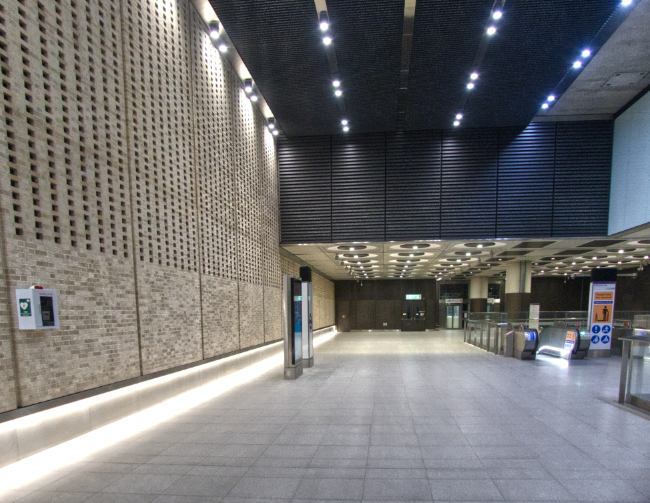

Capital is a dominant factor in global production (wage labour is another), it has a hegemony of production, but it is not monolithic. There is competition between nodes of capital accumulation (clothing industries are competing with other consumer industries; jewellery, books, electronics, household goods, foodstuffs, entertainment) . And there is competition within each productive sector. Fashion stores are in sharp competition with each other; Zara, Primark, H&M, Oliver Bonas, Gant, Hackett, TW Lewin, Next.
The parent company of Zara is Inditex which is 59 percent owned by Pontegada, the €90bn-plus personal investment group of Amancio Ortega’s ‘family office’. He is the 13th richest person in the world. Pontegada is now expanding its real estate.
The expansion of capital is also a fractal-like process of replication whereby the patterns spiral in ever increasing circles. Capital replicates itself around the world in identi-kit shopping centres, mirror-image office blocks, the standardisation of software, machines and consumer commodities. In these gigantic process of reproduction and replication, we are all reproduced and replicated.
This walk through the shopping centre is in appearance, exactly the same walk as the week before, or the month before that. It’s the same fashions, the same looks on the people walking by; they are having the same conversations, attitudes and mannerisms and movements learned from a thousand interactions with screens and media. The expansion of capital creates an idiom, a style, an atmosphere. It is all an illusion, a multi-faceted crystal hanging in space from which the light bursts forth and bounces across space-light years in flashes of rainbow colours.
A million replications of exactly the same labour process. The standardisation of machines leads to a standardisation of how shop workers physically move their bodies. Take commodity image-object and put it in a bag with the retail-unit’s name printed on the side. It’s a brand, brand-image, image object, self-image, the creation of our very own brand identity.
The same processes, over and over again, so they appear to be part of human nature, when in fact they are an alien and alienating imposition on the potential nature of the human. Puts the commodity into a bag, card payment machine, card touched against card reader, press button, print receipt, over and over again. And as the simultaneous process of buying and selling is completed, the security guard stands and watches. All this happens in the five minutes or so it takes to walk to work.
Someone is supposed to come and see me for a meeting. I wait in the reception area. The receptionist looks gloomy but she’s good fun when she gets talking. After fifteen minutes of watching the world go by at ground level I decide my visitor isn’t coming.
‘I’ve been stood up’, I say to the receptionist handing back the temporary visitor’s pass she gave me. She laughs in that sort of way people do when they’re trying not to laugh.
‘Will my broken heart ever heal?’
‘Oh dear’, she says, purring and laughing at the same time.
A women steps into lift, looks in my direction, smiles. Goes to the corner of the lift and arranges her hair in the mirror. The lift stops at the third floor. She looks at me again, smiles and leaves.
After work I am in two minds as to whether to go to Praed Street and explore the area. I almost don’t and walk away from the underground station but without even thinking, that unconscious power that lives within us all, so hard to explain, propels me to turn around and go back. Before my heart has beat three more times I’m on the Crossrail train heading west.
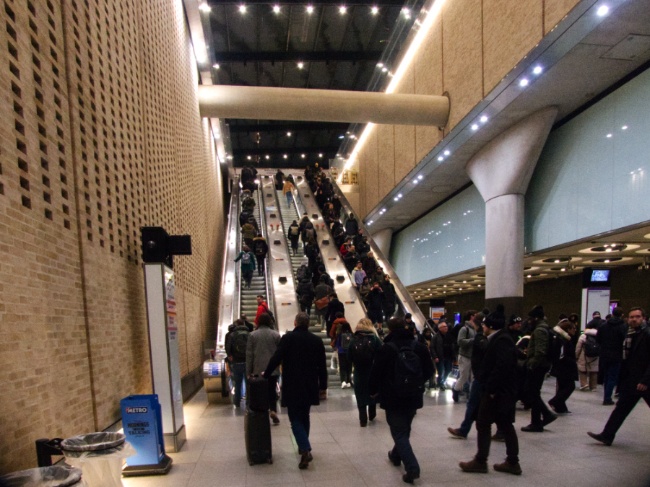
The new offices and luxury at Paddington Basin is one of several nodes of property-development capital concentration in London. They all look the same. They all have the same vibe. They all have a sprinkling of glitter to conceal the inner screaming of alienated and despised and discontented office workers, the grim boredom of the security guards, the menial labour of the cleaners.

Millions of words have been written about this place. Opportunities, sustainability, community, work life balance, the office of the future and much more. There is not a single mention of these words:
exploitation
alienation
capital accumulation.

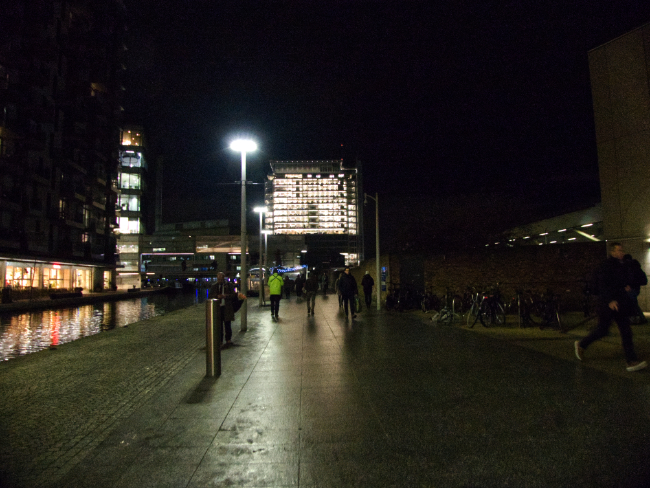
In one of the office building an electronic display is going round in circles with some headlines of the days news. ….Rwanda….Palestine…..Rishi Sunak…..house prices….inflation shock….Prince Charles in hospital….as if all these things are somehow connected. While I am filming this, I am aware of someone sitting in a Range Rover watching me. Then a young Black woman comes along wearing a long dark coat with a furry lined hood. She has this pulled over her head and it frames her face in a rather lovely way.
‘Are you filming?’ she asks softly.
‘Yeah, but I’m not really recording any sound’.
‘Can I have a look?’, she asks.
She looks at the view display and she can see the headlines of the day….Rwanda…Sunak…Politicians….
She explains that she lives in a building in the street. We chat for some time. She’s been in London for three years and is originally from Nigeria.
‘I like London’, she says, ‘whatever you’re looking for, you can find it here’.
I walked into Paddington Basin itself and through a passage way and I was back on Praed Street. One of the first things I noticed was the bedding of a homeless person next to the offices of Hamptons. And the air changed and became colder and the glitter that had been sprayed on the office blocks hadn’t found it’s way to this part of London. I crossed over Praed Street and into a different world. Star Street, St Michael’s Street, Southwick Street. I walked down to Sussex Gardens and then back.
There is something magical here, an atmosphere from the Cato Street conspiracy and the memories of the artisan class that are bought to life in EP Thompson’s The Making of the English Working Class. This was from an earlier stage of capitalism when capital was less powerful, ubiquitous and rampant. There were not billions of transactions each day of consumption. Life was not capitalised to the same degree, everyday events were not so financialised. All of this works upon our perceptions, emotions, ideas, how we see, how we think, how we write. It feels as if there is something more human in that past, something more creative, spells could be made, there are enigmatic shadows.
In the glass and concrete all shadows are eliminated by the homogenous white light. Enigmas are impossible because they cannot be described in Gantt charts and key performance indicators. It is impossible to add a column to a spreadsheet to capture spectral mystery.
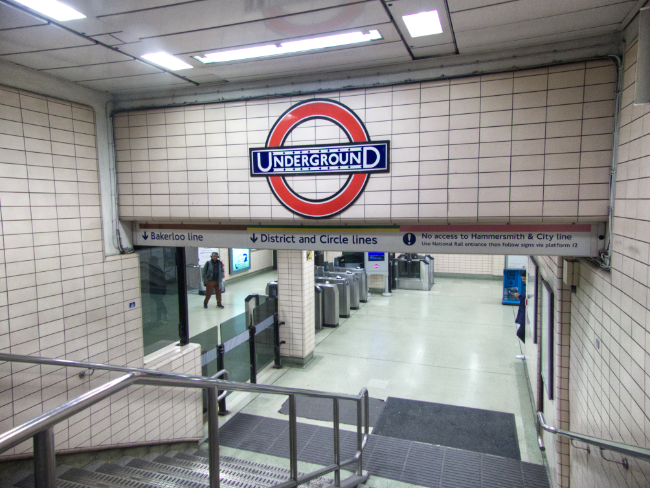
There is an entrance to Paddington Underground directly off Praed Street. It lacks the razzamatazz of the new station but it has a magical charm that suggests great adventures. Here a train may appear and take a hidden branch line that leads to a fantastical London, a place that is multi-dimensional, a pluralism of architectural styles, the non-dogma suggested by Josef Frank; well-tailored fashions, colourful interiors and quality design. But it is the people. This is the difference. They have a pleasing manner and contented air. Their conversations sparkle, full of footnotes and cultural references, at times enigmatic, and other times with intellect and insight. There’s an easy-go-easy-come air about this place. There is no poverty, war or violence.
I rush along the platform, I can see the train there, but as I reach it, the doors close and I’m left in the cold London air of a stale capitalism that is moving to its own destruction. Someone pulls the lever for the death machine; there are fighter jets in the air, war cabinets, a poison rain of lies and unfounded accusations. I missed the train to paradise, I don’t think it will come around again any time soon.
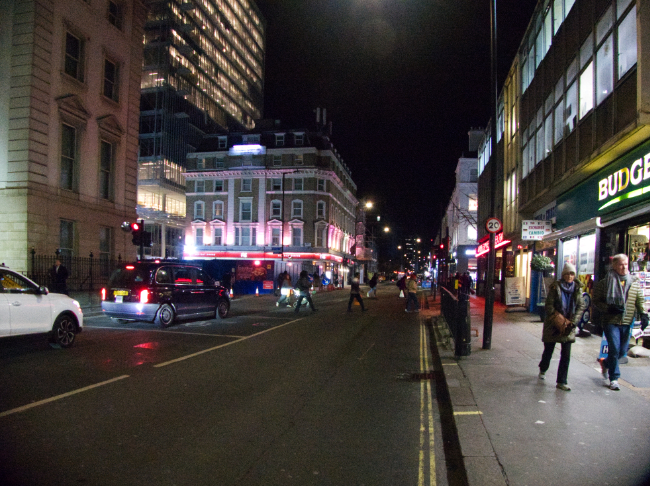
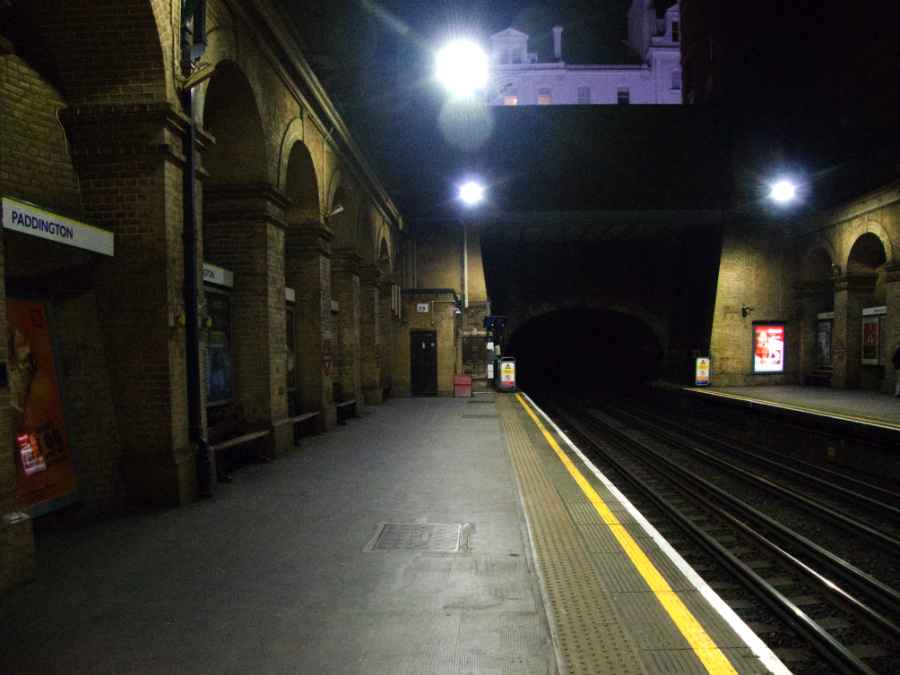
These are some thoughts towards a Radical Walk ‘Praed Street and the Liberty Tree’.
The walk will take place on Thursday 18 April, starting at 6pm. Not yet sure of the starting point.
Please use this contact link to email me for the details
 Commodity Fetishism
You must be logged in to post a comment.