A dozen sheets of paper, printed with double-spacing. It’s easier to read. It is a collection of streets in Soho, and Dean Street in particular. A list of dates of buildings and their uses, trades and occupations and the details of the 1851 census. At number 28 Dean Street is recorded Charles Mark, his wife Jenny and their children, Jenny (Jennychen), 6, Edgar, 4, Eleanor 3 and a newly born baby, Franziska. The places of each birth records a life already lived in exile; Salzwebel, Trier, Brussels, Paris and London. Charles Mark is recorded as ‘Doctor (Philosophical Author). Jennychen, as a scholar ‘taught at home’. *
Karl Marx arrived in London in August 26 or 27 1849. Jenny and the children arrived on 17 September, accompanied by Helene Demuth, ever known as Lenchen. She could be described as a ‘domestic servant’ but she was an intimate and close friend of Karl and Jenny. Wilhelm Liebknecht wrote, ‘Lenchen was the dictator in the house of Marx, Jenny the ruler’.
The family lodged for a few days in Leicester Square and then moved to Anderson Street in Chelsea. The house is still there, having now experienced significant embourgeoisement. The family were evicted in March 1850 for alleged non-payment of rent. There is whiff of jingoism and xenophobia about this, the landlord taking advantage of the precarious position of recently arrived refugees. During the eviction process the bailiffs seized goods; the children left crying as their favourite toys were taken from them.

After another temporary stay in Leicester Square they moved to 64 Dean Street in May. Engels had lodgings in nearby Macclesfield Street. In November 2850 their son Heinrich died. He had been born on the 5 November 1849 and known as Guido or Fawksey. In December the family moved to 28 Dean Street where they lived for the next five years.

Dean Street in 1851 wasn’t a slum in the worst nineteenth century sense. Those were the rookeries and there were several in close proximity. These were grim collections of dilapidated buildings with sodden cellars, raw sewage and a mass of the most destitute of the population crammed together in single rooms. It was these conditions which nineteenth century reformers and philanthropists concerned themselves with. There is nothing of that built infrastructure that remains; and because the poorest of the poor rarely, if ever, write books or diaries or letters to the newspapers, there is a great silence where the voices of those people might be.

Nearby were (and are) areas of affluence and grandeur. Regent Street is a ten minute walk from Dean Street and would have provided a novel contrast. It had been laid out in the 1820s, a deliberate grandeur of shopping for the middle and upper classes (it was rebuilt from the 1890s onwards and no original buildings remain). Marx is described as carefully observing a toy train in a shop window, powered by electricity.
Dispiriting and hungry poverty haunted the Marx household during their time in Dean Street. Marx wrote to Engels that for ten days the family had lived on nothing but bread and potatoes and he was unsure whether he could even procure that.
There was also great fun and antics and games and stories. To the children their father was Mohr or Challey or Papa; Jenny as Momchen. On one occasion, when Momchen was away, Laura wrote to her explaining that Papa had laid in bed all Sunday ‘because the day before he had drunken lots of gin’.
Jenny and Karl would organise Shakespeare plays in the front parlour and Marx read Dante, Balzac, Cervantes and Sir Walter Scott to the children. Sundays were for family outings, often to Hampstead Heath. Marx would invent stories on the way home, including the mysterious toy maker Hans Rockle. Eleanor later wrote:
“Hans Rockle himself was a Hoffman-like magician, who kept a toyshop, and who was always ‘hard up’. His shop was full of the most wonderful things – of wooden men and women, giants and dwarfs, kings and queens, workmen and masters, animals and birds…tables and chairs, carriages, boxes of all sorts and sizes. And although he was a magician, Hans could never meet his obligations either to the devil or the butcher, and was therefore….constantly obliged to sell his toys to the devil”.
Jennychen and Laura were not allowed to play in the street in the afternoons and evenings, amongst the shabby-chic there were grubby edges of street sharps and prostitutes, but their brother Edgar, nicknamed Musch did so. As a baby Jenny called him her ‘little monster’.
This boy was the family favourite, full of cockney street slang and Irish songs, outwitting the local baker who came demanding money. One of the long-standing family friends was Wilhelm Wolff, or ‘Lupus’. He had been imprisoned in Silesia between 1834 to 1838 for simply being a member of a radical student’s organisation. Lupus had a reputation for drinking and getting into scrapes and at one point the Marx children got it into their heads that he had been assailed by highwaymen. Musch wrote to Marx:
“My Dear Devil,
I hope you are quite well because I am going to come and see you and forgot to tell you that Lupus went out to get drinks like he generally does and got quite drunk and as he’s going along the streets there came some thieves and stoles his (illegible) and his spectacles and five pounds….I am your friend Musch le Colonel’
Marx dedicated volume one of Capital to Wolff, ‘To my unforgettable friend, Wilhelm Wolff, intrepid, faithful, notable protagonist of the proletariat’.
Musch died in Marx’s arms on the 6 April 1855, of intestinal tuberculosis a disease made worse by poverty. Marx was inconsolable; ‘I feel broken down’, he wrote to Engels.

Dean Street had been developed between 1678 to 1697 by Nicholas Barbon and Robert Frith. Barbon was a mercantilist, property developer and economist. It is claimed he was one of the first exponents of the free market. In a nice symmetrical twist, he also appears on the first page of Capital when Marx begins the discussion on commodities,
‘The wealth in which the capitalist mode of production prevails as an immense collection of commodities’.
‘The commodity is, first of all an external object, a thing which through its qualities satisfies human needs of whatever kind. The nature of these needs, whether they arise, for example, from the stomach, or the imagination, makes no difference’.
And here he references Barbon:
‘Desire implies want; it is the appetite of the mind, and as natural to hunger as the body…the greatest number (of things) have their value from supplying the wants of the mind’.
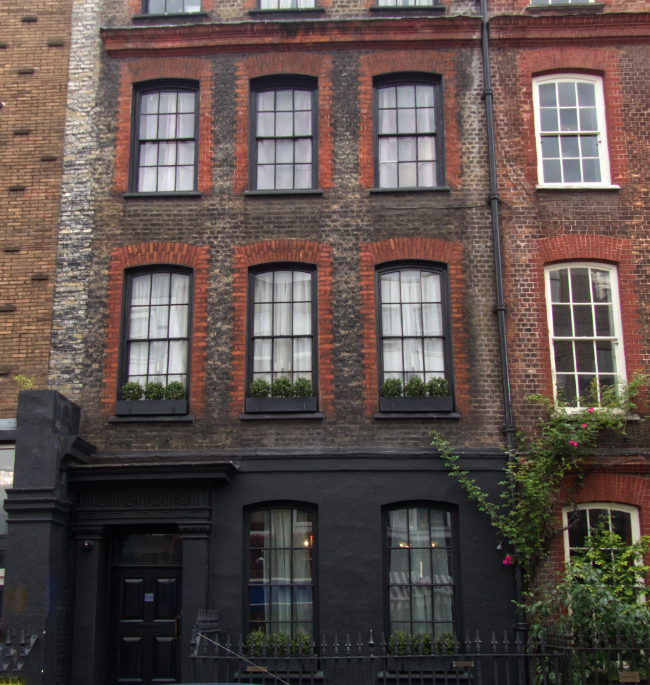
The early houses were constructed by individual builders and carpenters. There are excellent examples in Meard Street and Frith Street and one or two in Dean Street itself. For some reason the Soho area never achieved the hoity-toity snobbishness of Mayfair or the concentration of intellectuals in Bloomsbury. It sort of started, stuttered and then its pretensions gave way to the expansion of workshops, warehouses and factories of the industrial revolution.
When the Marx family moved into 28 Dean Street it was characterised by artisan production, service industries and the sort of people who exist in the imagined world of Bohemia. Combining data from the 1851 census and the Post Office Directory of 1852 produces the following occupations and trades:
appraiser, attorney clerk, baker, ballet dancer, boot and shoe maker, boot seller’s porter, cabinet maker (master), carpenter, cartwright, carver and gilder, chiropodist, coal merchant, commission broker, currier, currier apprentice, dairyman…..
……decorator, domestic servants (also, servants and general servants), dressmaker, engraver and enameller, fishmonger, fruitier, general practitioner/ surgeon, grocer’s cheesemonger, hairdresser’s assistant, ironmonger and tinplate worker, jeweller…
…….journeyman gunmaker, journeyman tailor, lace and wardrobe dealer, manufacturer of coloured, embossed and varnished papers, milliner, optician, pub landlord, ornament manufacturer, paperhanging manufacturer, professor of languages….
…..professor of philosophy (Marx), solicitor, tailor, tailor and habit maker, timber merchant, upholsterer, violin manufacturers, waiter, watchmaker, wine merchant.
Perhaps some of these were the shopkeepers and creditors that Jenny and Karl refer to in their letters to friends.
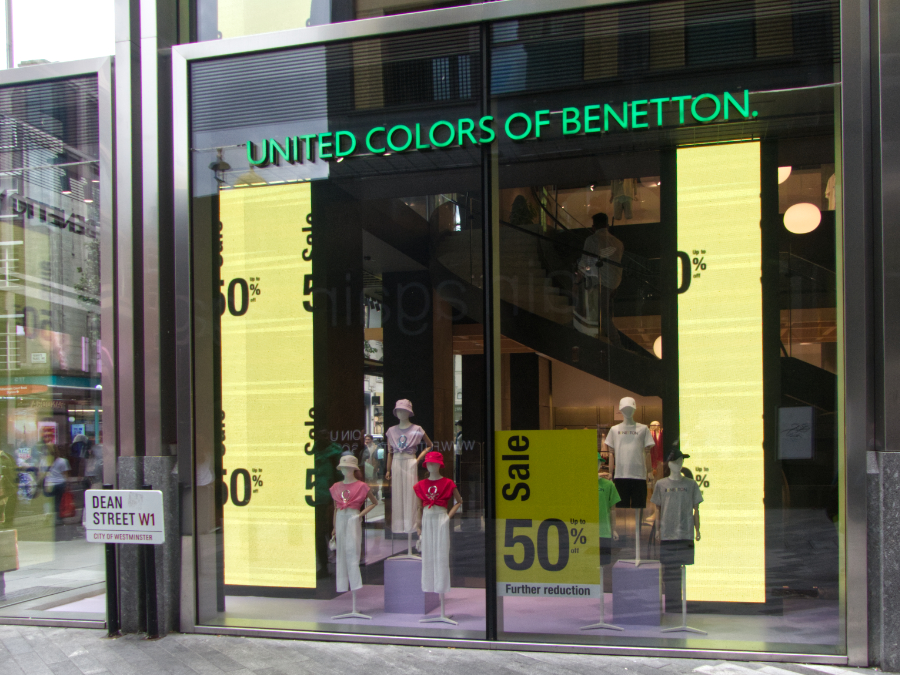
I started at number 1 Dean Street which is now a large three storey branch of the United Colours of Benetton. It is a good example of the triumph of marketing over workers’ rights. The clothes carry tags making claims of ethical credentials but there is nothing about the exploitation of labour. A cursory glance at the labels show clothing produced in China, India, Myanmar, Bangladesh, Brazil, Tunisia, Turkey and Egypt. A collection of countries with human rights violations, active union suppression and poor working conditions.

I check the label for a green jacket, ‘Manufactured in Myanmar’. For a moment there is a fragile connection with a factory thousands of miles away. Perhaps the names of the workers should be added to the labour, and their hours of work and how much they are paid. That would really help to connect up the world. The difference between the workers wages and the price could be written on the tag and that would enable a crude analysis to be made of profit and the rate of exploitation.
Across the street, a new block of luxury apartments with a weird soulless vibe. Land values, capital investment, buy to leave, a housing crisis of a large stock of empty property and the exploitation of renters.

Number 88 was built in 1791 and is the last surviving Rococo shop front in London. The windows are full of tacky advertising and on-off flashing signs. I would like to think of Marx buying cheap cigars in there on the way to and from the British Library but in 1852 it is listed as being occupied by a carpenter, so perhaps not.

Number 76 was built in the 1730s and has an original interior. It is opposite number 28 where the Marx family lived and it would have been the view from the front room of their apartment. I would like to see the interior and by chance a man and a woman arrive and open the door.

‘Is this a private house?’ I ask. The man ignores me. The woman in a blue trouser suit turns round and says, ‘well yes it is, but it’s a private members club’.
‘Do they let people look around?’
She gestures with her head and says, ‘follow me’. This is a lovely touch on a summer evening in Soho. I’ve been invited in. She disappears and I’m left alone (and ignored) at the reception. I make small talk about historic buildings when someone I assume is the manager. Then someone comes to collect her and the mystery continues in a Chesterton-like way. Finally the receptionist acknowledges my presence and I ask if I can look around.
‘If you apply to become a member we’ll show you round’. To join one must be recommended by two existing members and ‘work in the creative industries’. I could blag the latter but I doubt I know anyone who has joined this. It’s £100 a month.
Later I discover that it’s part of Soho House, an organisation that operates 42 clubs around the world and claims 240,000 members. It is also claimed that since it was founded in 1995 it has never made a profit. That in March 2024 it reported losses of $118m and in the previous year, $220m. The majority shareholder is an Ron Burkle’s investment vehicle, Yucaipa. Burkle is a retail billionaire and a fan of historic architecture. This doesn’t mean he wanders around London with a battered copy of Pevsner. It means when he takes a fancy to a building he simply buys it. As he did with Michael Jackson’s Neverland. For 22 million dollars.
Various commentators in the Financial Times have described the Soho House clubs as dull, with dire food and full of show offs. I do get to gawp at some of the 1730s interior while I generally hang around but am told no photographs allowed.
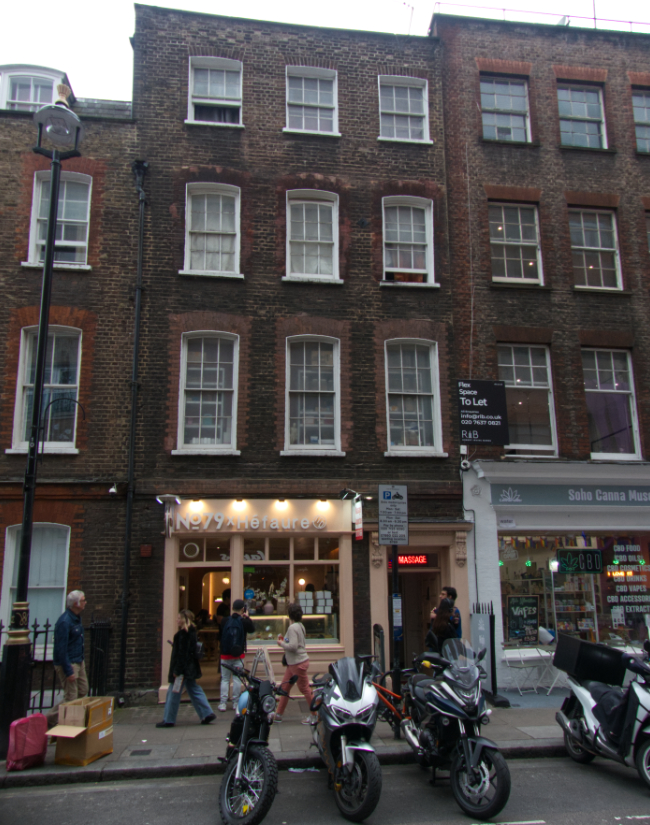
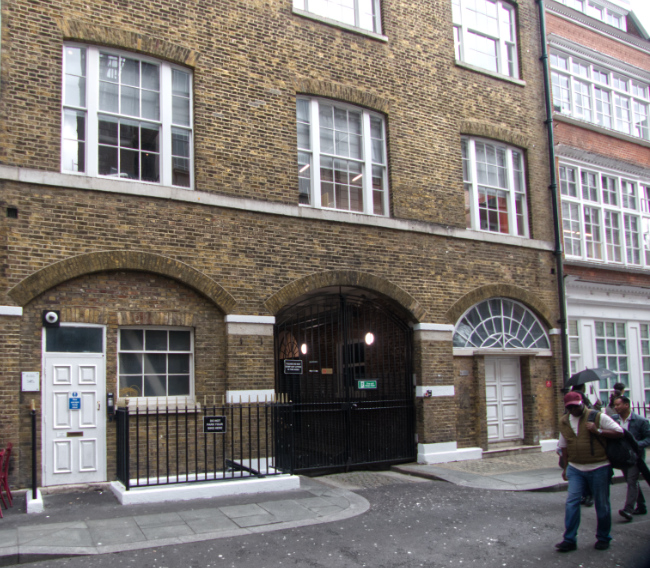
I move back to the other side of the road and examine the list of buildings, dates and people. Number 80 was occupied by a jeweller and watchmaker in 1852. I think the building is a bit earlier so we’ll count that as one that Marx would have known. For no good reason I begin to explain this to a man who comes out of a building and starts smoking a cigarette. He is wearing a tight radiant white t-shirt and appears to have two places of interest (at least); the gymnasium and the tattoo parlour. When I’ve finished he takes the cigarette out of his mouth and makes a movement with his face as if he’s chewing gum, which he isn’t.
‘There’s a lot of history in Soho’, he says, ‘that’s for sure’.
He brings to mind Quentin Crisp ‘…and I discovered that some toughs were queer and some queers were tough’.
Across the street again and another door opened. I asked the young Black man who came out what went on in there.
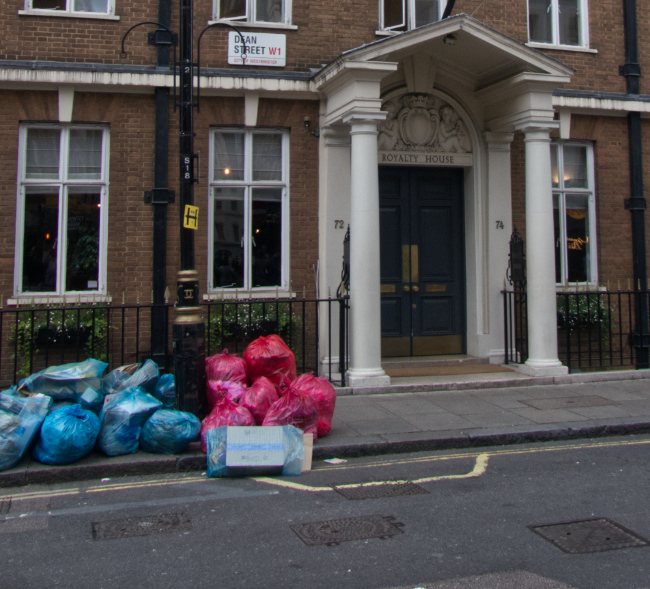
‘It’s Soho Works’, he said. He seemed to be wearing a lot of bangles, earrings, necklaces, rings and other items of jewellery. And clear glasses in heart shapes. It was all very cool and worn with charm and affection.
‘What’s Soho Works?’ I asked
‘Offices, it’s like offices’, he smiled, turned and walked away.
Offices. Soho Works. I checked that out later and it’s part of the same thing that provides, ‘Soho House’. Let them tell their own tale:
“Soho House & Co Inc. is a global membership platform of physical and digital spaces that connects a vibrant, diverse and global group of members. These members use the Soho House & Co platform to work, socialize, connect, create and flourish all over the world. We began with the opening of the first Soho House in 1995 and remain the only company to have scaled a private membership network with a global presence. Members around the world engage with Soho House & Co through our global collection of 43 Soho Houses, 9 Soho Works, The Ned in London, New York and Doha, Scorpios Beach Club in Mykonos, Soho Home – our interiors and lifestyle retail brand – and our digital channels. The LINE and Saguaro hotels in North America also form part of Soho House & Co’s wider portfolio”.
And yet for no financial cost, it’s possible to just wander around the vibrant and curious streets of Soho, talk to people who aren’t show offs, enjoy the Spectacle and entertainment and become part of it all yourself.

A man is sitting on a window sill eating a bag of chips. I’m hungry, thirsty and beginning to feel tired.
‘Where did you get the chips from?’
‘Poppies’ he replies, pointing to Old Compton Street with the end of a chip which he then put in his mouth.
‘What are they like?’
‘They’re too hot and crispy’ he says. They sound like the Ideal chips to me.
‘It’s hardly the fault of the chips that they’re hot’, I countered.
Then he laughed and his beige coloured cork-screw hair jiggled about over his head.
‘I’m just being impatient’ he says.
I bought a packet and they were delicious. When I had eaten half, I walked back to the shop and asked for another dose of vinegar on the remaining ones.
There are some sprinklings of magic in Dean Street, some echoes and voices of children playing at cooking on the chair at number 28, Engels arriving with a case of wine, carrying it on his shoulder as he marches down the street to visit his closest friends, the children squealing with delight and affectionately calling him Angels.
Marx works late into the night on economic theory, ground rent, capital, the expansion of capital, the accumulation of capital, surplus value, the rate of profit. Sleeping on the sofa during the day. Creating the notes that will become Grundrisse and volume one of Capital.

An early evening. Jenny and Karl are sitting in a corner of the Highlander (now the Nellie Dean), drinking beer and gin, sharing a private joke, some momentary relief from debts and bills and creditors. The pub has an earlier evening ambiance of pleasure and relaxation. The light comes through the window, sunlight on Jenny’s face, hair tied up, a wisp comes down, she raises her hand and tucks it behind her ear.
She leans her head on Karl’s shoulder and closes her eyes. Life and nothing but. ‘Let’s have another’, she says. They both know it cannot really be afforded, but they have a wish for this cosiness between them, a shared love, the camaraderie, the companionship, that this conviviality can be an antidote to alienation.
When they step out of the pub, the world of 1851 is gone. The dusty street, the carts, horses, costermongers, ragged children reeling round with fantastic street imaginations in their heads, the violin maker, the milliners, the domestic servants with baskets filled with groceries, the man carrying a bucket of water from the pump, the well dressed women holding parasols and handbags, the bootmaker’s shop; it’s all gone.
At the end of the street, the United Colours of Benetton, connected through shipping lanes that never stop to the industrial textile industries of the world, ships with 24,000 containers, 300,000 DWT, the new underground Crossrail, people walking past with mobile phones, powerful, hand-held computers, a global communications systems of satellites and sub-sea cables and fibre optic networks.
Advanced microchips with billions of transistors on a single silicon wafer; a global system of production, of machines and computers and tools and scientific instruments. All of nature’s raw materials, mined, extracted, crushed, cultivated; turned into the shape of time of the 21st century.
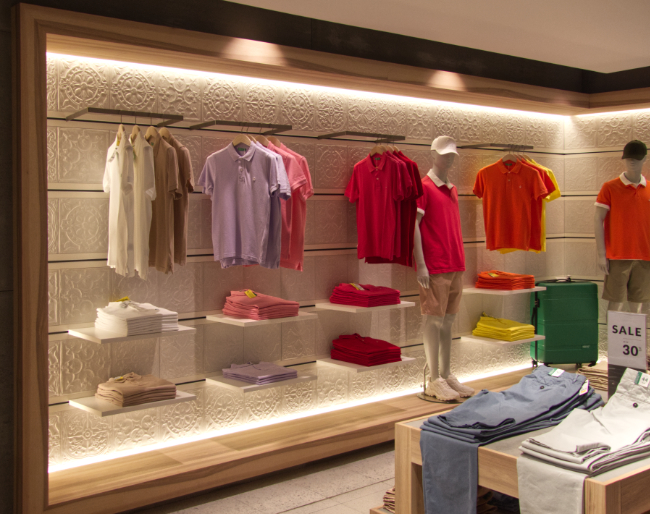
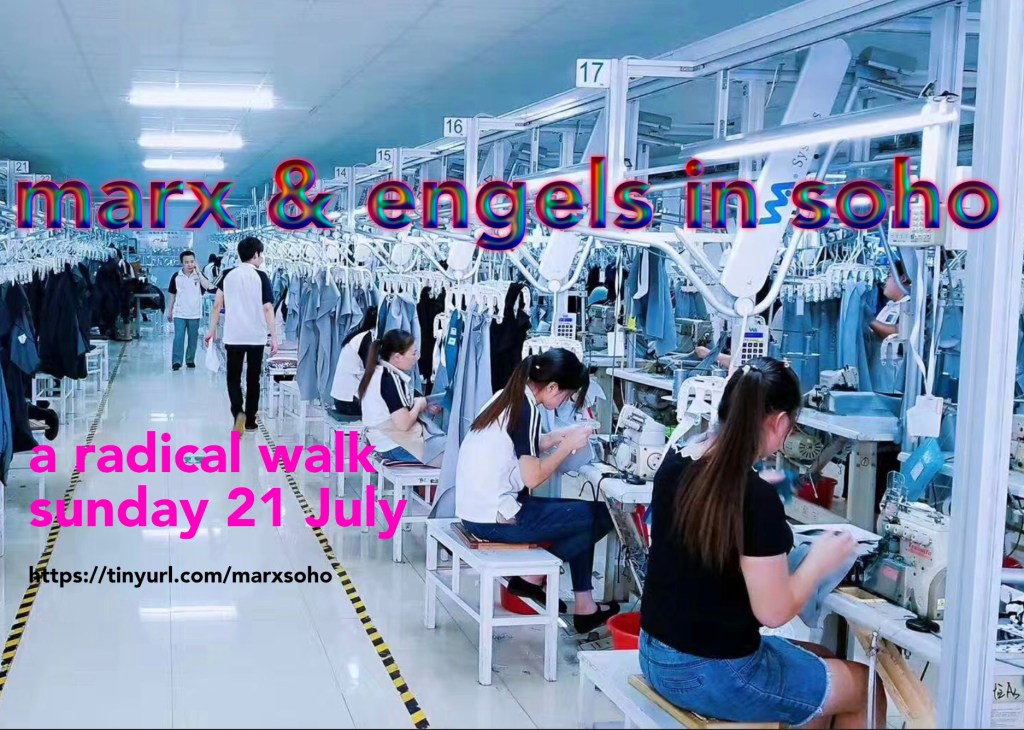
Thousands upon thousands of commodity-objects, surrounded by adherent signals of marketing, branding and advertising to transform them into image-objects. Assembly lines with conveyor belts moving ever faster, rows upon rows of workers, sorting and selecting with human hands, bringing inanimate objects together and bring them to life, into a world of commodity fetishism.

Sewing, stitching, welding, glueing, tying, riveting, soldering. Giant blast furnaces, always in operation, raw crushed ore melted into steel. Factories, sawmills, workshops, hand assembly of components in the slums, warehouses, ports, shipyards; children in mines scratching in the rock and soil for rare earth metals, women with babies strapped to their backs sorting through toxic waste dumps for strands of copper and gold.
And everywhere, each day, billions of drops of human labour from an infinite number of human hands take raw materials and produce. All because capital must expand, must accumulate, must warp and stretch and intensify; capital that must exploit human labour, must crush the workers’ political opposition, must use its industry of head fixing to divide, and split and conquer the workers, to divide and rule the workers. Must take the products of human life and commodify them, financialise all relations between people, monetise the basic and essential needs of humanity.

All the great contradictions Marx outlined, with the support of Jenny and Engels, continue to intensify and sharpen. The social character of production is in opposition to the existence of private property, the needs of humanity are in conflict with the dynamic of capital accumulation, the immense forces of production fail to deliver essential needs for masses of people. The social art of creativity is turned against the worker and instead of fulfilment through their own labour, the soul of the worker is crushed, separated from their own selves, their own being. The forces of production which could liberate humanity, instead are used for war, violence, destruction and the daily oppression of wage-slavery.
‘Where are we?’ Jenny asks, looking around, bemused, slightly tipsy.
‘The future’, Marx replies.
————————————————————————————————————
* There is considerable variation and inaccuracies, even about dates of birth. The 1851 census records Marx as 32 and Jenny as 30. However, Jenny was born on 12 February 1814 and Marx on 5 May 1818.
The Marx-Engels Chronicle, Volume One, describes Edgar’s birth as either December 1846 or January 1847. Mary Gabriel in Love and Capital gives the date of birth as 3 February 1847.
————————————————————————————————————
Marx & Engels in Soho – A Radical Walk – Sunday 21 July 2024
https://www.eventbrite.co.uk/e/913098872307?aff=oddtdtcreator
 Commodity Fetishism
You must be logged in to post a comment.