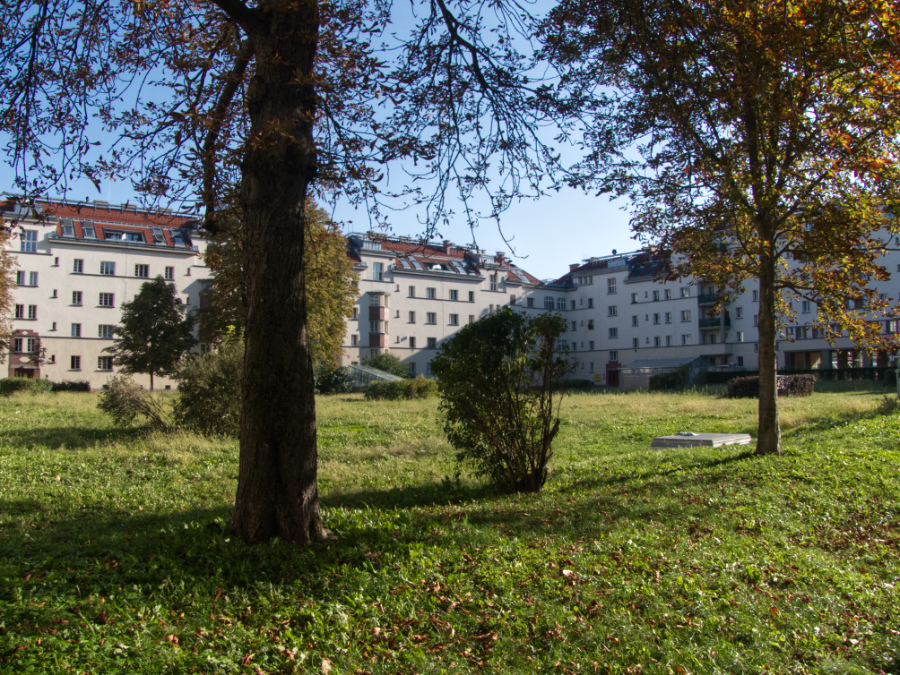
What follows is just a word-sketch of an afternoon visit to Goethehof in Vienna. I have flawed conversational German, have never visited any archive in Vienna (although I would like to) and have access to only a small number of books while I’m staying in the city.
But sometimes impressions can be useful in terms of helping to build towards a bigger picture. And impressions can spark curiosity and lead to greater study.
Perhaps it’s a little like visiting a gallery to see a great painting; say The Peasant Wedding by Pieter Brueghel the Elder. One can take away an impression (and many people do). But then after studying the Reformation and counter-Reformation and the developments that lead to the First Dutch Republic and the change in medieval Europe to mercantile capitalism and the manufacturing system, and Absolutism and much more; you go back to Breughel and see it all in a different way.
On that first visit however, you notice the shoe of the peasant in the foreground of the painting, the person in the white apron who is helping to carrying a tray of food. And that impression of the shoe, and the white apron, sets something off inside you; perhaps it’s the curiosity that’s needed.
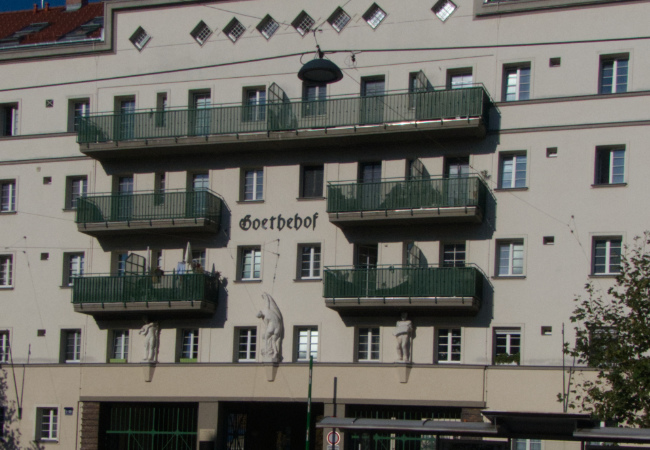
Goethehof was built between 1928 – 1930 by the municipal council of Vienna, then under the control of the Social Democratic Workers’ Party of Austria (Sozialdemokratische Arbeiterpartei Österreichs, SDAPÖ). This was a party with serious Marxist intellectuals among its leadership and a mass working class base, particularly in the capital city.
Otto Bauer, one of its leading members, was recognised for his intellect, debating and writing skills and theoretical contributions in a number of subjects, including the complexity of the national question in the Austro-Hungarian Empire. He took part in ferocious fighting during the First World War and experienced life as a Russian prisoner of war. He had been a deputy to the Austrian parliament during the days of Empire and served as the Foreign Minister of the Republic of German-Austria in 1918 and 1919.
There are still ongoing debates about Bauer’s theory, the character of Austro-Marxism, the national question, strategy and tactics and much else. This is not the place to add or distract from that debate but it is worth pointing out that whatever one concludes about Bauer, he was caught up in debates in real-time with Lenin, Trotsky and others and that these debates are still worth studying. His book, ‘The Austrian Revolution’ has been described by the US writer Mike Davies as standing ‘unique as an analysis of the revolution’s internal dynamics and costs of defeat’.
Within the ranks of the SDAPÖ there were many other thinkers and strategists, organisers and advocates of both right, centrist and left versions of socialism. Many of these people had fought in the First World War and had been active participants in the Austrian Revolution and workers’ and soldiers’ councils that helped to push the Austro-Hungarian Empire over the cliff and led to real, tangible reforms for the working class in Austria; universal suffrage, reduction in working hours with no loss of pay, subsidized rail travel, social insurance, pensions and more.
Many workers were so caught in the general feel and atmosphere of revolution that throughout much of 1919 there was a reluctance to work. The fresh air of freedom had been breathed and many had little wish to exchange it once more for dirty factories and railway yards and stuffy offices and the subjugated labour in shops and services. This aspect of revolution seems to be rarely studied and this is a mistake because the break up of capitalist labour processes – not the introduction of Taylorism – is essential for the revolution to break the power of capital.
There is much to criticise about what became known as Austro-Marxism but there is also a great deal to learn, particularly in relation to the ongoing tension on the left between reform and revolution. The SDAPÖ were critical of the state smashing of the Bolsheviks but far more committed to reform than the passive timidity and anti-intellectualism of the British Labour Party.
This is the gestation period in which the general ideas of building estates such as Goethehof developed. The whole period from 1919 to 1934 became known as Red Vienna.

The broad brush shows that in this period, despite a period of money destroying inflation, war dislocation, the break up of an Empire and the declaration of a Republic, and the constant spitefulness, destructive behaviour, lies and hate of the reaction, the municipal council of Vienna built 64,000 homes supported by innovative and extensive social, welfare and educational services.
This was funded through taxes on luxury goods, taxes on the rich in Vienna, taxes on landlords and general taxation. It is estimated that the richest one percent contributed 50 percent of the taxes raised. To put this into context, according to ChatGPT, the richest 350 people covered by the Sunday Times Rich List have a combined income of £837 bn. Even a one percent housing tax would raise £8.3 bn for house building.

And this is what I was thinking about one sunny Saturday afternoon as I made my way through Hernals and then caught the U1 train to Kaisermülhern.
The first thing I did on leaving the train was to buy a black coffee and a Mohnkuchen and sit on a bench by the estate; just sitting in that state which I characterise as consciously active self-awareness. Or to use a phrase a good friend introduced to me, ‘at least once a day we should be aware of the sensation of being alive’.

The resources I found on the web have variable use-values. Some stuff is clearly incorrect. There is content which needs to be verified and I can’t find the verifications I want. There isn’t actually that much stuff in the first place and there is a lot of repetition of limited content.
There are huge gaps and it’s unclear how they can be filled. I’m on holiday in Vienna and despite packing my suitcase with so many books that I can hardly move it, I don’t have access to my library. Books by Charles A. Gulick, Helmut Gubler, the Collected Works of Josef Frank, Christopher Long’s book on Josef Frank, Rebel Modernists by Liane Lefaivre are just some of the volumes I wish were here. With these caveats, here goes.

There was an existing ‘wild settlement’ in existence in the area before the estate was built. The settlement movement originated during the First World War when Viennese people – it included several classes of society – started growing food on land in and around the city. To prevent the theft of this food and because many of these people were also homeless, they started to built their own housing next to their allotments.
It is estimated that around 150,000 people were involved and there were large demonstrations by the settlers in 1919 and 1920. This led to more formal support from the council, including funding and the provision of skilled building labour. One of the settlements was built mainly by war veterans, who along with their families made the very bricks, calling them ‘peace bricks’. The settlement itself became known as the ‘Peace City’.
The settlement movement as a whole has been described the biggest self-help housing movement that Europe has ever seen. So to find a reference stating that ‘an illegal settlement’ stood on the land (or next to the land?) where the Goethehof was built is fascinating and frustrating in equal measure.
Why build here? Was this a deliberate policy to reduce the power and scope of the settlers? Where did the settlers go? Into the Goethehof or to be displaced elsewhere? There are two million people living in Vienna today and someone must know the answer to this and I would dearly like to find them.
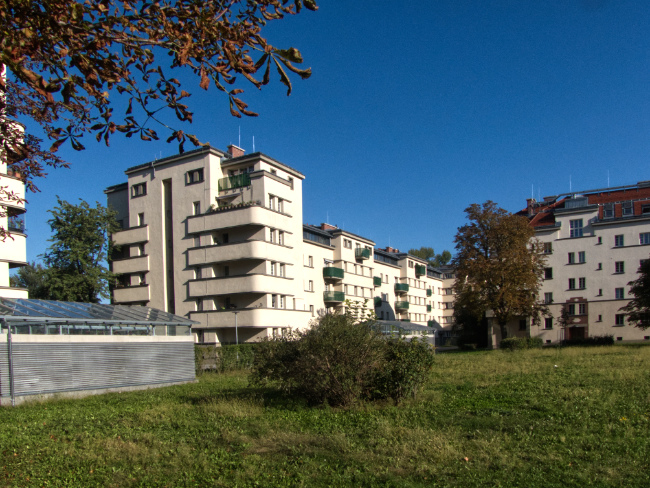
I can find nothing about the number of workers involved in the construction, nor the method of construction, nor whether these workers were from private building firms or employed directly by the municipality.
Nor anything about the conditions, rates of pay or levels of unionisation. These would have all been of great interest to the worker’s themselves and they are of great interest to me.
This is what I mean about ‘gaps’ in the knowledge and some of the difficulties in filling them. But at least we can start the process of asking these questions in the first place, which some historians either don’t consider or actively neglect.
727 flats were originally built. These were relatively large by the standards of the time and that subsequent redesign and redevelopment has reduced the number to 677.
It would be fascinating to learn of the discussions in the central and local municipal organisations, and more so of the conversations among the rank and file socialist workers, in relation to the building of the estate (and others). Sadly, there is a lack of both a comprehensive written and oral record. Even in more recent times it can be difficult to trace decision making at an official level, let alone an unofficial level. Does this tell us somthing? Yes, of course it does.
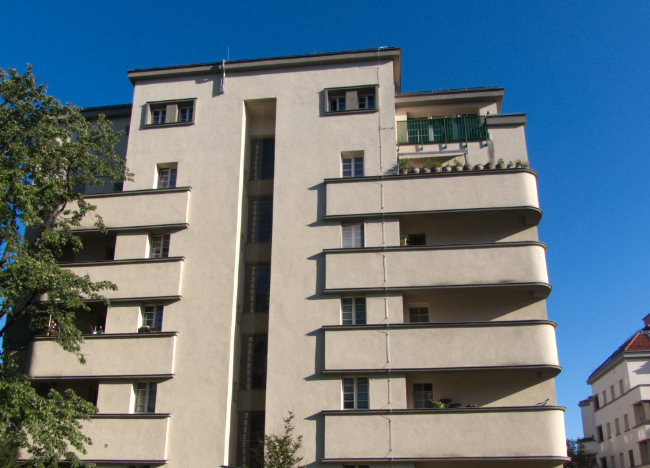
The architects included Karl Hauschka (influenced by Peter Behrens), Hugo Mayer and Johann Rothmüller, Alfred Chalousch, Rudolf Frass and Heinrich Schopper. They were all students of, or influenced by Otto Wagner.
The artists involved (statues, ornamentation) included Carl Wollek, Alfred Chalousch, Oskar Thiede, Joseph Humplik, Franz Pixner, Hans Vohburger
One of the most powerful first impressions is the large kindergarten building in the middle of the estate.
It was the first kindergarten funded and supported by the city council to be run on Montessori principles. The architects and designers were Franz Singer and Friedl (Friedericke) Dicker, both Bauhaus students.
Maria Montessori had an interest in the relationship between pedagogy, psychology and architecture and Singer and Dicker immersed themselves in her ideas to try and reflect them in the building and its design.

It is a grand building without the authoritarian domineering that some grand buildings have. It is a large building for a kindergarten but it has the feel of being relaxed into itself; a favourite grandparent sitting in a big cosy armchair, immense to the child looking up, but always welcoming and friendly.
It is stand-alone and this gives it an independence from the apartment blocks with their atmosphere of grown ups and all their troublesome and tiresome tragic-comedy of manners. This is a castle of the realm of the child.
Seperate entrances were built into the fabric of the building for parents and children, thus immediately creating an independent space for the child itself. This predates Christopher Alexander’s formal presentation of pattern language, but the pattern here is obvious, clear and well expressed.
This particular pattern is entrance, from the street, into the building, the physical separation of home space from public space from the child’s space. I make a note never to leave Alexander’s books at home again.
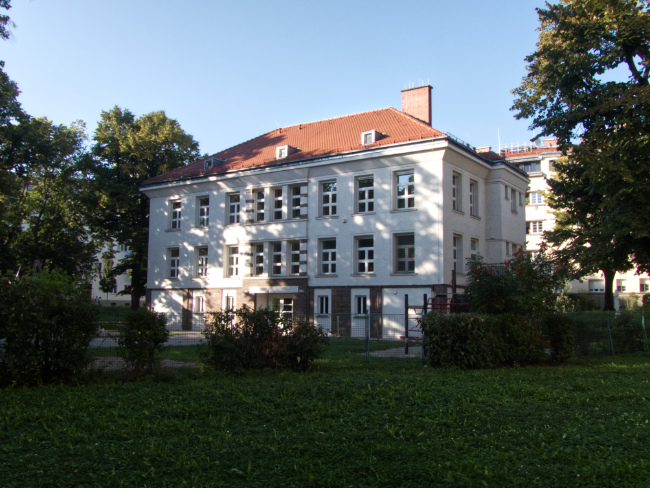
The building was designed on principles that would support child development in a context of the functional needs of teaching, play, eating, socialising. Rooms are large and designed in such a way as to support multiple activities through the routine of the child’s day.
Dicker was responsible for the interior decoration and great use was made of colour and colour coding to help orientate and socialise the children. Thoughtful care was taken with the design of everything from coat hooks to toothbrush holders.
The building is still surrounded by a good deal of open space with a range of play equipment and garden. Furniture was specially designed that was suitable for the strength and size of the children. It could be folded and stacked so that rooms could be used for different functions at different times. The furniture itself was made by young people in a reform school as a way of working with them to try and resolve their personal and social inner conflicts.
There were existing Montessori schools in Vienna run by private interests. This was the first Montessori kindergarten in the city to be built and run by the council. And it was specifically for poor children.
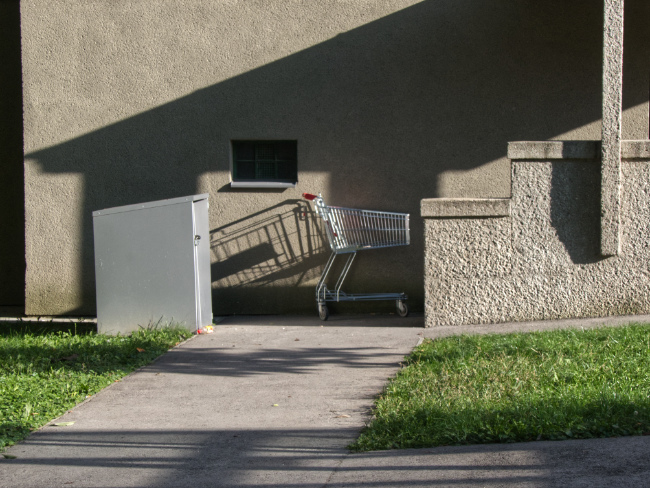
There were dozens of children playing in and around the estate when I visited. None appear in the photographs because it is not acceptable to photograph children without their, or their guardians permission. And so the photos seem bereft of life but this took an enormous amount of waiting around for ‘quiet’ moments.
All the games and chasing around are not recorded as images. The two girls with prams and dolls acting out an elaborate game outside the door to a block of flats, the girl pushing a supermarket trolley around until she saw some friends and dashed off to join them.
Groups of children in a central grassy garden were playing a complex fantasy game, with all the seriousness of real life, which they were making up and developing as they went along, all involved in using their imaginations to add further twists and turns to the elaborate plot.
Collections of teenage boys were being very teenager-y with attitudes and poses, just-so haircuts, cat-walk style, clothes so fashionable they are barely yet in the fanciest shops in Paris and Milan.
Some of the adults had that art-house modernism that English council estates once produced; think of the original John Lydon.

I stop and ask people what I know to be really stupid questions and I gamble that I will gain more by playing the role of a stranger in a strange land.
People answer these inane interventions into their day with grace, patience and good humour. My one regret is that I never managed to delay anyone for long enough to get more insight.
Everyone was in that contented sunny Saturday afternoon mode when the working week is most remote and they were off to the shops, to see friends and relatives, going ‘out’ and so on.

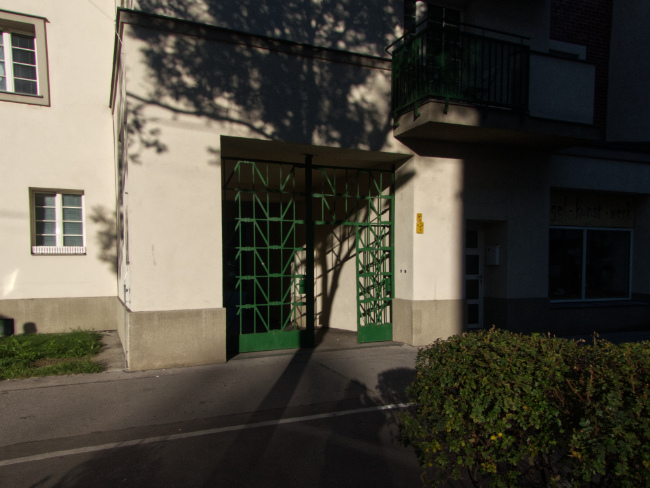
I walk around and around, in and out of the entrances and along wide and narrow paths. Through the estate and around the perimeter. There is lovely detailed skilled brickwork. It brings a real joy to the buildings. Here and there people have appropriated the grassy space near their apartments and planted sunflowers and roses. Some balconies have brightly coloured sunshades, pot plants, glittering dream catchers, sails and artefacts that can be blown by the wind.
The estate has an irregular shape which makes it intimate without being intimidating. A large central part of the estate has the communal luxury of a sweeping curve, seductive and tantalising as it makes the person walking along curious about what is around the corner.
It’s easy to walk everywhere, from one part to another and the quickest path always seems to be the default option. Some of the grassy areas have been left to meadow and create a gorgeous sense of urban countryside.

The atmosphere, the ambiance, the quality of the buildings, the dignity and proud civic character of the whole ensemble are powerful and best experienced in person.
There is evidence throughout the estate of the principles established by Josef Frank, Margarete Schütte-Lihotzky, Adolf Loos and others; of air, light, open space, greenery. These principles are the core dynamic, rather than rules of aesthetics and dogmatic style.

It wasn’t until the next day however that I understood how progressive it all was, and is.
It was a Sunday morning I got up early to go the bakers and on the way back passed a Catholic Church. I don’t mind a Christian service nor indeed a Catholic mass. But this made my skin crawl. I have never experienced the reactionary and oppressive wing of Catholicism in such a way.
At the front of a subordinate congregation stood a priest in red robes not so much preaching as hectoring and ordering. It was as if Ignaz Siepel had made an appearance from whatever hell he belongs in.
And here he was once again, laying the ground for clerical fascism, never missing an opportunity to make an unpleasant comment about the improvements for the working class.
The counter-reformation played out in very different ways in Central Europe than it did in England. I kept telling myself to stay, that this service would be a useful experience but after ten minutes I had more than enough.
I went outside where the air was lighter and flowed in a free and easy way outside in the morning sunshine. And that’s how I’ll remember my visit to the Goethehof; free wheeling and easy-going; predicated on well-designed, low cost, good quality, not for profit housing.
Let’s put an extended coda to these first impressions.
Much has been made about the notion that the estates of Red Vienna had been built as ‘fortresses’. Extra thick walls to absorb machine gun bullets and artillery shells, specific layouts to prevent all out assaults. There is no written evidence (that I’m aware of) to support this.
The layout of this estate does not support the ‘fortress thesis’ (there are several wide entrances) and I cannot believe that the SDAPÖ would have planned to fight with guns among families and children.
And a great criticism remains that the SDAPÖ leadership were always too reluctant to fight even when it was essential for any form of survival.
After 1934 the history becomes increasingly disturbing and I wonder what the legacy of this has been on the community. People would have heard grim stories from their relatives who lived through the Austrian civil war of 1934, the fascist victory in 1938, the bombing of Vienna by the allies and the mass rape of women by the Russian army. The impact of war lasts for generations. How is that story woven into the fabric of the estate?
GER Gedye describes in his book Fallen Bastions how he visited the estate after the fighting of February 1934 to find the police and fascist Heimwehr ‘combing out the building for traces of vanished defenders’. Across Vienna there were judicial executions and thousands were arrested and beaten.
The number of workers killed is still disputed. Gedye writes, ‘In the Goethehof alone, one of a dozen buildings shelled in Vienna, I saw the bodies of between forty and fifty men and women laid out after the surrender’. The estate had been hit by artillery fire and machine guns and bombed by at least one aircraft.
In the days that followed, the interior of the Montessori nursery was smashed up by the Heimwehr and then completely destroyed by the Nazis in 1938. Friedl Drickel was deported to Theresienstadt concentration camp in 1942 where she ran art classes for children. Of the 4,000 children’s drawings that survived the camp, 600 are attributed to her influence. She was murdered in Auschwitz in 1944.
I doubt few remember the visit of the Prince of Wales to Vienna on Tuesday 19 and Wednesday 20 February 1935. This was reported in The Scotsman with the headline, ‘Prince of Wales – Visit to Workers’ Model Flats in Vienna’.
Was he aware that almost to the day, a year previously, the clerical fascist government of Austria had garrotted Koloman Wallish, the national secretary of SDAPÖ and a popular figure with the Viennse working class? How long does a memory like that stay among the people?
Somewhere there is a memory of a civil war. Somewhere there is a memory of the time of optimism and hope and the physical expression of progressive ideals in the very stones of the city itself. Somewhere those memories are alive again, but so too the damned-in-hell viscousness of reaction.
We can all say a word, tell stories, write impressions. We need weight to push our side forward and to set aside our foes. We cannot build this weight and pressure in an instant but we can add a tiny particle of defiance here, an atom or two of solidarity there.
Building, building, building, something of great quality and magnificent élan.

 Commodity Fetishism
You must be logged in to post a comment.