
If we travelled sixty years back in time we would recognise that world. The fashions, music, films, motorism, typography and street life would be familiar to us. The surfaces of daily life would be familiar to us; even though within the capitalist mode of production there has been a great deal of change. Manufacturing has been digitised, ports are dominated by containers, desk top computing has replaced notepads and pencils and manual typewriters, China, India, Brazil and other countries have emerged as major manufacturing centres and producers within a global market.
But if someone from sixty years ago was to travel back sixty years, say to the year 1900, London would look and sound quite different. The streets would be dominated by horses, there would be no sounds of radio or television, very few telephones, none of the constant connection of the internet, more visible poverty in the clothes that people wore, real slums, some in quite central areas, the Port of London a huge commercial enterprise employing thousands of people, the river Thames full of ships and lighters, all along its banks, warehouses and factories, central London a major manufacturing centre, the north of the country a landscape of ship building, mining, steel making and heavy industry, a much larger proportion of workers on the land.
And one of the visible sights would be the changes in fashion. If we wore a pair of jeans and a polo shirt in our time travel, and perhaps a pair of Hush Puppies, we would not stand out in 1964. But we would appear quite unusual in 1900. Production changes through accumulations of capital, technical inventions, the pressures of competition; but how and why do fashions change? Something to consider as we plan our walk through the West End.
West End
The boundaries of the West End can be defined as Euston and Marylebone Road to the north. Park Lane to the west, Kingsway to the east and more or less the river to the south. It embraces Covent Garden, Soho, Fitzrovia, Mayfair and Marylebone. It is an area of luxury goods, housing for the super-rich, clubs for millionaires and aristocrats, a concentration of global wealth. One of the stations on the global map that includes Dubai, Paris, New York and others. A map used by a certain type of person as a guide to how to spend their wealth. A map which itself goes in and out of fashion.

One of the great powers of capital is to create illusions; an illusion of fairness, of justice, of freedom. The tramp can live in the West End too, even the poor may walk its streets, and in between a great mass of people who work in offices and services and transport and construction find that they too can discover a playground in its streets. The streets are a place to show and to be seen, a hyper-ventilating energy of consumption, of goods, services, food and drink, of atmosphere. The possibilities of encounter, fleeting eroticism, to be surrounded by glamour, to watch the people and listen to the street sounds. As if we are in an open air play, with thousands of characters, but in which we hear little of their dialogue.
Urban culture has itself become a fashion, the topography of the West End is a fashion. Both contribute a sense of modernity and historicism. Impressive architecture from the eighteenth century onwards provides a background to the most advanced computing technologies. This curious mix helps to create the latest fashions, an underground where attitude is mined.
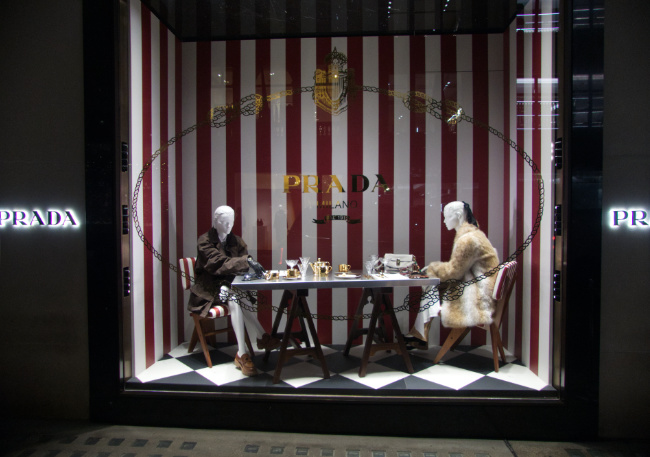
For this walk we are going to explore luxury. This includes clothing, perfume, watches, jewellery, art. Taken together, global luxury industries are worth something like £400bn a year. These industries are dominated by a small number of large firms, LMVH, Kering, Hermes, run by powerful and super-rich family dynasties. The major brands, Dior, Prada, Louis Vuitton are owned by a tiny number of people. But in luxury, brand-image is a key component of what creates price and value and the individual identity must be maintained.
Commodities
The commodity form is the dominant product of industrial capitalism. Everything that is manufactured from natural resources can become a commodity; shoes, buildings, ships, cups, bags of sweets, vehicles, t-shirts, socks and on and on. Our very own labour power becomes a commodity which we sell to other people, thus monetising our own existence.
We live within an intense visual culture. It is a visual culture defined by mass production and standardisation, a complex division of labour and the use of nature’s resources in a great variety of ways. This immediate visual culture is then endlessly produced by visual phones adding a stream of content to social media. Print publications, television, cinema, advertising in all its form adds to this constantly expanding image richness.

Commodities are part of this visual culture and can be described as commodity-image-objects. Some commodities are in a brand-image-shape. A Coca Cola bottle, Louis Vuitton bag, Levi jeans, Macbooks, Doc Martin boots. The surface reality we experience is saturated with the commodity-image-object, a triumph of capital, a general ideological message that capitalism is the unbending, underlying state of humanity, more powerful than anything defined as natural.
Production
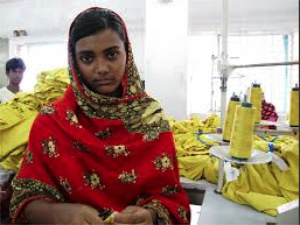
Commodity production is made up of a giant web of raw materials, labour and machinery. This is how capital is formed. Immense factories, sweatshops, workshops and home working are all part of this international division of labour. In the clothing industries alone, at a world wide level, it is estimated that 60 – 75 million people are involved.
There are constant developments in the technologies and processes and techniques. These too change fashions and designs, but they are generally hidden, in the production centres of economic zones, enterprise regions, industrial estates, slums.
The sewing machine is just one of the instruments of production that can be traced as an illustration of the ongoing development of capital based technology. As as machine artefact it was invented in the middle of the nineteenth century. The speed of seam-stitches increased from 35 to 1,200 per minute.
In 1853 there were estimated to be 2,000 sewing machines in the world. By 1871 there were 500,000. Machinery speeds up production. Today it is estimated that there are approximately 50 million sold each year. The sewing machine market is worth over $4bn. In 2022 China was the top net exporter, the United States the top net importer. Brief histories like this can be written for all of the instruments and machines used in the production of clothes as commodities.

Consumerism
Within capitalist society a phenomena has emerged of consumerism. It is almost a way of life, a end in itself. It is no longer the simple procurement of the means of life; it is an activity surrounded with billion pounds of advertising spending, celebrity endorsement, psychological manipulation, the promise of pleasure, a realisation of what we are encouraged to believe are our real desires.

A great infrastructure has been created to facilitate consumerism. Public transport systems in part. Crossrail has been marketed as reducing the time for shoppers travelling to central London. Bond Street even has its own grand station.
The historical topography of central London has become an asset in itself. Westfield stores are the same regardless of where they are; London, Paris, Dubai. But Bond Street, Piccadilly, St Christopher’s Place, Marylebone Lane, Jermyn Street with their individual shops and nineteenth century pubs and arcades is unique.
Physical retailing is still a major economic activity. It is estimated that around of 8 percent of London workers are in retail. It contributes over £40 bn a year to the London economy.
From time to time theoreticians emerge who fear that consumerism will emasculate and prevent the self-emancipation of the working class.
Fashion
Fashion and clothing are different things. Everyone wears clothes; but not everyone consciously wears fashion. There is in a sense a clothing market and a fashion market.
If there is a language of fashion it needs to be understand as being different from spoken and written languages. What is the syntax, the grammar? A conversation in the streets will dissipate as the speakers walk along, conversation can change a great deal in a short space of time. What you wear throughout the day is a constant, steady statement and if it is read at all, will be read in different ways by different people. There can be a great deal of ambiguity and ambivalence in what people are trying to say with fashion and the amplification of ambiguity may be a conscious intention.

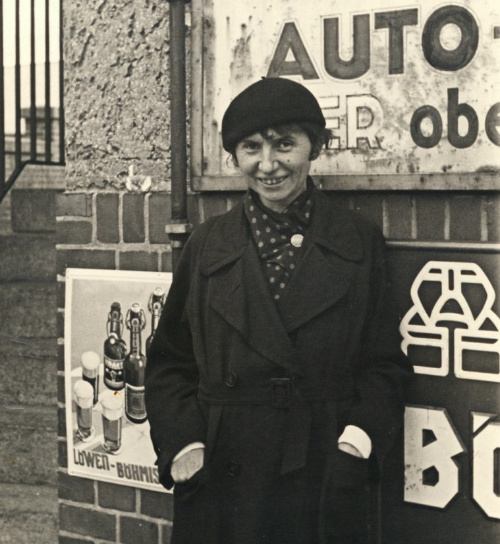
Fashion can include elements of voyeurism, eroticism, exhibitionism. It can be used for display but also concealment. The artist Jeanne Mammen walked through 1920s Berlin dressed down in a rain coat and beret. She wanted to fit in so she could be absorbed into the street life of the city.
Oscar Wilde dressed extravagantly, he wished to use fashion to make statements about aesthetics and encourage speculative gaze. Fashion may be an expression of sub cultures, it may be overtly political, it may be to flaunt great wealth, but it can also be luxurious and rich and understated. For some it is part of the creation of a personal identity. For all, clothing and fashion carry messages and meaning however messy and complicated and contradictory they may be. It can be a collation of complex relationships of identity, class, race, gender, culture, desire, power, ego; all bought together by fabric, texture, colour, pattern, volume, silhouette and occasion.
Fortnum & Mason
An antiquated version of a department store and the physically closest many of us will ever get to the rich; or High Worth Net Individuals as they are more plainly called. It always feels both sumptuous and yet, the nearer we stand in position to this sort of luxury the greater the question of ‘is it really worth the asking price?” I guess the psychology of price works differently across income levels. But I’ve never been rich so I have no idea what it’s like to spend thousands of pounds on a watch or haute couture. Do the rich still get that moment of FUD, (fear, uncertainty, doubt) in the immediate aftermath of purchase? Have I bought the right thing?!
If you’re a wine drinker, try the F&M own brand Claret and Cotes de Rhone. Excellent value for money and good quality.
If you start the walk here and need the loo, this is the place to go.
Piccadilly
The former Simpson department store is now a branch of Waterstones. It opened as Simpson in 1936 mainly selling high fashion for wealthy men. The shop fitting and lighting was designed by Joseph Emberton and the merchandize display by Laszlo Moholy-Nagy. The architect of the building was
It must have been a fine advertisement for the celebration of cosmopolitanism (something once aimed for), modernism and the avant garde. I imagine a future world of socialist communal luxury along these lines rather than communal singing of songs about tractor production.
Bond Street
Although units of capital are in competition with each other they gain benefit from centralisation. Shopping centres are an example. The infrastructure is a large capital investment and into this are placed companies that compete with one another. So too with luxury shopping centres. Bond Street contains many of the big names in close proximity. This creates a shopping destination and Bond Street is one of the richest of its type in the world and is a street with one of the largest concentrations of haute couture.
The street takes its name from Thomas Bond, a landowner and property developer, a supporter of Charles II and a beneficiary of the Restoration of 1660. It is also claimed he is a distant ancestor of the spy, James Bond. They both share the same motto of Orbis non sufficit – The World is Not Enough.
Bond Street is for slow strolling. The luxury needs to be absorbed. Pause for a moment outside Sotheby’s at no 34 which has an Egyptian statue from 1320 BC on public display. A reminder perhaps that even the seemingly greatest civilisations can fall. ‘Look on my works, ye Mighty, and despair!’
Bond Street attracted the attention of the Suffragettes. There were at least two shops in the vicinity which actively supported the women’s movement and created window displays in the colours of purple, green and white. Women with sandwich boards demanding the vote walked through the street, on one occasion a Suffragette Drum and Fife band marched on its way to Holloway prison. In March 1912 there was an extensive campaign of window smashing by militant Suffragettes in the Strand, Piccadilly, Regent Street, Bond Street and elsewhere. Women were both the destructive and productive force. The shops they attacked were predicated on cheap female labour and the patronage of women customers.
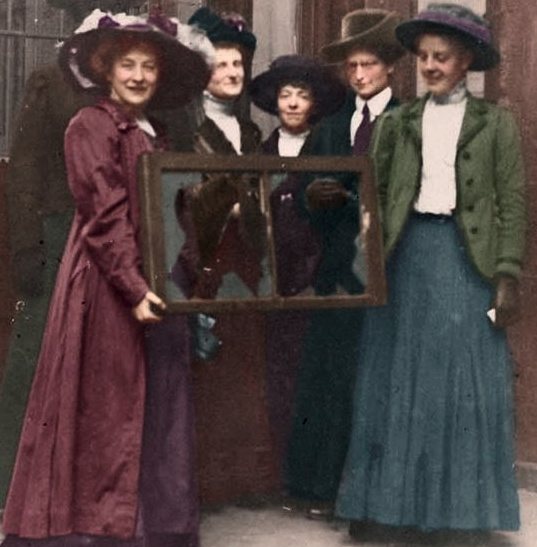
Some of those caught and sentenced and imprisoned include the following:
Florence Ward – damage to Walter Truefitt, New Bond Street; four months.Margaret Haley demanded to be heard by a jury of women (as did others). This was refused. Four months in jail. Annie Humphreys wore her nurses uniform, a great act of defiance, stated that the police testimony was not true and that men got lighter sentences for much graver acts. She refused to give an undertaking to ‘abstain from lawful methods’. Four months in prison.
Dorothy Evans broke windows at numbers 50, 53 and 54. Emma Bowen attacked Hudson Bros at 160 New Bond Street, Dorothea Benson broke the window of John Colling, fine art dealer at 92. Emily Fearn broke the windows at the National Linen Company at 130 New Bond Street. Hilda Birkett smashed windows at Joseph Land & Son Ltd, gunmakers, and A.Ramsden Ltd, piano-forte dealers. Sarah Cress destroyed the windows at the London Soap and Candle Company. All these attacks were in New Bond Street and all the women were imprisoned.
Oxford Street
Years ago The Evening Standard ran an article that claimed 50,000 people worked in Oxford Street. I have never been able to verify this or how ‘work in Oxford Street’ was defined. But it will be several thousand. And if they were all collected up into an aircraft factory or port their social power would be more evident. If all the street cleaners, electricians, plumbers, lift engineers, doctors and medical staff were added in, the social power would be stronger still. Capital relies on this division of labour and fragmentation and atomisation to exert its control. If only we could work out how to mobilise the labour side of this equation.

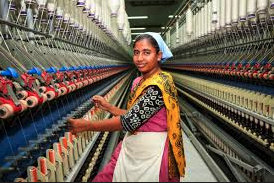
Oxford street is the place to study the selling of mass produced clothing from around the world. Take any of the shops and check the labels; clothes made in China, Cambodia, Vietnam, Turkey, Bangladesh, India, and on and on. Most of these countries are run by authoritarian regimes who crush opposition movements making it much easier for the capitalists to keep wages down. And yet here in the bright colours of contemporary fashion, ‘freedom of choice’ appears to be on display.
Selfridges
Selfridges is a good counter-point to Fortnum & Mason where the walk started. It was opened in 1909 by the American retailer Harry Gordon Selfridge. There is some likeable opportunism associated with this. Adverts were taken out in the Suffragette newspaper Votes for Women and apparently a Suffragette flag was flown from the roof which helped to ward off women armed with hammers. It was, and is, a fine example of how fashion, architecture, art and design (FAAD) can be bought together in the creation of a powerful visual culture. There are doors everywhere, encouraging easy and open access from the surrounding streets.
Selfridges continued the trend of large department stores providing new spaces for women. Restaurants, cafes, events, open displays and a sense of public security encouraged middle class women to become more independent. One wonders what conversations all this encouraged and how they contributed to the increasing demand for women’s emancipation.
For working class women a job in a department store could be an escape route from stultifying family life, a chance to meet other smart young people, to be in the excitement of the West End. These women were part of Modernism, carriers of new ideas and wider social changes.
Selfridges is still good value as consumer entertainment and a perfect place to study the cornucopia of how commodities are bought together into one outlet of the global market.
Marylebone Lane
The Golden Eagle is one of the few London pubs to still have a piano and it’s a nice friendly place to have a drink. Note the portrait of the landlady on the wall. Round the corner is the Golden Hind restaurant which serves up excellent fish and chips.
Some reading and films
A selection of books that helped inform this chapter:
Adorned in Dreams- Elizabeth Wilson
The Sphinx in the City – Elizabeth Wilson
Shopping for Pleasure – Erika Diane Rappaport
Cheap – Ellen Ruppel Shell
Fashion, Culture and Identity – Fred Davis
Fashion – Christopher Breward
Packaged Pleasures – Gary S. Cross and Robert N. Proctor
Bond Street Story – Norman Collins
…and a film
Bond Street (film, 1948) with Jean Kent and Roland Young
Here’s how to book a place on the Radical Walk on the 5 December.
 Commodity Fetishism
You must be logged in to post a comment.