
A new edition of the first volume of Marx’s Capital, translated by Paul Reitter has arrived. It’s a handsome book made with good quality paper, hard cloth covers and a bold dust jacket. It’s been laying on top of a huge illustrated catalogue of the Louvre in Paris. Perhaps by some mystical osmosis the ghost of Marx can study the history of art.
I’ve been busy researching consumerism and fashion and the book has been unopened. But now the daylight hours are getting shorter and it rains and it’s cold and grey and cloudy and the world is getting darker and more unstable and war is seeping out of the pores of the military bases and missile silos.
The first chapter of the book is The Commodity.
‘The wealth of societies dominated by the capitalist mode of production appears in the form of an ‘enormous accumulation of commodities. The individual commodity appears as the elementary form of that wealth’.
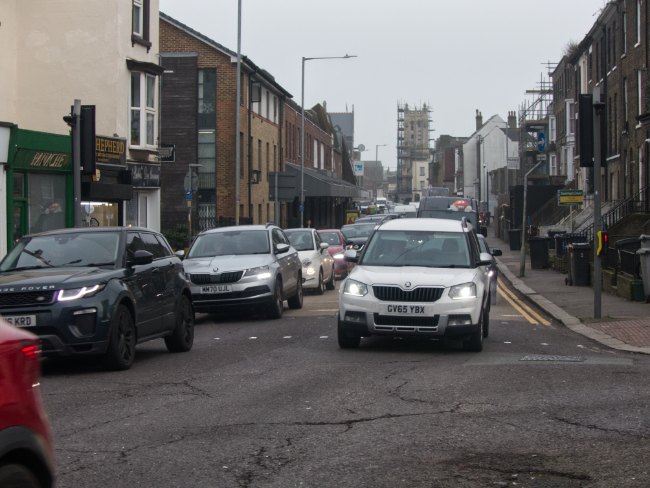
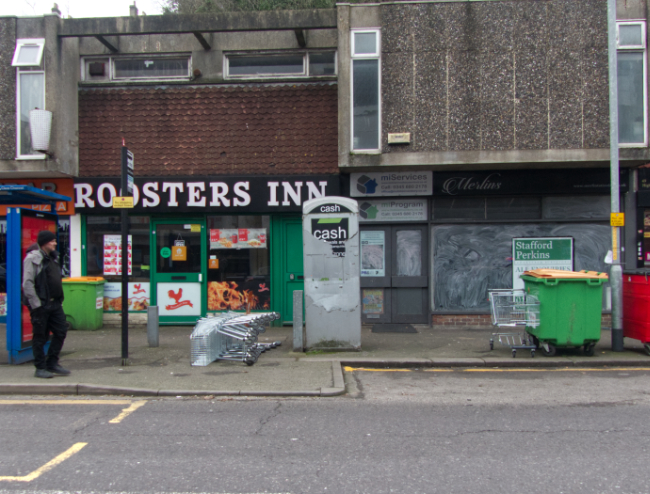
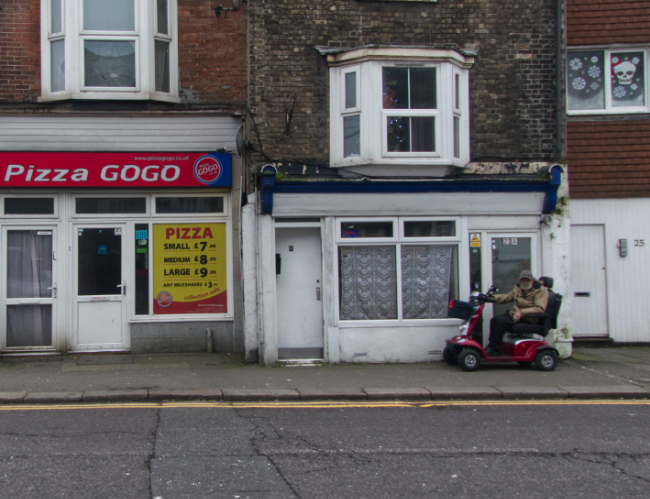
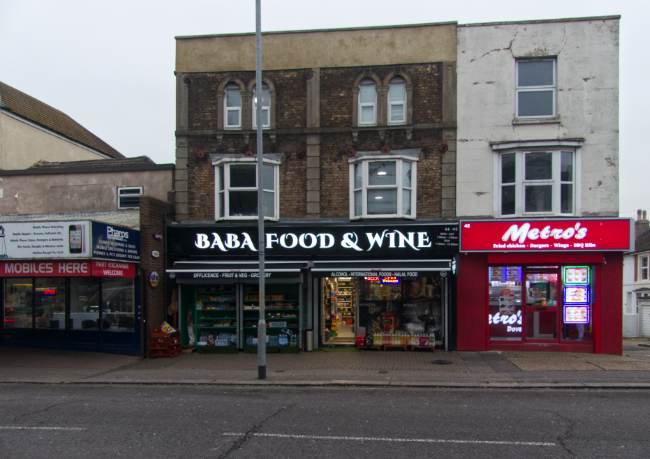
An idea came to me that it would be worth testing Marx’s theory about the commodity in the local shops. After all, if his theory could be illustrated in this urban area it could be scaled up to all urban areas. I set off with a camera, notebook and couple of pens tucked into the pocket of my coat. London Road is fairly close by. It has a range of shops and it has a variety of architecture and people.

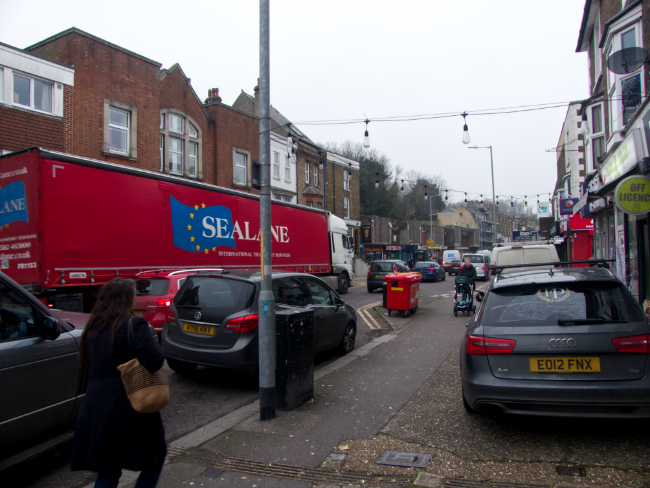
I walk along the main road which is full of cars. Commodity-vehicles produced by a world car industry of 8 to 10 million workers organised in a network of factories which is scattered across the globe. The cars are heavy and oppressive. Some drive too fast and some have modified exhausts which make as much noise as possible. Expressions of profligate arbitrary individualism. This is why the planet faces mass extinction. For the most banal trivialities.
I intend to buy some chocolate biscuits. I noticed them in the shop a couple of days ago. They are made in Slovakia and cost £1.99. I’ve been thinking about those biscuits as I travel with Marx through the multi-faceted layers of commodity production. The biscuits are part of the surface reality that helps to form our immediate sense impressions and ideas. But surfaces are just surfaces. The surface of the sea changes all the time, but whether calm or stormy, the sea surface provides few clues as to what goes on within the depths. So too with the system of commodity production dominated by capital.
What is this thing, the commodity? For the purpose of today’s experiment in London Road it is a physical object (we will deal with haircuts and nail treatments at a future date). It is an objectification of human labour. It has been produced by human labour-power. It can perhaps be better described as a commodity-image-object. It is a physical object with a clear visual identity. The visual identity is part of the branding, a mix of colours, logos, indeed the very shape. It is the visual identity which is used to tempt, to tantalise, to seduce, to create the exchange with the commodity’s great love; money.
As a physical object the commodity must have a use-value, it must be useful to some person in some way. The use-value is the physical characteristics. The tea bag has a use-value, it can provide a hot drink. A loaf of bread has a use-value, it can feed the stomach. A shirt has a use-value in that it keeps the wearer warm or cool (depending on the shirt), it makes the wearer feel more attractive, it contributes to their sense of style and fashion and identity. The use values are determined by the physical properties; tea, wheat and yeast, cotton or linen or silk. The physical properties represent the qualitative differences.

There must be a want, a desire, a need (these are three different things) for the commodity-object. Where these wants or desires come from, is not the key issue according to Marx, and it is regardless of ‘whether they come from our belly or our imagination’.

In the capitalism of the 21st century, the production, distribution and consumption of commodities is accomplished by a global network of mines, farms, factories, ports, ships, lorries, warehouses, centralised shopping centres and distributed local shops. A global labour force has been created working in factories with machines, robots, computing; and also in sheds, workshops, on the streets of slums.
I doubt anyone could disagree with any of this (although the production layer often feels out of sight and is generally neglected in the world of television, film and popular culture). But there is something else going on here. Marx points out that:
‘A commodity appears at first sight an extremely obvious, trivial thing. But its analysis brings out that it is a very strange thing, abounding in metaphysical subtleties and theological niceties’.
And this is what he explores in this first chapter.
The superficial introduction to the commodity is that it is of course the product of human labour; the consequence of human labour-power being applied to raw materials in an organised way. But while the commodity must have a use-value, this is not the primary reason as to why it is produced. So the strangeness begins. It is produced to enter a general sphere of circulation, into what is now a world market. It is a physically useful object, but it is also a carrier of exchange value.
Now something called ‘exchange-value’ has been introduced.
But what’s that? I am going to buy a packet of biscuits made in Slovakia. I can take those biscuits home and pound them into crumbs, soak them in tea, heat them up and eat with cream, break them in half and examine them closely with a magnifying class, weigh them, measure them. At no point will I ever discover a physical element of exchange-value. I can taste butter, chocolate, coconut, sugar. But not even a hint of exchange-value can be detected on the palette. I tap one of the biscuits on the kitchen table, but no sound of exchange-value can be heard.
And yet the commodity, in this case a packet of chocolate biscuits, somehow has ‘exchange-value’ attached to them. To the capitalist, this unseen, tasteless, weightless feature is the most important element.
‘For the commodity’s owner, a commodity has direct use-value only as a bearer of exchange-value, and thus, as a means of exchange’.
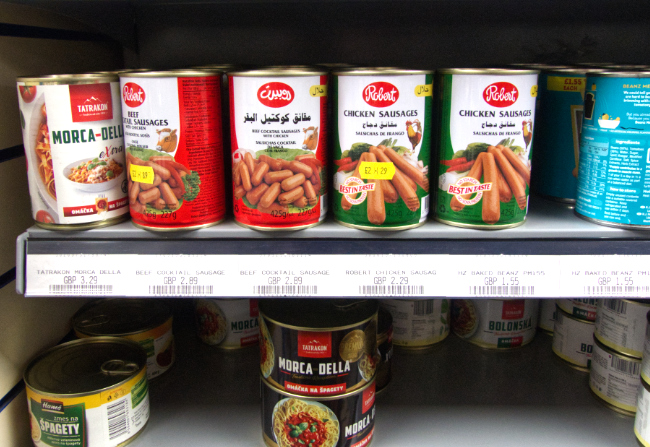
And in this case, I will be able to exchange the fiver in my pocket for the biscuits (which are £1.99) or anything else in the shop, up to the ‘value’ of five pounds. I can add another packet of biscuits and a jar of hotdog sausages (made in Denmark with Arabic writing), or two packets of noodles (made in South Korea), or three bottles of beer made in Turkey. Or many different combinations.
In the early days of human society exchange was completed directly on an object to object basis but if we take a huge leap through time into the 21st century we discover that today, all commodities can be exchanged for money through a price measure. Money has developed from stones, cattle, real gold and silver, into a commodity of its own, a universal commodity that can be exchanged for all others.
To enter even the smallest shop is to encounter all of these physical and metaphysical dimensions of commodity, money, price, use-value and exchange value. I think Marx might be on to something.
I slowly bring the five pound note out of my pocket where it has been happily asleep. It has been having a rest from moving through the sphere of circulation. Now it is about to meet the commodity who signals to it with come-to-bed eyes. The exchange of money for the commodity will be unconditional. Once I have the biscuits I can do what I wish with them within the law. This would include eating them, feeding them to the ducks, but not throwing them at police officers.
I approach the counter and explain to the young woman behind it that I am writing a short piece about how it is that a shop on the London Road has biscuits, olives, noodles, gherkins, wine, tobacco from all around the world. I keep the stuff about commodity-image-objects and use-values and exchange-values to myself.
‘Yeah’, she says, twirling a strand of her long black hair and then tucking it behind her ear.
I cannot place her. She seems to represent a kaleidoscope of ideas and colours and cultures and even her accent is both familiar and unfamiliar. She points to the packet of biscuits with a finger that ends in a long glossy white coloured false nail.
‘These are nice’, she says.
I am in the act of buying, the young woman, in the act of selling. These are two different processes but by definition are united. One is different to the other but they cannot exist independently of each other.
The five pound note is on the counter; the moment of great decision. There is now going to be a movement, a transubstantiation where the money changes into a commodity for me, and for the seller, the biscuits change into money. It is nothing short of a miracle.
I am almost gasping for breath as I leave the shop. Did all of that just happen?
As I walk along I notice a man with a box camera. I stop to ask him about it. He lets me look through the lens and there I see a new view of the London Road. I still cannot see exchange-value but the place seems vibrantly alive.

 Commodity Fetishism
You must be logged in to post a comment.