
The most unlikely places create stimulation. Stepping out into Kings Cross from a train that’s just arrived from the coast. Into the middle of a world city. The train ran up from east Kent and the Channel could be seen alongside the track. Grey and steel-like, container ships and tankers and bulk carriers in the shipping lanes.
The sea has no borders and was indolently lapping up against the coast of England. Splashes of water teasing into the smallest of crevasses in the rock face, testing to see where chalk can be pulled out, to cause the cliffs to fall. And a thick mist engulfed the fields, straggling dark branches, hidden witches covens, sleeping dreams and living nightmares; sentient beings move upon this landscape.
A great reverberation from the United States shakes the world. Trump and Musk appear to be everywhere, money-power amplifying the broken mirror fragments of a new phase of capital.
Is this really ‘Late, late capitalism?’ Or is it a new phase, an intensification of the digital control of production and greater coercion of living labour. Of mobile phones, and satellites moving packets of data that become images of genocide, streamed into every home; hyper-consumerism, generalised body dysmorphia, influencers and has-beens, the phenomena of the modern workers. The speed of the Society of the Spectacle isn’t constant over time; an acceleration, as the train moves through the tunnel under the river Thames.
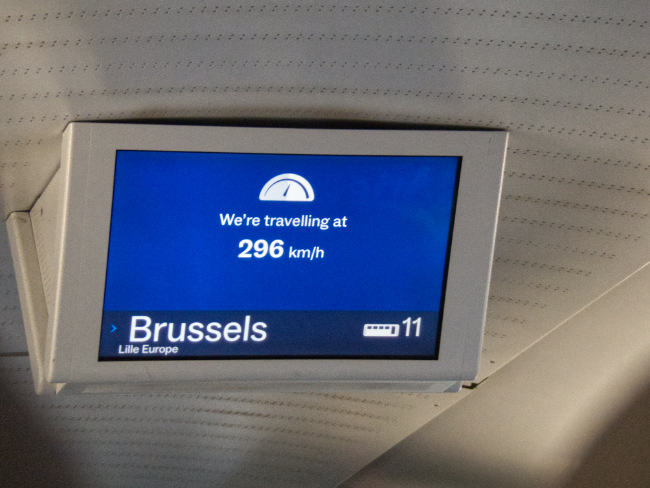
Alongside the capital layer is the political layer. New and grotesque figures dance macabrely upon the stage. Some support the leader principle and cheer the outstretched arm. Easy sound-bite solutions. But they must be quickly implemented before disillusionment and doubt set in.
Capital is liquid but can be diverted into dead spaces where it hesitates and dies. Capital is ubiquitous but its Empire is not invincible. The moral compass of the so-called liberal world lies shattered in the ruins of Gaza. Now villages in the West Bank are being attacked. Laws are passed that make it illegal to not believe the lies. Are we all to be taken for such fools? Yet in tradition, fools are the only force that may speak truth to the power of the kings.

The phenomena of the modern workers continues to metabolise. Who are these modern workers? Many live in countries with no forms of democracy, no free press, no right of assembly or opposition. The money-rich and property-power people suppress trade unions and control the media. Voices of dissent and opposition are harassed, intimidated, forced from their jobs, black-listed, beaten, imprisoned, tortured, sexually abused, murdered.
Look at who is holding hands together at the top. Look at the chain of people that rule the world. Observe how they are all complicit in this, regardless of what mask they think they wear in public.
In the space-time moments at ground level, the phenomena of the modern workers reveal huge differences in the types of labour applied; lifting, carrying, driving, hammering, sewing, ploughing, metal working, stone working, wood working, dying, painting, leather working, typing, assembling components, packing boxes, machine operation, computer code manufacture, picking fruit.
This division of labour, and the political frameworks within which it operates, creates vast differences in wages, prices and magnitudes of value. Some of the modern workers appear prosperous and have access to health care, education and welfare services, partly created by mass actions of previous generations.
Other modern workers fill the slums of Mumbai and Karachi and a mass of other cities; but they are productive too, each adding their thousandth of a measure of value with the movements of their hands and the twisting of their bodies, to adapt to the needs of raw materials. They live on dirt and sleep on hard earth floors.
Borders everywhere. Concrete walls, razor wire fences, watchtowers, armed guards, passport control, biometric scanning, an ideological onslaught to create the biggest and most powerful border of them all, the one inside a person’s head.
All modern workers are subjected to the idea-forces of nationalism, religion, consumerism, patriotism, neo-liberalism, reformism, possessive individualism; the ideas of class and hierarchy and the impossibility of change, powerlessness; and an experiential sense of alienation that is never directly described. Yet this alienation is within everyone’s sense of their own self.
Where does revolutionary communism come from and how does it break through?
Capital is reproduced each day in thousands of factories, workshops, warehouses and sheds. It has created a huge industry to create ideas about capital, and endless propaganda about the unchangeable capitalist relations of production.
The movement of money-commodity-money happens billions of times a day and is now so embedded in social life that it is sensed as a natural phenomena instead of being humanly induced.
How to fight capital?
In wars, contending armies fight each other with similar weapons; archers, pikemen and cavalry fight archers, pikemen and cavalry. Troops in trenches with machine guns fight troops in trenches with machine guns. Armies with tanks and artillery and planes fight other armies with tanks and artillery and planes. But how do we fight capital?
We cannot fight capital with capital. The capitalists own trillions of pounds of assets; machines, buildings, mines, land, ports, factories, farms, the whole means of production, the means of destruction, the means of communication, the means of disinformation. We have what exactly? Gardens and allotments, sheds and toolboxes, a computer and a mobile phone. It’s not like for like at all. We need the social equivalent of guerrilla tactics, asymmetrical responses; the art of class war also requires guile and cunning.
Capital has no ethics or morals and is therefore philosophically vulnerable.
It is essentially an anti-life force and so is threatened by the principles of humanity, unity and solidarity.
It is created through collective social power and therefore can be defeated through collective social power. Not one ounce of capital can be accumulated if the life-force of living labour refuses to move hand and brain and the luxuries of the five senses.
The fetishism of commodities can be dissolved through real life interactions between real life people. Alienation can be dissolved by the modern workers taking control of the means of production, which after all they have created, and making them work in the general interests of all. There, we have overthrown capital in the realm of ideas. Which means it must be possible to do so in the world of practice.

The man in Waitrose steps back with his suitcase and says, ‘after you’ and smiles. I buy a sausage roll and ask if it can be heated up. The woman at the counter asks if I would like some sauce. Actually, I would. Brown sauce, HP, the stuff with the Houses of Parliament picture. What curious branding.
She fishes around in a huge box. I’m waiting for her to disappear inside, through the looking glass, to the land of wonder. She brings a small sachet to the surface, ‘the last one’, she says, ‘it must be fate’.
As I’m eating this sausage roll in the cafe area I ponder what this fate might be, and how fate could be determined by a sauce sachet in this way.
At the Eurostar terminal there’s plenty of time to ask the man at the information desk how the ‘any Belgian station’ ticket works. I pass him my phone which has a hopeless email app on it. Whatever he does, it closes the app.
‘I’m sorry’, he says, ‘I’m not really a phone person’
‘Nor me’, I reply.
Perhaps this engenders some sympathy and he offers to print out all my tickets. I tell him that this would be really helpful and greatly appreciated.
‘It’s not so good for the trees though’, he adds as the printer whirrs away.
I suggest, without making a speech or sermonizing, that managed in the right way, trees are a sustainable and renewable resource. He nods his head to one side in agreement.
The American woman who is standing behind me in the queue makes the sort of smile that someone makes when they are trying not to laugh, in a empathising sort of way.
I’m in the wrong part of the train and I stand near the door, waiting to try and get off again, and trying not to be in the way. And then I become an unofficial helper. I pick people’s luggage up and pull it up from the platform into the carriage. I explain the directions for carriages number ten and eleven. An elderly Bohemia couple have to be helped on. They both wear bright and colourful clothing. The man does not want to be fussed over and I discreetly help him. We pause.
He is unsteady and stops and looks at me and says, ‘thank you for working with me’ and everything now slows down. The people behind stop pushing and all trying to get on the train at the same time. Everyone breaths. And that’s what needs to happen. No one is going to miss the train. No one will be left behind. A bit of fair minded cooperation has just made it easier for everyone.

I change trains at Brussels and sit in the commuter train to Antwerp, gazing out of the window at the towns and villages along the way and the sodden muddy fields.

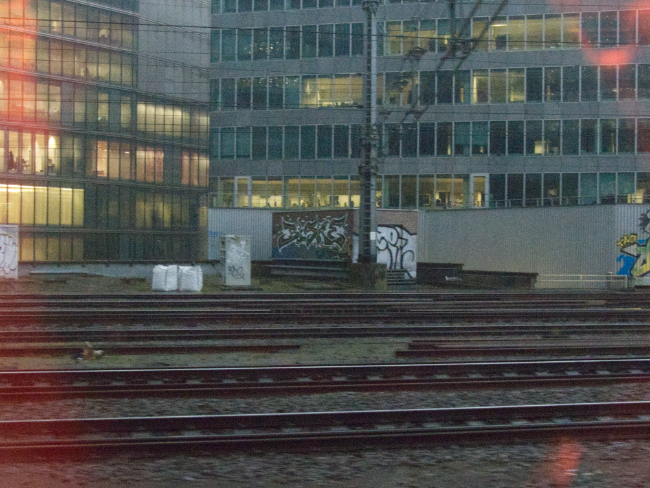
The train slows into a long glide through the industrial and working class suburbs of the city. The untidy world of production and productive workers. The electric light glare of office windows makes it possible to see into the office interiors.
Each desk the exact same measurement at every office node throughout the globe. Standardised office and line of business software on millions of identical computers displayed on millions of identical monitors. The same in Shanghai as in San Francisco. This is the office district.
Through one of the windows I can see a large crowd of office workers. Was it some sort of evening party? They looked as if they were singing. I would like to wishful think that they might be singing The Internationale. But I can’t. The idea won’t form yet. But I wonder if it might form in some nostalgia yet to come?

And then the raggedy streets of an older Antwerp, a trading city, a world city. The unplanned collection of shops in the workers’ districts; shop workers from Ghana, Vietnam, Poland, Turkey, India, and all the places that workers are scooped up from and deposited on factory floors and warehouses and offices and depots and where ever else cheap labour is needed.
Étude by Éliane Radigue is playing through the headphones as the train arrives at Antwerpen-Centraal. It seems like arriving in the city just after the liberation from the Nazis.

There are armed workers standing on the corners smoking asbestos defying cigarettes. The Third Reich lies are burning in the gutters. A man climbs a building and hammers off a Nazi emblem. A crowd is tearing apart a Swastika flag. A bonfire consumes fascist memorabilia. No one now dares to offer the world an outstretched arm salute.
The geeks and freaks, mods and rockers, dockers, port workers, delivery drivers, care workers, construction workers, factory workers, the heads, beatniks, oddballs, office proletariat, the tramps and prostitutes, the isolated and alone, the despised and dispossessed. A collective social power.
Someone has written ORGANISE on the global calendar of the twenty first century.

I wait for the bus in the cold and rain and study the contents of a jewellers shop. Row upon row of hard and delicate diamond rings and necklaces. They shimmer in the bright light.
The next day I was in a cafe in the centre of the city reading Owen Chadwick’s history of the reformation. I was so engrossed in this that twice the waitress made me jump. Once when she put a glass of mint lemonade on the table, and the second time when she bought my dinner. We both laughed a great deal at this.
And then a woman got her pram stuck in the door and the waitress and another woman dashed to help her. The woman rescuer still appeared to have a mouth full of potato waffle. It was one of those small moments when something human propels people to help.
I looked up later to the place where the woman with the pram was sitting. The baby was eating a huge dinner and showed no signs of stopping any time soon. His sister was drawing in a book with great concentration.
I returned to Chadwick, who at this point in the book was making a few points about Erasmus. He explains that in one of his books, Erasmus has a character say, ‘I heard a camel preaching in Leuven that we should have nothing to do with anything that is new’.
This notion of a camel preaching seemed to sum something up that I couldn’t quite put my finger on.
And then it came to me. The recent elections in the States and the whole gang of so-called world leaders.
And that when people stopped listening to the preaching camels in the sixteenth century the whole system of feudalism, popes and empires, kings and autocracies, came crashing down.

 Commodity Fetishism
You must be logged in to post a comment.