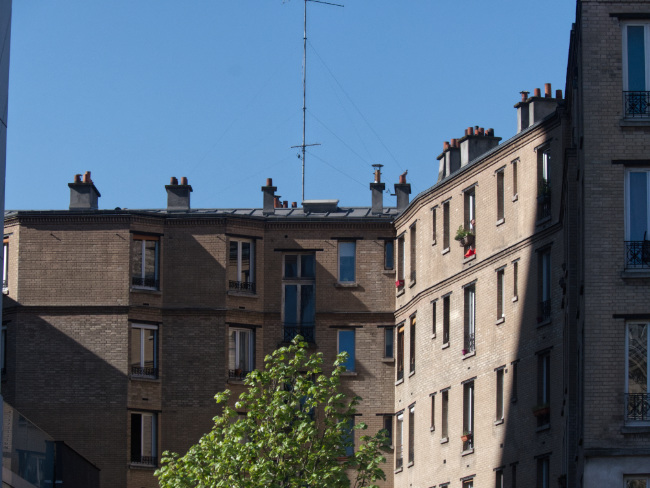
It was as if a scrap of paper was found in the street. One of those anonymous streets that lead through a time-space warp and into a fragment of the city that is both imagined and real.
A door opens, tumble through, a dusty corridor, it’s airless and stale, there is someone in the corner bleeding to death. They have been defending a barricade of the Commune. Here they will die slowly and in pain; but in dignity. They reach out a hand; they just want to feel external life one more time before the drop.

I reach towards them; their hand is cold and metallic, rotted and already dead, bloodied, the dirt of centuries under the nails, they look at me with fear and hate and joy and love. I feel their slimy fingers weakly grip my offered hand, they slip; they are going, in the corner, now just scattered bones.

I open the scrap of paper and it expands, over and over and over again. Here can be traced the smoke and sweat and rough hands and blood stains of the Revolution. People are running along this forgotten passage, clogs clamp on the cobble stones, shrieks of an earlier age. The language of Revolution emerges first crudely and with oaths; somehow, three words congeal. Liberté, égalité, fraternité. Who might imagine that the struggle for those words still continues.
Paris is a working class and a bourgeois city; the bourgeoisie are currently in power.

The Nazi occupation and the cruel ‘efficiency’ of stupid looking bureaucrats. Calculating and cruel. They make notes about Jews and Communists and write down numbers in office notebooks and vans arrive full of police and they knock on doors and people are taken away from family, home, their past and present. They no longer have a future.

After the war; so many war criminals escaped. How? Their type is making a return. They dream of concentration camps and tortures and humiliations. Netanyahu meets Orban. Sickness unlimited, sickness unchecked. The test bed is Gaza. Someone is responsible for the murder of Palestinian paramedics.

I’m reading The Search Warrant by Patrick Modiano on the RER train to the Gare Saint-Lazare.

On a Sunday afternoon in Paris Marie Le Pen is holding a rally to protest a court ruling. It was expected to have larger crowds. I walk along the edges. I don’t want anyone to think I’m actually attending. It is a strange sensation to be half tangled up with this.
I’m trying to work out who might be a tourist, who might just be going about their own business, who might actually be a supporter of Le Pen. It all merges. There is no way of telling.
The smartly dressed young woman with the brown coat turns out to be a Le Pen supporter. The middle age couple who could be academics; turn out to be Le Pen supporters. The group of student looking types; the same.
I stand at a distance watching the people queuing up to be searched before they enter the parade ground. They could be project managers, warehouse workers, office workers, people who work in shops. It looks more ‘middle-class’ than working class. There is no MAGA imagery on show, no fascist stuff visible. There is a smattering of conspi-racist types. They are always looking into the distance, a madness in their eyes.

It’s chilling. How ordinary it looks. And why people like this have the motivation to come out on a pleasant, warm, sunny afternoon in Paris to attend.

The delivery bikes craze me. I hate them on the whole. A black guy goes through a red light while I’m crossing the road on a green pedestrian light. He sees me and points a finger at me then I point a finger back at him and we both laugh. If at the moment he had stopped and got off his bike we would have spent three days drinking our way through Paris and explained everything there is to explain in the world.

The tension had been broken. Perhaps that’s what’s needed. Some way of breaking all this tension that’s building up?

I took the kids go-karting once in Carlisle. They whizzed around the track with all their mates. They were young. There was a really big rough and tough looking guy running the show. For some reason we got talking about Germany.

‘What do you think of Germany?’ he asked me. I had no idea where this was going. But it would be cowardly not to say I’ve had some great experiences there and I love the culture of the pre-Nazi period when Germany was this big socialist place with fantastic progressive ideas and the culture of Brecht and Otto Dix and hang it all, before that Hegel and Marx and Casper David Friedrich and the Romantic movement and all sorts of stuff.
Anyway, I didn’t quite say all that but I made it clear I liked the place. What is he going to say? I wondered.

‘I love the place’ he said. And then he explained that his dad had been in the army and liked Germany so much that when he left the army he stayed there. And in the town he lived, once a year they had a carnival, or similar sort of event, and on that day, everyone had to go up to everyone they had fallen out with during the year and shake hands and become friends again. This must have origins in the medieval period.
‘And’, he added with a triumphant flourish, ‘it works’.

I went to the Louvre. I joined as a member online but there’s a problem with the app, or the internet, or the user interface or packet switching, or satellite communications or something. I’m advised to call in person at the office of des Amis du Louvre. But do I need to join the queue?
It’s a hot Friday afternoon. One of the workers who spends their day in the great courtyard near the glass pyramid is sitting on a concrete block.

“Excusez-moi madame” She looks up at me, holding her radio like it might be a truncheon. It might be on occasion.
The wind blew her long black hair across her face. She brushed it back. She looked at me but there was something in her eyes in that moment which was nothing to do with her being a worker at the Louvre. She became alive.

She waved the walkie-talkie-truncheon towards the concrete wall indicating that I should sit down next to her. The moment of comedy is difficult to explain but it made us both laugh a great deal.
She explained that I still had to join the queue. The time and distance no longer mattered.
My card was printed out by a helpful man in the office. I now have unlimited access to the Louvre for a year. It won’t be long enough.
I went to see the Mona Lisa. I wanted to see the crowd more than the picture.


On the next visit I went to see the art of Northern Europe from 1350 – 1600. I managed about ten paintings. Each one like a long complex film. Full of enigma; magnetic, hypnotic. I dreamed a dream but it was a forgotten dream; it was a dream land but it was all unfamiliar.
I stepped through the grass and flowers of the sixteenth century, I felt the breath on my cheek of extraordinary women who revolutionised the world by reading books. Their looks, grace, poise; it means so much, but I cannot read it properly. Why should I? Their lives do not exist to be consumed. They are a non-commodity form. This is why the enigma is so powerful, for we are so saturated in the concepts and realities of value, profit and commodities.

I sat in front of Jan Massys painting David and Bathsheba. It is absurd to try and measure this experience in terms of ‘time’. It’s not like that. I visited the painting for five days in succession. Each time seeing something new. The way that David and Bathsheba hold their hands. David’s fingers are pointing upwards to the sky, Bathsheba’s finger is pointing to the ground.

The delicacy of the jewellery. The landscape and cityscape. This absorbed me for the duration of at least three solar systems. The haunting impact continues; I am transfixed. Even now when the painting is locked in the Louvre on a dark Paris night with flickering lightning and I can hear the rumbling of the RER trains on the bridge over the Marne.

Henri Sellier was a socialist mayor in Suresnes in the 1920s and 1930s. He became the Minister of Health in the Popular Front government. He was active on the left wing of the
IFHTP (International Federation for Housing and Town Planning), along with Emile Vinck, the burgomaster of Ixelles, Florentinus Wibaut, alderman of housing in Amsterdam and Hans Kampffmeyer, a settlement official from Vienna.
Sellier had helped to establish the Office des Habitations à Bon Marché (Office of Affordable Housing) of the Seine department and was appointed its managing director in 1915. It set out to build good quality, inexpensive public housing for the working classes based on the principles of light, sun, air and a green environment. Much of this housing still exists; in the Île-de-France, Vienna, Zurich, Berlin, Frankfurt, Vienna, London, Amsterdam and elsewhere.
Today the principles which underlie public housing in England – if it is built at all – are money, profit, accountancy, privatisations and vacuous marketing nonsense.

I went to visit the Garden City of Compigny which Sellier had been involved with. I got lost when I crossed the Marne on the high level bridge. Nice bourgeoise houses all neat and locked up and safe and sound behind big high gates and fences.
The postman was a black guy on a bicycle with big bags on the front and panniers at the back. ‘Bonjour’, he said as he passed me in an official-friendly way. I should have asked for directions because immediately he was gone I missed the turning I was looking for.
I found a market and wandered around and watched the working people – all shapes and sizes and skin colours – all seemed to be getting on ok. From how I saw it there was a lot of secret integration. A woman in a bookshop pointed me in the right direction.
When I found the estate I discovered it has street names that include Rue Karl Marx, Rue Proudhon, Rue Charles Fourrier. I felt it would be better if Marx and Fourier were in parallel and Proudhon a little on the outside.
This is proud, dignified, well build public housing. All the principles are here. Light, air, sun, greenery. And here and there, cherry blossom trees.

The estate includes a well built school. Great swarms of kids were playing outside. Scooters, balls, tag, races, elaborate complexity, fantasy for real, growing up games; kids are always growing up. Stay being a kid. Never grow up, always be involved in growing up; but please, never reach that grown up point.

It also includes the Oliver Messian Conservatoire. A group of people outside having lunch. I walked past, initially too gauche. Oh come on, what could they say? I shyly approached them. We’re all just made of stars.
They were fantastically lovely. They all talked at once; they explained that they were musicians, ‘a lot of Portuguese people migrated here’, ‘housing in Paris is too expensive’, ‘it’s a lovely estate’, ‘come and see our concert’.
And through this process the estate came alive; it wasn’t just red bricks and nice design and cherry blossom trees it was a place where people lived and learned to play instruments and read books and learned to dream and fell in love and had fun and discovered life. Too much to ask?
The war mongers seem to hate this sort of everyday, ordinary life. I went into a local church. Long lists of war dead. There were separate lists for each year.
When Henri Sellier died in 1943 the Nazi occupation authorities issued one of their stupid miserable edicts banning any public mourning. Thousands of people came out onto the streets.
I’ve been reading fragments. Three chapters of Marx’s Capital, Eric Hazan, A Walk Through Paris and The Invention of Paris; The Search Warrant and Jacques Yonnet Paris Noir: The Secret History of a City. The intensity affects my thinking.

I just read a paragraph or two, a page on the RER, part of the introduction, the acknowledgements. Another paragraph. A line or two stays in my head all day.
It’s all getting mixed up, the history of revolution, occupation, the modern city with its modern workers, the literary representation, the photographs, the cinematic representation, here in the streets, in the glimpses and sense of life.
There’s a patisserie nearby. The woman in there is funny and pretty. When I ask for a Mille-feuille.she makes me repeat the words until I get it right. She takes her finger as if she’s in charge of the opera at the Met in New York and she raises that finger in the air until I get the inflexion correct. And then she smiles and makes me put all the change I have in my hand and she counts it out. It is like a moment in the film Larks on a String. If you’ve seen the film, you’ll know the moment I’m referring to.

On a Saturday afternoon I take the RER to the Gare de Lyon and walk with no purpose or intent. It is a form of gravity, pulling me in ways I don’t understand.

I cross the Seine and pass the Gare d’Austerlitz and into the Botanical gardens. A child skips in an elaborate skipping game. Into the fifth arrondissement I discover the Rue de Mouffetard by chance. It immediately becomes one of my favourite streets in the whole of Paris.

I buy au gratin potatoes and two sausages ‘made with merlot’ and sit eating it all on the window ledge of an empty shop. The shop is full of dust and cardboard boxes. It’s a good place to sit, I can watch the world go by.
A woman walks past with gorgeous Afro-hair. And as she passes me she momentarily turns to face me and flashes a beautiful smile and says, ‘Bon appetit’. I catch her eye, just for a moment and in that moment gold and coloured sparks splash across the ground and run up the walls of these ancient buildings, the valorisation of the Paris stones.
Let’s see who is up for the future of humanity. It’s a better place. The people are nicer, more humane, full of wit and charm, more fantastic, with real life; it just needs organising.

 Commodity Fetishism
You must be logged in to post a comment.