“In Paris in 1885, a judge declared that for a landlord to be compelled to lay on water in his houses for the use of the tenants was an interference with the liberty of the subject, and held that a water-supply was not an indispensable necessity for maintaining the healthiness of the a dwelling”
Catherine Bauer, Modern Housing – p 40

I’m not sure where to start with Paris. It’s not the size or the topography or the history. It’s the starting point. Where does Paris begin for me? At the Gard de Nord where the Eurostar train arrives? Or is it when I push and pull my book-laden suitcase into the RER train? Or is it when I finally arrive at Nogent-sur-Marne. Ah, but that’s not really Paris, it’s the Ile de France.
I like where I’m staying and I like my host. It’s in the surburbs and it takes about 25 minutes to get into the centre of the city. Suburbs are generally cheaper places to stay and provide a more local view of place and I quickly settle into a routine, generally using the same shops each day.
The woman in the patisserie won’t let me leave until I speak corrcetly. She uses her finger as an uptick, as if she might have been leading a choir, to make me pronounce the cake name of Mille Feuille properly. And then counts out the change from the coins in my hand. I feel the delicate touch of her fingers. The intensity of her presence.
I spread a large map of Paris and its region on the kitchen table of the studio I’m staying at. I check things on the web. I study articles on JSTOR. I read through the pile of books by Eric Hazan I’ve bought along. I’m looking for clues and detail about the history of public housing and the city itself.
I have things to do in Paris. Read Jacques Yonnett, visit the Lourve, walk the streets for hours and hours. I’m still in the process of creating my own mental map and that needs updating and developing. I need to check the places I’m vaguely familar with and become familiar with places I don’t yet know.
One Tuesday morning I set out to walk to the Cité-jardins de Champigny-sur-Marne. According to the measurements and calculations it’s about an hour walk. It’s a bright sunny day. Languid, lazy, the sort of day that’s timeless, the sort of day that will exist when Paris is gone, and world of folly has finally ended. The Marne and Seine will wash away the dust the bones and everything will be green and alive with an immense range of flora and fauna.
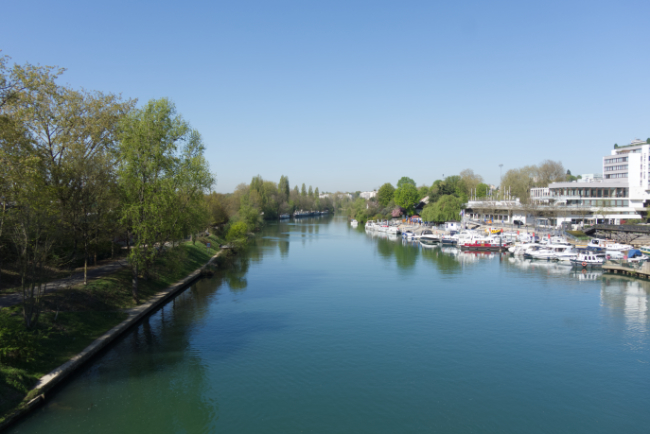
At the bottom of the street there’s an uneven brick wall. And to one side there is a small wooden door. I lift the latch and step through. And now I’m in Paris of the 1930s. I like the air. Its seductive and suggestive.
I walk across the bridge and along the Quai du Viaduc. I’m careful with my money and refuse to have my phone on just for the sake of it. It costs too much. Instead I have a hand drawn map I created when my Macbook was connected to the internet. It’s a good map. But it has one flaw that will be shortly revealed.
On this map the Marne is clearly marked, as is the bridge that spans it and the path along its banks. There are lovely looking houses that have gardens right up to the waters edge. It’s an arcadia, the level of quality that all housing should aim for.

I walk under the railway bridge. That’s clear on the map too.

The map is put back in the breast pocket of my shirt. It’s hot and sweaty and the ink is beginning to run and smudge. And this is the point where I get lost.
I was fine as far as the Rue de Mulhouse and if I’d gone left, instead of right, I would have been exactly where I wanted to be.
Instead, for anyone familiar with the area, I ended up at the Rue de Stalingrad, in the opposite direction.
I should have asked the postman. He said ‘bonjour’, I replied ‘bonjour’ but experienced a moment of shyness. I knew he was looking at me and hoping I’d ask directions. You could tell by the way he looked wistfully as he cycled off. ‘He’s lost’, he was thinking, ‘he should ask me directions’.
It was a long way back from Stalingrad to where I wanted to be. I found a market full of all sorts of people, posters on the wall for the Popular Front, traders and market stall holders from all around the world.
All the poorest places in Europe are like this. African women shopping for cassava and yams, women wearing headscarfs buying Halal food, and a class of people who have all fused together in such a way that it’s impossible to tell visually where they may have come from. These are the poor of the earth. And they are everywhere.
There’s a book shop on the corner and I go in to try and buy a map. They don’t have a map of the area but one of the workers gets a map up from the internet on the screen and shows me where I need to go. I update the smudged and damp map that is extracted from my pocket. She looks at me curiously.
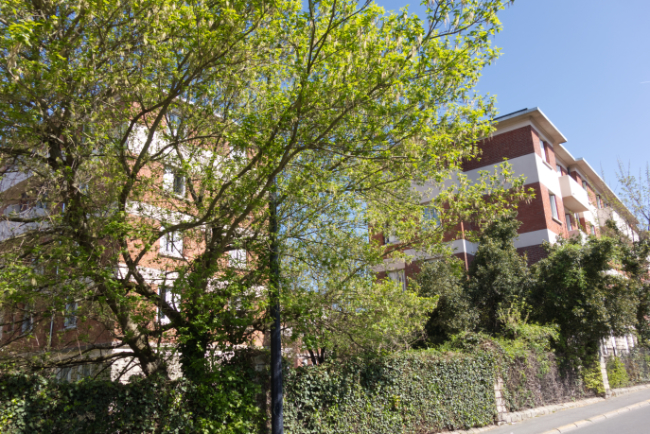
The Cité-jardins de Champigny-sur-Marne is an estate that was built in two phases. The first between 1928 and 1936, and the second between 1948 – 49. A world war separated its development.
The street names express something of the original planning and building of the estate. Rue Karl Marx, Rue Proudhon, Rue Charles Fourier, Rue Babeuf, Rue de la Côte-d’Or, Rue Benoît Malon.
Marx lived in Paris between October 1843 and early 1845, when he was expelled by the French authorities and moved to Brussels. It was in Paris that Marx cemented what was to become his lifelong friendship and collaboration with Friedrich Engels.
He befriended Joseph Proudhon and the anarchist Mikhail Bakunin and the poet Heinrich Heine while living there. His first daughter, Jenny Caroline, was born in the city on the 1st May 1844. While living at the Rue Vaneau (or nearby street) in the Latin Quarter, he wrote The Economic and Philosophical Manuscripts. This book is a powerful introduction to his work.
Charles Fourier was one of the French Utopian socialists of the early nineteenth century. His ideas can be considered eccentric but there is something wonderfully compelling about writings such as The Theory of Four Movements.
And one aspect of Fourier’s thinking remains contemporary and relevant. His seething contempt for capitalism and the way it distorts life. At one point Fourier summed up his idea of society as being organised around the enjoyment of sex, food and aesthetic pleasures.
Marx was close to Proudhon for some of the time while living in Paris, and then they spectacularly fell out. Proudhon however had a significant impact on the history of the left in France.
Babeauf, known as Gracchus Babeuf, was involved in the French Revolution. He formed the Conspiracy of Equals in 1796, an attempt to form a more egalitarian society based on the power of the revolution. He advocated the abolition of private property and the communal holding of land.
Benoît Malon was born into the poverty of the peasanty. He worked as a shepherd and then as a factory worker in Lyon. He played a leading role in the Paris Commune of 1871.
Rue de la Côte-d’Or is a reference to the Côte-d’Or which was created in 1790 as part of the re-organisation of France following the revolution of 1789.
Rue Francis de Pressensé, named after the socialist politician and journalist who supported Alfred Dreyfuss against an establishment and anti-semitic frame up.
So as we can see, the street names themselves are part of a upotian, communist, revolutionary and communard-ist history.

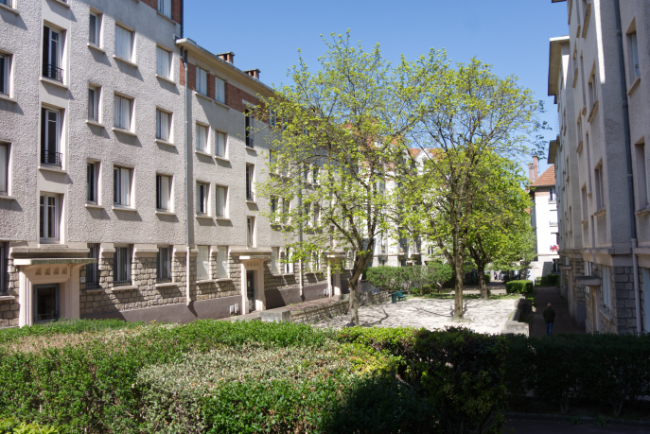
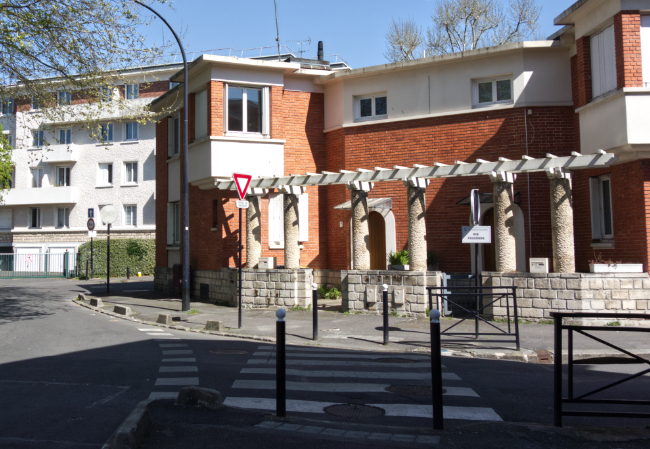
The estate itself is a mixture of single-family red brick housing and blocks of flats. Houses have private gardens, the blocks of flats have shared communal space.
All the housing types look to be of good quality build and with high class design standards. All aspects of the estate were clean and looked well maintained.
A key figure in the development of this housing was Henri Sellier. He was born 1883 in Bourges ( a town with a fabulous cathedral and medieval atmosphere). His father was a skilled metal worker who worked in the cannon foundry in the town. His mother came from a more bourgeois background and ran a watch and jewellers shop.
Sellier was a socialist, reformer and urban planner; a combination we seem to now lack in contemporary England.
He was an early member of the French Communist Party, voting with the majority to join the Third International. He was expelled from the French CP in October 1921 and joined the French Section of the Workers International.
He moved in the same political circles as Lenin, Trotsky, Otto Bauer, Rosa Luxemburg, Clara Zetkin, Jean Jaures, Albert Thomas and the whole constellation of people who made up the Second, and then Third International.
During this period revolutions took place in Russia, Germany, Austria and Hungary. Four empires disappeared. In Russia, the Tsarist state was physically smashed. Workers and soldiers councils took power – even if only momentarily – in a wide arc from Kiel and Hamburg through to Vienna, Budapest, Petrograd and Moscow.

In Russia, Germany and Austria in particular, there were huge gains for the working classes and peasantry. Wages increased, hours of work were reduced, democratic rights were established; there were attempts to break the power of sexual oppression, great dynamic movements emerged in art, music, architecture and design.
These were powerful historical moments. Interesting times to form ideas and practice about worker’s housing and urban planning.
And it is worlds away from the ideas and circumstances that have dominated urban planning, architectural practice and housing development in Britain in the past 45 years.
Thatcherism, neo-liberalism, post-modernism, political and professional cynicism, housing debt, landlordism, poor quality buildings and relentless attacks on wages, conditions and on the welfare of the weakest sections of society. A lack of coherent left-wing opposition, an intensification of consumerism, alienation, financialisation, commodification.
In 1915, even while the First World War intensified, the Office des Habitations à Bon Marché (Office of Affordable Housing) of the Seine department was created. Sellier was appointed managing director. One of the first initiatives he inspired was to actually find out what housing was available, and what was needed, and what the key issues were.
The costs and price of urban housing (which impact on quality, design and space standards) is greatly defined by land values. Sellier pushed through the practice of buying land as cheaply as possible, even during war time, so that it would be there to build on in the future.
This generation of urban planners and reformers were all motivated by much more than simply costs. Sellier had been greatly influenced by the ideas of the Garden City Movement, developed by Ebenezeer Howard at the beginning of the twentieth century. Tree lined streets, cooperative ownership, a relationship between good housing and reform and democracy and peace. Principles of air, space, light; an end to overcrowding and squalor.
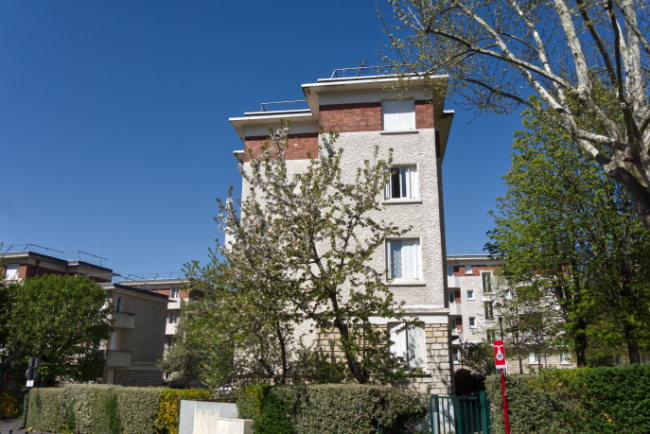
Nature itself would be utilised in a non-commodified way to support a pleasant environment for people in a relationship of mutual aid.
And add to this, bathrooms, inside toilets, hygeniec living conditions, good quality build, attractive materials, intelligent and joyful design and support it all with schools, medical centres, theatres, open space, cinemas, paddling pools and sand pits for the kids.
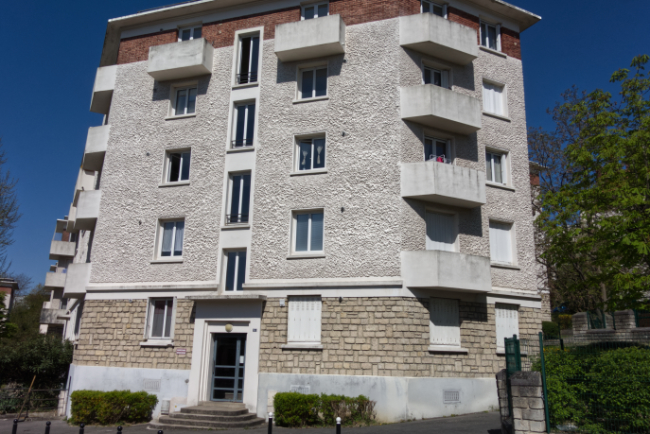
The starting points are principles, rather than profit. The implications of these different starting points are enormous.

The estate was built with a nursery school and a primary school, both named after Albert Thomas.

It’s lunchtime as I walk past the primary school and there is a great game going on in the school playground that spills out into the street, where the children are allowed to play with equal abandonment.

Alleyway to the Rue de Charles Fourier.

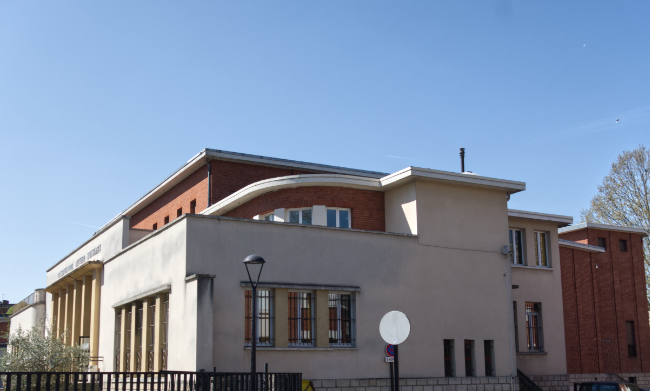
The estate was also built with the Conservatoire Olivier Messiaen as a centre piece, a music, dance and theatre centre which is still in use.
Outside there’s a group of musicians sharing a picnic lunch. They are taking a break from practicing for a forthcoming concert.
I introduce myself and briefly preach Modern Housing which they listen to attentively and with curiousity. All the time they continue to dip pitta bread into houmous, hesitate before picking a tomato and nonchantly select olives from a large bowl.
This uncalled for public lecture is a curious mix of Marx, Fourier, Christopher Alexander, Catherine Bauer, Jane Jacobs, Margarete Schütte-Lihotzky, Josef Frank and others. There’s a bit of early Trotsky and in a way it’s Friedrich Engels who brings it all together. It doesn’t really last any longer than it takes to read these few sentences.
A woman with a composed look and striking attitude looks at me with ice-cool style. The woman next to her bursts into her own manifesto with regards to the modern Paris workers. She has Lenin in head and Louise Michel in her heart.

And in a way, her speech, and the comments from the others who continued with their picnic, brought Henri Sellier and his ideas and achievements all to life, and that whole movement between the wars where reformists and socialists and Marxists fought for great improvements for the working classes.
Sellier in Paris, Florentinus Wibaut in Amsterdam, Emile Vinck in Ixelles and Hans Kampffmeyer in Vienna. Ernst Mayer and Ludwig Landsmann in Frankfurt and Martin Wagner and Bruno Taut in Berlin.
They all favoured an incremental socialist reformism. They believed that the state and local authorities should provide housing for the working class. All very reformist, but in terms of England now, it’s Bolshevism, its revolutionary. How has this come to be that even the mildest reforms now seem so threatening to rentier and landlord capital?
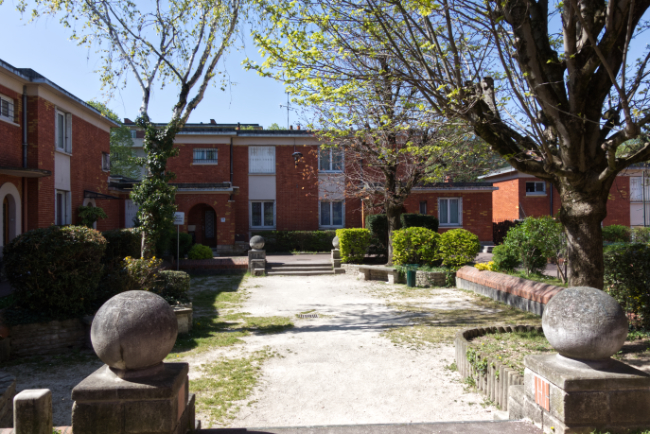
I walk around the estate again. Up to the railway lines and through the open space between the blocks of flats.
There’s something fantastic about all of this. Nearly 100 years old and from what I can see, still going strong.
Meanwhile in England, housing built not more than 10 years ago is already experiencing mould, damp, infestations, and the ongoing scandal of fire-risk cladding. And I wonder if anything as good as this being built in England today? And if not, why not?
And why it is that so much now just seems to be a facade, a lie; dominated by profit and money-greed.
But the answer lies not just in design and architectural practice; but in political power and workers organisation.
For better housing we must overthrow empires, establish our own forms of democratic control, break the power of landlord capital.
As James Connolly once said, “For our demands most moderate are, we only want the earth”.

 Commodity Fetishism
You must be logged in to post a comment.