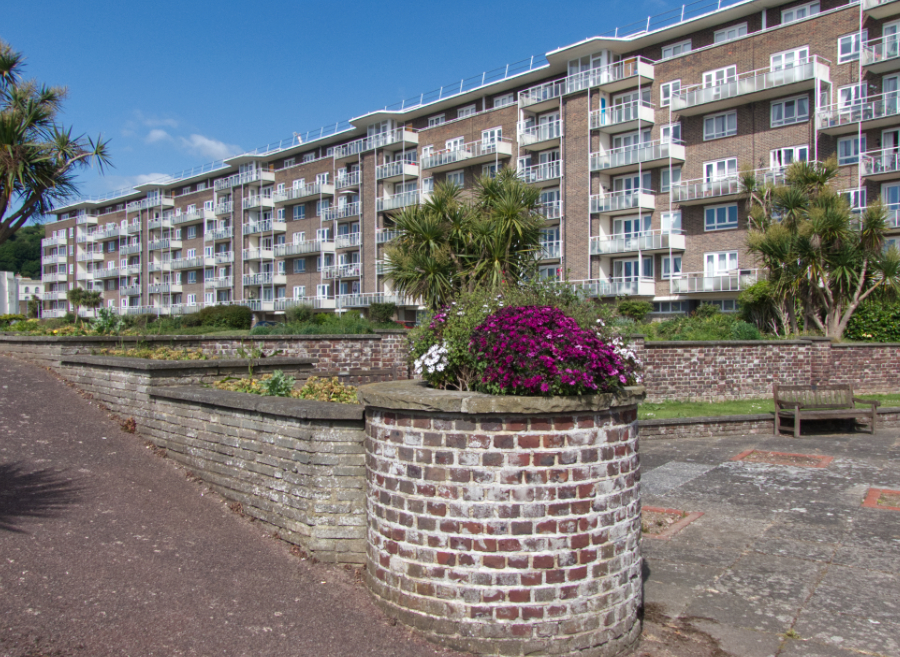
The Gateway Flats in Dover were completed in 1959. Over 200 council flats, with sea views and easy access to the sweeping, curving promenade by the harbour. There was some controversy at the time, and small echoes of that rumble on. Why should council tenants have such elegant and graceful housing? Why this intelligent and thoughtful modernist design?
There was no doubt that at this time, housing was needed; not just in Dover, but across the whole of England.

By the end of the Second World War, over 250,000 houses in Britain had been completely destroyed and around another 1.75 million suffered varying degrees of damage. There was substantial economic dislocation, war weariness and a social and political atmosphere demanding change.

Churchill thought he would easily win the election which took place on Thursday 5 July 1945.
He offered nostalgia for an Empire now emasculated; anti-Bolshevism, weirdly out of place when so many recognised the Soviet contribution to the defeat of fascism, and a personality that wasn’t quite as popular as might be imagined.
Many, rightly, suspected that Churchill did not want a new world based on a common anti-fascist front, on the resistance movements and the calls for an end to war and poverty. That he preferred a return to the old world of monarchists, aristocrats and authoritarianism.
The result was a landslide victory for the Labour Party.
The whole atmosphere of the election and the mood of the country was for reform. Of health, education, national insurance, industrial control; and one of the most pressing needs of all, in housing.
Many remembered how the promises of 1918 of a ‘Land fit for Heroes’ had quickly become the General Strike of 1926 and its bitter aftermath (in Dover all the tram workers were sacked for taking part in the strike), the Wall Street Crash and the depression of the 1930s.

Homes fit for Heroes had been built; of good quality and often impressive design. But not in sufficient quantities and when war started in 1939 there was still an ongoing programme of slum clearances. And that stopped, as did all house building, as the economy turned to military production.
Few alive in Britain today have experienced war. By the early 1940s many had experienced two world wide conflicts. Between 1939 and the end of 1941 Britain was isolated. The USA reluctant to commit to battle, Stalin striking a deal with Hitler. Would the war ever end? Would fascism triumph across Europe?
In the early parts of his six volume history of the Second World War, Churchill outlines the fear, the desperation, the military defeats and the political challenges. Churchill has been described as a ruling class militant. And he developed a persona of defiance; that he would be on a beach in Kent with a tommy gun should the Nazis try to cross the channel.
The great change was the Second Battle of El Alamein between 23 October and 4 November 1942.
The British Eighth Army, commanded by Montgomery, with units from India, the Libyan Arab Force, Australia, New Zealand, South Africa, Free France, Greece, and with air support from the US, defeated the Nazi and fascist armies commanded by Rommel and Burbasetti.

Churchill commented, ‘Before Alamein we never had a victory. After Alamein we never had a defeat’. On the 15th November, for the first time since the war started, church bells were rung all over Britain. And two weeks later, on the 1st December, the Beveridge Report was published.
During the war, Mass Observation used volunteers to determine the mood, thoughts and ideas of people around the country. In pubs, restaurants, shop queues, on buses, at railway stations. The government commissioned reports on post-war reconstruction, housing, health, urban planning and more. The Beveridge Report brought much of this together.
Beveridge has been described as cold, vain and ambitious. He wasn’t a revolutionary, nor indeed much of a reformer. He seemed to be disdainful of some of the proposals in his own report. But he was an active self-publicist, and having produced the report, he wanted recognition.
The report was quickly summarised in all the major newspapers. People formed long queues to buy copies. For those who didn’t want to digest its 300 dense pages a summary was produced. It is estimated that at least 635,000 of those two documents were sold.
In The People’s War Angus Calder writes ‘Within two weeks of publication, a Gallup Poll discovered that nineteen people out of twenty had heard of the report, and nine out of ten believed that its proposals should be adopted’. (page 528).

It was from this report that the underlying principle of welfare and support from ‘the cradle to the grave’ was set out. A slogan which underpinned so much of how the welfare state subsequently developed; not just in practice, but as an idea, as a place in people’s hearts. The new world, of hope and progress, against war, want and poverty.
The workers in the factories and workshops, the troops in North Africa, and Burma, the seafarers on the Atlantic and Arctic convoys and the young men on dangerous flying missions felt that this, and the destruction of fascism, were things worth fighting for.
The end of the war in Europe in May 1945 was one of great trauma and dislocation. Central and Eastern Europe with masses of refugees, France and Italy with large numbers of Resistance fighters reluctant to give up their arms, the revelations of the horrors of the Holocaust, Red Army soldiers questioning Stalinism, the continued fighting in the Far East; which would only end after the dropping of two atomic bombs. Much more quickly than anyone could have imagined, a new war, the Cold War started.
In these conditions, could the recommendations of the Beveridge Report really be implemented?
Housing was the pressing need. By 1946, there was a large squatters movement in Britain involving up to 50,000 people, some of them well trained and battle experienced troops, now with babies and toddlers in tow rather than machine guns and artillery. Disused army camps were taken over; including at Ramsgate, by demobbed troops, who also happened to be coal miners by profession.

The Town and Country Planning Act had been introduced in 1944 in preparation for the peace. This had been preceded in September 1942 by the Uthwatt Report Expert Committee on Compensation and Betterment. It’s terms of reference may seem rather technical and possibly obscure, but they set out something fundamental which should be of great interest today.
That there should be public control of land and the stabilising of the value of land required for development. It also made provision for the compulsory purchase of land in favour of local authorities and not developers or land speculators. This was revolutionary in 1942 and it remains revolutionary today.
The report was shelved due to Conservative opposition. But it did lead to the Town and Country Planning Acts of 1944 and 1947 which gave local authorities compulsory purchase powers. And was an attempt to control the price and value of land in relation to the development of housing. For then as now, the more expensive land is, the more expensive it is to build housing.
Which, by the way of a long introduction, brings us to the Gateway Flats.

In 1957, Harold MacMillan had become Prime Minister and not long into office, at a speech in Bedford declared, ‘you have never had it so good’. He then went on to denounce socialism and nationalisation and central planning – but that part is now largely forgotten.
(As a footnote, my dad once claimed that he’d dug a pond out on MacMillan’s estate. Like all my dad’s tales, the truth was never clear. But generally, the more outrageous the story, the more likely it had actually happened).
It’s in this context, the hopes at the end of the war, the introduction of the welfare state, increasing prosperity for many and a particular type of paternalistic one nation Toryism, in which the flats were built.
Dover had been hit by over 2,000 bombs and shells during the war. It was within range of the Nazi coastal guns in Calais and under the flight paths of bombers heading towards London. It must have been dispiriting to be surrounded by ruins and destruction amidst all those struggles that working class people go through on a daily basis.
Finally, a complex process of decision making led to approval to build the Gateway Flats.

The flats were designed by Roger K Pullen and Kenneth Dalgleish, established architects who had designed Marine Parade in St Leonards at Sea in 1938.

They were part of the tradition of British interwar architecture that had produced Battersea Power Station, Peter Jones department store, the fine town halls of Hackney, Waltham Forest, Bolton and others; Shell Mex House, High Point One and High Point Two in Highgate, Arnos Grove underground station, the Hoover Building in West London, the Daily Express building in Fleet Street.
When we look at the Gateway Flats in that context perhaps we can see how the composition has been influenced by the fine architecture which preceded it.

Kent County Council had its own architect’s department at the time (no London borough now has such a team) who examined the initial design proposals (there were 144). The Royal Fine Arts Commission was involved. The design which was eventually built was given approval by the architects Arthur Kenyon and Geoffrey Jellicoe. There was a lot of architects involved; there was a lot of thinking in terms of the architecture and design.
It is worth considering the flats in their location; of the sea, the White Cliffs, Dover Castle and the Western Heights. From every angle they fit in well. This would have all been determined by observation and walking around the site, rather than CAD (Computer Aided Design) and BIM (Building Information Modelling). It is some achievement.

The flats were built by Rush and Tompkins in a dark brick with white trim on the balconies, windows and roof edge. This fits nicely with the colour palette of the castle and the cliffs. The design, style and colouring don’t clash with the surroundings but blend in.
At point of origin, the flats had central heating (supplied by a central boiler), hot water, telephone cables installed by the GPO, fitted kitchens and a television tower. This enabled a television service to be delivered by Rediffusion. That most essential factor, a caretaker service was also provided.

There are substantial and well designed gardens at the front of the flats, and easy access to the promenade. This is a genuine seaside promenade. I don’t know quite what it is, perhaps the design, perhaps the whole ensemble, but personally I have had many conversations with people there and after a while, developed some good friendships. Just by an opening of a ‘hello’, ‘good morning’, ‘lovely day’, ‘bit rough’ (pointing to enormous stormy waves) and so on.
The flats were originally owned by Dover Corporation. Following a reorganisation of local government in 1974 they were transferred to Dover District Council. In 1979, Margaret Thatcher became Prime Minister and after a period of more than 80 years, the sense and experience of progress in housing ended.

Within a year of Thatcher coming to power, ‘right to buy’ had been extended and by 1987 a significant number of the Gateway were privately owned. The council sold the freehold and the flats came under the management and control of various different private companies. As if the hopes of 1945 had never happened. As if, after all, a new England, could not be built.
A new England based on community, civic pride, democratic accountability, fairness, toleration, caring for those who need care, holding out the helping hand to those in distress, providing something of good quality at a personal, rather than money, level.

The seeds of a better future are in front of us, but so too behind us; when people fought against fascism and right wing populism and for liberty and freedom. And in that sense, the Gateway Flats continue to be a success because they represent a better England.
One of the advantages of making up your own research projects is that you can make up your own research methods. Part of mine include just hanging around in the streets and sparking up conversations with that most dangerous class; ‘strangers’.

I went out early one Friday morning to take photographs of the Gateway Flats while the sun was shining (the pictures used here). I had a long conversation with someone in one of the sunken gardens. Then I went around to look at the back of the flats. A man was pulling a shopping trolley along.
‘Excuse me, do you live here?’
He looked at me with the expression of, ‘what’s it got to do with you?’
I started to preach Modern Housing. He quickly put a stop to that.
‘Do you want to come and have a look at the view’

We took the lift and then I carried his shopping trolley up the final flight of stairs. The view is fantastic. Although he said he would prefer fields and trees and cows and badgers. He’d been a ship’s engineer and travelled all around the world and said he’d ‘had enough of looking at the sea’.

‘Would you like a beer?’, he asked. It was 10.30am.
Now, I never drink in the morning. But there was something about this. And I do have the interests of the ‘Housing is more than houses’ project to consider.
We settled down with beer and he described his fascinating and extraordinary life. And told me a great deal about the flats themselves.
Personally, I think this sort of research is just as valid as elaborate surveys, and certainly more so than focus groups. It’s also a lot more enjoyable.
It was fabulous to sit in his living room and look out at the Channel and it made me wonder if the architects and builders realised how well the flats can be seen from the sea.
I often sit on the seafront and look at the ships travelling around the world. They can be monitored and tracked with various bits of software. From Rotterdam to New York, Thames Port to Le Havre, Antwerp to Sao Paolo, Hamburg to Shanghai. Container ships of 300,000 tonnes, bulk carriers, car carriers, ferries, oil tankers, Liquid Natural Gas tankers, warships, submarines, dredgers and reefers.
Do the world’s seafarers look up and see the White Cliffs and the castle and the Gateway Flats and think to themselves, ‘you know, that’s pretty smart housing, I wouldn’t mind something like that myself’.

I looked through some local social media sites for anecdotes and reminiscences. At first my impression was that there was still quite a lot of hostility to the flats. But when I read more closely, I realised that was just a minority shouting loudly. There’s a lot of that behaviour about.
Someone complaining that they ‘spoil the view of the sea’ to which another responded, ‘any building on the sea front will do that’. Incoherent mumblings against modernism. Half baked stuff about eyesores and so on. Tis a pity the internet has become a place of so much curtain-twitching.

When I read more carefully I found more interesting and measured interventions. People explaining how they had grandparents and relatives who lived there when they where first built and loved the place.
People who have friends who live there now who love the place. People explaining that they are not sure about the design but would very much like a flat there. The private rented sector in Dover is expensive; and high rents are often accompanied by poor quality housing and a lack of tenant’s rights.
A sense that perhaps the local authority and the state should be providing housing and health and education for the people. Just like they used to. Perhaps some of the anger all around us stems from this? That people resent the way the welfare state is breaking down because private profit is deemed more important than people’s needs.
There was one anecdote that reminded me of the writings of Christopher Alexander, Jane Jacobs and Josef Frank. Architects, writers: simultaneously both ruralists and urbanists, philosophers and people-centric thinkers.

The person described how her mum used to work at the National Coal Board offices on the seafront and after school she would go down to meet her. While she was waiting she explored the area.
“One day I discovered the Gateway Flats. At the time, though modern and box-like, they were relatively recently completed and so in good condition. I remember climbing a flight of steps, fountains, water splashing onto concrete and a ‘gateway’ suggesting a grand entrance. I was riveted. Though I have a deep affection for traditional buildings, the power of this modern design spoke to me in a way I couldn’t begin to understand at 14 years of age. Good luck with your researches, Danny Bee”
Resources:
There is an excellent and more detailed history of the planning process here:
The Dover Historian
And more material here:
The Gateway Flats
A detailed overview of the Uthwatt Report Expert Committee on Compensation and Betterment
https://www.lexology.com/library/detail.aspx?g=468f4538-0bda-47b0-9c2a-1676acc185b0
For more about squatters in the immediate post-war period:
The Squatters of 1946, Paul Burhnam
Winston Churchill’s ‘History of the Second World War’ can still be found relatively cheaply in secondhand bookshops. It’s really, ‘How I, Winston Churchill, won the Second World War single handledly’.
It’s a fantastic read.
 Commodity Fetishism
You must be logged in to post a comment.