
The Labour government has recently announced plans to build 1.5 million homes. Keir Starmer has promised ‘shovels in the ground and cranes in the sky’, suggesting that this is the only way to create that most mysterious place, the future.
All this digging of trenches, pouring of concrete, chopping down of trees and no doubt demolition of some perfectly good existing housing, will solve both the housing crisis and generate growth. Who could possibly be against this?
The proposals are certainly popular with the building industry, property developers, asset management companies, indebted housing associations, civil engineering companies and those politicians and policy makers (both national and local) who if they do nothing else, always ensure they are buzzword compliant.

The Immediacy of Now
In the online world we are warned about people who insist that things must be done now! whether it’s clicking on a great bargain or handing over money for that too good to be true opportunity. In the real world, time pressure is used to drive all sorts of political decisions forward when they really need to be slowed down, if not paused, or stopped all together. Before anything else is built perhaps there needs to be better understanding of what already exists and what the landscape (excuse the pun) actually looks like.
There are certainly issues about housing, homelessness, overcrowding, poor quality build, expensive housing costs and a lack of tenants rights. But little, if any, of this is related to the actual number of buildings. Rent controls could alleviate housing poverty within a matter of weeks, regulations and sanctions against private landlords would quickly increase the quality. Control of short term lets would soon make more housing stock available.
Let’s consider some of the facts and figures outlined in Nick Bano’s excellent book Against Landlords. There are an estimated 100,000 children in temporary accommodation. Over 300,000 children have to share a bed with a family member. The poorest 20 percent of the population give over half their income to landlords. Over 20 percent of private housing is categorised as hazardous.
And yet there are 370,000 short term rentals in England, a significant increase from 2019.
The number of long term empty homes rose by another 4,000 in 2024 to 265,061. The number of second homes also rose to 279,870.
Historic England claims that there could be a gain of between 560,000 – 670,000 new homes by ‘repairing and repurposing historic buildings’.
England loses about 50,000 buildings a year (some in mysterious fires which are never solved). That’s 500,000 buildings in the past ten years.
It’s estimated that around 70 percent of the housing in London is under occupied.
And these are only some of the pieces of the jigsaw. And yet suggest potential alternatives to a construction extravaganza.

The Sisyphus Machine & the Database of Destruction
In Greek mythology Sisyphus was condemned to roll a boulder up to the crest of a hill. When he nearly reached the top, it rolled down. And he had to start again. Sisyphus is an apt metaphor for the cycle of housing construction and destruction that never delivers enough. We never quite reach the top. England never finds itself in a situation where everyone is well housed and there are just one or two houses left empty; perhaps for emergencies or unexpected visitors.
In the 1950s and 1960s whole areas were designated for slum clearance, some rightly so. Much was destroyed which should have been preserved. More would have been bulldozed if it hadn’t been for the quick thinking and militant protest and pressure of people who created societies and petitions and lobbying and demonstrations. Some desirable parts of London only now exist because for once the boulder reached the top of the mountain.

A lot however was demolished and replaced. System built tower blocks which quickly became damp, mouldy and infested with vermin and soon revealed catastrophic design faults. The first warning was Ronan Point in Canning Town which suffered a partial collapse in 1968, killing four people and injuring 17 others. It was extraordinary chance which meant the death toll wasn’t far higher.
It would be useful to have a database of destruction which included all the building destroyed in the past 50 years. There’s certainly software that’s powerful enough to build such a thing. There could be fields such as year of build, year of destruction, cost to build, cost to destroy, cost to build the replacement. It could be called the Sisyphus Machine.
If the underlying information architecture is well designed then it would be easy for the user to click a category, say 1965, and reveal how many tower blocks were built in that year. And graphs and charts could be displayed to show when those buildings were demolished and how much the construct-destroy cycle had actually cost.
The Trowbridge Estate in Hackney, built in 1965, could be a case study. Residents in the terraced housing who demanded refurbishment were ignored. They lost their existing homes and moved into the seven 21 storey blocks.
The first block was (partially) blown up in 1985 (it didn’t collapse properly), by 1995 it was all gone. The rubble was removed, the site cleared and terraced housing was built again. How much did that all cost? Not only did the buildings come and go, but the memory of what happened has largely gone to. The people who lived through this macabre pantomime and had their lives upended over and over again are nought but silent ghosts in the background, people to be moved around as pixelated shapes on glossy brochures.
Oh that’s all so long ago. Things have changed since the 1960s. Just look at trouser styles. And yet, as the Dezeen website points out, over 60,000 council houses in London were demolished between 2014 to 2024.
Within this period, over 120 acres of public land, some of it school playing fields, were sold by London councils to private landlords for £70 million. Obviously according to Oscar Wilde’s dictum of, ‘Nowadays people know the price of everything and the value of nothing’.
These sort of numbers are useful. For measures are important; in slowing movement down, in unifying theory and practice. Measures are part of a scientific approach. More measuring is needed but beyond calculations of profit and loss. The true environmental costs (rather than bogus claims about sustainability) need to be measured too.
The social costs must be considered too, although these are always harder to quantify and therefore often too easily ignored. How many people spent how many hours in miserable living conditions wishing they were dead. Broke and fed up. Squashing cockroaches, chasing mice, despondently trying to pick bed bugs out of the kids duvets. People always pay the highest prices for the stuff that can’t be measured in spreadsheets.
Commercial (un) Real Estate
Commercial Real Estate (CRE) suggests the involvement of people with financial acumen. Surely if millions of pounds are going to be spent on a building then the investors will want to see it on the horizon for years to come? Not so. The money to be made in CRE isn’t just the buildings, it’s the land values. True, a large office block isn’t cheap. 22 Bishopsgate for example cost over one billion pounds. It’s going to be a nuisance to take it down. But that guarantees nothing.
River Court was built at 120 Fleet Street in 2001 by Goldman Sachs. Surely they know how to count up beans? Perhaps too well. It was demolished in 2024 and there is currently a big hole in the ground. The Chinese investor involved has gone bust (the property market in China is another bubbling disaster that will have a crisis-like impact if it erupts). Even emptiness sends out a message in the world of speculative development.
This sort of stuff would also be high quality content for the Sisyphus Machine. There are many more examples. If we wanted the Sisyphus Machine to become a tool of Marxist analysis then land values could be fed in, capital investment, rates of profit, rates of exploitation of the workers, amount of government subsidies, the extent of off-shore corruption and tax avoidance schemes, and who the investors and beneficiaries actually are.
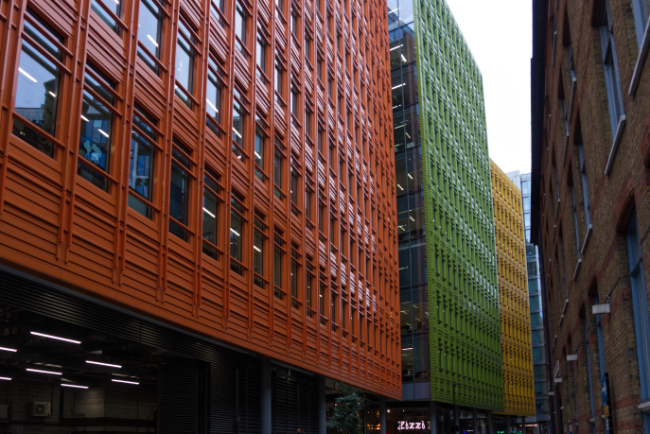
I don’t want to speculate too much but I’m fairly sure such a machine would strongly suggest that investment in any sort of building, including housing, is now no longer about meeting social need but in generating profit. That the destruction – construction cycle is because buildings are now generally speculative ventures with the purpose of enriching the capitalists at the expense of the proletariat. There, I’ve said it, it’s all about class war. Which actually it is.
(Don’t look now) …there’s already loads of really good housing
All over England there is a great legacy of high quality, low cost, well designed council housing. And yet since 1980 that housing has been insulted, sold cheaply and bought dearly and turned from homes into ‘investment opportunities’.

Over two million of those council houses have been sold and 40 percent are now owned by private landlords. Many are of those landlords are small, both spiritually and in terms of their portfolios. There are an estimated 2.5 million of them with a disproportionate and unfair hold over other people’s lives. Some are opaque companies based in off-share tax havens with a great deal of cruel power.
When this housing was owned by the council, payment of housing benefit – a necessary safety net when someone is out of work or sick or circumstance change – went back to the council. Now, something like £20 bn a year is paid out in benefits to people living in ex-council housing and that goes straight to landlords. And some of those landlords don’t even pay tax on it. A landlord’s paradise as Bano describes it.
Why does Utopia Always Seem Behind Us?

I am not against buildings; far from out. There is a great need for refurbishment of poor quality housing stock across England. Perhaps open up colleges for people to learn building skills in Middlesbrough, Hartlepool, Sunderland, Maidstone, Plymouth and all the other urban areas which need much better quality environments. Train up local people; create tenant cooperatives. Enable a relationship to develop between a person and their home (which is impossible with the dominance of landlordism).
Imagine the drop in depression, alienation and atomisation if people could say, ‘I learned how to fix my house and now I live here as I want it and it’s well within my budget’. Might this not be part of the real basis of community?
The excellent history and legacy of public housing in England is matched all over Europe (and possibly the world but I’ve not yet had the chance to study that). In Amsterdam, Vienna, Berlin, Frankfurt, Zurich, Paris and elsewhere. A great body of intelligent learning and ideas. The sort of observations and thinking of Josef Frank, Christopher Alexander, Margarete Schutte Lihotzky, Catherine Bauer, Jane Jacobs, Steward Brand and a great host of architects, designers and planners who have had an input into some truly great low cost, good quality, well designed housing.
Is this story being taught in schools of architecture, is it being taught in schools of construction and engineering? Is it something public administrators and civil servants learn? Is it of any interest to those powerful think tanks, often right wing, who have so much influence in public life?
Is Westminster abuzz with the ideas and examples of Red Vienna, when housing was built around the principles of air, light and space? Where the housing was supported by clinics, schools, kindergartens? Where it was paid for by general taxation, including wealth taxes and landlord taxes, to ensure an absence of debt for future generations? Where rents were less than 10 percent of income?
Is anyone studying the Cite-Jardin of Suresnes, built under the administration of the socialist mayor Henri Sellier, from the outset designed to be an urban community with a core principle being to support the development of the child?
Are there any proposals for trade unions to build and manage housing, for the self-autonomy of tenants cooperatives? Could a New England be better built by handing land directly to people so they could self-build, to remove the speculators, developers, estate agents and all the non-productive and non-essential labour?
No one needed those classes during the house building of the 1920s and 1930s. In fact there were controls on their activities. No one needed huge armies of consultants and media campaigns It all spoke for itself.
Housing was integrated with health care, community centres, theatres, music schools, cinemas, dentists, maternity clinics; civic dignity, municipal pride. A sense of place. Public responsibility. That the rich would be taxed to pay for general welfare provision for all. That society as a whole would be the village in which the child would grow, in which the old and sick would be tended for and cared. That when a person fell, many helping hands immediately reached out to help.
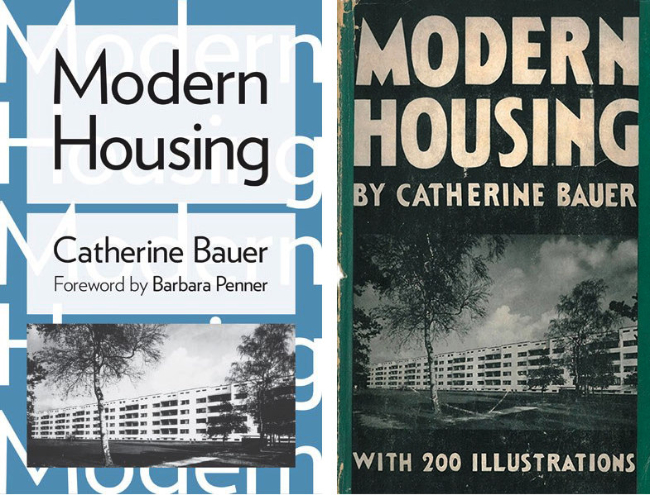
Catherine Bauer visited Europe in 1933 and published Modern Housing in 1934 based on that experience. Among her conclusions were that land values and land prices must be controlled. Governments have a responsibility to ensure housing. Modern housing should be built. High quality, low cost and well designed.
She estimated that between 1919 – 1934 over 4.5 million houses and flats were built by local authorities, many controlled by socialist, reformists, democrats, progressives and even Marxists. It is estimated that around 16 percent of the population of Europe was re-housed. The underlying principle was that this housing was built for public use, not private profit. That housing must be removed from the realm of profit and be provided as a social necessity.
This may seem strange, but stay with me. We don’t need to build that volume again. It’s already there. The threat it faces is privatisation, private landlordism and neglect. It faces the threat of commodification; of how homes are turned into housing units. The housing stock is being worn down by the capitalist principle of profit. The idea of shelter as being an essential human necessity is being eroded.
It feels like I study housing in fits and starts. It becomes all engrossing and I tramp the streets of urban England and when resources allow, tramp the streets of urban Europe.
In England it often becomes depressing and overwhelming. The gloating landlords getting rich, the Orwellian language of ‘housing providers’, the nauseating bile of media campaigns, the vacuous nonsense of politicians and policy deciders.
At the top, driving all this on, the shiny happy people who make immense amounts of money from the housing ‘market’. At the bottom, the sorrow and misery of people living in damp and mouldy conditions, fighting infestations, crying because they can’t feed their kids properly, sleepless nights over rent arrears and bills, the endless insecurity of ‘no-fault’ evictions.
The struggling relatively well-to do. The breaking of friendships because someone bought their house 30 years ago for £20 and it’s now worth half a million; but their friend didn’t, and now pays more than half their income on a flat which the landlord refuses to repair. It creates endless social inequality and no community will ever be built on this.
Perhaps I should drink the kool-aid. Open my mind to the verbiage of meaningless slogans, hypocrisy at ever level, enrichment for the few and exploitation of the many.
But I’d rather not. The streets are alive with people and ideas, the once great council estates still create powerful nodes of dignity, pride, working class bohemia, proletarian fighters and organic intellectuals. I’d rather catch a smile on a breeze of someone who really gets it than have my brain fried by speculation in housing provision.
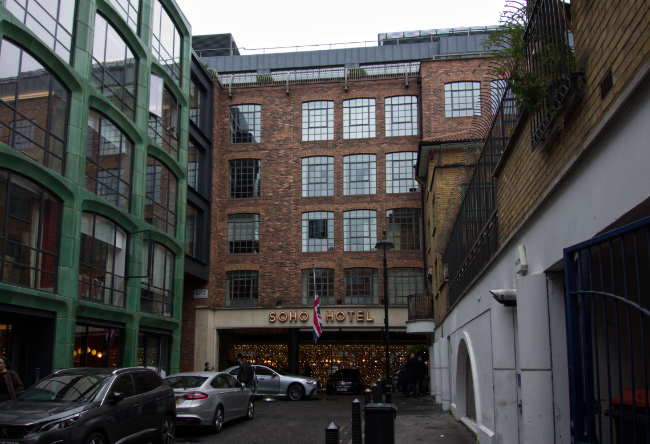
I was exploring Soho in preparation for my walk. I noticed a hotel and thought I’d give the man outside a line of talk. I asked him if he knew anything about the history of the building. He looked at me with that professional style hotel workers have. Friendly enough but with an edge that there will be no taking of liberties.
‘It used to be an NCP car park’, he said. ‘This used to be entrance’, he pointed to a large glass panel covered in golden lights.
‘Just a minute’, he said.
He escorted a group of scantily clad women in high heel shoes from the door of the hotel to a waiting line of chauffeur driven cars, ‘there’s are two film premiere’s this evening’, he said as an aside.
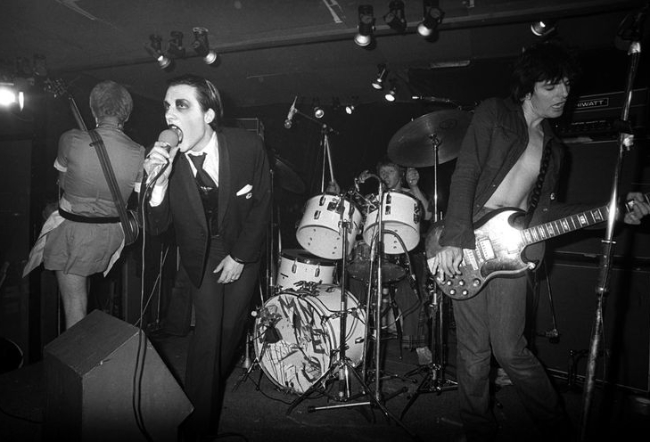
He came back and told me a story about driving to London 40 years from ‘a village in the middle of nowhere’ with a mate to see The Damned at the Marquee Club. And how they had spent the night in his mate’s car in this very car park.
‘If someone had told me that forty years later it would be a posh hotel and I’d be working here….’ he tailed off and smiled, as if contemplating four decades in the flash of a cosmic second.
It was a good story. The building is a good example of refurbishment. It means that the stories of the past can be connected with the present. Surely that’s part of life as well?
And that everyone deserves that kind of madcap weekend, even if just on an occasional basis. And where we live and how we live should help support the comedy and chance of life as much, no, in fact more than, profit.
In fact that should be the purpose of housing. To support life. That’s it.
No More Buildings: A Radical Walk
Sunday 1 June 2025
Meet at Richmond Buildings (just off Dean Street, Soho, W1) at 2pm
 Commodity Fetishism
You must be logged in to post a comment.