
This is based on a Radical Walk that took place on Sunday 8 June 2025 as part of the London Festival of Architecture. It’s a longer than usual blog pieces because I get regular messages from people who say they would like to come along but for various reasons they can’t. So this is for all of you.
The meeting point was the main entrance to Tate Britain at 2pm. People started to arrive in ones and twos and then I began to get the usual messages on my phone. ‘What bus do I catch ?’ ‘I’m going to be 30 minutes late, where will you be at 2.30pm?’ ‘Can my friend come along?’ ‘I’m at the Tate Modern, where are you?’

A good crowd of people assembled and after a brief introduction we set off. And here’s a write up of some of what we saw and heard.
Millbank Estate
The industrial and agricultural revolutions of the late eighteenth century created an immense expansion in the global productive forces, population sizes and urban areas. There was no coherent approach to urban planning or governance.
Until the creation of the London County Council in 1889 (it started to operate in 1890), London was ‘managed’ by over 300 different organisations with some notional control by the Metropolitan Board of Works; or ‘Board of Perks’ as it was known because of the widespread scandals, malpractice and corruption.

From the 1880s onwards mass production developed, alongside mass trade unions, mass socialist parties and the influence of the ideas of Marx’s Capital into sections of the working class.
Small, but surprisingly influential political parties and groupings formed; the Social Democratic Federation (1884), the Fabian Society (1884) and the Socialist League of William Morris and Eleanor Marx in 1885. That was also the year the Report of the Royal Commission on the Housing of the Working Classes was published. It was to be the only comprehensive report of that character for more than 75 years.
In 1888 women workers at the Bryant & May factory in Bow, East London, struck work and won. Throughout 1889 gas workers in London struck work and won shorter working hours. In August 1889 dock workers in London struck work and won a pay rise. Large numbers of manual labourers who had been percieved as being impossible to organise had achieved the impossible. The balance of power between class forces in London changed.
The working class was now much larger, more industrial, increasingly literate; and as these strikes and embryonic socialist organisations showed, becoming more political. To the ruling class this was threatening. They not only faced competitive pressures abroad from the rising capitalist powers of the USA and Germany but pressure from below. In the very streets of urban areas, and in the workshops, ports, factories, warehouses and centres of production. It is in this context that the LCC started to develop its initial housing programmes.

From its inception until 1907 the LCC was controlled by Radicals and Progressives and people who would help found the Labour Party.
An Architects Department was created in 1894 which included a seperate section on ‘Housing for the Working Classes’ which was headed by Owen Fleming, a committed socialist. He had earlier lived in working class housing in Stepney. One of the architects within that team was R Minton Taylor who was the main architect for the Millbank estate.
The original blocks were intended to house 4,430 people and are all named after artists, a nice reference to the nearby Tate Britain which was built in 1897. The purpose was to rehouse people displaced from slum clearance and road widening schemes. All the flats had hot water and inside toilets and supported by caretakers. The large courtyards provided safe play space and sheds were avialable to store prams and bicycles. Two schools were built as part of the plan.
The architecture is influenced by Arts and Crafts style and ideas. These ideas were transmitted in part by the Central School of Arts and Crafts established by the London County Council in 1896, under the leadership of William Lethaby. The Art Workers Guild, also an influence, had been established in 1884.
Millbank Estate was one of 42 housing schemes built by the LCC between 1890 – 1907. In that year the Progressives lost the election to the Municipal Reformers and the first phase of LCC housing came to an end (although many metropolitan boroughs continued to build good housing).
It’s worth exploring the estate. There’s no rush. Note the towers on the corner of Ruskin House and the layout of the estate, the staggered windows which provide light to stairs, the pram and bicycle sheds and the use of planting. It’s possible to discover the former wall and ditch of the Millbank Penitentiary.
Make your way to Vincent Street.
Westminster Estate
The chequer-board design flats are possibly unique in London. They were designed by Edwin Lutyens who is much better remembered for country houses, war memorials, commercial and public buildings. Note the lodges and their gates. Built between 1928 – 1930 as housing for the working classes.

The hand of philanthropy can be felt here. The Grosvenor Estate granted a 999 year lease to the Metropolitan Borough of Westminster and £120,000 towards the costs.
I personally prefer Lutyens country house type stuff. There is a lot of peeling paint here at the moment and the concrete looks as if it’s beginning to degrade and flake. As ever, the real verdict must always be with the tenants, and that can be difficult for outsiders to discern in any meaningful way. These balconies have lots of plants and that’s always a good sign.
In 1990, Westminster City Council went to court to argue that this housing no longer needed to be designated for ‘the working classes’ as the term was now meaningless. This would have enabled the council to sell them in an open market. The Duke of Westminster disputed this and argued that the flats should be retained as low-rent accommodation. A High Court judge agreed with the Duke, and not the council.
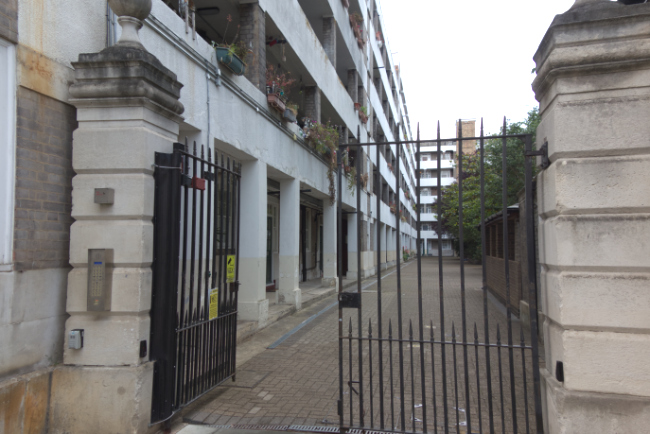
Continue along Vincent Street until you come to four red brick mansion blocks, the Regency Estate.
Regency Estate
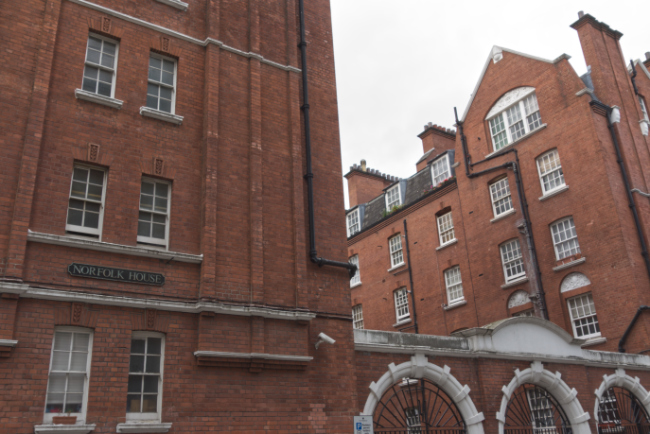
This was built by the Metropolitan Borough of Westminster. There are four blocks. The architects of Jessel, Probyn and Norfolk were NS Joseph & CJ Smithem, built between 1902 – 04. The architect for Schomberg House, built 1926 – 27 were Ashley & Newman.
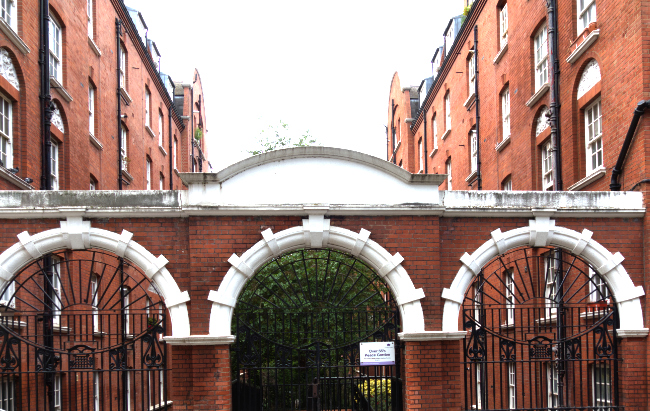
Nathan Solomon Joseph also designed synagogues and was known as a social reformer. He was the architect of the original Jews Free School in Bell Lane in East London.
The Arts and Crafts style is bolder than Millbank, a little fancier with a baroque touch. It’s worth looking carefully for the detail of the brickwork, window styles and ornamentation.
A good test of any housing is ‘would I like to live here?’ In this case, yes please.
As part of the research I discovered that some recent maintenance work had been completed by a property services company called United Living. They have recently been bought by a New York based asset management company called Apollo. They have assets of over $700 bn and are known for risky investment strategies.
Public housing provision in all its layers is being taken over and controlled by private equity firms. Is this the ‘community’ that the developers promise?
Now slightly come back on yourself until you find Horsley Close. There is a public right of way through there, although most of it is private.
Regency Apartments
This is a gated ‘community’ completed in 2002 on the site of a former gas works. The developer was Barratt Homes and design by Assael Architects. Barratt Homes are one of Britain’s largest house builders. They have faced multiple criticims and actions for poor quality build.

It is complete with concierge, secure underground parking, gym, communal gardnes, spa, jacuzzi and steam room. It shows what can be done.
I did a show-of-hands-survey here to ask whether people liked it, didn’t like it or were indifferent. The majority clearly liked it. I would agree. The design is modern, it’s very green and for a central London location it has a great sense of privacy.
When I spoke to residents in one of the reconnaissance missions I do before the walk itself they said they liked it too. Apart from the service charges which they clearly did not like.
The service charges seem to be imposed by the Regency Apartment’s Management Company. Someone please correct me if I’m wrong but there are so many different layers, and such a lack of data it can be difficult to work out what’s actually going on.

I looked up the directors of this management company on the Companies House database. It’s all in the public domain. One person – and not to particularly pick on them personally – is described as an artist. They worked for Damian Hirst for seven years. There seems to be a north Devon connection. I wrote to the artist innocently asking them what experience or knowledge they might have in managing housing. To date I’ve not had a response.
You can walk alongside the estate through the public right of way. If it’s after 6pm the gate will be closed but it will open with the push of a button.
You will now be at the other side of the Millbank Estate
Millbank Estate Play Area
The title of the walk is ‘Where are the Socialist Voices?’ and this is a useful place to consider that of Henri Sellier.
He became the Director of the Office of Affordable Housing for the Ile de Seine in 1915. Sellier was a militant socialist, a contemporary of Lenin, Trotsky, Luxemburg and others. He was involved in the debates that led to the creation of the Third International. He was also an urban planner and well organised and efficient administrator. He helped instigate several garden cities in the periphery of Paris.
One of these, the Cite-Jardin de Suresnes (I must write up my notes) is a fantastic example of what can be done. It was built with three schools and the centre piece is the fabulous Théâtre Jean-Vilar of Suresnes.
The whole ensemble was designed to support the development of the child.
It is all still working well. There’s a museum of Sellier relatively nearby which is also well worth a visit. He refused to cooperate with the Nazi occupation and when he died in November 1943 they banned any form of funeral procession. On the day he was buried thousands and thousands took to the streets in defiance and to pay their respects.
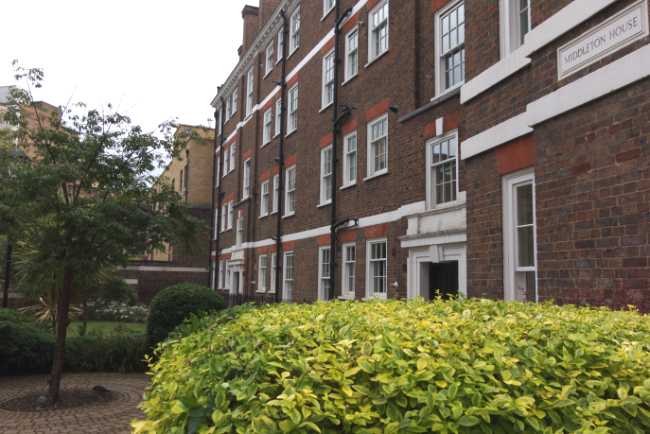
You will now come out on to Causton Street. There are two medium rise blocks of Middleton House. These were build by the Church Commissioners in 1934.
A short walk along Causton Street and you’ll be in Regency Street.
It’s worth going north for a hundred yards or so to have a look at Hide Tower properly. Although you can probably see it from where you are.
Hide Tower

Hide Tower was built by the Metropolitan Borough of Westminster between 1959 – 1962 using prefabrication processes and techniques. This was generally cheaper (although there is at least one tower block in Westminster with a brick facade, Glastonbury House in Warwick Way). This was once one of London’s tallest buildings.
The block looks to be of good quality and anecdotal evidence suggests its popular . Some tower blocks have a ‘good reputation’ and some have a ‘bad reputation’ (rather like pubs and people). These differences can be build quality, provision of services, congierces, costs, design, intelligent design.
Walk back along Regency Street until you find Rampayne Street on the right hand side. Cross Vauxhall Bridge Road at the lights. It’s a busy road and used by people who like to drive too fast while their car makes exploding noises. It’s all very miserable; and dangerous too.
On the right is the Lillington Gardens Estate
Lillington Gardens
I would suggest going free-style walking at this point to explore the estate properly. You could walk through the estate or walk along Tachbrook Street. If you walk up towards Warwick Way you’ll find shops, places to eat and drink and on certain days, a market.
I have to make a confession here. I never, ever drop litter but I’d bought a slice of pizza from a great shop and a tiny bit of paper blew out of my hand as I was trying to avoid getting covered in melted cheese, olive oil and tomato paste.

Someone who could be described as a street drunk shouted out, ‘Oi! don’t drop litter!’ I apologised and picked it up, about the size of postage stamp, and put it in bin. As I walked back passed him he said, ‘you shouldn’t drop litter!’
To which I replied, ‘I listened and I changed it’. He didn’t give me a thumbs up or any sort of camaraderie but a look of, ‘don’t do that again’.
It’s this sort of street interaction, and its importance, that Jane Jacobs describes so well in The Death and Life of Great American Cities. I think Jacobs over-cooks her anti-planning thesis at times but what she says about the eyes and ears of streets is spot on.
Jacobs cannot be described as a socialist in a way that a lot of people would define the term but personally I think socialism needs constant feeds from all sorts of people and ideas. There is a great deal to learn from Jacobs. I for one have no desire to see the development of the Stalinist type of housing that some people seem to associate with the ‘progress of the proletariat’.
Anyway, about Lillington Gardens.

There was already housing on the site, deemed to be of poor quality. Westminster City Council made a compulsory purchase order to buy the complete site.
The estate was built in three phases between 1964 and 1972. The architectural competition specified that St James the Less church was to be retained and that estate would be supported with schools, playgrounds, a tenant’s hall, car parking, accommodation for the elderly and community buildings.
The competition was won by John Darbourne who then set up a partnership with Geoffrey Darke to work on the project.
The estate combines a high density of people and a medium scale of building. It was in part a reaction to the discontent that had quickly developed towards the high rise system of prefabricated tower blocks.
Note that there is also the Longmore Gardens Estate which was the extension of Lillington Gardens built between 1978 – 1980. There is a much more detailed description here.
Something that’s noticeable about the estate is the sense of space, light, air, quality. These were all principles established during the early years of the housing and welfare programme of Red Vienna.
In 1919 the city became the first major city in Europe to be run by a majority socialist council. The economic and political circumstances were grim and tough and yet laced with an intense sense of optimism. Economic dislocation and inflation caused by the collapse of the Austro-Hungarian Empire; a hopeful future imagined by the revolutions in Russia, Germany, Austria and Hungary.
One of the first moves of the socialist council in Vienna was to appoint Hugo Breitner as Director of Finance. Breitner put down a hard line. The planned housing for the working classes would be paid for through city wide taxes, taxes on landlords and luxury goods. He was insistent there would be no debt.
Between 1919 and 1934 the socialist council built over 64,000 homes supported by schools, kindergartens, maternity services, mother and baby clinics, playgrounds, paddling pools, communal gardens, parks, sports grounds, cinemas, theatres, studios for artists, workshops for craft workers.
When you start looking you can find the influence of Red Vienna everywhere. And many of the artists and architectures and designers involved in that had also been influenced by Arts and Crafts and the ideas of Garden Cities; and the work of the London County Council. See how the walk is developing?
The bit that needs to be much more widely adopted now taxing the rich, the landlords and the property speculators. If it was possible in Vienna in 1925 it should be possible in London in 2025. But perhaps we first need a revolution and the destruction of empire?
While you’re exploring look out for Cave, a vintage shop and gallery on Tachbrook Street. It was once a storage space for the caretakers. It’s good fun and worth browsing through.
Head towards Pimlico Underground station and look out for the Bessborough Centre on Bessborough Street.
Bessborough Centre
This was opened in 1937 as the Westminster Maternity and Child Welfare Centre. It already has the air of the Welfare State and a free NHS about it. But it would take a world war and huge pressure from below before those were realised.
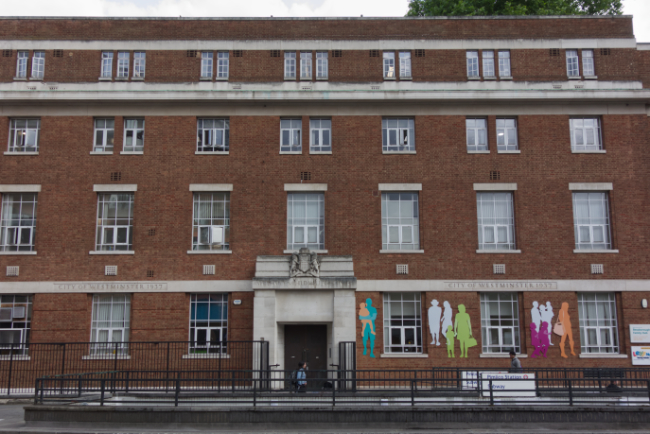
The architect was F Milton Harvey who also designed the adjacent Tachbrook Estate that we’ll come to in a moment.
The centre included a maternity and child welfare clinic, ante-natal clinic, demonstration and weighing room, doctor’s room and health visitor’s room, all on the ground floor. On the first and second floors was a day nursery, three bathrooms, kitchen, dining rooms, staff bedrooms and night nurseries. On the third floor were additional nurses bedrooms, laundry and drying room. Here we find in practice an approach from the cradle to the grave. This was adopted in different ways throughout much of Europe in the interwar years.
In Britain today 1 in 4 children who start school are not toilet trained. The Child Poverty Action Group estimated that 4.5 million children, 30 percent of all UK children, are living in poverty.
Tachbrook Estate
The first phase of the Tachbrook Estate was opened between 1935 – 37 for the Westminster Housing Trust and consisted of seven five storey blocks. The architect was F Minton Harvey. It is now managed by the Peabody Trust.

I somehow got tangled up with one of the residents in conversation. She initially thought I was some sort of official. She explained she could go on for hours. ‘Give me one thing that’s a problem’, I suggested.
‘How long you have to wait for repairs’, she instantly replied, ‘ four and a half years so far’.
‘And the smell of the druggies downstairs smoking dope’.
One of the most interesting point about Tachbrook however isn’t the slowness of repairs or the zombie state of some people (who can be found anywhere). It’s the fact that the land was sold below its market value by the London County Council. Cheap land means cheaper housing.
Development is all about increasing land values and thus the price of housing rises in, and around, development areas. Trying to square the circle of development and ‘affordable’ housing is an impossibility which is why so much is spent on marketing to fix everyone’s heads to believe in something that is essentially unbelievable.
If we want housing that we can afford in relation to our income then we must drive down land values. It’s as simple as that. I mean, land could even be socialised. And it should always be remembered that the vast majority of land, if not all, was stolen in the first place. The legal stuff about title deeds and contracts is all much later than the violence which wrenched land from people who were using it for their immediate productive, social and community needs.

If you walk around the estate look out for the commemorative plaques on the older blocks. If you walk into Aylesford Street you will see the later phases of the estate on one side, and a row of solid terraced housing on the other.
I can’t trace the terraced housing in Aylesford Street but I guess it’s mid nineteenth century. I did discover some sad and poignant stories about the street, including an article from the Evening Mail from Thursday 5 September 1867.
It describes the death of a four month old baby, the son of a grocer’s clerk who had died of choleraic diarrehoea and convulsions. In one week during this period it was recorded that 208 children and 18 adults had died from diarrhoea; that is, cholera, across London.
One of the reasons why mass trade unions, socialist organisations and ideas about reform, and revolution, began to form.
Walk back up towards Lupus Street and turn left.
St George’s Square
It’s a typical London square laid out by Cubitt in 1839. The houses are grand now and would have been grand in the nineteenth century. They represent the expansion of that most elusive sociological grouping, the middle class.
Everyone talks about the ruling class and the working classes but the middle class just seems to plod along, dominating the creative arts (which they have turned into industries), running government departments, corporations, and public services, along with the local coffee shop and sour dough bakery. They have their own ideas, style, manners and mode of thinking. They are greatly underestimated.
It’s worth going to look at St Saviour’s church. Built in the neo-Gothic style in the 1860s by Thomas Cundy as part of the Cubitt estate. The Pevsner for Westminster describes it as ‘quite large and prosperous’. Part of its modern fame is that Princess Diana once worked at the kindergarten there as a play group assistant.
The square is a perfect place to have a rest and a cup of coffee and a cinnaman bun. Which I did one Sunday morning and thoroughly enjoyed it. There’s a good bakers nearby in Moreton Street that you could try.
A Gap Where Pimlico School Used to Be
Well perhaps not exactly. Pimlico School was built by the Greater London Council in 1964 – 65. It was designed by John Bancroft. It lasted forty years. Part of the problem was the design and then it got caught up in the expensive muddle of Public Finance Initiative policies and the ignorant and mendacious interventions of Michael Gove. Demolition began in 2008.
The Pimlico Academy replaced it but the moat still remains and that’s currently being used for car boot sales.
The schools built as part of Millbank Estate were built 120 years ago and still in use.
Dolphin Square
There isn’t anything connected to Dolphin Square that’s much to do with socialism. Although Harold Wilson once had a flat there. Does that count?

Take the first left (it’s not really a road) from Chichester Street and there’s a door on the right hand side. If you’re lucky that door will be open and you can walk through an art deco inspired shopping arcade. Note the curved glass of the shop windows. At the end of the arcade you may have to turn right and then left and then left again. There is currently major building works going on. You should now be in the gardens of Dolphin Square.
I’ve included Dolphin Square in this walk because there is far too much housing for the working classes which was too small when it was built and is too small now. In a sense I think the aim should be this type of housing which was intended for the middle class. This is why the Millbank Estate has worked so well. It was highly aspirational; and that’s what housing should be.
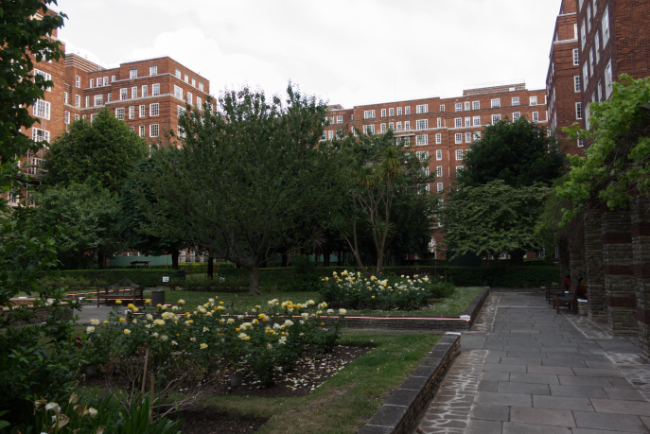
Dolphin Square was built on the site of the former Royal Army Clothing Depot. The Social Democratic Federation decried the shocking conditions experienced by the workers there, many of them women. The Suffragettes sold newspapers and held meetings outside and in the surrounding streets. It even gets a mention in the first volume of Karl Marx’s Capital.

Walk through the gardens and come out at the southern end of Dolphin Square, through the wrought iron gates. There should be one open.
Cross Grosvenor Road by the traffic lights and turn right. Make your way about a hundred yards to the wall by the Thames. As you do so note how the river front has effectively been privatised and how gates have been installed to prevent access.
Across the River….Nine Elms
So far we’ve seen a mix of working class and middle class housing from a period of about 150 years. Across the river there’s a brief glimpse of the future. I say brief because none of this is designed or planned to last more than 50 years or so. Some might say even that’s too long.

It looks like junk because it represents a particular form of junk capital. This is what happens when any sense of planning is abandoned and capital, some of it corrupt, is allowed to do what it likes.
It was from the Nine Elms development that the writer Ann Minton conjured up the term ‘dark light’. This can best be seen at night. Look up and see how many floors of the buildings are not lit. Dark light. That’s because no-one lives there.
It’s estimated that around 40 percent of Nine Elms could be flats which are ‘buy to leave’. Investors from Hong Kong, China, Malaysia and elsewhere buy the flats with no intention of ever living in them and with no intention of anyone else living in them either.
Thames City was developed by R+F UK and CC Land, both Chinese companies. Believe it or not, the Chinese property market is even more dysfunctional than that in Britain.
Over the past 30 to 40 years, around 500 million people have moved from rural China to rapidly expanding urban areas. Capital accumulated, tower blocks built, fortunes made, debts piled up.
Two major property developers involved in this, Evergrande and Country Garden now have respective debts of $300bn and $150bn.
The size of the debt is such that the Chinese government either will not or cannot support a bail out. But there are so many small investors involved that the Chinese government cannot allow a general collapse. It is like a giant balloon full of water. Who will get drowned when it bursts?
The ex-wife of one of the Evergrande founders owns 33 luxury apartments in Nine Elms. She is currently part of a major investigation under way into what is said to be the largest fraud to emerge from mainland China.
Churchill Gardens
Cross back over Grosvenor Road and you will be at Churchill Gardens. The estate was built between 1947 – 1952. The architects, Philip Powell and Hildago Mayo, were both in their mid twenties.

It is bold and ambitious housing of 36 blocks over 31 acres. There is a mix of seven to nine storey blocks, terraces, flats and maisonettes. There is plenty of open space and facilities and a sunken garden area. It’s best to explore by wandering. For detail, a copy of The Buildings of England – London 6: Westminster’ is essential (indeed for the whole of this walk). These books can be pricey but it should be possible to photocopy the relevant pages at a local library.
I’ll let you peruse the different views on the architecture for yourself. What I will do is to put Churchill Gardens into some sort of political context.
During the Second World War the government realised that there could not be any sort of return to the 1930s of industrial depression in the north, slums everywhere and a lack of generalised universal welfare provision. In 1942 what became known as the Uthwatt Report was published Report of the Expert Committee on Compensation and Betterment.
The original recommendations of the report were watered down but what did come through was that there needed to be control of speculation in land values and that the method of compensation to land owners needed to be sorted out.
If land prices rose as a result of state sponsored development then the landlords should pay higher taxes on that land.
The Uthwatt Report has been somewhat over-shadowed by the much better known Beveridge Report. This was published in November 1943, just after the allied victory of the second battle of El Alamein which Winston Churchill described as one of the turning points of the war; ‘Before Alamein we never had a victory. After Alamein we never had a defeat’.
The Beveridge Report and a shortened summary sold 650,000 in three weeks. Mass Observation reported that 19 out of 20 people had heard of it. Regardless of the detail, it was widely regarded, then as now, as a good thing. That at last people would see improvements in the provision of welfare, working conditions and much more. Housing was a central theme of the report.
Shortly after the war ended in Europe, the incumbent Tories called a general election on 5 July 1945. Churchill expected to win. He and his government and party were comprehensively defeated. The mood of the country, the mood of the armed forces was for substantial, lasting change.
As troops began to return to Britain they were reunited with their families and soon discovered chronic housing shortages and the stench in the air of war profiteers and black marketers. A large squatting movement developed involving more than 50,000 people. Hard conditions for people made worse by the harsh winter of 1947. There was a significant wave of strikes involving miners, dock workers, London bus workers and others.
And that was all going on regardless of the nationalisation of the Bank of England, coal mining, civil aviation, railways, road haulage, gas and electricity, some docks and harbours and the creation of the National Health Service.
Something had changed in Britain. And in the immediate post-war period there was a sense of progress with the people, of a more consenual, less class-conflict approach. Churchill Gardens represents that mood. I think it still retains some of that today.
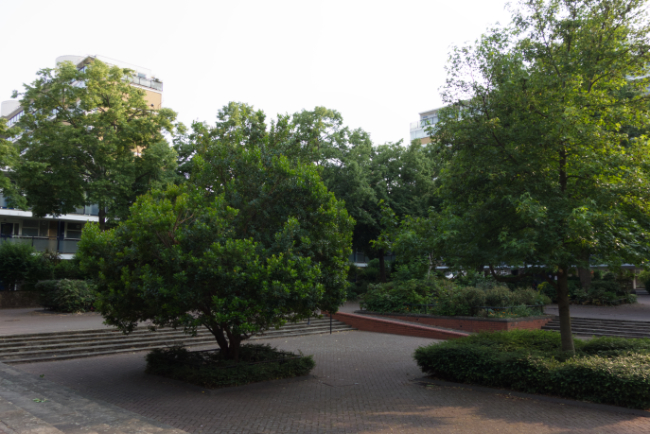
Dark clouds gathered over the provision of public housing in Britain with the election of Thatcher in 1979. Selling off council housing, degrading tenants rights and constant attacks on local government and trade unions has created a huge mess for working class people trying to find inexpensive good quality housing. The beneficiaries have been private sector volume house builders, corrupt investors, fraudsters and criminals from around the world.
Inside this cauldron all sorts of stupid ideas simmer away and sometimes boil over and spill onto the ground. If you walk through the estate you’ll notice a new block. It’s aimed for ‘shared-ownership’ and that sort of new-fangled untested type of financing. A mortgage might go on for 45 years.
There was perfectly good housing where this block stands (it’s been demolished). And a bit of play space and a section of the historic wharf wall. But someone drank a lot of the ‘jobs, opportunity, community, sustainability’ kool-aid and decided good housing could be destroyed and irreplacable open space reduced. Many estates in London now face this threat. It’s really all about profit. A great deal of obsfuscation goes on to try and present it as something else.
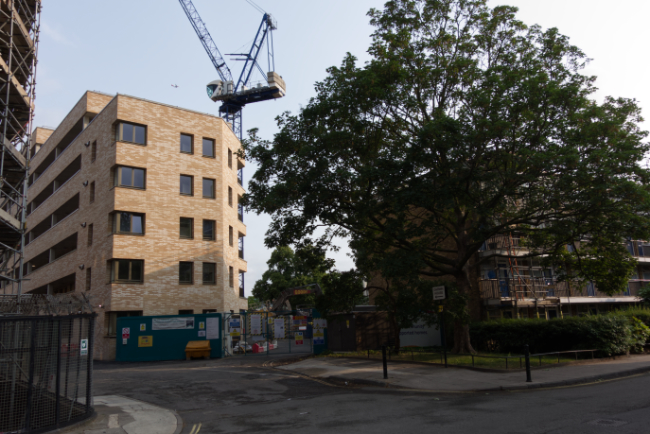
And basic principles of light, air, space are replaced by other principles of profit, greed and ignorance.
And that brings the walk to an end. I agree there should have been more socialist voices but you’ll find those elsewhere on this blog and if you come along, on plenty of the walks.
What I wanted to show is that there is a fine legacy of good public housing in London. And that much of that housing was built, designed and planned by people who were influenced by John Ruskin, William Morris and William Lethaby and others.
That there were deep commitments to socialism and to the idea that housing for working class people should be of high quality, good design and low cost.
A couple of days after the walk I was invited to a reception to celebrate the reopening of the Maison Dieu in Dover, some of which had been adapted and renovated by William Burges.
One of my table companions explained that she restores illuminated and medieval manuscripts. She was fascinating company. She had once held in her hands one of the four original copies of the Maga Carta. A symbol of rights.
I asked her how she started the conservation process. ‘By looking’, she said, and seemed to peer into a space where something magical and fantastic from another age was hovering above the table. ‘I look for a very long time before I do anything’.
And perhaps that’s what needs to happen before any further in-fill or development projects or housing schemes take place. That a long time is spent looking at what we already have.
And let’s bring the idea of the Magna Carta into this and accompany that long look with fundamental rights for tenants, housers and everyone who needs, and deserves, a decent home.
The next Radical Walk will be on Thursday 10 July:
Empire of Corruption
 Commodity Fetishism
You must be logged in to post a comment.