
When the starting point is unclear it can be helpful to aim for something well known. This is why tourists swarm to Trafalgar Square, the Eiffel Tower, the Taj Mahal, the Statue of Liberty. It’s a way of anchorage, of finding bearings. And if nothing else, it means a sense of having arrived; after all, many millions of other people have arrived at these places too.
With a field trip to research public housing, this is slightly harder. In Vienna, even the casual visitor could stumble across Karl Marx Hof in a guide book. But a visitor to Paris would be lucky to discover the Garden City of Suresnes by chance. And where would the clues and references be for those unfamiliar with the public housing of Berlin, London or Zurich?
By chance while trying to step into the history of public housing in Amsterdam, I discovered an advert for an exhibition in the city on the Garden City Movement. It was being held at Het Schip museum and due to shortly close. I booked a ferry crossing and a zig-zag rattly train journey and a few days later set off.
I stood on the deck of the ship and looked out over the sea and talked to someone who had once been a refugee and built up a life for his family far away from the bombs, machine guns, snipers shooting children, the deliberate creation of famine and the war crimes of the Middle East.
Within a day or two I found myself in Hilversum (a pile of notes and photographs are in the queue to be sorted out), a twenty minute train journey to Amsterdam Central. And from the main station, a twenty minute walk to the exhibition at the Het Schip Museum.
I enjoyed the exhibition and joined one of the walking tours. At the museum shop I discovered Giuseppe Giolitti’s book Amsterdam and the ‘Droom in Baksteen’ which was exactly the book I needed. I had found some starting points.

The particular historical circumstances of the Netherlands meant that the country was relatively late to the industrialisation of the nineteenth century.
Once that process started all the usual things followed; steel making, engineering, railway building, factories, large construction projects, the expansion of ports, technical developments, widespread social and political change, the exploitation of the working class within capitalist relations of production. And the accumulation of capital in the interests of one particular class.
Industrialisation always manages to produce a great new mass of people. In 1800 the population of Amsterdam was 200,000. By 1900 it was 510,000. In the next twenty five years the population grew by 40 percent to 725,000. Where would all these people – essential for production – actually live?
The development of mass production in the capitalist world from the 1880s onwards helped create trade unions and socialist and communist parties for the masses. With a certain form of industrial production, a certain form of workers’ organisation. The Netherlands was one of the first countries where workers and intellectuals organised a communist party.
But there was no political revolution in the Netherlands to accompany the industrial revolution. The revolution was in the sixteenth century against the Spanish Occupation and for religious and mercantile freedom. The burghers painted by Hals and Rembrandt developed into a capitalist ruling class. Over several centuries the Puritan white ruff was replaced by the black tie and collar.
The state wasn’t overthrown and no monarchs were marched to the guillotine or scaffold. The monarchy was re-established in 1815 when the Kingdom of the Netherlands was created following the defeat of Napoleon.
Even so, the rapid expansion of capital and new relations of production created social tensions and pressures. And events at an international level helped to intensify internal class conflicts. Imperialism and colonialism, increasing competition of capital, the first world war.
Revolutions in Russia, Germany, Austria, Hungary, all within a day’s train journey from the Netherlands; the speeding up of news and communications with the telegraph, telephone and the increase in literacy and mass circulation newspapers.
In 1901 a Liberal- Progressive government introduced a Housing Act (Woningwet) and Education Act (Leerplichtwet), creating the basis of welfare statism. The legislation helped to established the conditions for an extensive house building programme. In 1905 the Woningwet was strengthened with the introduction of robust building codes which defined standards for safety, durability, hygiene and more.
These were favourable conditions to effect social change; but effective change needs social forces. The Dutch working class displayed its potential power with general strikes in February and April 1903.

These strikes were only partially successful in terms of winning immediate gains. However, they expressed the unrealised power of the working class and it was clear that socialism, anarchism and communism were becoming influential ideas in the heads of many people, including dockers, railway workers and wider layers of the labour movement.
A number of effective reformist politicians, able administrators and left-wing artists, architects and urban planners now found space in which to influence and shape public debate and housing provision.
The socialist commitment was the most important determinant in how the building of public housing developed. This socialist theory and practice included the municipal ownership of land, the control of land values and the prevention of land speculation.
Three of the politicians are described here but there were many others. This is after all, just a sampler, a starting point.
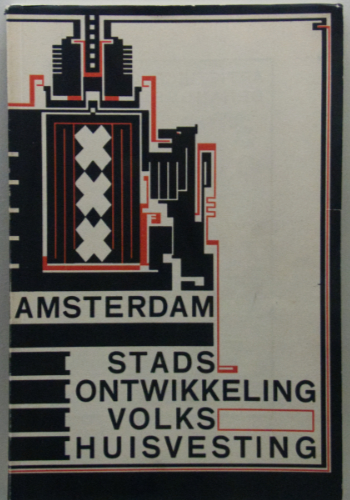
Floor Wibaut came from a wealthy family and was involved in prosperous business activity before becoming a socialist. He joined the Sociaal Democratische Arbeiderspartij (SDAP), the Social Democratic Workers’ Party in 1897.
He attended a number of congresses of the Second International including that of 1910 when Clara Zetkin proposed the establishment of International Women’s Day. He was the representative of the Dutch social-democrats at Henry Hyndman’s 70th birthday celebrations in London in November 1914.
Wibaut was a member of the Municipal Commission for Public Health from 1907 – 1914 where he directly witnessed the filthy and degrading conditions in which many people in Amsterdam lived.
He became the Wethouder, the Alderman for housing in Amsterdam between 1914 – 1927.
As well as housing he was concerned with the general welfare of the working class; advocating for central kitchens, free school meals and cheap coal for the low-paid. Once the housing programmes started he defended its quality against accusations from the right that it was ‘excessive’ and ‘too luxurious’ for workers.
He was close personal friends with prominent Dutch communists including Frank van der Goes, Herman Gorter and Henriette Roland Holst.
Wibaut earned the sobriquet of Die Machtige, ‘the mighty’ for his work on the city council. For many years he had a close and effective working relationship with Monne de Miranda who we will return to in a future article.
Arie Keppler was the Director of the Gemeentelijke Woningdienst Amsterdam (Municipal Housing Department of Amsterdam) from 1915 – 1937. He argued that good quality housing was a civic responsibility, that a high standard of design was important for public health and community living.
He supported the ideas of the architects of the Amsterdam School seeing a positive relationship in good architecture and good living.
Jan Willem Tellegen was the head of the Dienst Bouw- en Woningtoezicht Amsterdam, the Amsterdam Department of Building and Housing Inspection between 1900 – 1910. He then served as mayor from 1915 to 1941.
He was a political moderate and a determined and effective administrator. He helped introduce welfare reforms across the city including in the spheres of housing, health and education and the modernization of public transport, sewage and street lighting.
He died shortly after the workers’ protests in Amsterdam in February 1941 against the increasing persecution of the Jewish people of the city by the Nazi occupiers.
There was support and commitment from the municipal administration for a creative and artistic approach to the delivery of housing. This helped to ensure good quality, well designed housing and encouraged the formation of the Amsterdam School of architecture.
This style was characterised by working with brick, the integration of art and architecture, the use ornamentation and sculpture as integral to the overall design of a building, ensuring that craft was the foundation of construction and a particular and profound relationship between architecture and public housing. Three key figures are briefly sketched here, but again there were many others.
HP Berlage (1856 – 1934) had an immense influence on the development of both the architecture and the planning of large parts of the city. His influences included Romanticism, Eugene Viollet-de-Duc, William Morris, Arts and Crafts, Modernism, Frank Lloyd Wright and others. Like all thoughtful creative people he absorbed a great many ideas and then produced his own original ones.
Michel de Klerk (1884 – 1923) had been apprenticed to the architect Eduard Cuypers. A committed socialist he was one of the leading figures of the Amsterdam School. He favoured brickwork, careful attention to detail and architecture that could be described as Gesamtkunstwerk; a total work of art. He closely inspected the building process, from brick laying to the consistency of the mortar.
This is a very good overview of Het Schip and Michel de Klerk by Suzanne S Frank written in 1970 and with photographs by her husband which show how well lived in the estate was, and is.
Piet Kramer joined the Public Works Department in 1910, shortly after Joan an der Meij had been appointed the ‘aesthetic advisor’. He designed buildings and bridges and is responsible for much of the particular city-image atmosphere of Amsterdam of the 1920s and 1930s that continues to valorise throughout the city. Kramer was influenced by Sufism and natural forms.
Margaret Kropholler was the first female architect to join the department in 1915.

Building and planning working class housing on the scale carried out in Amsterdam in the early twentieth century was a new endeavour. What should the housing look like? How should the streets be laid out? How should utilities and transport and open space and schools and services be designed and where could they be placed? As can be seen a 100 years later, the underlying socialist ethos answered many of those questions rather well.
One great problem with reformist approaches to housing provision is the constant tension between available funding, budget constraints, right wing and landlord opposition and expectations.
The Housing Act of 1901 enabled housing associations and cooperatives (in 1922 there were 1350) to borrow long-term, low interest loads from government. Workers could buy shares which gave them voting rights. Any profit from rents were to be re-invested into housing. In 1918 rents were adjusted to be 16 percent of a tenant’s salary.
Many housing associations were created from within the labour movement and from social and religious communities; Protestant, Catholic, Jewish, socialist and others. Some were of workers in the same industries and occupations. This lead to a further workers’ influence on how the housing was developed.
Between 1915 – 1930 over 135,000 homes were built. Most of these are still extant.
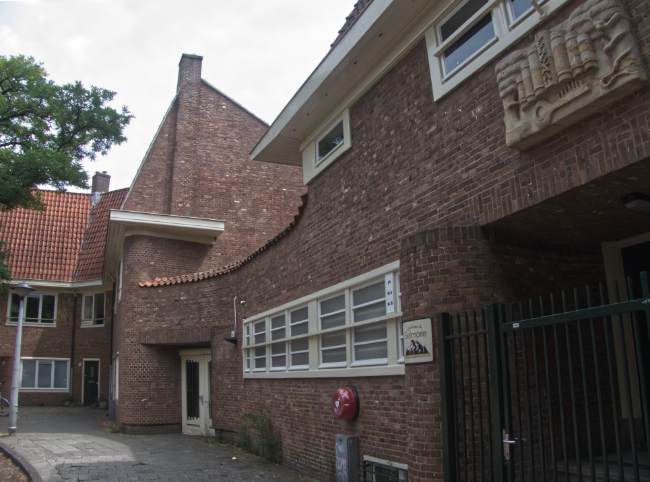
This legacy is excellently summed up by the Harvard scholar Hanneke van Deursen:
“Social housing makes up 29 percent of the total housing stock in the Netherlands. These social units, which in 2022 rented for an average of €561 per month (or about $600), are noteworthy because of the decentralized network of 284 independent, nonprofit housing associations (called woningcorporaties) that build, maintain, and operate the country’s social housing.
Surprisingly, the Dutch housing associations—whose portfolios range from 400 to over 80,000 units—do not receive any direct subsidy from the government to fund their activities. Instead, their operations are sustained by revolving funds of rental income.
New social housing construction is funded with the housing association’s excess rental revenue, long-term loans, and equity from unit sales. These features of the Dutch social housing system—that it is a decentralized system of nonprofit organizations independent from the state; that they own almost one-third of the country’s housing and keep it off of the market; and that the system requires no direct state subsidy—make this system a fascinating case study for policymakers around the world looking for new models to address affordable housing crises”.
It is worth reading both her papers at the above link.
And if you want to get a glimpse into the Amsterdam of the 1920s and of today, here is a small photo essay of two of the well know public housing landmarks, Het Schip and De Dageraad.
Het Schip was constructed between 1919 and 1921 to provide 102 homes for local workers many who were employed in the local dock and riverside industries. The block is built of brick with distinctive ornamentation and tile work. It included a community hall and post office, with a telephone booth designed for privacy.
There is a rather curious tower which has no ‘function’, unless creating enigma in a building is consider to be functional. Het Schip was designed by Michel de Klerk as a total mass and yet it isn’t monotonous or repetitive.
The building flows and bounces with a wavy rhythm and there is a surprising variation in texture of materials. Brick, tiles, concrete, glass are all in harmony with trees, flower pots and verdant communal gardens.
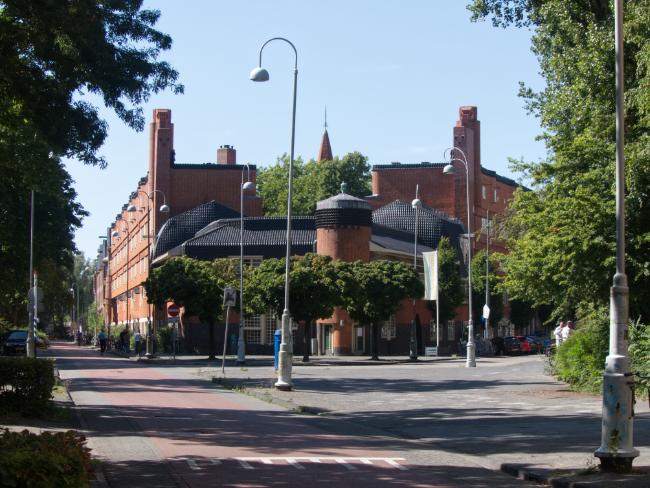
How I first saw Het Schip. Many of the first tenants worked in the nearby river industries and railway yards. This was a complex site to build on due to its triangular shape.
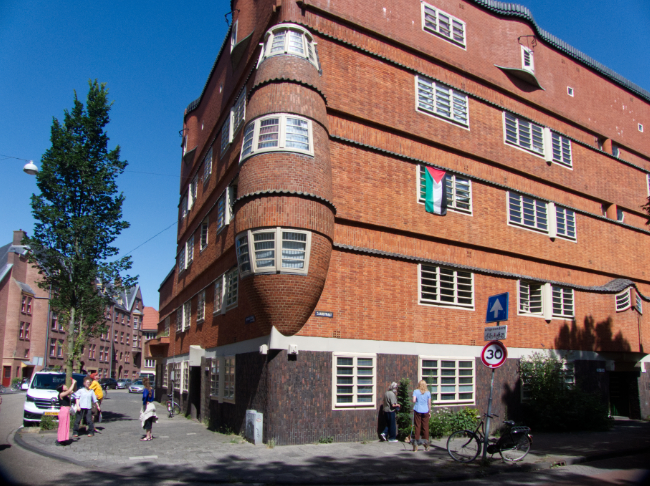
A rather fabulous tower. There were always lots of people around while I was exploring. It felt very neighbourly. The Palestinian flag speaks of the solidarity that exists.
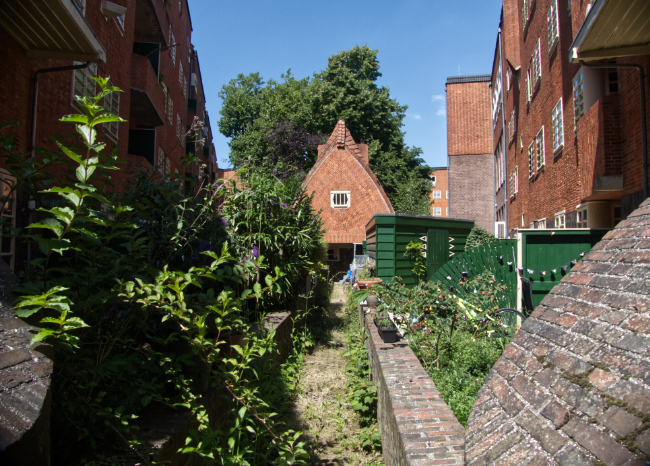
Gardens and communal space within Het Schip

Reproduction of an original kitchen. Running hot and cold water, inside toilets, homes free from damp, mould and vermin.
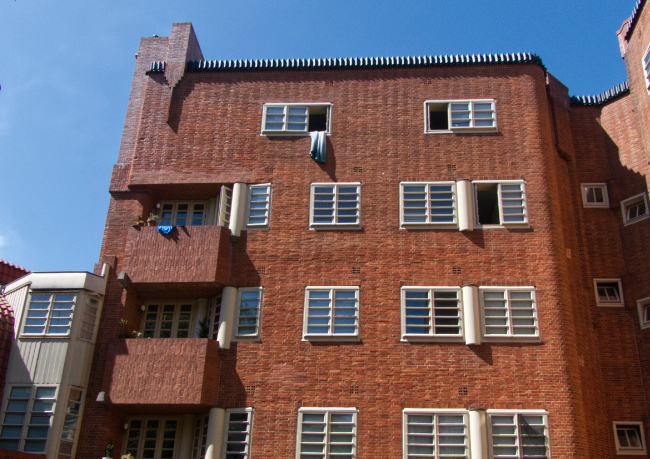
Washing hanging out of windows and draped on balconies is a signifier. In many contemporary ‘developments’ in London this is prohibited.

Not just a wall, but art as architecture and architecture as art
De Dageraad was built between 1919 and 1923. The architects were Michel de Klerk and Piet Kramer. It was a consciously socialist initiative.
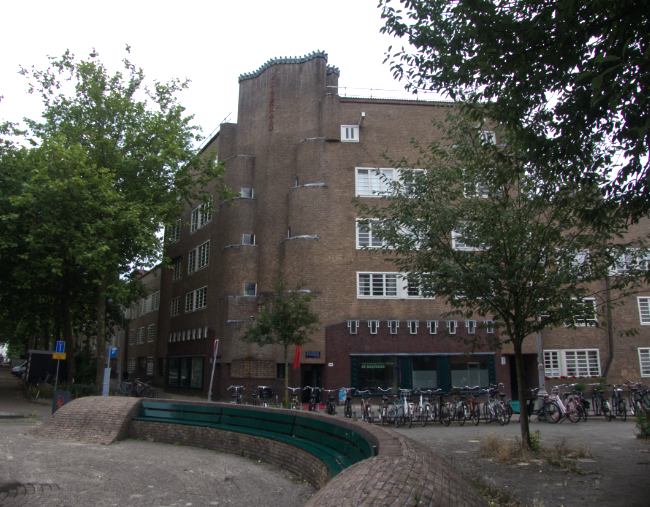
One of the De Dageraad blocks which now also hosts the museum
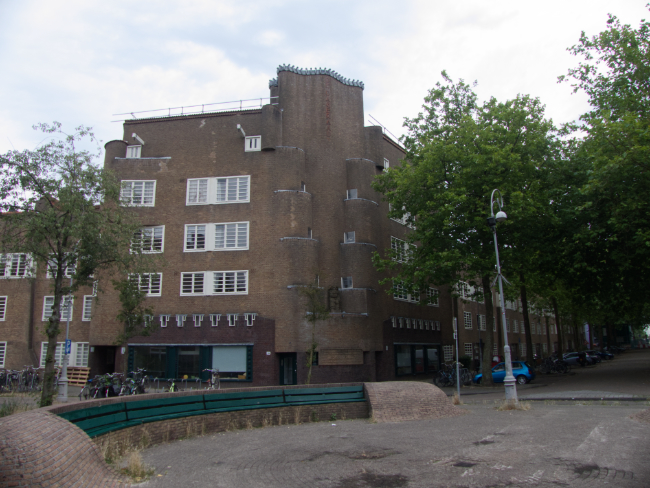
The other side of the street. If I had thought about this I could probably have taken a single photo. But I’m sure you can piece it together in your mind’s eye
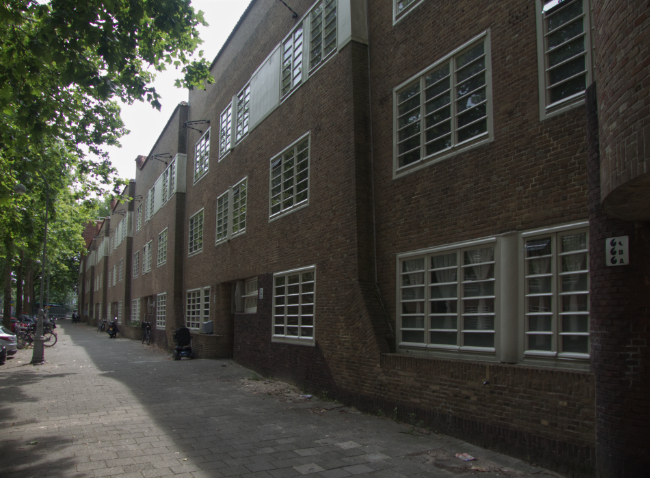
The street was deliberately designed with significant width

This is such a clever way to deal with the corner of a large housing block. The sculpted brick is the sort of luxury the right wing opposed. Why should the workers have luxury? Why indeed.
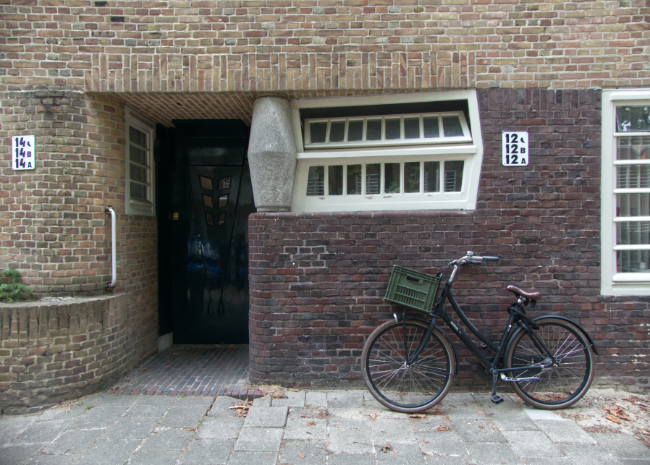
Good brickwork, a home, a bicycle and a pleasant neighbourhood. Is this really so difficult that it can no longer be achieved in England?
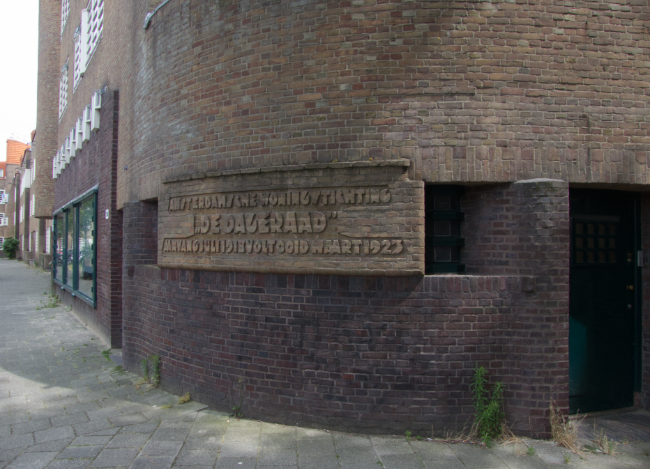
A dream in bricks from 1923. Meanwhile in England in 2025 rented housing is expensive, poor quality and with few tenants rights

Worm’s eye view
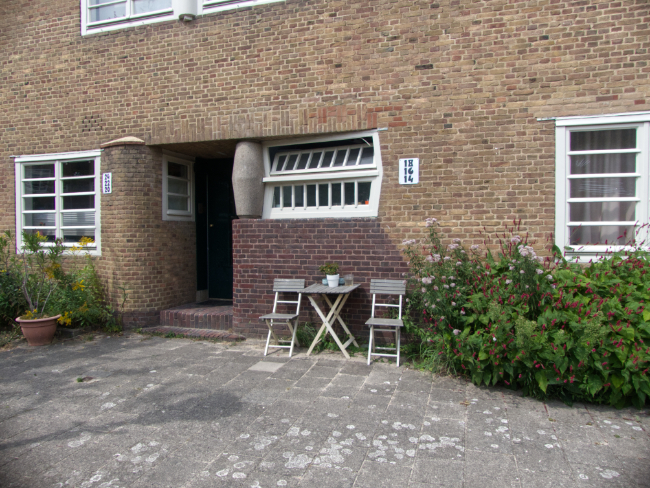
Sometimes – probably always – a table, a couple of chairs, a bit of space free from cars and a some flower pots are enough to build community. Much more effective than costly consultants waffling on about ‘community, opportunity and sustainability’.

Reproduction of a worker’s flat in the museum
And that concludes this brief outline. More to follow, but there is so much to learn.
The story of Amsterdam’s public housing will be woven into the Radical Walk, ‘Housing is more than Houses’ on Thursday 14 August 2025.
More details here.
 Commodity Fetishism
You must be logged in to post a comment.