
I have to accept that a write up of a Radical Walk will never be along the lines of, “meet outside the Bishopsgate Institute, turn left into Artillery Row, proceed in a southerly direction to Middlesex Street, note the estate on the corner, here is the heart of the East End; it’s quite some distance from the bleak moors” and a thousand other cliches. That’s not really how Radical Walks work. It’s more like this:
On the day of the walk itself I realised that something wasn’t quite right. I couldn’t make the walk work in theory and therefore it wasn’t going to work in practice. I stood outside the Bishopsgate Institute, the starting point, wandering what to do. I watched the constant flow of people on the pavements. Perhaps an new idea would emerge.

A woman wearing a white halter back top and beige coloured wide trousers, looking at her phone, held upright, her gold-brown hair blown away from her face. A line of red buses, on the way north to Hackney and Islington, their compatriots driving south to London Bridge and Southwark. I’m waiting for something, unfamiliar and vague, simultaneously concrete and abstract.
The two places I really want to show people are Principal Place and the Boundary Estate. And then I realise that they needed to be at the start of the walk and not the end. The rest would fall into place.
Walking in the opposite direction to the original plan also revealed the streets and buildings in different ways, new perspectives, previously unseen angles.

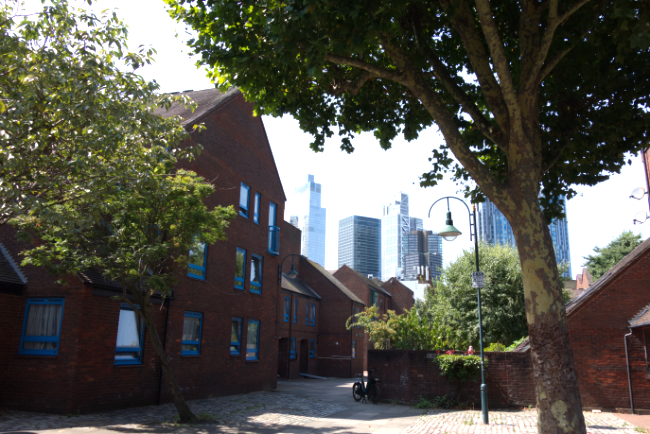
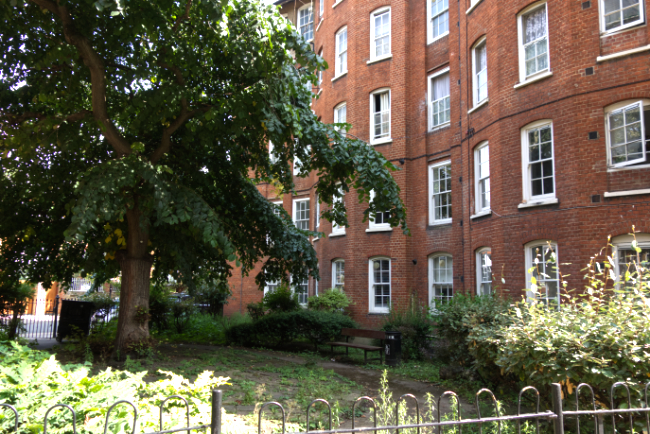
In Quaker Street I noticed a London County Council block that I guessed was from the 1930s. It can be difficult to trace the history of an individual block. Web searches just produce endless lists of property to rent at inflated prices, or properties for sale. Flats built with public money effectively handed over on the cheap to private landlords. And in the process rights are lost and housing costs increased.
A young guy was standing outside a flat on the ground floor smoking a cigarette.
‘What’s this estate called?’ I asked him, looking for a line of talk.
‘It’s Wheeler House’, he said.
There were a few brief encounters of words, and then we found our balance into a proper conversation. I learned that it’s basically an ok place to live.
‘These people here’, he pointed to the next flat, ‘are Bengali’ and then he sort of indicated with his head, just a fraction, ‘these people are Afro-Caribbean, another Bengali family, those people up there are English, and then along there, they’re English too’. I guessed he was English-Bengali. It was all said naturally in a voice and tone that said, ‘this – is – London’.
‘It’s a good community’ he said, ‘and the flats are ok’.
The problems?
One flat had been rented out on airbnb and for some months there were endless parties. Another problem was the 24 hour economy.
‘It’s not bad really’, he said, ‘but it’s there all the time, always people and noise’.
He pointed to a flat that was now privately owned. ‘They pay £2,400 a month. If you’re a council tenant it’s about £800 a month’.
I sense Red Vienna here and the Dream in Bricks of Amsterdam. The influence of Josef Frank, Michel de Klerk, Pietr Kramer, Margarete Schütte-Lihotzky and others can be traced in the curve of the balcony. There is something of an earlier socialist tradition that could be found in cities across Europe in the 1920s and 1930s; London, Berlin, Paris, Amsterdam, Brussels, Prague, Frankfurt, Vienna, Zurich, Warsaw, Leningrad….and possibly many other places. I always feel to be a scholar who has only just begun. I have only researched so far. There is always much more.
He reached out his arm to shake my hand. ‘I need to go back in’, he said.

We stopped outside Wheeler House on the walk and I explained this story and added, that this is the experience of many people’s lives in England. And yet it is rarely reflected in the right wing media. Why would they? Their narrative is hate, division, bellum omnium contra omnes; that language, the tone, the voice of everything they say is aggressive, deliberately misinformed, provocative and bullying.
I wonder sometimes if there are more effective ways of opposition than trying to meet noise with noise. Is the answer to the dominance of capital; convivality? Is the antidote to noise; creativity?
And while we were standing outside Wheeler House I added the story about how earlier in the day I’d been at St Pancras station. An elderly woman was slowly moving forward firmly gripping a stroller and trying to manoeuvre a suitcase at the same time.
‘Do you want some help?’ I asked
‘It’s my husband’ she said in broad Yorkshire accent. ‘That’s him and he’s got dementia’.
She looked up at me from her crouched position over the stroller. I could see an elderly man slightly ahead with two large suitcases.
‘You wait here’, I said, ‘I’ll go and get some assistance’. I think she was reluctant to let go of her suitcase to a stranger.
I went into the Eurostar terminal. The first staff member I found told me he wasn’t allowed to leave his position but if I could bring them into the terminal area (it was about 20 yards away) he would sort out some help. I went back to see the elderly woman.
‘Are you going on the Eurostar?’ I asked.
‘No…’ she said, ‘we’re going to Newcastle on the L – N – E – R’. She spelt it out.
Another man turned round and said, ‘can I help?’
‘I don’t mind if you do’, she said
‘I’m going to Newcastle’ he said, ‘you come along with me’
And then one of the railway workers from Kings Cross Station came out to help. And now this elderly couple were surrounded in a protective bubble; right here in the streets of Kings Cross. And with their guard and helpers they went to catch their train.
‘Thank you’, she said looking at me directly, ‘thank you’, she repeated. And a taxi stopped in the road and the driver nodded to her as she slowly crossed to the other side.
And so I continued my reconnaissance and traced out the steps that we would follow later. Into the Boundary Estate, along Wheeler Street, into Commercial Street, a cut through into Jerome Street and a manufacturing district, Corbet Place and into Hanbury Street, a turn into Wilkes Street, a pause at Puma Court, and then into Fournier Street and Brick Lane.

In the passage way between Brick Lane and Flower and Dean Estate some boys on bicycles were racing, with the freedom that all children deserve.
But did you know that children are bombed and shot and killed by snipers and machine guns and bombs? Here on earth? But where? And who does this shooting and bombing? Who is blowing up their houses and placing their teddy bears and toys on the front of tanks and military bulldozers?
Into Wentworth Street and Toynbee Hall.
I stop and have some lunch at a newly opened Japanese restaurant. Fried duck, boiled rice and steamed pak choi. It’s delicious and to celebrate the recent opening there’s a 20 percent discount.
I walk around the Middlesex Estate which was constructed between 1968 – 1972. There were still building unions in London at the time. What of their future now? A half a century and more away, a time of revolutionary talk in the streets of Paris, workers and students on the barricades; climbing on the top of Russian tanks in Prague. A workers’ state being invaded by a workers’ state? Something is wrong with the practice, perhaps it can be made to work in theory. The ideological and practical destruction of American imperialist power in Vietnam.
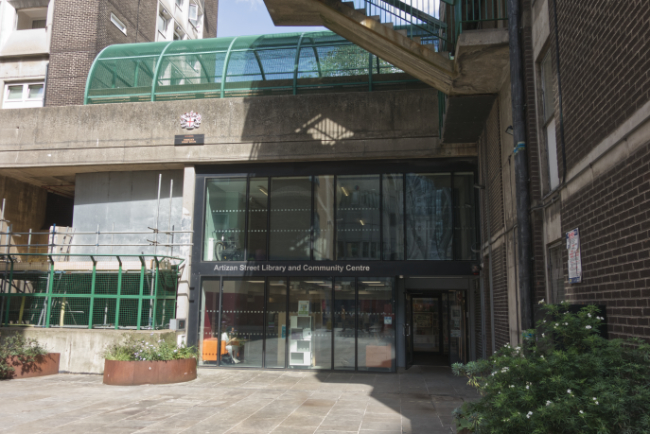
The estate was built with a library and community centre which are still being well used. I sit in one of the comfortable chairs reading the Financial Times, taking a half interest in all the other people who are paying serious attention to newspapers and computer screens.
This idea of the late nineteenth century reformers, of reading places for the working classes; nicely put into practice. I should like to see inside the estate as apparently it has a central area of greenery.
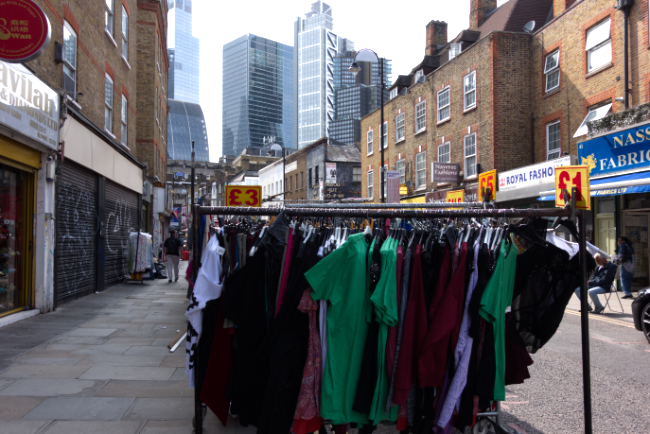
I finish this version of the walk by exploring a little of Old Castle Street and Petticoat Lane and conclude at the Holland Estate built by the London County Council in 1928. Someone stops and we talk and he tells me that a few years ago it was badly neglected and run down and that it was going to be demolished. It survived and it’s looking good from what I can see.
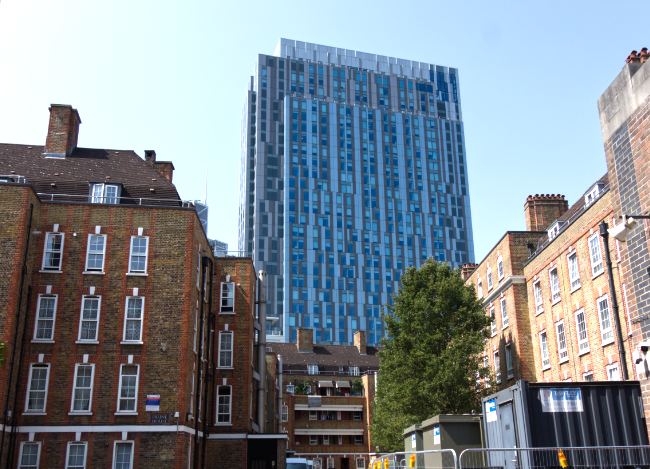
I need a break from this intensity and walk to Uncorked in Copthall Street. It’s a City wine shop and most of the bottles cost more than I would spend. However they sometimes have bin ends and a couple of wines on special offer. And a cheap-ish bottle of wine from a high quality retailer is always good. I buy a bottle of Bordeaux at a very reasonable price and it turns out to be an excellent choice.
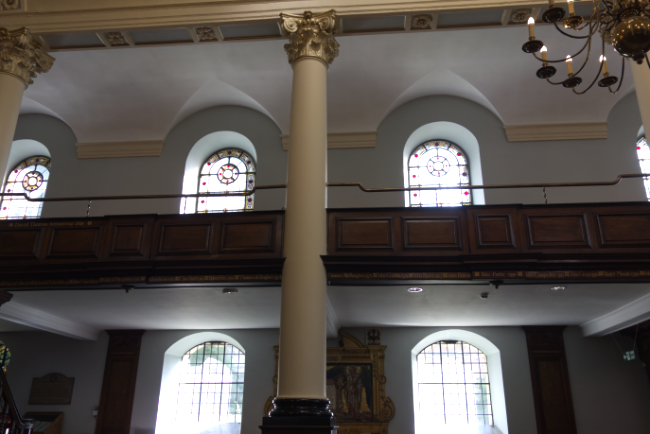
And then I sit in St Botolph’s church. I’m the only person there and study the stained glass windows and am aware of the city sounds somewhere in the distance and now they are beginning to fade, perhaps I’m in a time machine, the fractal patterns in the glass are of red, blue and gold, they slowly blur and now they merge into one single light….I wake up twenty minutes later feeling refreshed and with a clear head.
There’s still an hour before the starting time and I sit on the raised steps of the Broadgate building and watch the workers once again. People checking their reflections in the mirror glass facades, business casual fashions, swiping through phone screens; affairs, disasters, latest news and gossip. Trump will extend a handshake and red carpet to a war criminal; Putin acknowledges the attention with an ignorant and vicious smirk.
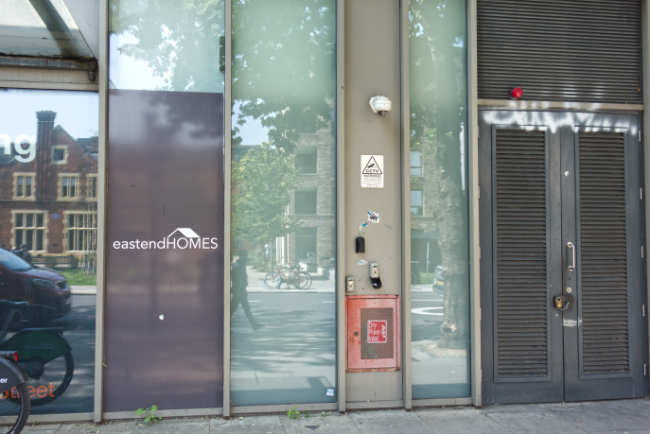
The workers continue with their flow and endless selling of labour power. In Russia, the United States, Britain, France, Nigeria, China, Germany, Peru, and here in London.
Receptionists, administrators, software developers, car workers, welders, financial consultants, ship builders, brick layers, steel erectors, advertising directors, project managers, database administrators, accountants, marketing juniors, data scientists, bus drivers, machine operators, retail assistants, hairdressers, train guards, local government officers, teachers, nurses, bin collectors, electrical engineers; who really speaks for them, in terms of their relationship with capital?
The Bishopsgate Institute is closed but I calculate that if I stand close enough I’ll be able to pick up the free wifi and check my email (it won’t work on my phone; it’s a known bug with no obvious answer). I lean against the glass doors and get the MacBook from my bag.
I become aware of someone on the ground who appears to be talking to someone; he’s talking to me. I look down. There is someone curled up on the ground in a sort of crumpled dignity.
He looks up at me and grins.
‘What you doin’?’
‘I’m picking up the free wifi’
His grin widens.
‘What are you doin?” I ask him
‘I’m writing a book’.
He asks my name and then he turns the pages of his A4 notebook and writes it down, the latest addition to a list of names. He writes left handed with a plastic biro, one of those pens that has the option of red, blue or black ink.
‘I’ve spent 39 years in jail’, he told me. ‘Not all at once’, an immense pain, anger and sorrow emit from his eyes.
We talk about London and places we’ve been and his hopes for having his story being made into a television drama. It wasn’t so much for the money, more that this story needed to be told.
‘My story is in this book….’ he said, nodding towards the book he was writing on the pavement outside the Bishopsgate Institute.
And he looked at me again and smiled, that turned into a wide grin, a mischievous sense of life, with half a mouthful of yellow teeth, just stumps and cracks really, but it was one of the best smiles I’d seen all day.
I passed him some money and he held out his hand and it disappeared into the layers of coats and shirts and vests. He looked so frail and so strong and as if one hundred years of a certain type of proletarian life lay there; from the Caribbean to Canning Town and everywhere in between.
We spent time just watching the street together as if we were the angels of the city, wondering how could we help, what kindness could be passed on. Whenever we exchanged words we looked into each others eyes. There was no shyness there nor any fraudulent behaviour.
In ones and twos people started to arrive, and then the group was assembled. We were part of this vast city; people walking by, some paused to look and listen.
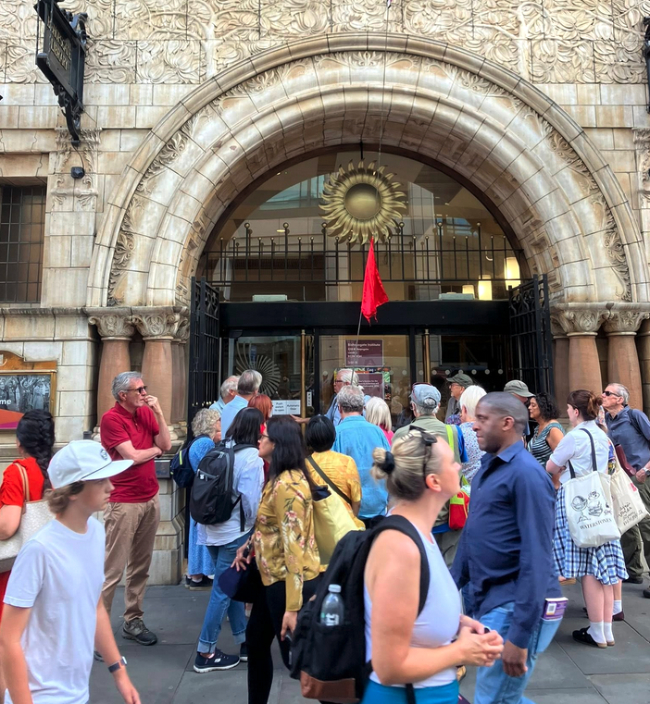
The Bishopsgate Institute was opened in 1895. The money came from a legacy fund owned by St Botolph’s church. In the 1890s the vicar of the church, William Rogers, realised there was 500 years of accumulated donations. This went back to the fourteenth century when people paid money to go to heaven. There are versions of this in the modern world too.
Rogers concluded that this pile of money could be used for philanthropic purposes and so the idea of the Bishopsgate Institute was developed. A Polytechnic for the People, with a reading room, a newspaper room, a library, lectures, concerts; a cultural centre in the widest sense.
The architect was Charles Harrison Townsend who also designed the Whitechapel Art Gallery and the Horniman Museum. It’s in an Arts & Crafts style, with lovely enigmatic twists; the two towers, the embroidery in stone, the use of tiles within, the hints of the coming Art Nouveau. The arched door was unique in this part of London in 1895 and it is unique now. An entrance into an enchantment.
The first librarian was Ronald Heaton but he was overwhelmed by the task and in 1897 Charles Goss replaced him. Goss was that type of organic intellectual that we lack in numbers and yet so desperately need. Born into poverty in south London he was one of those auto-didactic curious workers of the late nineteenth century, partly bought into being by the Education Act of 1870 that had helped to start the long process of increasing literacy and knowledge.
Goss was a good organiser and administrator and an even better strategist and tactician. Below the radar of the conservatives of the Institute board he spent forty years building up a huge library of socialist, trade union and working class history as and how it relates to London.
We were ready to move off.
‘I just need to say goodbye to my friend’ .
I went over to where he sat on the ground on a crushed cardboard box. He was still at work on his book. He raised a clenched fist and we bumped. Now when I write this I wish that I had suggested to the crowd to make a contribution to his cause. If you see him sitting there ask about his book, and at street level money is always welcome.
We walked north along Bishopsgate into Norton Folgate to Principal Place and the offices next to it. These offices are used by Amazon. I spent some time trying to work out how they pay less tax than they should. This cannot be easily explained in the street so I give a much higher level account. Even getting accurate figures is difficult. There is layer upon layer of obfuscation.
The main conclusion is that this company simply doesn’t pay enough. Another conclusion could be that if they paid more tax, 50,000 disabled people who are having their benefits reduced would not be plunged into poverty. I’m sure Amazon have some nonsensical corporate responsibility policy but I can’t be bothered to look. It will just be more vacuous nonsense.
Next to Amazon is a 50 storey building called Principal Place. It obviously could not be called Principle Place because it has none. Flats are one, two, three million pounds. Someone told me that the penthouses at the top are around £15 million. I would feel nervous up there; momentarily safe from the increasing number of wild fires (some of which have already taken place in London), but not so secure against earthquakes caused by fracking or the problems caused by the drying out of water tables. These places are not easy to escape from.

When I spoke to my friend earlier in Quaker Street he explained that there is a video on YouTube taken from the top floor, and his estate, Wheeler House, can be clearly seen. He thought this was funny; and it is funny.
‘Would you like to live there?’ I asked.
‘Who wouldn’t like to live there’, he replied with a laughing smile.
Would I like to live there? I’m not sure.
This block is branded as ‘The Unsquare Mile’. It’s almost an antitheses of an earlier irony. Or is it? See the trick in play.
Next to it is ‘The Stage’ a strange mass of neurotic concrete bullying its way into an earlier time. This earlier time is a muddle of nineteenth century buildings and railway arches and large factories converted into offices and apartments. It seems more chaotic, less bureaucratic. It also seems to be more popular and better lived in.
In the book A Pattern Language by Christopher Alexander, Sara Ishikawa and Murray Silverstein, 253 patterns are described These patterns can be assembled in different combinations at regional, city and living room scale.
Pattern 8 is ‘Mosaic of Subcultures’. There is no subculture visible in Principal Place and The Stage. These are monocultures, homogenised, standardised into a rigidity that is also expressed in the steel frame and glass facades of the buildings. Under communism everything will look the same.
How can a future emerge from so much dominance of capital?

We arrive at Boundary Street.
At the end of the nineteenth century, two anarchists, Fritz Katz and Charles Mowbray lived here and established a printing works. They lacked the means to buy all the equipment they needed and therefore used a paving slab as part of the machinery for printing. Both had been in the Socialist League and were good friends with William Morris.
This area was the well known slum of Old Nichol. In her book The Blackest Streets Sarah Wise describes its life and times in great detail. I still remember the shock I experienced when she describes how much money local landlords made from the slum. This relationship continues today; some of the worst housing proportionately delivers the biggest profits.

We walk around the Boundary Estate and up to the bandstand. It is quiet and tranquil and the Arts and Crafts design of the housing can be appreciated and the luxurious width of the streets which gracefully radiate from this central point. And the London plane trees planted over 100 years ago provide a canopy of shade and cool fresh air.
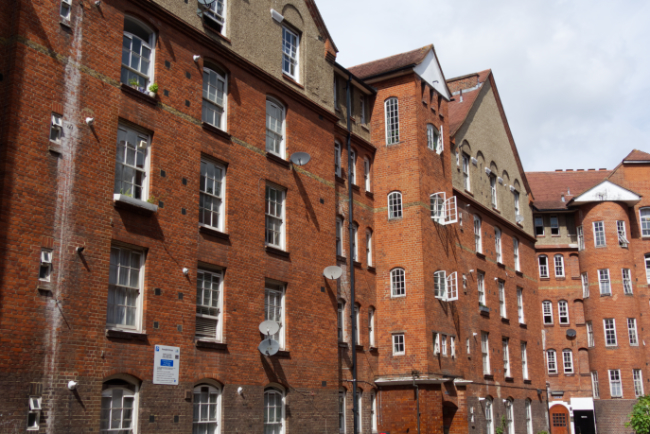
The estate was built in the 1890s to a design by the socialist architect Owen Fleming under the direction of the London County Council (LCC). It is an example of the once fine housing building undertaken by progressive and socialist councils and administrators in London.
The story of Miss Colley is told. She organised a contingent of women clerks from the LCC to march on the great Suffragette demonstration on Saturday 18 June 1910.
We briefly float over Europe; the Dream in Bricks in Amsterdam, the house building of Red Vienna; Frankfurt, Berlin and elsewhere. The idea set out by Catherine Bauer in her book Modern Housing that housing is more than houses; and that Modern Housing is that which is of good quality and low cost.
People ask question after question. Perhaps it’s just me but I sense the atmosphere changing; we become a collective with shared social energy.

For a long moment we stand in a semi-circle in silence, the murmur of conversation from the people on the benches, squeals of children playing in a nearby street, the hum and humdrum of London far away, over the seas and rivers, another place, were we imagine utopia might be; it cannot be. Utopia must be built here.

We walk through Wheeler Street where there’s a street party happening under the railway arches. Into Commercial Street to look at the first social housing built by Peabody in 1863. Their standard yellow brick square blocks come later. The rows of windows at the top are where the laundry, drying and bathing rooms were. I found a reference that they are now all private flats but these things need a lot of checking.
Into the factory district of Jerome Street and Corbet Place.
We stop outside Puma Court and the atmosphere changes again. There is a stillness of an earlier time, as if the very air is from the eighteenth century. Many of these houses were built by carpenters from the 1720s onwards. When carpenters arrived on site one of the first things they did was to make a wooden box. And into that each morning they would place their top hat.
Here is glass, wood and brick arranged in pleasing symmetries, slightly off-set, with individual quirks and peccadilloes. Why has this housing and this street pattern lasted so well and so long? It has weathered and matured and the houses have been built in such a way that they have successfully grown through three centuries. They seem as much about some sort of possible future as of things from a distant time.

We walk along Fournier Street. The attic windows where the silk weavers worked at their hand looms are pointed out. Then into Brick Lane, and through the arch where the children play and into Flower and Dean Estate. We conclude at Toynbee Hall; some commentary on the reformist movement of the late nineteenth century, the world of the New Woman, socialism, Suffragism, trade unions, an ambition for a better world, which continues still.
In the pub afterwards someone told a compelling story that while living in London, the Russian revolutionary Lenin, had visited the Garden City of Letchworth. And that this visit had a significant impact on the development of housing in Russia following the revolution of 1917. I enjoyed this tale, told while I supped on a cool glass of beer. My talking time was done; now I had the pleasure of listening.
* * * * * * * *
The next Radical Walk is on Sunday 31 August, ‘Karl Marx & the Mystery of Hans Röckle’
Meet at Richmond Buildings (just off Dean Street, Soho) at 2pm
More details here
 Commodity Fetishism
You must be logged in to post a comment.