
I wrote something that I considered I ought to write. An exercise for an imagined writing class. Or in response to one of those books, ‘How to be a Writer’. It’s not really ‘writing’ that’s the issue. There’s plenty of that. A large mass of it is incoherent, introspective and of no interest.
I didn’t think much of the piece that I felt I ought to write. It was flat and dogmatic, verbose and formulaic. There were words as exchange-values and ideas as acts of consciousness but there was a lack of voice and personality. It was an affected version of someone who wasn’t really me.
Then an idea started to form of what I should have written about on that sunny afternoon in the French countryside outside the town of Saint Omer.
I had started the journey a few days before on a ferry. The sea crossing was smooth and bright and I watched the shipping in the Channel and leaned over the rail and dreamed as the mass of metal churned the turquoise-blue water into a creamy foam.

I caught the train from Calais and enjoyed a few days in Saint Omer mainly idling and sitting in the market square, eating ice cream or drinking coffee with a croissant or two. I explored the shops and visited the esoteric Musée Sandelin. On evening I walked along the canal and that might have been the starting point to walk around the world.
I read The First International and After, a collection of documents, letters and articles from the 1860s by Karl Marx and Friedrich Engels, with an introduction by David Fernbach.

On Sunday morning I went to the Guy Delalleau pâtisserie on the corner of the Place du Maréchal Foch and bought a large cake as part of my supplies.
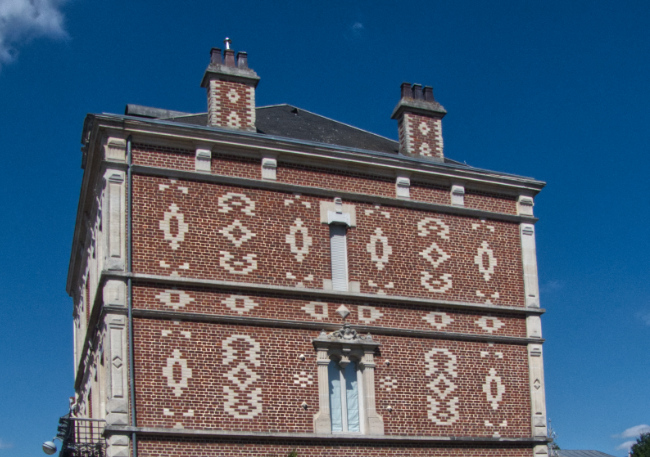
I walked through the quiet streets to the edge of town. Stone upon stone, brick upon brick, terracotta tiles laid out in neat rows with jumbled chimney stacks and pots poking through the roof tops. I wondered what the town was like in an earlier time before alienation acquired a digital dimension. I imagined the streets full of people, and without cars.
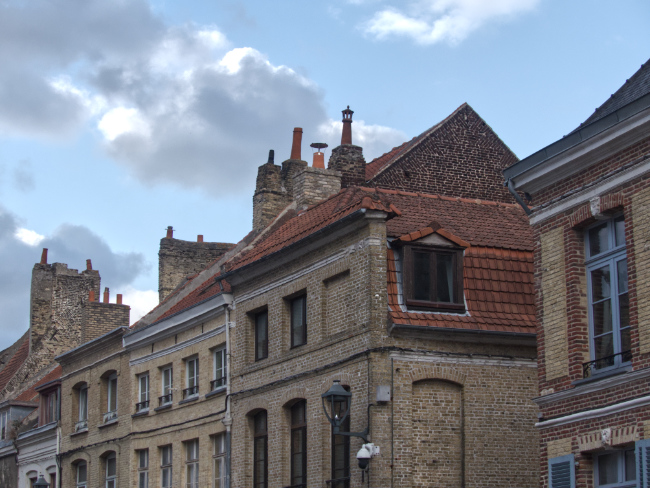
A white dusty track ran alongside La Maison du Marais. I imagined this would lead me into a Flemish landscape of dykes, ditches, streams, rivers, low lying fields with a marsh-ish atmosphere, damp and verdant, wisps of long lost corpses, sunk beneath the mud, ragged trees, shuffled together over time, low bushes, and poplar trees running alongside the wide industrial canals. This landscape does exist, but I didn’t immediately find it.
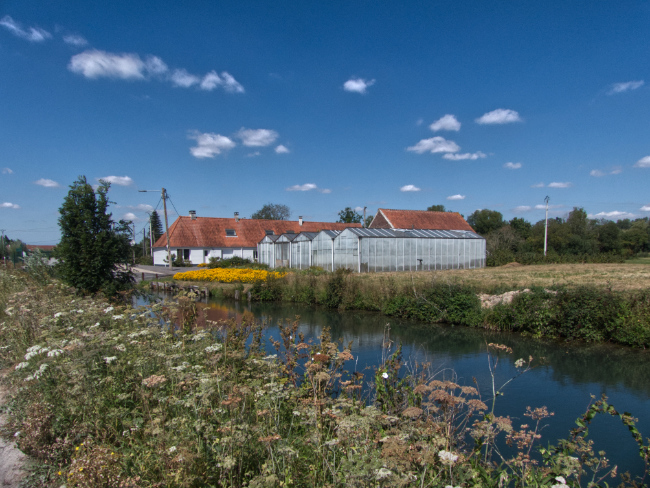
Instead of an idealised Flemish landscape I found myself in sprawling villages, scattered houses with just-so lawns, workshops and small factories, warehouses and retail units all contained within large steel boxes.
Concentrations such as this are everywhere; they don’t look much but each and everyone is a global node of production and distribution of commodities and services. They are designed for cars and with motorism comes roadside litter and the black residue and dust of engine exhausts. The hedges and hedgerow plants struggle for life here and at these margins there is a strong sense of how nature is being strangled.

There are rarely other people walking in such places and another living soul generates a stand-offish curiosity. As I walked along I caught sight of another person from the corner of my eye. He seemed to be carrying large square box.
Some psychic particle must have carried on the wind because I made an instinctive decision to avoid him. I started to walk slightly faster, in the way you do when you don’t want someone in the street to know you have started to walk a little faster.
For some odd reason the man and his box disturbed my inner equilibrium. I could say here that I was having some great profound thought about something and he’d upset that; but I was in that state of not really thinking about anything, a pleasant animal-like un-meditation where the senses are happy enough to be doing nothing much at all. Now however my thoughts were kick-started and they were all about this man, that box, and what they were both doing in the French countryside on this Sunday afternoon.

My initial reaction was that it contained a television. But televisions as objects are now thin and wide and this box was square. It would have to be an old television and that seemed unlikely; and besides, it looked like a new box that had yet to be opened. It would be more likely to be an air fryer but for some reason I don’t think that’s what it was either. But what was inside it?
It was a large box and obviously an awkward thing to carry. Even from a distance, and I had only briefly glanced, I could tell that the man was struggling to get his arms around it.
‘Aidez moi!’ he shouted. I clearly heard this though I pretended as best I could that in fact I hadn’t. I waited a long minute or two walked a tiny fraction faster. Some instinct seemed to be telling me not to get involved. I assumed he would give up on me.
But now he shouted louder, ‘Aidez Moi!’.

Religious ethics around the world are generally the same. Thou shalt not kill, remain humble, be kind and helpful. I generally agree with all of this but I detour around aggressive begging, I generally hang on to what cash I have rather than donating it elsewhere, I don’t go out of my way to help the poor and needy.
Isn’t this similar to what most people do? What really holds us back from greater egalitarianism and equitability? And the more he shouted, the more determined I became not to help him and greater my effort to escape from hearing his plaintive cries.
‘Aidez Moi!!!’ The tone was getting angrier and more frustrated. When the road started to curve I realised I would be momentarily out of his sight and so I press ahead at a quickened step for a hundred yards or some. Then I turned my head to say if I’d outpaced him.
He was further in the distance than before and he seemed more diminished and the box larger and he seemed to be struggling and staggering with greater effort with its bulk and weight. There roadside edge in places and there were also the passing cars to contend with.
Now I began to justify my actions. Why didn’t he stop one of them? That made much more sense. A car would be a perfect thing to convey him and his box to their destination. But some unwritten rule was being played out it seemed. While he could ask someone who was also walking, it would have broken a social code to actually ask a car and its driver for help. And we both knew that. I was his only hope of assistance, I was walking away.
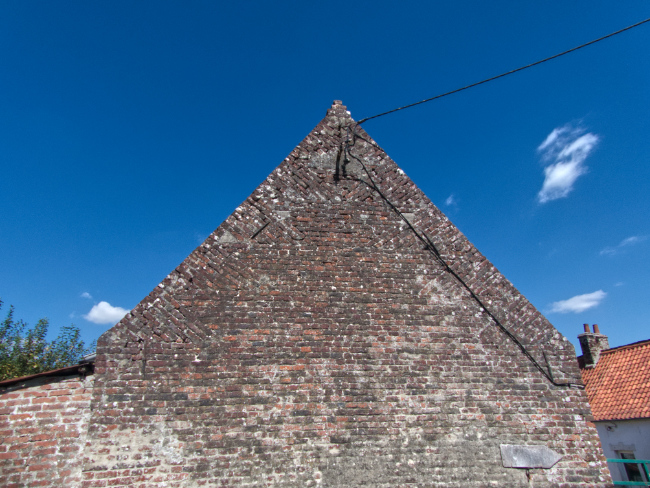
We were now approaching a village (why had this become ‘we’?) and he shouted even louder, ‘Aidez Moi!!!!’
I decided that if he really needed help he could ask for it here. His cries for help were no longer my responsibility.
The road curved again, and then a fork in the road appeared, and I took the left one and I was out of the range of his pleas for help. But his memory lingered on.
An odd thought came to me that he might know someone in the village and they would both drive through the country roads until they found me. The would slow down and stop and the window of the passenger side would be wound down and the man would be sitting there.

‘Why didn’t you help me! The box was full of urgent medical supplies for me elderly mother; blood for a transfusion, a saline drip, a heart surrounded by ice for a transplant operation. The doctor was all scrubbed up and waiting for me!’. The man would pause for breath.
‘And because you didn’t help, it was all too late. And now we have to bury her!’
But imagine if I had helped? I would have been in close proximity to him. Perhaps only inches from his face as we both now struggled to move this ungainly object. He was a thin man. Even from distance I could discern that.
I imagined a gaunt face with deep, dark, sunken eyes. Alive in a creature of the night sort of way. We would be breathing the same air and exhaling into the same space. Our breathing in would also be the absorption of the each other’s breathing out. I had an image of a mouth flecked with spittle as he endlessly explained to me why he was carrying this box along a country road. With stumpy and broken teeth discoloured and long neglected of brush and paste.
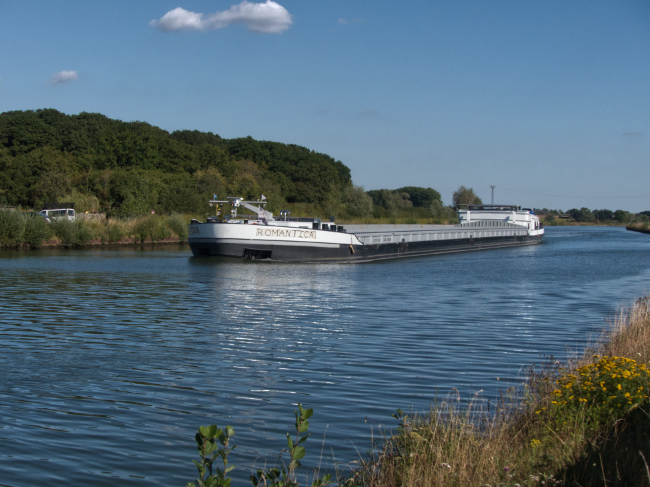
And then I would be complicit with the contents of that box. What if it was stolen? Would he cry for help if he’d stolen it? Difficult to say. Some criminals exhibit great guile and immense stupidity in equal measure.
Was it full of illegal drugs? For some reason I didn’t think so. A box with that amount of drugs within would be surrounded by security, bureaucracy, greed, fear, distribution networks and complex accountancy arrangements. If he had double-crossed some local dealers they would be searching the countryside even now. It seemed too quite.
What if it was full of bank notes, the product of a weekend bank robbery? What if had started digging a tunnel on Friday night, dug his way into the bank vault by Saturday tea-time and spent the early hours of Sunday morning blowing up the safe?

It had all taken too long. He should have emerged during the previous night, in the dark, unseen. And once he had got into the bank he realised he’d left his holdall behind. Looking around in the bank itself, this box was the only container that came to hand. He emptied its contents of printer supplies and filled it up with cash. And he did have a car but it refused to start. There was no other option than to carry the box, full of cash, along the road.
And what if this was a political act? A deliberate robbery to fund a revolutionary organisation to overthrow capitalism, a twenty first century version of the League of the Despised? Should I not be helping a comrade in their dedicated task to support the working classes? Another ethical dilemma.
There are at least two storeys here. Mine, and the man with the box. I wonder what his version says?

 Commodity Fetishism
You must be logged in to post a comment.