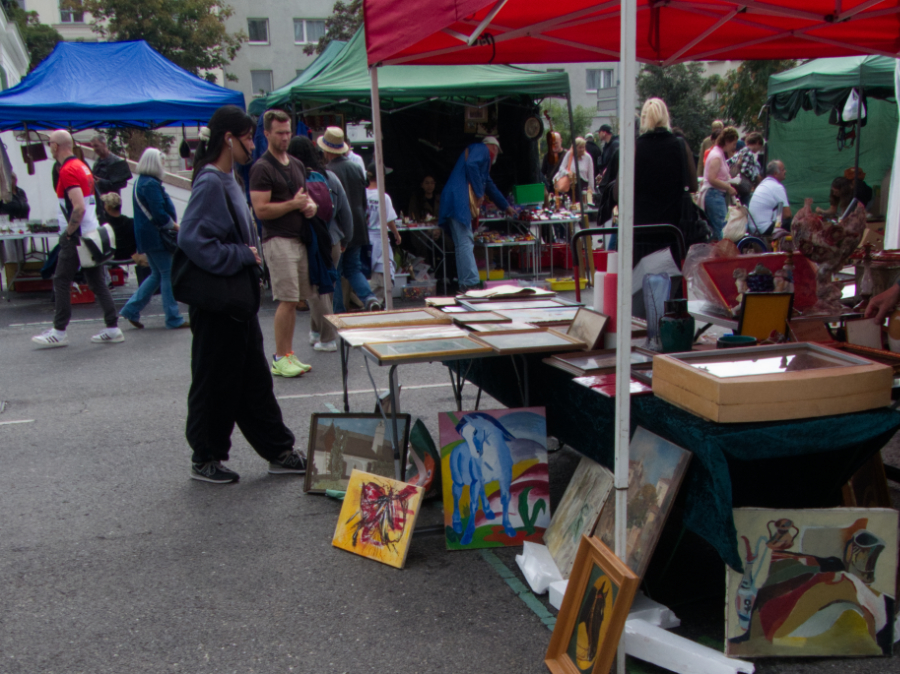
The Naschmarkt in Wien is as good a place as any to study the national question. It feels as if all the people of the old Austro-Hungarian Empire are here, selling the accumulated debris of the centuries. Amidst the tacky kitsch are art-deco dinner services, relics of war, objects of Empire.

Some of the people look as if they might have been 3-d printed from the pages of Balzac, Dickens, Dostoyevsky or walked from the woods where the Grimm Brothers conjured up their tales. A young woman is sitting on a box playing a saw with a bow, an eerie sound that transports the watching crowd into some mystery, some other place; but the Naschmarkt can be weird enough.
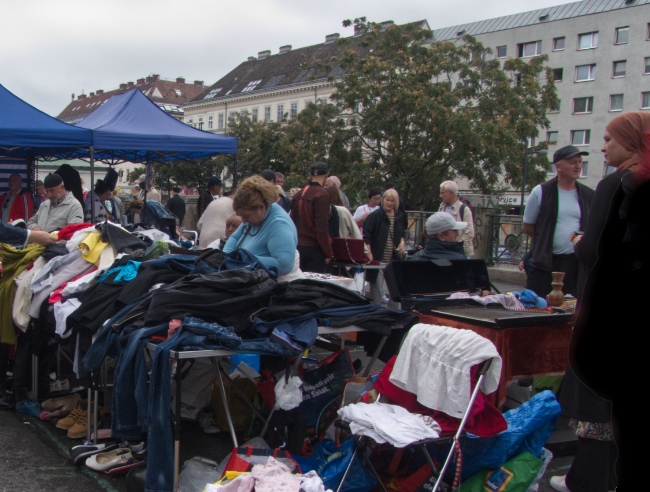
A man with such thick leathery skin, he is at least five hundred years old; he was left behind after the last great battle when knights in armour fought soldiers with pikes and crossbows and heavy swords. He can no longer remember what the war was all about. He’s been walking ever since, from place to place. He once shared a prison cell with Jean Genet, in Paris, it was long ago.

Boxes full of forgottten books, that’s where the treasures lie, all human knowledge and human activity, ‘nothing that is human is alien to me’, said Marx; not even here, in the Naschmarkt on a September morning.
A stamp album with row upon row of the dictators faces. They need validation, it must be everywhere, in the loyalty of the bow, the fear in the eyes of the people, the portraits on the walls, the hanging flags, the posters on the street corners.

Paintings scattered on the ground. ‘Das Blaue Pferde’ says the man who runs the stall. I pick it up to take a closer look; could this really be an original object from Der Blaue Reiter?
Nearby a man in a red baseball jacket is putting on his wrist a watch he’s just bought. He taps the watch face glass with his finger. It’s stopped working. But it worked when he bought it; only just a minute or so before. And now it’s dead.
Over there, a stall selling watches. Perhaps it was one of those. I ask if I can take a photograph and the man says ‘no way’, he laughs, I laugh. The man who just bought one of these watches isn’t laughing. A vignette of consumerism and raised expectations, never met. The hollow emptiness of the buying-selling charade.
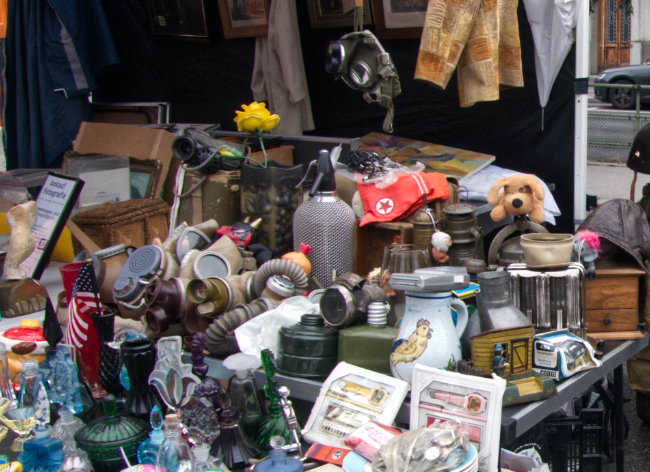
These wine glasses, so fine and well designed, with gorgeous colours, thin stems, a delightful delicacy. Could these have been crafted by Otto Prutscher? Surely there are experts here too, hiding in their most ordinary clothes, smoking a hand rolled cigarette, searching through the debris for the jewels. Each week, a different disguise, doesn’t that describe us all?

Over by the other stall a man has just bought a huge book on socialism. Perhaps it has the answers for our time, perhaps the lessons can still be learned, perhaps it will help to organise a movement. The noose of time is tightening, it’s running faster than before, it’s a race to a certain point, the destination isn’t clear.
This is a time of history and yet so many of those who talked of this time of history seem unprepared.

On a patterned carpet, laid out upon a stall, a map of Jugoslavija. The physical landscape of central Europe is of hard mountains, limestones, schists, gneisses and granite. The main rivers of the Danube, Rhine, Elbe, Oder and the Vistula. Mountains and rivers, thick forest; it’s a difficult terrain to cross. And yet the borders are shifting all the time. Here on the scattered stalls of the Naschmarkt the weapons of Empire have fallen from dead hands.
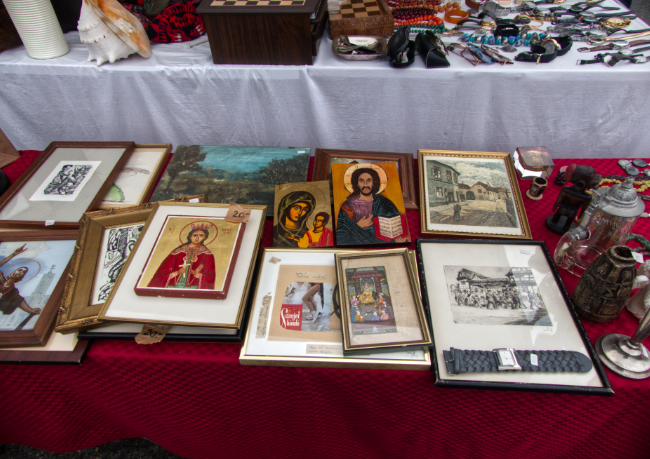
A pile of newspapers with headlines of war, rebellion, occupation and revolution. Now, looking back, the pattern of the past seems so clear. How could history have developed in any other way? In the shock of rifles and cannons and whistling of bullets and loud explosions it wasn’t clear at all.
A revolution that seems to come from nothing, slowly and suddenly all at once, a 400 year old empire that collapses overnight, marching armies, so proud and discplined, reduced to bloody stumps by machine guns and artillery. The crown is placed upon the king’s head; the dictator swears an oath. The peasant works and spits.

Two goths with black spider web clothing, black make up, long black skirts, piercings, heavy boots. They are searching for goth relics, teutonic armour, a studded glove.
Someone is shouting, ‘ein Euro!’ over and again although it’s not clear what he’s selling. Perhaps a dream.
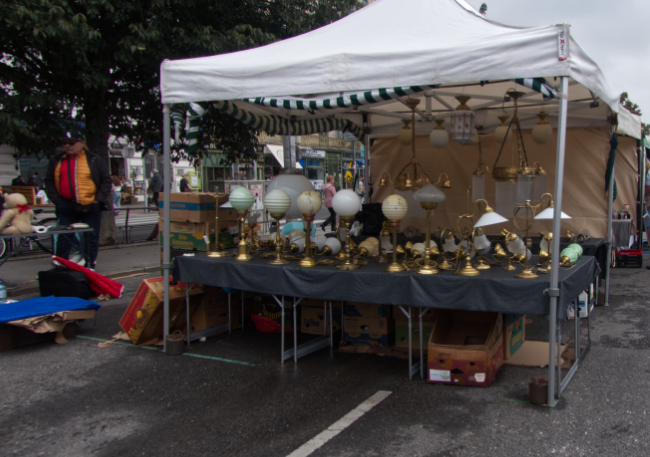
A pile of photographs of such beautiful cities, in black and white and faded images. Breslau, Warsaw, Sarajevo, Zagreb, St Petersburg, Dresden, Berlin, Coventry; how could all these cities go to war with one another until everything was destroyed? Why are cities still being destroyed today?
Here at the Naschmarkt are the traders who always emerge first from the piles of rubble. They have an old box with some buttons and one shoe, a belt buckle, two apples, a broken chair. Somehow it all starts again; money-commodity-money, all into capital, capital accumulated.

Look at how the city has been rebuilt with an even greater mass, more and more people, an immense collection of glittering objects. The city has just recovered from the last war, and now the new war comes. The arms factories never stop, the politicians never stop; money flows towards the war parties.
A vacuum cleaner in a shopping trolley. Are they both for sale, or only to be sold as a single purchase, or would it be possible to buy one without the other?
More goods have been scattered at the entrance of the U-Bahn station. A woman is sitting on the ground besides them. Looking up, imploring, indifferent, she counts her money carefully. A man dressed in black is looking for food inside a dustbin.

Births, marriages and death. Recorded in the one photograph the family saved up hard to buy.
A steel helmet from the Wehrmacht.
And yet I can find no reference here to the objects of Social Democracy and the time of Red Vienna. Where has that history gone? And yet it remains all over the city in the Gemeindebauten.
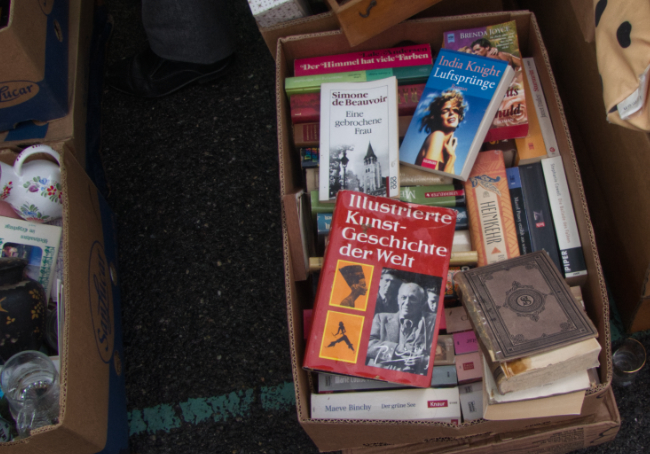
By some extraordinary chance, it’s so unlikely that surely only a god or gods could have helped this happen. One of the first people I talk to tells me that he collects photographs of the city going back to the 1860s.
He explains he has many photos of, and within, the Gemeindebauten, taken by the residents themselves, throughout the years. I hand him my card and hope against hope that he will email me. It as if I found a diamond on the earth, hiding beneath the dust and tar, and briefly it brightly shone.
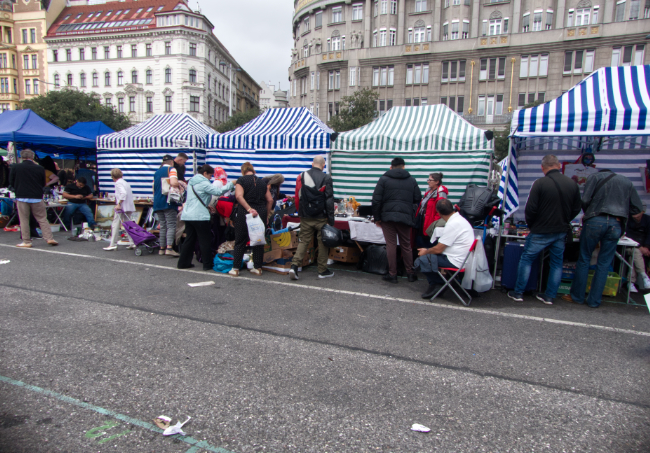
I walk back to the food market and buy spring onions. The man who serves me must have been born in the Empire. He has never bothered to shake off his anti-Empire attitude. Here is a portrait for the 21st century, here is a life story to be told, here is something proletarian that is always there but seems so hard to find. This class, abused, ignored, invisible, indespensible.
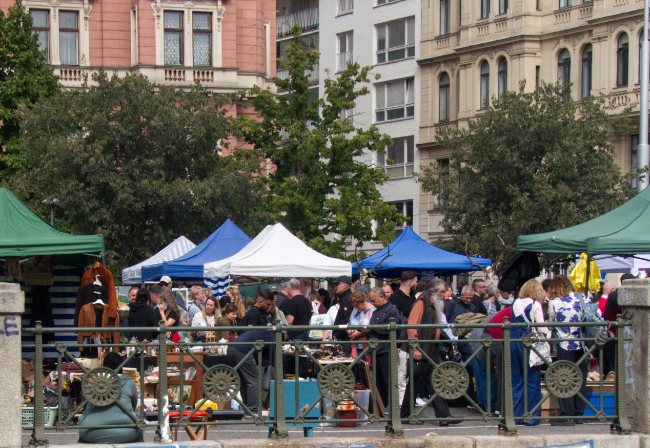
And then they are buried in the paupers graves or reduced to ashes in the crematorium, or disappear through the cracks in the streets, into the underground below, the hell fires, the steaming clouds, their emaciated bodies piled high in common graves; and when they are gone, all they leave behind are some souveniers, a broken cup, a scratched mirror, a coat without buttons, a china statue of a dog, a hussar upon a horse, painted in gaudy colours, a painting that no one wants.
All collected up at the Naschmarkt. That’s it. Life and nothing but.
 Commodity Fetishism
You must be logged in to post a comment.