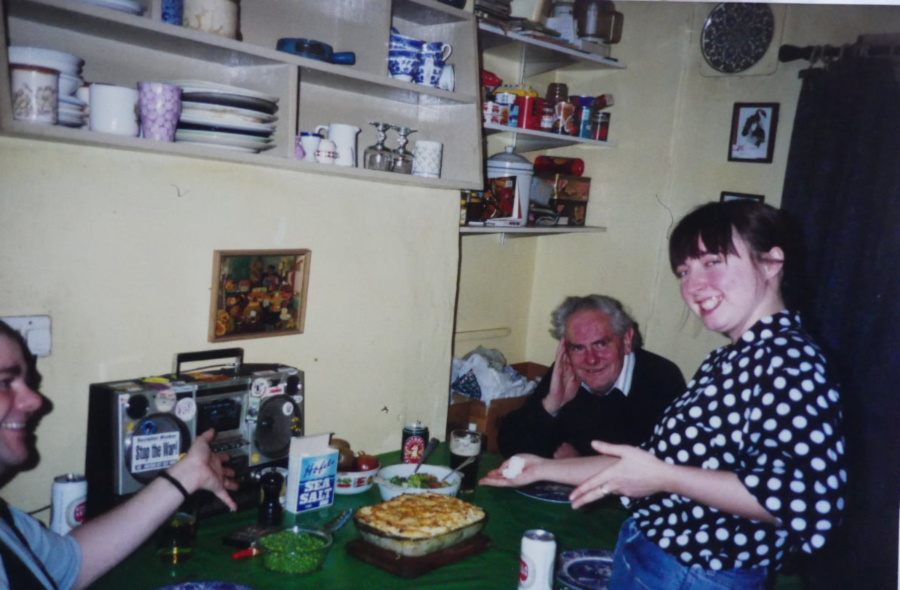
Duncan Hallas was born on the 23rd December, 1925 into a working class family in Manchester. I shared a flat with Duncan for 2 – 3 years at the end of the 1980s and early 1990s. He was a good flat mate; democratic, fair and egalitarian.
And of course, if you wanted a discussion about Marx, Engels, Hegel, the history of Ireland, the Russian Revolution, the expansion of capital or a thousand other things that are of the utmost importance; he was there on tap, sort of. If you raised something like the origins of the internet he would raise a hand and say, ‘now Danny, I know nothing about this, tell me more.’
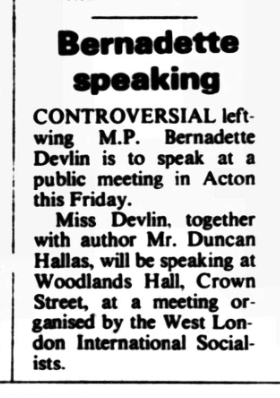
For a lot of that time Duncan was active on the Central Committee of the SWP and rightly so, much in demand for branch meetings and public speaking. He was away most of the week. Coming home on a Friday, tired and just needing some rest and recuperation.
“Do you want some supper Duncan?”
He would come into the kitchen pretending not to notice what was on offer. Sausage, mash, fried onions, peas, or chips and fish or a pie. He was well up for that. A glass or two of beer.
Saturday evening was television, ‘Westerns’, he would say, ‘are the limit of my unsophisticated tastes’ and laugh. He was good at this sort of self-effacingness when in fact he could, and did, provide a fascinating historical and materialist analysis of westerns, Manchester City football club and a great deal more.
And as I left for the mystery and magic of raves in derelict warehouses and the low life dives of Hackney I could hear gun shots ringing out from his bedroom.
Sunday was the best. I would wait for the knock on my bedroom door.
“Do you fancy a pint?’
Of course, who could resist this. Off we’d go to the Fountain pub on the Lower Clapton Road. By the time we were in the door the history of the Paris Commune had already been covered; the writings of Victor Serge, Lenin’s The State and Revolution were being tossed around as if it was 1917. Everything came alive.
In the corner, on the table, a pouch of tobacco and rizlas for me, a packet of Capstan full strength cigarettes for Duncan. Pints of foamy beer. Sinead O’Connor and The Clash and Junior Marvin’s Roots Train on the juke box. It was loud in that pub. Packed with people. We would be an inch apart arguing and discussing everything in the world. The best conversations anyone will ever have.
The Fountain could be a rough house. On one occasion a shitty racist came in and started up all that far-right blah blah blah. The Irish landlord leapt over the bar, grabbed him and said, “this is my house! and no one will come here and abuse anyone who is in my house!’ and threw him out. We looked up and paused our discussion of the role of towns and urban culture in Flanders in the 13th century and the origins of capitalism. And then the pub was calm-ish again and we carried on.
One another occasion our dog (he wasn’t really ‘ours’, he was more like a flat mate) Max had his lead hooked around a leg of the table. A rival came in; a pit bull or something. Max charged towards his enemy, unaware that he literary had nothing to lose but his chain. Over went the table, beer in the air, tobacco and cigarettes everywhere.
He was a formidable opponent in political debate and in discussions and disagreements about strategy, tactics and the character of party building. And yet on a one to one basis I never knew of him beating anyone down; he certainly never did that to me. You lost the argument, or at least I did on a regular basis; but it simply encouraged more reading and thinking.

He had a quality about him that made him immensely popular with the rank and file of the revolutionary party he worked so hard to try and build. Not on the basis of hammering people into a line but listening to people, backing up his own arguments with an immense amount of knowledge and insight and the enjoyment of sharing ideas and conviviality with comrades.
He knew his stuff thoroughly and how to present it clearly and with vigour, and when required with passion and enthusiasm. He knew what pitch and tone to use and when. A meeting on something like the origins of human society was unforgettable. Duncan would bring together tool making with the development of the hand, the brain, the eye and language, the neolithic revolution, metallurgy, stone working, carpentry, primitive accumulation, religion (in the broadest sense) and the origins of class society.
One night for some inexplicable reason I became embroiled with Duncan in an argument about the mind and made a grand claim that animals don’t have consciousness (I will make the defence here that it must have been ‘the beer talking’). Duncan had extraordinary patience even when an opponent scored such a spectacular own goal.
We went back to our flat where Max was fast asleep in his armchair (no one else ever sat there).
Duncan filled the kitchen, hands tucked into his raincoat, a sort of Marxist Philip Marlowe, bright with beer and smoking and a good night in the pub. That’s one of my real memories of Duncan. It was like he was young again. And what must that version of Duncan been like? The hardness of his ideas, the suppleness of his character, the sophistication of his politics, his connection with the revolutionary tradition and practice. He could have held his own in any of the founding conferences of the Internationals; the first, second or third.
“Max!” Duncan exclaimed.
Max leapt out of his chair.
‘See’, said Duncan triumphantly, ‘Max has consciousness’ .
One summer evening we sat in the garden of Thistlewaite Road, under the giant mulberry tree, drinking scrumpy from flagons bought from the Pitfield Street Brewery. It was that hallucinogenic sort of scrumpy, the stuff that is really trippy. We listened to Rigoletto. The London sky and the stars above, Verdi all around us, the whole history of humanity and the universe at our finger tips.
Duncan once told me his favourite singer was Bessie Smith and whenever I hear St Louis Blues I think of him sitting at the table in the kitchen. That table was covered with a green oilskin cloth. There was a print by Frieda Kahlo on the wall. Max’s chair in the corner covered with a blue candlewick spread. Now I think about it I don’t remember that ever going in the washing machine.
Someone once came round and while they had a cup of tea said, ‘you haven’t really got a kitchen here’. Meaning we didn’t have a fitted kitchen. That had never for a moment occurred to either of us and never did we think of such a thing again.

Our other works of art included Édouard Manet’s A Bar at the Folies-Bergère and Pieter Bruegel the Elder’s The Hunters in the Snow. The latter was in the hall where the telephone was. If a couple of days passed without Duncan going to the newsagents to get cigarettes and newspapers, the owner, Mr Patel would phone up to check he was alright.
I would sit at the other end of the table. We never altered these positions. Duncan would be enveloped by a huge cloud of smoke engrossed in a volume of the 13th edition of the Encyclopaedia Britannica. This is the edition published in 1926 in which Einstein wrote the article on space-time and Trotsky was the author of the entry on Lenin. I have a feeling Duncan read it all from cover to cover but it seemed that a magical spell would be broken if the question was actually asked.

Perhaps I was reading Fernando Claudin’s The Communist Movement: From Comintern To Cominform (inspired to do so by Dave Widgery, a mutual friend), thinking, ‘I’ve got Duncan now! He’ll never win this argument!’ He always did. Then I’d get up and say, ‘Duncan do you mind if I open the door’. Fresh air from the garden and summer light would pour in and at least some of the smoke might disperse.
A party was organised in our flat for his 65th birthday. In the course of the evening a succession of leading lights of British Trotskyism were in that kitchen. Tony Cliff, Nigel Harris, Ian Birchall and others. There was some delicate planning to try and avoid certain people being in the same room as each other at the same time.
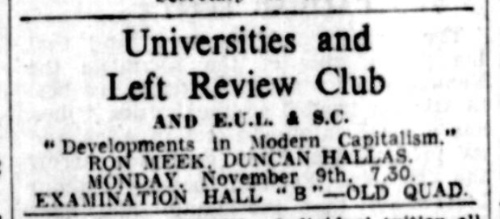
Biographies of Duncan describe him being born in a slum. However there is a further development which is sometimes neglected. In the 1930s the family moved to the new Wythenshawe estate in Manchester. Good quality council housing; based on the garden city ethos, designed and executed by Barry Parker.
To just locate Duncan in a slum is to keep him in a distant past. To move him into the good quality, progressive modernist housing of the 1930s makes him part of the present; and points into a future. He is in some ways a product of working class council estate socialism. He lived in Swale Road and if you look that up on Streetview you may get a sense of that world.
He told me about receiving a five pound note as his 18th birthday present. ‘A great white note’, he would say, ‘I had never seen one before’. I wonder what memories that brought back. That would have been in 1943, just before he was conscripted into the army.
When we went out drinking Duncan had the presence of a London docker or an engineer from the north west (which he had once been). And then it’s his turn to buy a round. He’s coming back to the table, a pint in each of his hands and he puts the glasses down and we clink cheers and then we’re off again. EP Thompson and The Making of the English Working Class, the origins of the Labour Party, wages and class struggle, an analysis of ‘the news’, anecdotes and funny stories.
The Berlin wall came down on Thursday 9 November 1989. There was a lot of confused excitement around and not just in left wing circles. We went to the pub early in the evening of the Friday to try and make sense of it all. We were joined by a well established Marxist intellectual who started by declaring he was all in favour of German re-unification.
“But which borders?’ Duncan asked, ‘Charlemagne? The Holy Roman Empire? Bismark? Kaiser Wilhelm the Second?!’
I was thrown by this. What was he going on about?
Our comrade went to the bar to get a round of drinks and Duncan leaned forward chuckling, ‘oh I do like to wind him up’.

With such large events going on in Central and Eastern Europe we cooked up a plan to drive to Berlin in my car, a Datsun Cherry 100a.
It had only cost £200 but this low price reflected the fact that it was impossible to go faster than 50mph.
What the masses of jubilant crowds, police spies, rapidly melting Stalinists and the guards at Checkpoint Charlie would have made of this is if we had managed to drive across Europe is anyone’s guess.
The plan never got beyond the kitchen table and I went to Berlin in February 1990 and then by train to Prague. The streets of Prague were still joyous and we were shown round the city by a young engineering worker. I filled a large notebook with observations, always with Duncan in mind. And spent hours telling him everything that I could about what was going on there when I got back.
Duncan was never a gossip which is immensely refreshing and he wasn’t prone to make personal comments about people; but on the occasions when he did they were pithy, accurate and descriptive; ‘soft politics and authoritarian personality’. And that was it.
He could be annoying at times, and sectarian on occasion. I disagreed with his assessment of reformism, Claudin and much else. This was all part of it; he was never some sort of socialist realist caricature. He coughed, he swore, he drank too much at times.
To me at least, the sign of a successful revolution won’t be 20 foot statues of ‘leaders’ with chins jutting out, a far away stare in their eyes and carrying tractors on their shoulders towards the Big Rock Candy Mountain. Duncan would abhor such a thing.
But if we do break the power of capital I would suggest a memorial along the lines of a good pub, with fine ales and pies, lined with books and piles of magazines and newspapers and called something like, “Now then Comrades”.

We argued about everything and yet never fell out. That isn’t because of some mawkish niceties and ‘feelings’; I guess now I think about it this was because we were both so committed to this idea, unpopular now perhaps, of working class self-emancipation, and the struggle against capital, as the centre of politics. And that was partially formed from council estate origins.
Indeed Duncan used to say there were three things that made a revolutionary; class background, theoretical understanding and personality. These could be combined in different measures, and depending on the strength of each characteristic, two of the three might be enough.
He talked little about his personal life. Small snippets would come out; of how his mother started working in the Manchester textile factories at the age of 10. His father worked for Manchester City Corporation, I think as a bricklayer.
He told a story about a trip to Loch Lomond with his wife and how they were having a picnic and some sort of Orange parade went past, complete with ‘King Billy on a white horse’. This always made us laugh.
On another occasion he talked about his time as a soldier during the Second World War. ‘ I became a sergeant’, he explained, ‘through the process of dead man’s shoes. First the machine gunner was killed, then the bloke who carried the ammo. And so I went up the ranks’. He was wounded in the fierce fighting around Caen.

At the war’s end he was in Egypt, pushed around in the way soldiers are by staggeringly incompetent military bureaucracies. There he took part in a mutiny and spent time in a military jail.
There is a rumour that he still had his service revolver in a drawer in his bedroom. I never saw this and decided it was best not to know.
In the past hundred years since Duncan was born there has been an extraordinary expansion of capital, the conjuring up out of the ground of vast industries; jet engines, microchips, fibre optic cables, containerisation, satellites, mass production, a huge quantitive and qualitative increase in the size of the working class on a global scale. An increase in the rate of exploitation of labour, an intensification of competition, wars on unimaginable scale, atom bombs, holocausts, genocides, consumerism, the crystallisation of the Society of the Spectacle.
Duncan sold his book collection before he died and gave the money to the party. Those books filled the bookcases of an entire wall of his room. ‘I have read them all’, he once said matter of factly. I still have one or two upon my shelves. The Fountain has been converted into multiple occupancy housing. Max is long gone. I took him to the vets when he was ill and comforted him as he was given an injection that killed him.
Lower Clapton is now partially gentrified but if you look carefully you’ll see the poor people in thin coats that don’t stop the winter, and kids with plastic shoes that don’t stop the rain and people crushed by the weight of all this stuff called exploitation and immiseration and atomisation and alienation.
And in the haze there are developers funded by global capital pushing up rents and evicting people and buses that are privatised and a lot of working people who never earn enough, and work hard for that too; and if you stand at the 38 bus stop by Clapton Pond and observe this you might just hear the echo of Duncan’s voice,
“If I could strike one blow…’
I organise Radical Walks in London, the south east, Vienna and Amsterdam. If you’d like to know more, please contact me.
 Commodity Fetishism
You must be logged in to post a comment.