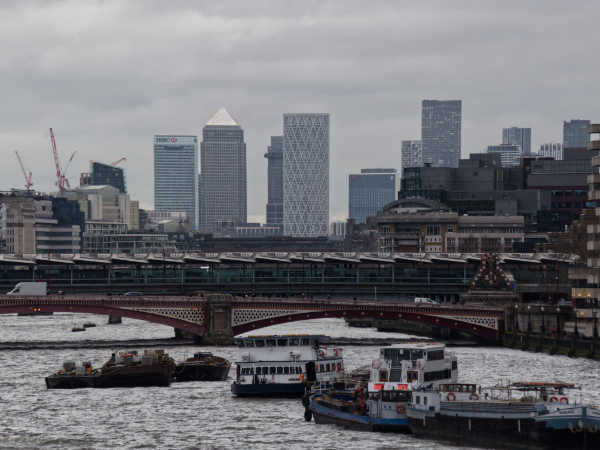
The journey started at the coast. The never ending sailing of the world’s cargo fleets, container ships, oil tankers, liquid natural gas carriers, specialist, technical craft. Warships, aircraft carriers, nuclear armed submarines beneath the waves. Shadow fleets evading sanctions, funding wars, killing children.
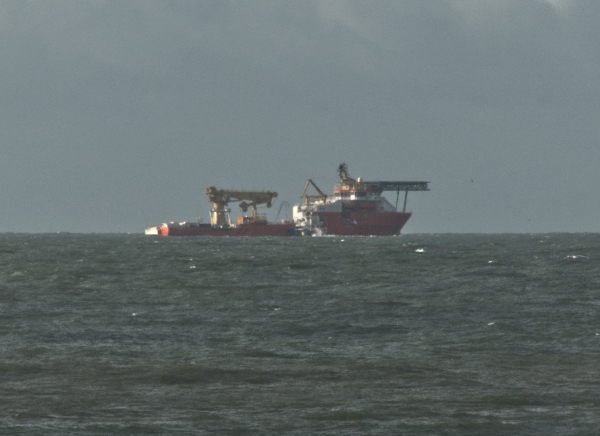
As the train emerges from the tunnel under the Thames an industrial landscape is revealed.
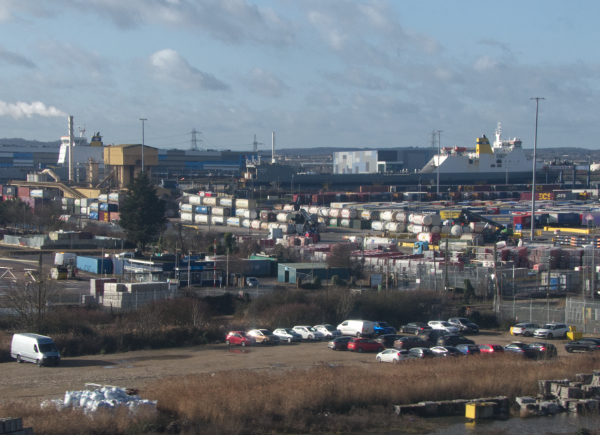
Two ships being loaded with vans and cars. Depots, metal cylinders filled with oil and gas and chemicals. Amazon and Tesco warehouses, storage depots, the scattered debris of yards full of building materials, scaffolding poles, car wash, eye wash, brain wash.
Someone’s typing ‘de-industrialisation’.
London is no longer a major manufacturing centre of physical goods although there is still some production; sweatshop or luxury or possibly at times both.
There is a large bio-technology sector, media industries, film production, tourism, construction.
Education has become a big business. Privatised health provision make super profits. People sleep on corridors in hospitals, discharge at midnight into the cold and damp and infestations of sub-standard housing.
In the City of London over 670,000 people work within a single square mile in financial services, corporate administration, law firms, insurance, banking, trading and foriegn currency transactions.
It is the most diversified workforce in the world in terms of ethnicity. This diversity is a collective social labour-power for global production, distribution and consumption.
The City is a large node of the modern world economy. Connected by sea channels, air routes, sub-sea telecommunications cables, packet-switching, satellites and infrastructures of ports, railways and roads to the other nodes of the world economy; the Pearl River Delta, Manchester, Mumbai, Glasgow, Sao Paolo, Silican Valley, the emerging economies in Africa, the huge city of Lagos, the slum production of the world’s poorest workers.
People mine and delve, they weld and glue, mix cement, spread mortar on bricks, move sheet glass into position, the same repetitive movements on production lines and conveyor belts, thousands upon thousands of times, a day, per week, by the months that slowly pass, the years that swiftly disappear.
Bodies still vibrating hours after the working day has finished. Heads still hearing the same robotic automatic artifical voices; ‘place bags in bagging area’, ‘if you see something’, ‘unexpected item’, ‘beware of cluster bombs’.
Children swim in polluted waters collecting the waste of consumption for a few coins of recycling compensation.
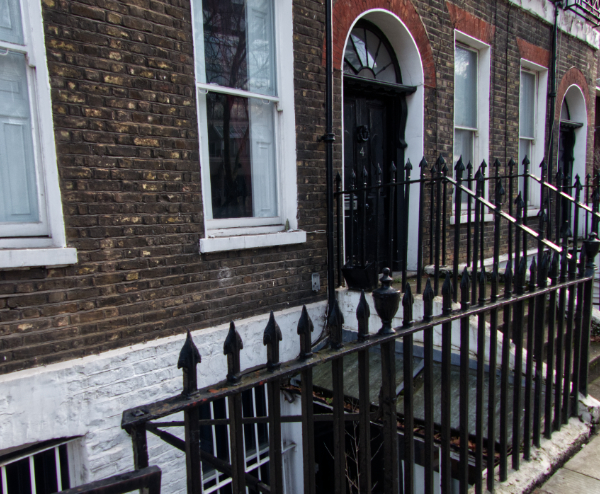
In the London streets. Bad memories in the gold mine. Chemical additions to the food. Plastic particles in the brain membrane micro-dosing on second hand vaccines; a digital tranquilisation. Newspapers of an earlier call for revoltion are rotting in the basements.
“…people had [then in Boston, before its building boom] a relatively coherent and detailed mental image of their city, which had been created in an interaction between self and place, and this image was both essential to their actual function, and also to their emotional well-being’ Kevin Lynch – quoted in Richard Sennett – ‘The Conscience of the Eye’ – 33
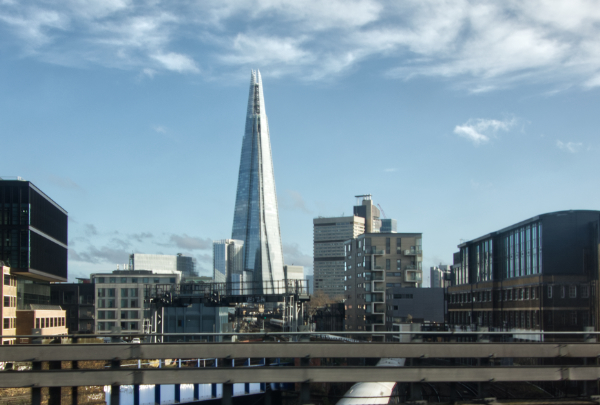
Now London has the Shard, a petrol-dollar imposition.
It breaks the visual identity of the London skyline on an immense scale.
It feels out of control because it is out of control.
It dominates space and time, a power of capital that cannot be tamed. This alien power of capital has long escaped the capitalist masters. It has power but no authority. The abscess that cannot be lanced. Validation through brutal domination. It is a despotic ruler of the sky scape, the Barad-dûr for the modern age, of mass digital survelliance, misinformation, concentrations of capital and therefore concentrations of money-power.
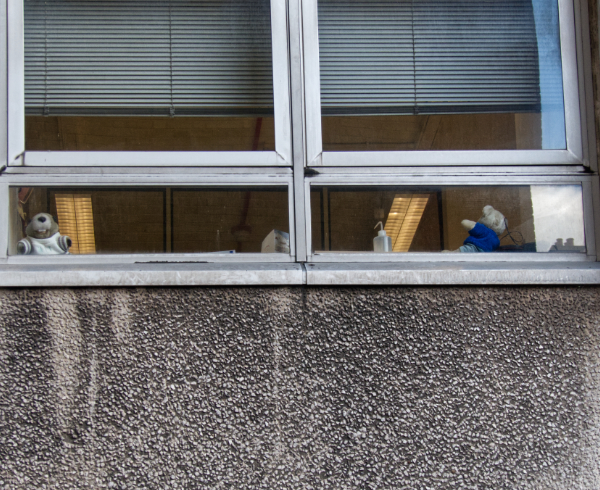
“the strange contrast between an inner life to which nothing outwards corresponds, and an outward existence unrelated to what is within” Nietzsche – quoted in Sennett – 39
The noisy wilderness of the streets gradually replaced by the pseudo-private, corporate mantra sing-songs, sterile environments.
The development of germ-free, antiseptic spaces; free of all aesthetics. The earth is soaked with blood. Space becomes the single dimension of the sterile ethic of capital. Egotistic money power. There is photographic evidence of how young girls must wash the feet of the sex abusers.
A life of entitlement. It crossed my mind that all the tax I have ever paid has been consumed by a single member of the so-called ‘royal’ family who has always lived in supra-luxury. Arrogant, entitled, grasping, gasping for the adoration that will not come.
Unbidden, a memory emerges.
I was in Währinger Strasse engaged in field research for a project on Red Vienna. Mapping out routes of the development of modern housing.
Walking through the estate at Währinger Strasse 188 – 190 designed by Michael Rosenauer in 1928.
It is an attractive place, pleasantly finished, bold lines, symmetrical in some parts, more free form in others, touches of Beiedermeier curves, large graceful trees. An elderly man talking to a neighbour, his hands tucked into the pockets of his padded anorak, grey whisps of hair gently blown by city air.
In a corner of the estate a passageway that is deep in shadow. From a doorway steps a woman wearing a loose and bulky trench coat, tightly tied at the waist with a knotted belt.
Underneath a dark fedora hat coal black hair falls to her shoulders. In a half hidden face eyes are dark and alive and searching.
She points a revolver at me and demands a password.
“Die Rote Fahne” I reply.
She waves the gun to indicate that I may pass. And then tucks it inside her coat again.
I still have an aching regret that I didn’t stop to talk.
‘this terrible business of finding one’s self’.
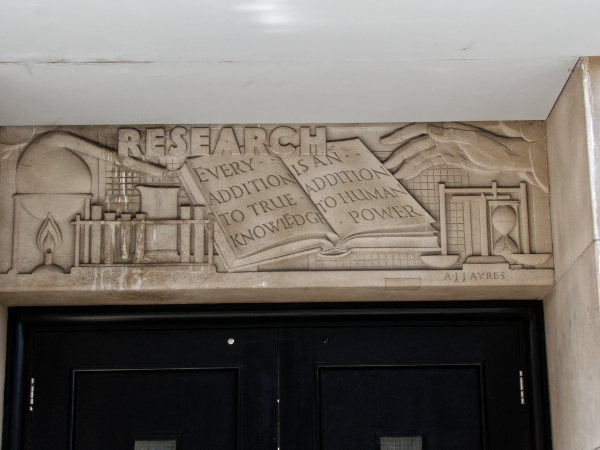
London is now a stage set with scenery composed from the cut-offs of long abandoned plays. Nothing quite fits together and all the actors, in the streets, offices, retail units, warehouse centres, have forgotten their lines.
People misreading the script of their own lives. There is not one, but many stage directors who stand and chant, ‘jobs, opportunity, sustainability’. They wear masks made of dollar bills.
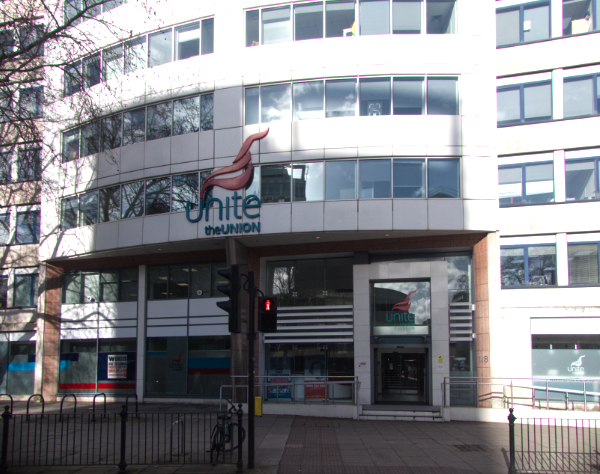
‘to achive solidarity through talk’
Time is nothing but a measure. It is not the dimension of time that erodes cliffs or shifts tectonic plates; it is climatic and geological forces.
It is not time that shapes the rise and fall of empires and civilisations; it is the actions of people, the conflicts of classes, the clash of arms.
And yet time appears to carry all before it. Life and death, art and disease, barbaric cruelties, random acts of kindness.
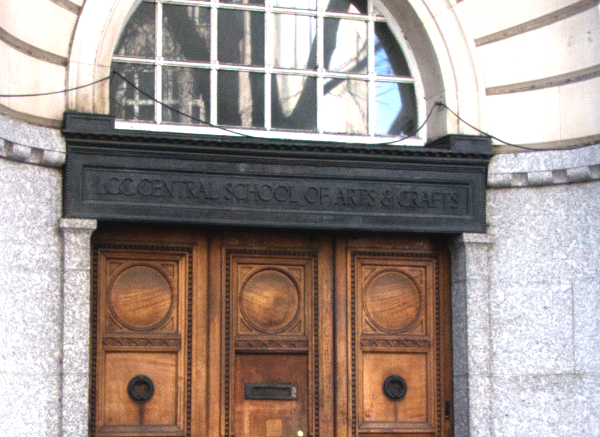
Glass architecture creates surfaces that cannot be penetrated by the outside observer during the day.
At night everything is revealed.
The coat hangers in the corners of the open plan offices, rows of desks, the untidy collection of monitors and computers, the sprawl of coffee cups and biscuit tins, the personal galleries of frame photographs, the debris of lucky charms, hand written notes, icons to be worshipped, staplers and containers for pens…
…propelling pencils, elastic bands, marker pens, nail files, tweezers, scissors, a hyperdermic needle, scalpels for local surgery, odd things that might one day be useful; a cyanide capsule.
A book lies in isolation; a battered copy of Christopher Isherwood’s Mr Norris Changes Trains. It’s now lost. I hope the last person who left the building on the day it was demolished slipped it into their pocket. Made the journey to Berlin overland, sat in a cafe on the Kurfurstendamm and opened it slowly, beginning to read the first page; what would they find?
The Berlin newspapers are full of the threat of war. Leaflets blow across the street. Ultra left liberalism, one person sectarian operations. Revolutionary phraseology stuck in dogmatic formulas.
All the lessons are already written.
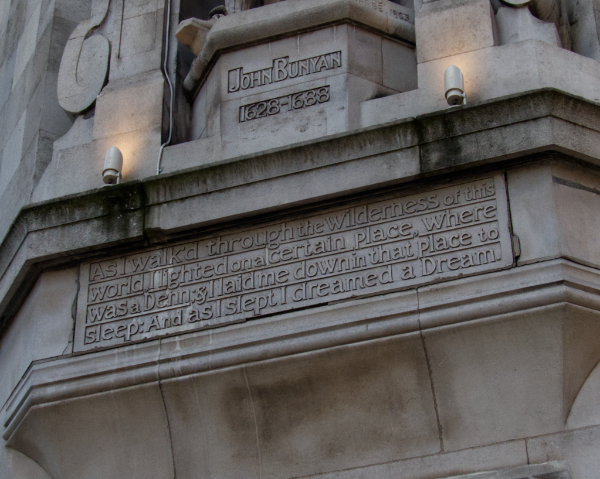
Someone is standing on London Bridge holding a magical looking glass to the blue sky; white clouds scud along.
The alienation created through the process of capitalist production is carried by the commodities into the shops themselves. Money carries neutrinos of alienation on its paper, metal and digital surfaces. They drench all who touch. Alienation is the hidden aura which is everywhere.
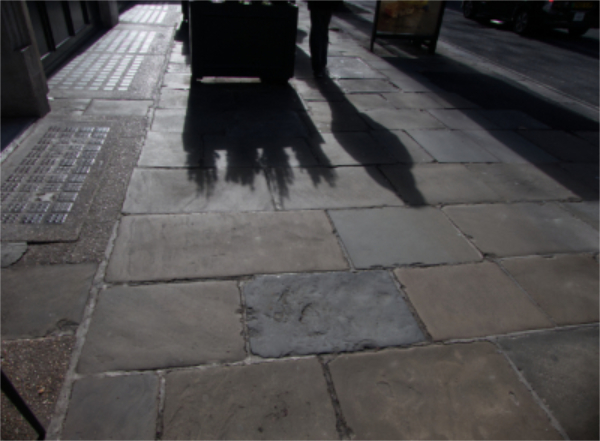
Medieval cities defended themselves with moats, walls, militias, crossbows, sharp swords and boiling oil.
The modern city of capital has defences of ideologies, security guards, guards and sensors and anti car-bomb infrastructure. The biggest barriers are now built into people’s heads by the head-fixing industries.
Everything must be in the present tense. Nostalgia is now a perversion rather than preservation. (see Ada Louise Huxtable).
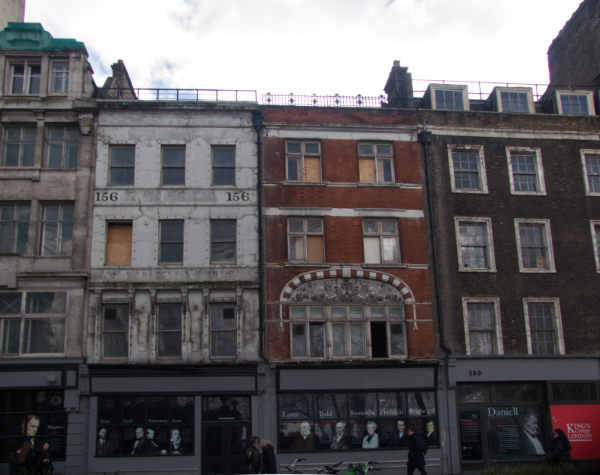
In the latest phase of capital development people flee their homes to escape war, the intensifaction of sun-heat, the increasing width and depth of water floods, corrupt governments, secret police, torture chambers, disappearances, incarceration that never ends, the end of the tenuous rule of law.
Capital expands into virgin forests and remote mountain areas.
Villages are bulldozed. Unknown flora and fauna species eradicated.
Farmland becomes the military training grounds for the battles yet to come.
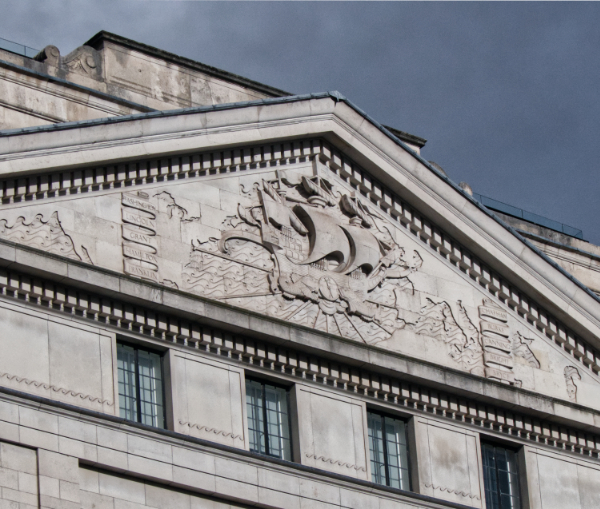
The displaced fall into the cracks of the military airfields. Jet propelled fighter bombers line up on the concrete runways. Today’s mission is to destroy the health infrastructure; yesterday it was schools and kindergartens.
Foamy mouth politicans furious at criticism demand the death sentence for heretics. The millionaire media plays again. A mouth so big that one day it will swallow its own body.
On the streets, in the streets, with and against the people of the streets. The inner lens shifts in and out of focus, clarity and opaqueness, insight and obsfuscation in different measures.
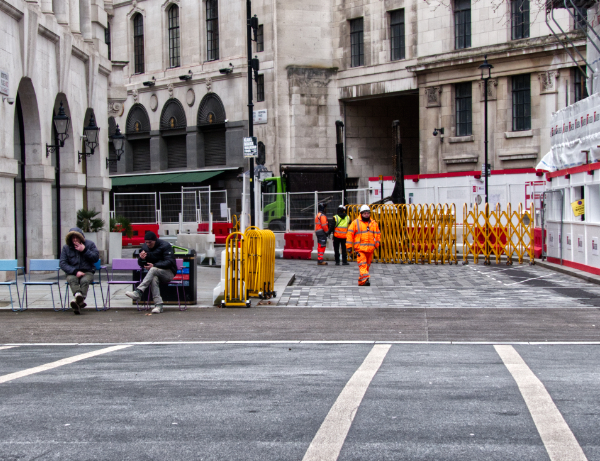
Run a hand along a limestone wall. The street is voyeurism and exhibition combined. An anonymous public presence, daydreams in stone, multifaceted experience, sensations in all dimensions. The sun is rapidly spinning in the sky, the universe in motion, the stars cannot bear to be still.
The generalised agitation of production-consumption finds its way into all life and social relations.
Pleonexia is a state of excessive or insatiable greed to always have more, avarice, covetousness, a psychiatric disorder.
Absolutist commands are issued during the process of production. They must be obeyed; the creation of corporate absolutism.
The act of production is the consumption of human labour and raw materials. The act of consumption is the continued production of human life. Development is also decomposition.
It is not this city or that city. It is never simply one thing nor a thousand separate things.
The city is the product and consumption and distribution of the movement of billions of hands and brains and sense of labour power on a minute by minute basis.
Figures being moved from one row on a spreadsheet to another. Writing code, legal documents, property deeds, contracts.
Application of hands to raw material. Application of hands to machines, keyboards, wheels and levers. Applications of hands to the baby emerging through birth, being pushed and pulled into the world. A life saving drug in a small plastic container being passed by the nurse to the patient.
For some reason I wrote in my note book, “late (pneumatic) Lenin”; what was I reading? What was I thinking? Or did someone else write this and it was just a copy?
There is a whirling electro-magnetic noise in the underground train. It rattles and accelerates. We are leaving the tunnel and tearing through the space-time continuum breaking from the gravity of earth hurtling into hyper-space past the planets were all life was destroyed by senseless wars of greed and vanity.
Into unimaginable dimensions of bright light and unknown colour spectrums a blending of all cosmic consciousness, all is light and weightless.
I lent a friend a copy of Anias Nin’s book The Delta of Venus. It never occured to me that she would read it on the tube on the way to work in a City law firm office.
She recalled how she became very aware of everyone around her and that she was convinced they all knew what she was reading. But then, she never had the superstition of a party card.
During the combustion, confusion and political fragmentation in Germany in the early 1920s someone is recorded as saying,
“Workers, unite, if not with your leaders, at least over their heads’
I arrive at the hospital bed of a friend. He has been there for 50 days.
Two volunteers come round with a trolley full of books. A young Black woman and a young Muslim woman wearing a headscarf. With their can-do attitude, fiestiness and friendliness they should be in charge of a lot more than a book trolley.
They pick books out at random and hold them up for approval or rejection. One is called,”Dead Tomorrow”.
“In a hospital?” somone says. We all laugh.
London Notes, February 2026. To be continued.
 Commodity Fetishism
You must be logged in to post a comment.