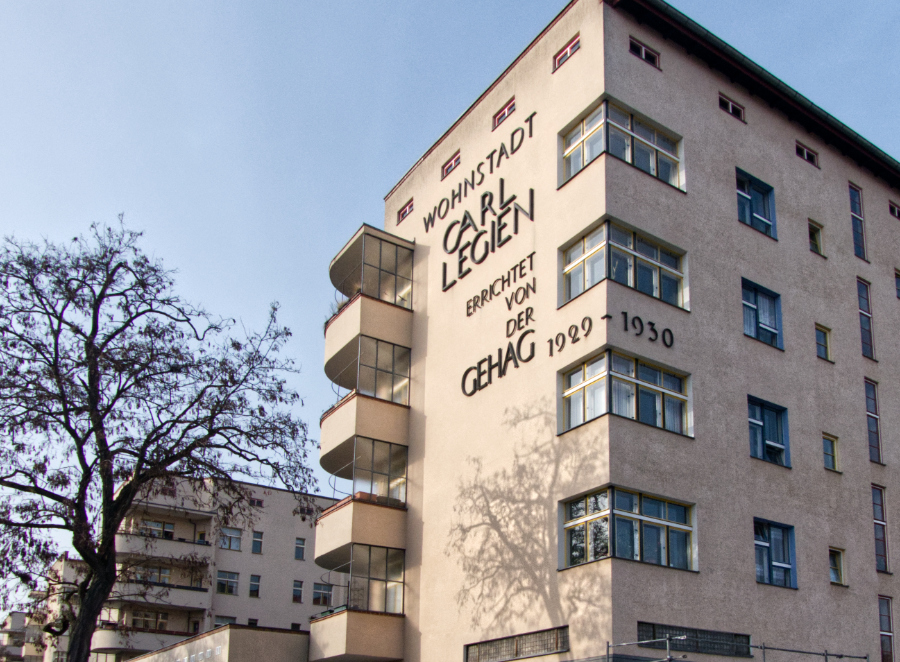
The Carl Legien estate was built between 1928 to 1930 with originally 1149 flats. The two architects were Bruno Taut and Franz Hillinger and the project manager was Martin Wagner.

Some brief biographical details:
Bruno Taut (* 4 May 1880 Königsberg – † 24 December 1938 Istanbul)
Taut was an artist and architect and influenced by Jugenstil and the Garden City Movement. In a sense these combined into a very distinctive central Europe modernism. That is the idiom of this estate.
In 1908 he was in Berlin to study art history and construction at the Königlich Technische Hochschule in Charlottenburg (now Technische Universität Berlin). This is also where Franz Hillinger and Martin Wagner studied.
Taut was fascinated by glass, by colour and the quality of the materials used in construction. He designed a utopian garden city (sadly never executed, perhaps one day) to house three million people. At the centre of this grand scheme – not an office block, not a football stadium, not a shopping centre. Instead a ‘purpose-free’ crystal building, the ‘City Crown’. Had Taut read Fourier?
Taut described it thus:
“The building contains nothing but one beautiful room which can be reached by either of two staircases to the right and to the left of the theatre and the little community centre. How can I even begin to describe what it is only possible to construct!”
A building that is ‘purpose-free’; that is utopian in itself. A luxury of space. A space where the quality without a name could be found, but never manufactured.
Taut was a pacifist and opposed the First World War. When that war was brought to an end by mutinies in the French army and revolutions in Russia, Germany, Austria and Hungary he became involved with the Arbeitsrat für Kunst. This was an association of revolutionary artists based on the model of workers’ councils.
Workers’ councils had formed first in Russia as Soviets and then following the German Revolution of November 1918 spread in a huge arc from Kiel to Budapest. In cities and villages they were composed of workers, socialists and rank and file trade unionists; they organised food, civil safety, transportation and much else.
In 1924 he was appointed chief architect at the housing association GEHAG (Gemeinnützige Heimstätten-, Bau-, Spar, und Aktien-Gesellschaft).
Franz Hillinger (* 30 March 1895 Nagyvárad, Hungary – † 18 August 1973, New York)
Hillinger had also been a student at the Technische Hochschule. He was appointed as the head of the design office at GEHAG in 1924. He generally worked in the Neues Bauen style, the modernist architecture that emerged in Europe in the early part of the twentieth century. This eventually developed into what became known as the International Style. This was partly influenced by the politics and practices of empire, militarism and war; or rather as reactions to those forces.
After the end of the First World War, empire was associated with the horror of trenches, machine guns, gas attacks and a senseless loss of life. And the architecture of empire was seen to reflect the vain-glorious and pomposity of generals in feathers and glitter declaring their authoritarian order. A new architecture was needed which represented different principles; those of democracy, civility and civilisation.
He was inspired by the new architecture which developed in the Netherlands, particularly the Tusschendijken housing in Rotterdam, 1920 – 21 by JJP Oud
Hillinger was a socialist and member of the Social Democratic Party of Germany Sozialdemokratische Partei Deutschlands (SPD).
When the Nazis came to power he lost his job (as did all Jewish workers). He went first to Turkey and later to the United States where he joined his wife and children. His brother was murdered in Auschwitz.
Martin Wagner (* 5 November 1885, Königsberg – † 28 May 1957, Cambridge, Massachusetts)
Martin Wagner was also a student at the Technische Hochschule (now Technische Universität Berlin) where he studied architecture, urban planning and economics between 1905 – 1910. He was also a committed socialist.
On completing his studies he worked for Hermann Muthesius as a draughtsman. He then worked for several different municipalities in northern Germany. He completed his PhD on urban spaces in Berlin in 1915.
In 1924 he helped to found the housing association GEHAG (Gemeinnützige Heimstätten-, Bau-, Spar, und Aktien-Gesellschaft). He became the chief city planner in Berlin in 1925. He was hugely influential on the development and planning of Berlin’s public housing between 1924 to 1933.
Wagner was forced into exile from 1933 and moved to Turkey where he worked as a planner and architect. He emigrated to the United States in 1938 and taught city planning at the Harvard School of Design. His pupils there included Catherine Bauer and William Wurster.
Carl Legien (* 1 December 1861 – † 26 December 1920)
Legien’s parents died at an early age and he grew up in an orphanage. He trained as a wood turner and became a trade unions and member of the SPD. He was on the right of the party and an active opponent of the left. He was obviously ambitious and talented in a particular way. He was at one time the President of the International Federation of Trade Unions and a member of the Reichstag (the German parliament) from 1893 to 1898 and from 1903 until his death in 1920.
He was a particular type of reformist with a workerist approach to politics. He supported the war aims of the German ruling class during the First World War and advocated a civic truce between the employers and the workers. He opposed calls from US socialists to mediate to end the war.
On the the 15 November 1918, when the workers and soldiers and sailors in Germany held a great deal of power and threatened the existing state machine, he signed the Stinnes-Legien Agreement with Hugo Stinnes, a leading industrialist. This led to the acceptance of national unions, the eight hour working day and the principle of allowing workers’ councils in companies of more than 50 people. Demobilised soldiers would have the right to their former jobs.
This all sounds good on paper but the reality was that there was constant pressure to force workers to work longer hours, the workers’ councils became caught up in political manoeuvring and lost their class-interest power and unemployment soared.

Legien had significant influence within the German working class both organised and unorganised. He was a leading figure in organising the general strike which stopped the Kapp Putsch.
A question for any communist reading this is why such a person as Legien had such power and the various iterations of the Communist Party leadership in Germany did not. The questions of the German Revolution and the role of reformists and revolutionaries are way beyond these brief notes but any serious student of revolution must study them.

Design, Planning, Architecture
The housing conditions of many German workers in the late nineteenth and early twentieth century were shocking. Damp, cold, draughty, dirty, expensive housing with shared outside toilets, no central heating, no privacy and not much security of tenure. Infant mortality and maternal deaths were high. Disease and illness everywhere.
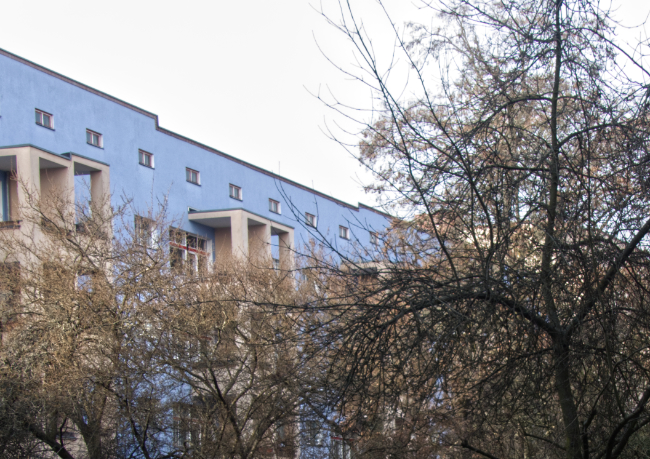
New principles were needed in antithesis to these conditions. These included the starting points of ensuring that housing had air, light and green space. That the build quality was good and the design supported an environment which was hygienic and could be cleaned; that there was green space for children to play and people to access fresh air.
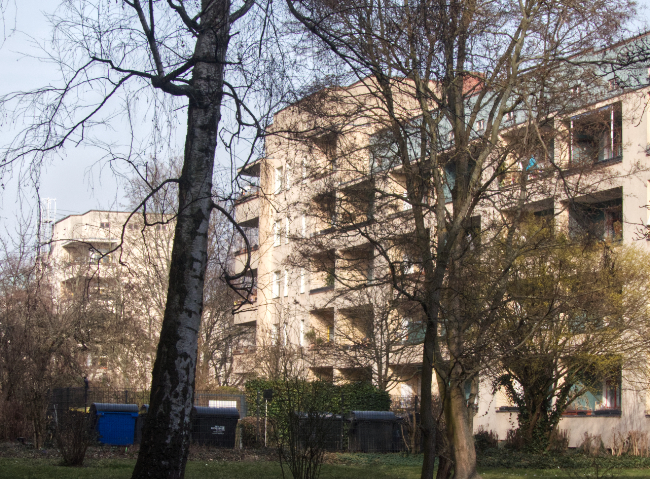
These are practical and physical things. It was also important that tenants were no longer treated simply as sources of rent and profit, regardless of the actual housing conditions. Rights of tenants were included in the new Weimar constitution.
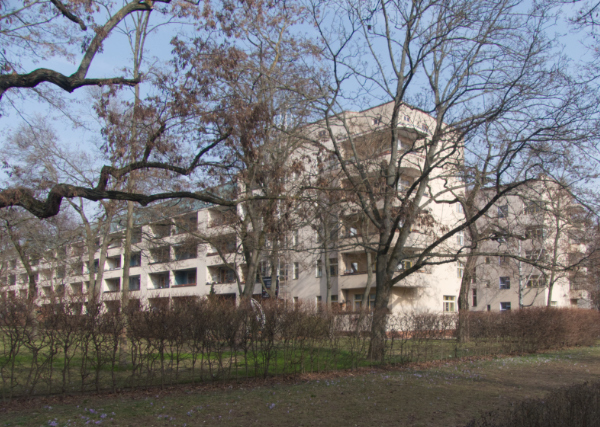
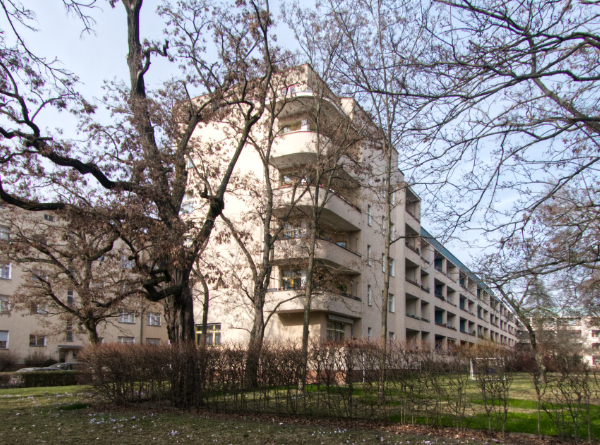
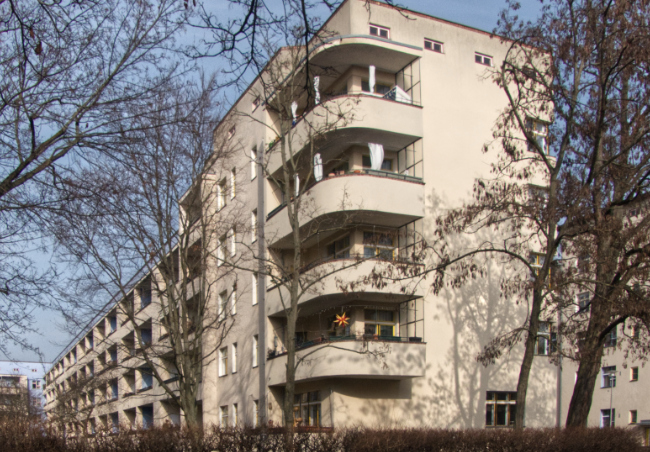
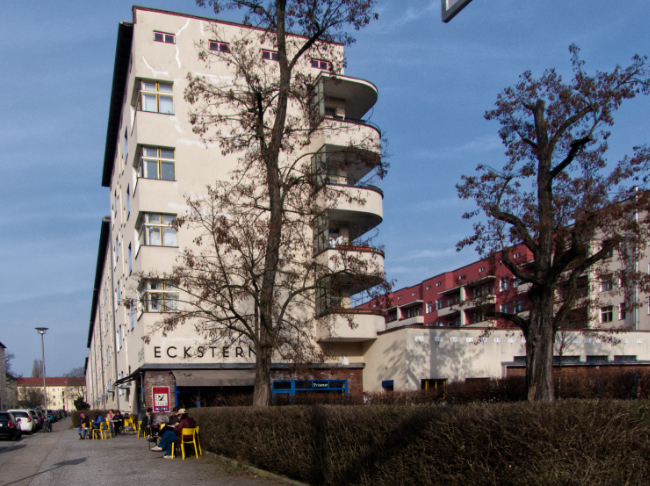
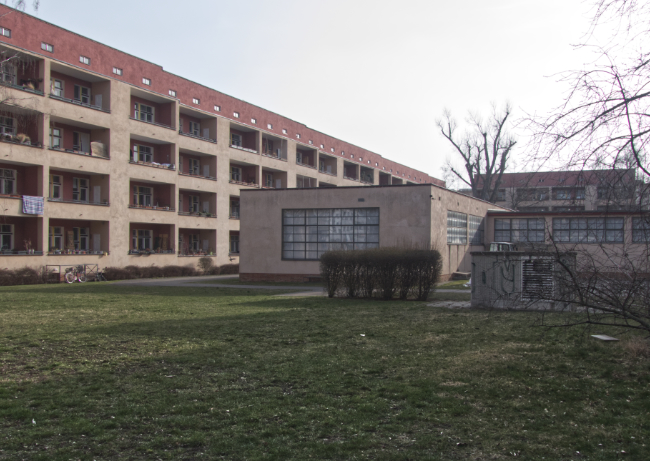
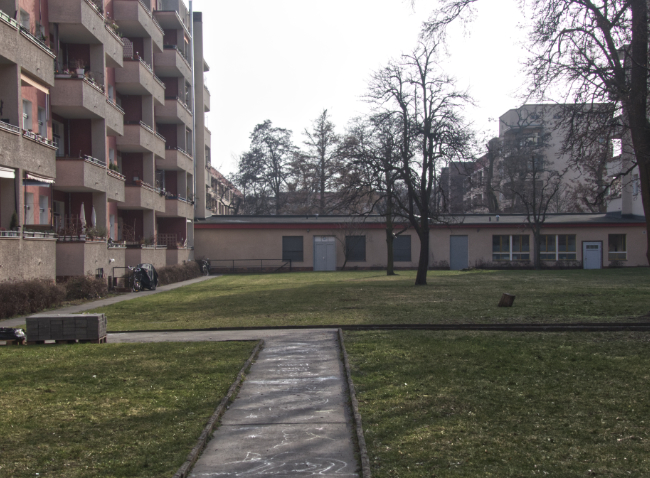
When first built the estate included a kindergarten, laundry buildings, library and combined heating and power plant. The balconies with their curved walls were partly designed to give tenants access to light and air and partly because they provide a superb aesthetic background to the estate as a whole. This combination of good design, tenants rights and supporting services were huge advances for Berlin workers.
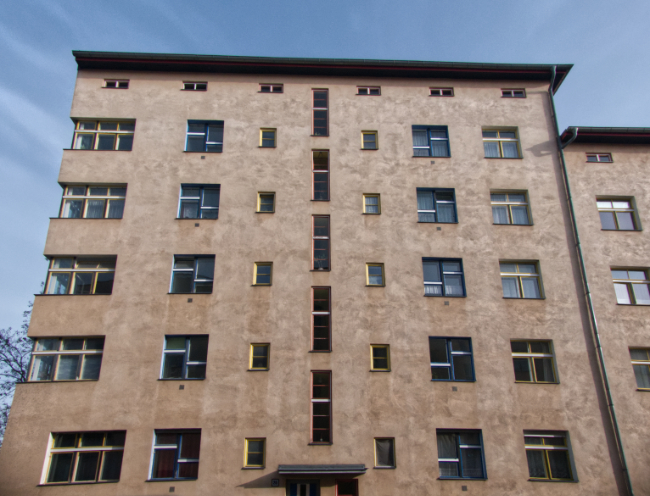
Even today, the sense of space feels like a well-earned luxury. The estate is clean, neat and tidy except for the rather pathetic graffiti ‘tagging’. Bins are in designated spaces and that’s kept neat and tidy too. Walking around you see balconies with all sorts of personalisation and pressed up against windows are flower pots, toys and nick-nacks and even, in March 2026, a Santa Claus. It all adds to a general quirkiness and individual expressiveness.

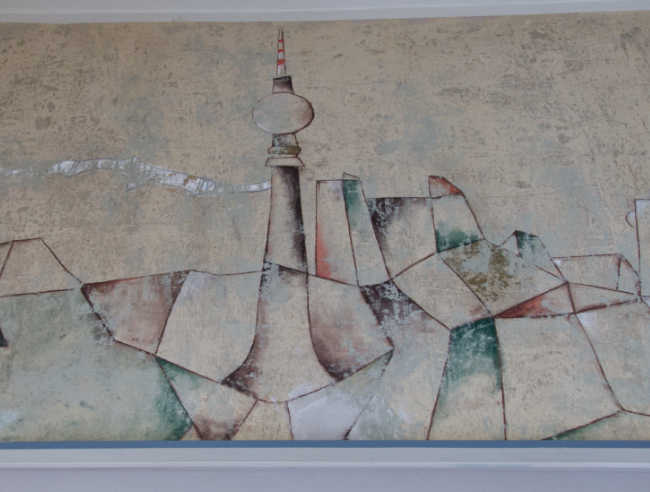
The Café Eckstern continues to be busy and I had a long chat to the proprietor and a good cup of coffee. He explained that he studied and taught art for many years. While he was making me an Americano I noticed the fresco on the walls. He had painted this himself ‘in the style of Bruno Taut’. I thought this was fantastic in many different ways.
The Sell-Out and Sell-Off
GEHAG was sold by the Senate of Berlin in 1998 to Deutsches Wohnen a real estate company. This was taken over by Vonovia in 1921.
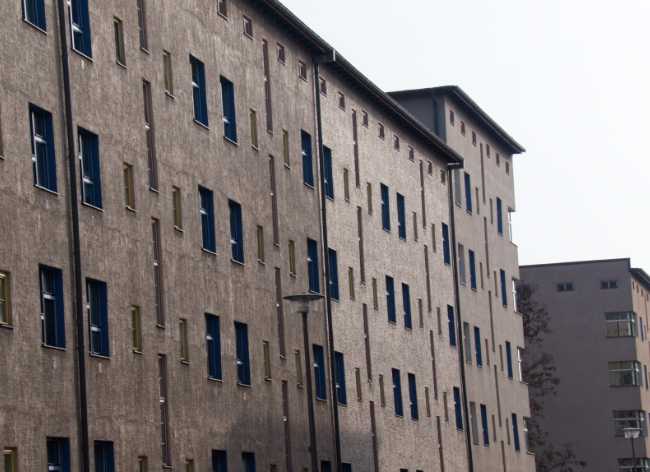
Vonovia, a name that means nothing to anybody which means it can be a universal representation of global capital. It is a real estate company based in Bochum which owns over 565,000 properties in Germany, Sweden and Austria. It is a member of the DAX 40 on the Frankfurt stock exchange. One of its largest shareholders is Black Rock, a US investment company with over $12.5 tn worth of assets. Another investor is Apollo Global Management.

Since 2007 a dozen real estate investment groups in Germany, including Deutsche Wohnen, Vonovia, Covivio and Adler have spent more than €42bn on buying properties. The consequence of this has been large rent rises and the generation of large-scale, well-organised and popular protests. It also led to a referendum on the expropriation of the housing of large corporate landlords. This is ongoing and I need to talk to people here in Berlin to get the real story of what’s going on. I will sum up those discussions in future posts.
Visiting the Carl Legien Wohnung
The streets to look for are Erich-Weinert Strasse, Georg-Blank Strasse, Gubitzstrasse, Küselstrasse, Lindenhoekweg, Sodtkestrasse, Sültstrasse, Trachtenbrodstrasse. You’ll find your way around. Stop for Kaffee und Kuchen at the Cafe Erkstern. Take your time. There’s a lot to think about.

 Commodity Fetishism
You must be logged in to post a comment.