
A Bob Dylan song, Don’t Think Twice, It’s All Right (demo version) came up while I was listening to music on shuffle mode. It was like a rip in the time-space continuum. It evokes a memory so painful it takes my breath away. It’s not so much to do with the lyrics or the music itself; it’s just that song was there for a brief moment, a long time ago, when something was slowly changing. It’s all too much to go into here.
I’d forgotten about the song, not played now for an infinity. And now it’s taken me back to another place and time. And then the strange spell is gone; and I’m back here, and now. Marx was a great student of reality. And yet reality still is naked and neglected.
Walking in the streets of the City of London. Everyone with a soundtrack, everyone with their own film playing in their head.
Someone was talking to me as if we knew each other. I’d never seen him before. I noticed a bruise on my hand.
‘You goin’ home now?’ he said, in a rolling accent from across Seven Seas; somewhere in the Caribbean I guessed.
‘No, I’m going into town’,
‘That’s the way to do it’, he smiled, ‘have a good evening’,
‘you too’.
He was wearing lilac trousers and a blue shirt. He had an elegance and coolness about him which defied a great deal, and it felt, was in favour of something else.
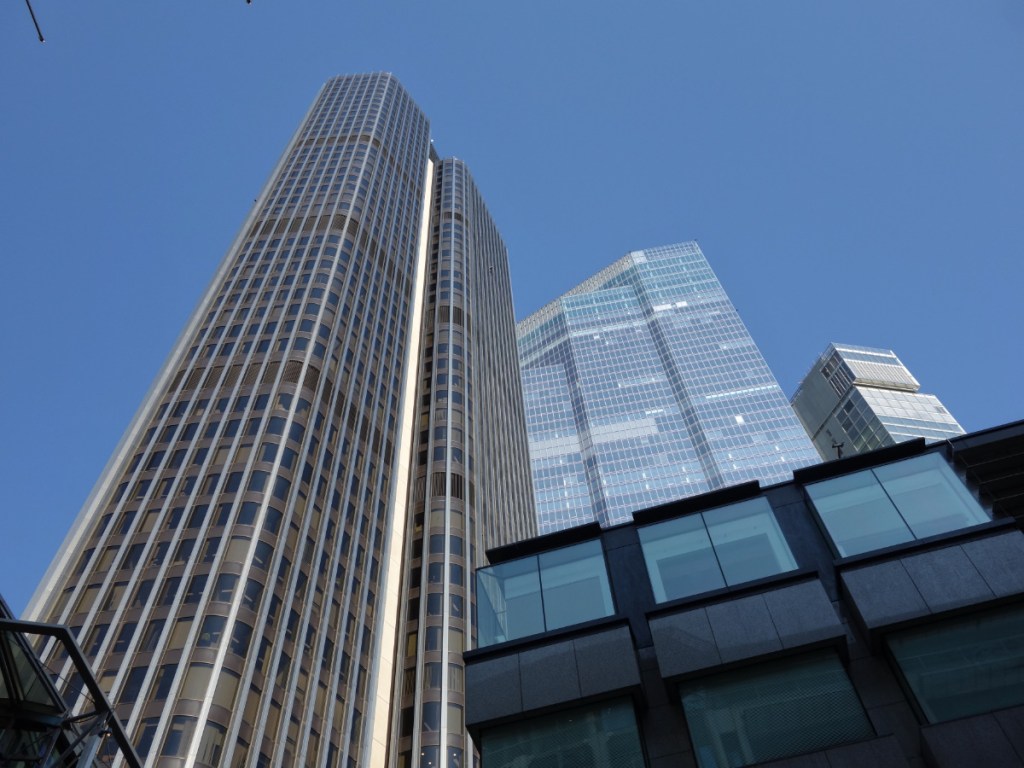
There’s an agitation in the air. Cooperation and isolation exist within millimetres of each other. Alienation runs down the glass fronts of the precision manufactured facades.
‘So perhaps the antitode to alienation is convivality?’
We were in the pub on a Sunday afternoon. I can’t remember how we got into this conversation. The example was that of Marx who suggested that the evenings of drinking and discussion by the Communists-in Exile in Soho in the early 1850s were a creative event in their own right. I like this idea. Conviviality isn’t a form of escape; its an attempt to be free from the alienation through the creation of camaraderie and conversation.

Early evening in the City at the end of a hot summer day. Every song that’s ever been sung, every opera and play performed, every rag-time band; it’s all here. Every novel, poem, manifesto, scraps of paintings, forgotten sculpture; fragments are in the heads of everyone who works here. Representatives of the people of the world are here, every language spoken, each idea, carefully preserved. Of sacred land, ritual, ancient religions, ancestral voices.
Capital works to homogonise the sky, to tamper with the speed of light, to insist that atoms work to accelerate the rate of profit. It is always year zero, everything starts afresh, nature shudders, grim skeletal hands push through concrete caverns, deep underground, the bones; a skull with a crushed steel helmet. The war is over, long ago, the war is over; but the war never ends.

Elements of capital went electronic some time ago. Now capital moves through the air as electronic signals, amplified by satellites, back to earth again through fibre optic cables. TCP/ IP and packet message switching. It reassembles. An agreement. The 1s and 0s can be reconverted into cash. Here’s the cash. In a pile. Now it’s electronic once again.
Switching bank accounts to pay for deep excavations, pile driving, steel beams, concrete foundations. Labour and machinery, computer aided design, building information modelling. Civil engineers and architects and designs. The 1s and 0s flying faster through the ether, construction has begun.
Goethe suggested that architecture was frozen music. But high rise buildings are frozen capital. Caught, imagined, held together with a steel frame and glass facade. A weird duality emerges of both use-value and exchange-value. The exchange values depart from physical existence, they are like the Holy Ghost in the trinity of raw materials, money and human labour power. Now the capital invested has become a capital object, but as such immediately begins to depreciate.

The utility of the office block is a source of rent. But that fails to keep pace with the rising land values. People – real people – (with their own soundtracks and films in their heads) – rush to keep up, chasing capital through the ether, trying to catch it with a net of spreadsheets and financial systems databases and inputs of the exact amount of labour, and the costs of that labour and the costs of the raw materials and how those costs can be driven down.
The ancestral voices and the traces of Marxism and anti-colonial struggles and the fight for women’s emancipation and family stories of grand-parents and parents and uncles and aunts in the trade union movement, at Cable Street, fighting racism in the factories in the 1960s, police victimisation, the grudge of daily life, sour faced landlords putting up the rent, a million songs, many with suggestions of rebellion, books which lift the spirit, against the crush of uniformity, conformity, multi-national diversity, top down edicts of how to change the world. Allies with who exactly, for what and how?
Along Old Broad Street, at the base of Tower 42. There is an invisible wall. But it must be pushed against. Up the escalator to the reception. The receptionists are low paid and may be treated badly. They can be forced to work long shifts. They may have to work late to cover for an absence. They are not just selling their labour power they are selling their availability, they are selling their presence. To have to sell one’s presence is to be hopelessly undone.
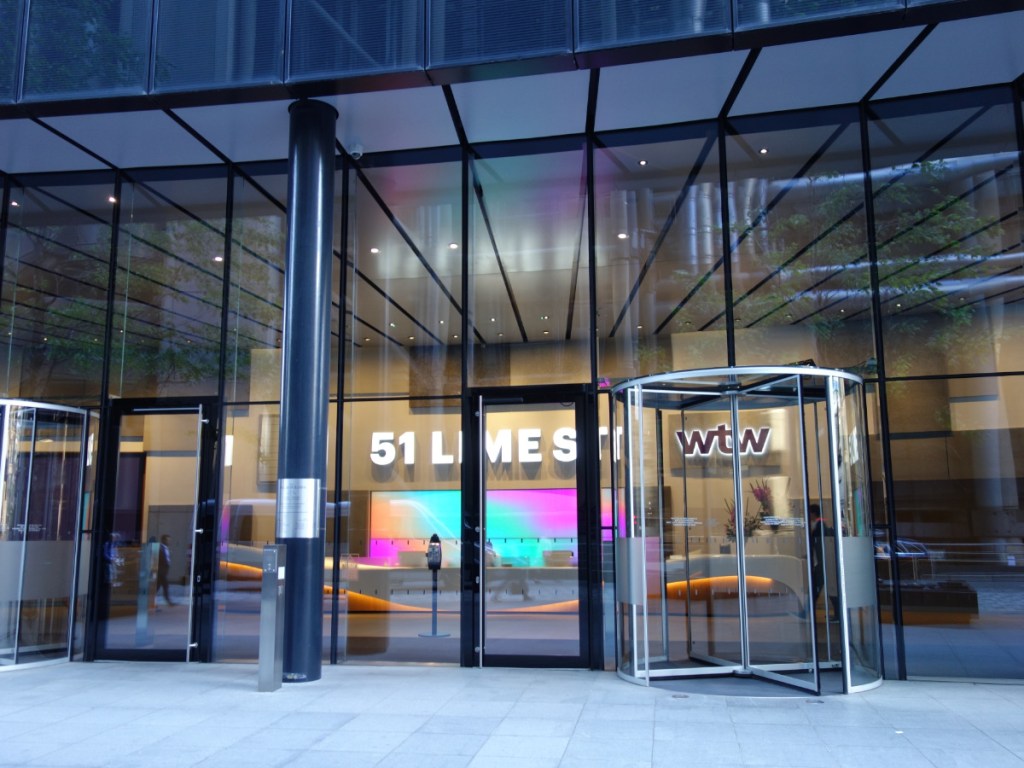
It’s a casual question about shops and restaurants and bars. Speculative. No, not here, you can’t come in here, but go back out and round the side and look for the entrance to the club.
I take things from my pockets, keys, phone, camera, notebook, pen and other bits and pieces and put them in a tray and then my bag is scanned.
It’s an elderly guy on duty. Work with him. He’s had a long day. He’s about to be replaced by a young Black guy who is just about to start a new shift.
Up in the lift to a floor high up within the sky.
I make an introduction about Radical Walks and such and this goes along suprising well. The manager is called. I like him. He shakes my hand and gives me a fascinating overview of high end hospitality in the City and beyond. He is an active historian of a history that most historians don’t consider. We spend some time talking. I would have liked to drink a beer but I have work to do.
He shakes my hand again and goes off to make sure that everything is fine in the private dining area. The staff are really nice and assume I’m not a customer but some sort of researcher, or something else, and tell me this and that. I feel as if a semi-official status has been acquired. This is one of the biggest keys of all; for the workers to trust that you are on their side. It opens many doors.

More soundtracks, fragments of paintings, scraps of novels, everyone with a film playing in their head. Their own film. Some of those films have fragments of rebellion, resistance, even at the level of how a glass is set upon a table.
There is an opposition here. At many different levels and with varying degrees of intensity and desire.
The revolutionaries talk of revolution. But what exactly do they mean?

 Commodity Fetishism
You must be logged in to post a comment.