
Unsure of the atmosphere on the streets. Mortimer Street, Cavendish Square, Mortimer Street, Tottenham Court Road. Not sure what atmosphere I’m trying to find.
The degradation of England is deliberate. The Tories have been in power for thirteen years. It would have been possible to have fixed poor housing, housing shortages, zero hours contracts, refugee crisis, hospital waiting lists, the lack of NHS dentists and much more. It could all have been fixed in the past decade or so. Instead, corruption, and the degradation of England. More and more town centres hollowed out by the digital companies avoiding tax payments. The delivery drivers of the so-called gig economy. Unregulated landlords letting out unsafe, damp housing at high prices.
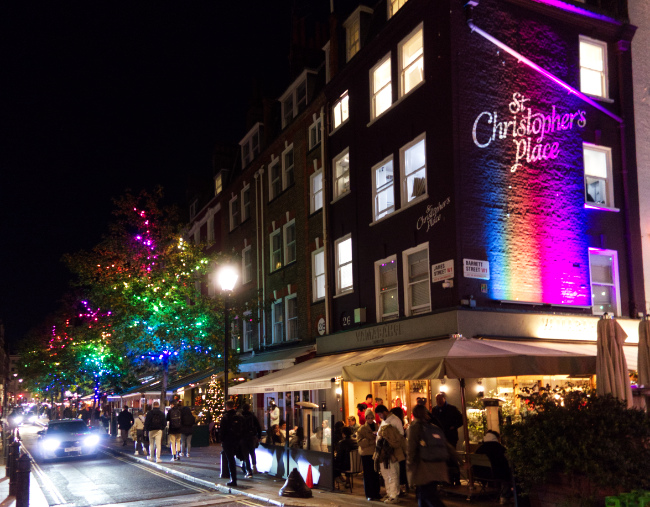
Capital is a fine mist that covers everything. Ruling class ‘ideology’ is a membrane that is only a molecule thick, but as strong as the toughest metal. It’s in our heads. It divides the streets. This side of the street, one set of ideas, on the other side of the street, different ideas. The membrane of dominant ideas is a layer that divides people in the workplace, separating the social relations at the point of production, the motorways, conveyor belts and shipping lanes of distribution, the decision making in the hierarchies of the bureaucracies. The bourgeois ideology membrane is everywhere.

The Tories have no project other than to enrich themselves and their class. This enrichment is easier done if their opponents are divided. The degradation of England is therefore also predicated on increasing division, where ever this can be done. Speed limits, the price of train tickets, the content of the BBC, lowering chronic levels of pollution, health care, the price of fish. Everything, everywhere, becomes contentious, stoked up by well-funded forces that are mysteriously concealed. Democracy subverted.

The limited first past the post system of democracy from the early twentieth century no longer fits. But there are sections of the ruling class who clearly do not want an extension of democracy. In which case, why bother with democracy at all? Those who carry the discordant pipes of authoritarianism whistle here and whistle there. Braverman, Trump, Orban. The fence sitters such as Sunak will disappear in the next and hotter phase of crisis. The economy of Germany is slowing down, the economy of China is slowing down. The most recent phase of capitalist development, partly enhanced by speculative property development is over. No one is quite sure what the next phase will be.
I wanted to call this piece ‘Cosmopolis’, it’s a term used in Wasserman’s book Black Vienna. I discovered it’s the title of a film. That won’t do. Cosmopolitan, cosmopolitics. I like the latter term, but too obscure. But it’s not an audience I crave so I’ll use it. It’s the urge to write; to see what emerges. And I’m still striving for a voice, a voice that will take off and soar. It’s not there yet. It needs much more practice. More ideas, more reading, more conversation, more stimulus from the world around me.
There is more technology And technology seems to lean towards and support the right. Current technologies are in part expressions of class relations. Those class relations are dominated by the capitalists. It’s not mechanical materialism. But there are mechanical forces; and of course, materialism.
Inside two different new buildings. There are too many materials used in one. Small grey bricks, a grey rubber floor, wood panels on the walls, a chrome and steel lift. None of the materials complement or talk to each other. It feels like a collection of bits rather than a totality. I don’t think that works for a building. The second building is much better. Nice clean, bold lines, the material is a sort of polished stone (it’s not marble, but that sort of thing).
There is the luxury of space, used to bring natural daylight into the central part of the building. It feels to have a better atmosphere. These are over-used terms but the former could be described as post-modern, the latter as Bauhaus influenced. We haven’t got the time to go into all that here. Personally I think only a few people have managed to mix styles and influences in an original way; Pugin, Adolf Loos, Josef Frank. Pugin is considered as a medievalist but surely he’s one of the first modernists of the nineteenth century?

I had an interesting chat with some colleagues about those two buildings. Above all else, I was interested in what they thought about them and so tripped out a set of questions. I was fascinated and intrigued by their comments. Some of which I’ve incorporated above. They saw different things. Perhaps all criticism needs to move from being the role of individuals to that of collectives?
A scribbled note to remind myself to start The Anti-Concrete League.
The degradation of England has found its expression in what I would describe as urban nodes of degeneration. This is, if nothing else, a counterpoint to ‘regeneration’. All the notes of degeneration are out of tune. These urban nodes of degeneration include speed, car, noise, air pollution. A polarisation whereby some live in cul-de-sacs and drive much too fast through poor quality urban streets.
There are whole areas which have become concentrations of urban nodes of degeneration. These nodes of degeneration are so intense and bleak that it is presented as being impossible to fix. This is a further intensification of division. Whole urban areas are divided and polarised.
There are crows and magpies flying between the towers of glass and steel. They look lost and angry. They swoop and dive but there is nowhere to land. They are eating the foul decay of a thousand take-away meals. Thrown to the side of the road.
Everyone is going on strike. The low-paid security guards, the moped riders, the maintenance workers in the goods yards at the base of the office block buildings, the telecomms engineers in holes by the side of the road, splicing together cables, connecting fibre optic cables, the sewer workers, the construction workers hundreds of feet in the air, the drivers of the trains deep underground. Someone blew a whistle, a red flag was flown, and then another, a poster on a wall, the word organise written in six foot high letters along a glass office block facade. A hurriedly printed leaflet with organise written as a headline, a sticker on the handrail of the escalator, organise.
Where is the resistance to the power of capital? I don’t mean some wishy washy words about a new government that promises more police and an austerity that will make it easier for capital to expand. Not that sort of stuff. I mean the resistance to capital in how it makes us work all day for things we don’t want or need, I mean the resistance to the way the dynamics of capital accumulation – war, competition, exploitation – messes with our heads. I mean the resistance to the totality of capital.
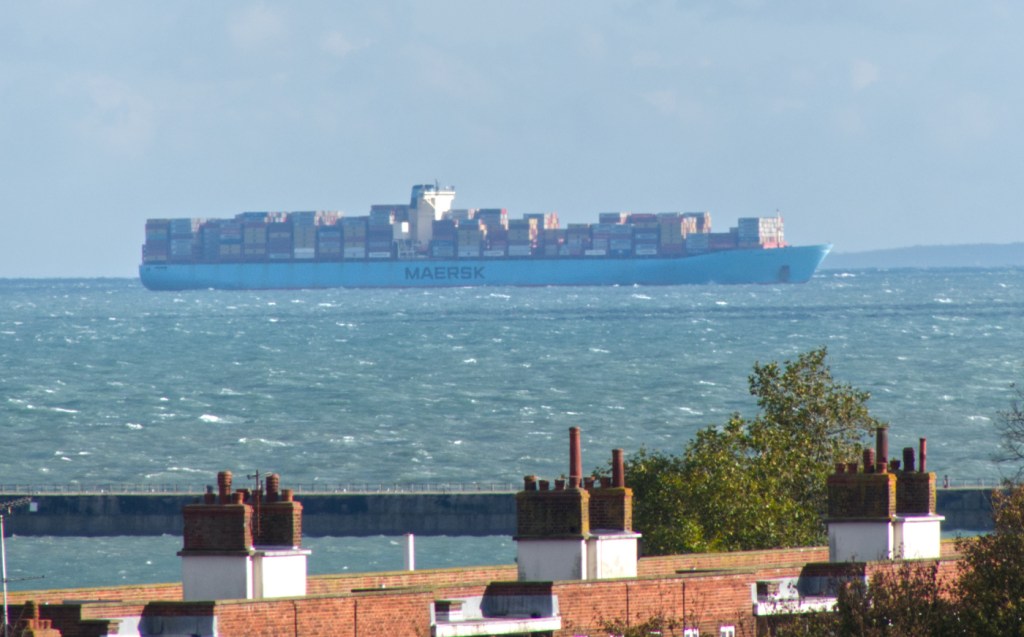
I sat in a meeting room looking out of the window. I could see long train loads of containers moving slowly on the railway tracks. Maersk, Cosco, China Shipping, Hamburg Sud, Sealand and many more. Perhaps a thousand containers went past in an hour or two. What’s inside them? Where are they going? What commodities will fill them up next and where will they be shipped to? How will the logistics software be used to maximise the load capacity? After all, no shipping company wants it’s ships filled up with empty containers.

The trains are only travelling at 15 or 20 mph. It’s not much. But it feels as if today, this afternoon, everything single object in the universe is moving at 15 to 20mph. The whole world of objects is in motion. The circulation of commodities. And in the process, the creation of the weird crude-oil liquidity of money. Just stop money. There’s a revolutionary demand. If only it was possible to convince a great mass of people how much better we would all feel if there was no money. Historically, a great deal of pleasure has been experienced outside the money economy.
There is a concrete bridge over the railway line and a four lane road. Two lanes in each direction. It’s not even marked as dual carriage way or motorway. It wears me out just looking at it. Then it makes me feel physically sick. Why won’t it stop?
My notebooks appears chaotic and random. However, there are certain rules. If nothing else each page is dated with a number. For example, page five of the 22nd November 2023.
They get left on the kitchen table or my writing desk. And then I’m in a hurry to get out of the house and I cannot find the latest one in the sequence so pick up an earlier one instead. Notes for this day in November find themselves injected into earlier notes from the sixth of September when I was in the Margaretengürtzel in Vienna. Those notes however are dated and numbered in sequence. It sort of sorts itself out. Sometimes the notes are just a one liner. At some point in the afternoon I wrote, The Myopia of Capital. There is a whole volume to be constructed from that.

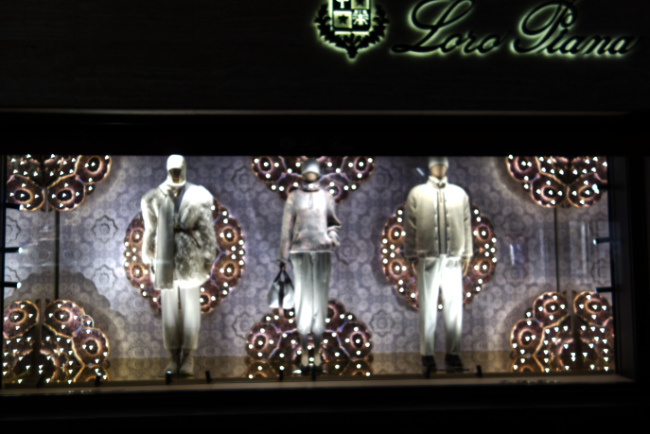
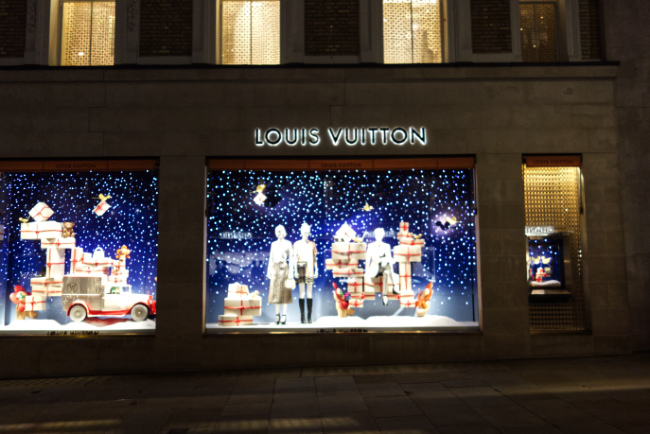
The mannequin in the window looks fed up. Even the shop room dummies have had enough. They can also be part of the revolution. We need to change our relationship with objects. That subject -object stuff needs a revolution too.
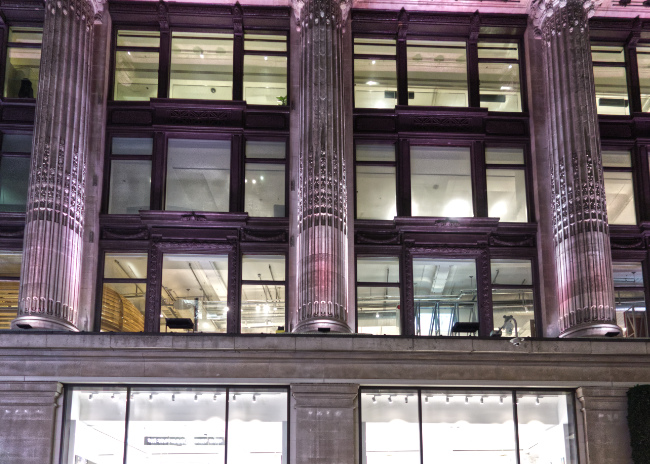
Looking through the windows of office blocks, catch my own reflection. There’s a world in that office block that I’m familiar with but now I’m just a mirror image. There’s a film in my head, I’m making a film in my head, at some points more consciously than others. There are fragments of a script, the story is still vague. It’s more a sequence of loosely connected vignettes. Isn’t that how we experience our lives?
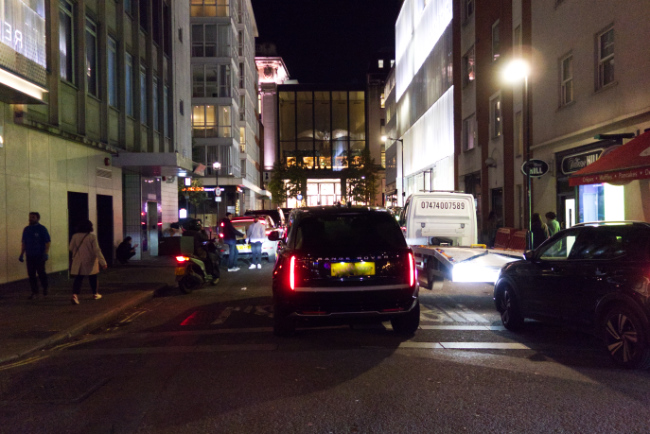
Once again in the West End, walking through forgotten streets, reaching out with an unsteady hand to touch the luxury consumption, but it is too far away, as if on the top of a mountain in the distance. Do we wish to climb that mountain or destroy it? There are big, expensive cars in the streets of Bond Street, Brook Street, Piccadilly. All production and consumption is predicated on cheap oil. And that cheap oil sprays a fine mist upon us, and each part of that spray is pre-loaded with the particular orders we must obey, and certain ideas, and the violence of exploitation.
See what I mean? We need a movement against capital. Not just ‘outrage’ against this or that expression of any of its particular movements.
 Commodity Fetishism
You must be logged in to post a comment.