
The starting point for this walk is Heitzmann Hof and then a perambulation through streets and estates to Sturhof. The walk will take about two to three hours. The walk is a ramble rather than a continuous straight line or a circular route.
There are small detours where you might find the need to retrace earlier steps. It’s all worth doing. The nearest U-Bahn is the U-1 at Vorgartenstrasse.
Heitzmann Hof
The building was designed by Hubert Gessner and constructed between 1925 – 1926. When first built it included a kindergarten, bathing facilities (as in baths for washing not swimming), artist studios and a fire station.

It’s a clever building which wears its learning lightly. There is something cosy and seductive about the building, a homely sort of place, which is what good homes should be.
The gate is usually open so it’s possible to go into the courtyard and have a look around. The facade of the building on Lassallestrasse has the former fire station at the ground level.
Now walk along Vorgartenstrasse to the large road junction.
Lassalle Hof
This is the large bold building on the corner of Lassallestrasse and Vorgartenstrasse. Any building bearing the name of Ferdinand Lasselle needs confidence and chutzpah. He was a follower of Hegel, adversary of Marx and Engels, maintained secret relations with Otto Bismark, helped found the first socialist organisation of the German labour movement and was killed in a duel at the age of 39. He needs more than a plaque on a park bench.

The building was designed by a team lead by Hubert Gessner and there was originally 290 flats. It was opened on Sunday 3rd October 1926, the same day as the nearby Heitzmann Hof.
Lassalle Hof itself is on a key route into and out of the city. Stretching out into the distance is the Reichsbridge across the river Danube. There is a sense of this being a gateway to another world, the east, to Budapest, Bucharest, Teheran, Kabul, Tibet and China. This road will take you there.
The original building included a centre for the Workers’ Samaritan Association, a library, socialist party headquarters, a photography studio and a meeting room for the Vienna Friends of Nature (in the tower), shops and plenty of open space.
The Friends of Nature was formed in Vienna in 1897 as a consciously socialist and ecologist and environmentalist group. Today it has around 350,000 members mainly based in Europe.
The Concentration Camp Association of Vienna has offices here.
Lassalle Hof is a self-contained building but it has also become a landmark of the city itself. This was one of the earliest of the large Gemeindebau and included services, shops and amenities not just for the residents, but also for the local neighbourhood and wider city.
Like all the large Gemeindebau the intention was to stitch the housing into the existing urban fabric of the city.
Walk along Lassallestrasse in the opposite direction to the bridge.
Note the shops of Lassalle Hof on your left and if you look across the road you will see the former fire station of Heitzmann Hof.

Some of the shops are now empty and the wide street suffers from the domination of motorism. Pichler Hof at 28 Lassallestrasse has a metal plaque recording the destruction of the previous building during the second world war. It’s all a bit gloomy but there’s a treat around the corner.
Turn left into Harkortstrasse
Harkortstrasse 3
On the left hand side as you walk along the street is number three. This was built in 1925 – 27 to a design by the architect Otto Nadel. There were originally only fourteen apartments, some with just a room, study and kitchen. If a shower was included this would personally suit me fine. Rents were low, about four percent of income. I could easily adapt to that arrangement.
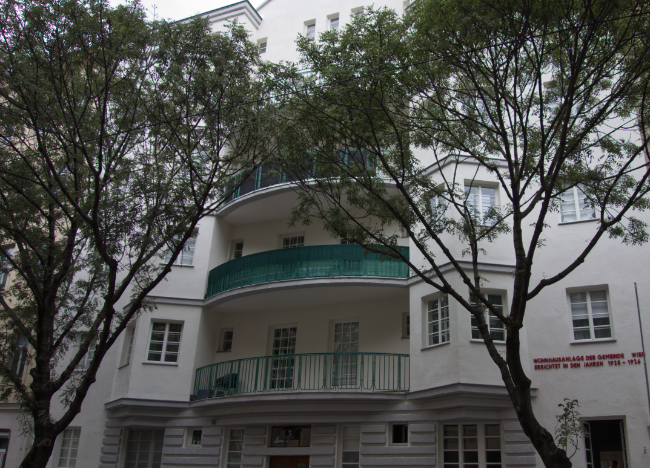
It’s a fine looking building. The bright white helps set off the standard red lettering. The balconies, well proportioned facade and solid entrance way provide a genial grandness. And once again the attention to detail that the Red Vienna architects understood so well.
Just keep reminding yourself that this is council housing.
Just about directly opposite is another Gemeidebau. It’s part of Hermann Fischer Hof. There’s a throughway next to a clothes shop. If it’s open go through and walk through the courtyard and come out the other side on Ybbsstrasse. If the gate is locked then just continue along Harkortstrasse and turn right.
Don’t be shy about using these entrances. The buildings of Red Vienna were designed to be part of the city not gated communities.
Hermann Fischer Hof – Ybbsstrasse 15 – 21
This apartment building was constructed between 1928 – 29 to a design by Otto Prutscher. There were originally 72 flats.
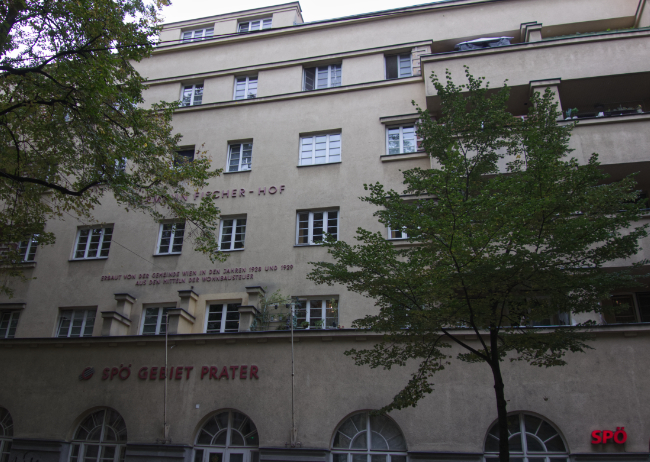
Otto Prutscher was an architect and designer influenced by the Vienna Secession. He designed glassware, textiles, interiors and furniture as well as buildings.
The ethos of the Secession included an emphasis on craft labour, good quality materials and a modernist aesthetic. The aesthetic included a fusion of decorative elements and functional simplicity. This can be seen throughout the building and its courtyard in the large stone spheres, the use of arches (including in the wall in the courtyard), the brick work and the iron work.
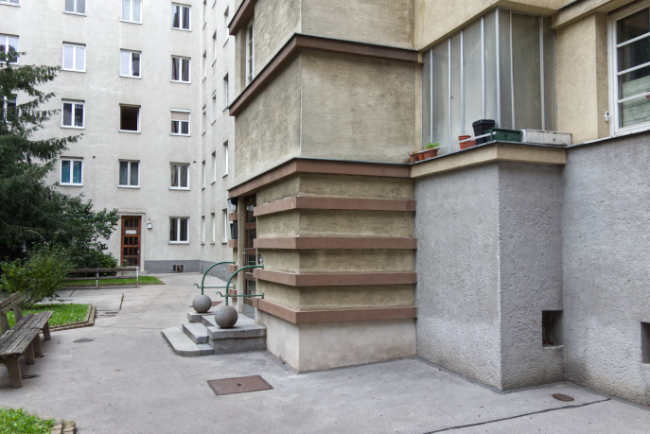
Hermann Fischer was a metal worker and shop steward at the Siemens-Schuckert works. The company was formed as a merger in 1903 and became the largest electrical company in the Danube monarchy. Fischer later became the chair of the Leopoldstadt social democrats organisation, and in 1919 a member of the Vienna City Council.
Turn left into Ybbsstrasse and then right into Harkortstrasse and then left into Ennsgasse and then right into Wohlmutstrasse. If you’re doing the walk during the week or a Saturday there’s a market there with several stalls that serve food, beer, coffee. There are also public toilets.
Wohlmutstrasse 4 – 6
Built in 1930 to a design by the architect Franz Wiesmann it was constructed with 30 apartments. It is directly opposite the market which has fruit and vegetable stalls, food shops, places to eat and drink and on some days stalls full of bric-a-brac and surrounded by boxes full of all sorts of curious things.

If a certain sort of space is provided people will find innovative ways of using that space. This cannot happen if rents are high and if there is bureaucratic management control.
In some urban spaces these free and easy spaces are becoming increasingly rare. The power of finance, money and capital pushes them out. New spaces, often pseudo-public are created with corporate regulation, security guards and closed circuit television. Westfield shopping centres are examples of the genre.
May this local market long continue. It’s full of character and characters; something PR companies simply can’t develop.
Wohlmutstrasse 14 – 16
Built between 1927 – 28 to a design by the architects Gustav Schläfrig and Hermann Reisser. To get a greater sense of the building take a short detour into Erslafstrasse.
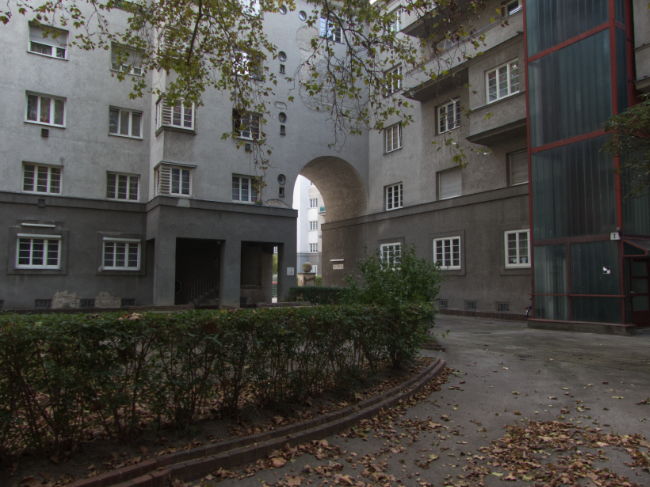
You may be able to walk through the whole courtyard interior if all the gates are open. Note the stone sphere and fountain, although unfortunately nothing is known about the artist.
The rounded balconies, the arches and the way the building mass and courtyard space are designed all encourage an inquisitive sense of ‘what’s around the corner?’.
Now turn round and walk back towards, and the through the market to Radingerstrasse
Radingerstrasse 21
Designed by the architect Franz Zabza, the building was constructed between 1927 – 28. It originally had 17 apartments. It’s another example of a good in-fill building.

The arches and the aspect of the building are done well. The style suggests a Renaissance palace. When Zabza was studying he won the ‘Rome- Prize’ which helped him take a study trip to Italy. Perhaps that were the style came from. This was Zabza’s first commission from the city council.
Continue along Radingerstrasse and then turn right into Ybbsstrasse again. You will see more of Lassalle Hof as you walk along.
Ybbsstrasse – 31 – 33
Constructed in 1927 to a design by the architect Ferdinand Kaindl. He came from the area that would have then been considered Bohemia.
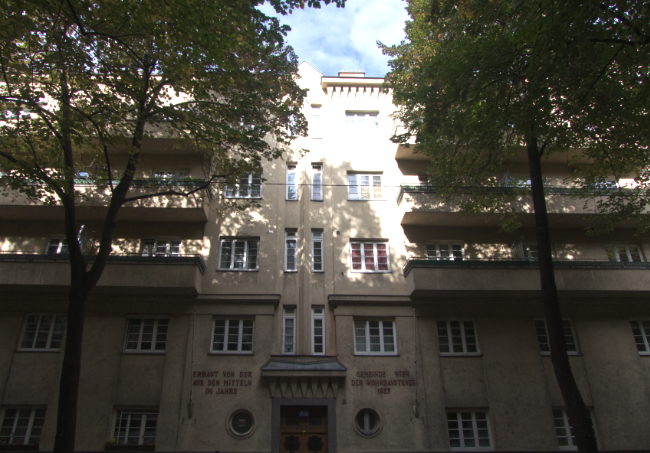
There is a Bohemian feel, a central European Cubism, a creativity and style that was mercilessly hammered by Stalinism and Hitlerism. So much was lost with the development of authoritarianism, dictatorship, fascism and bureaucratic state capitalism.
People murdered and incinerated, buildings and works of art destroyed, atmosphere poisoned, ideas and creativity crushed.
Red Vienna always stood for something democratic, equitable, humane, progressive and optimistic. We must learn that there are forces which deeply fear such things.
Ybbsstrasse 40 – 42
This was built between 1927 – 28. The architect was Erich Franz Leischner and there were originally 36 flats. The building is characterised by the intricate brick work at the ground floor level and the delightful sculptures by Josef Franz Riedl. There is also good iron work.
Several buildings in Vienna are clearly influenced by the Amsterdam Expressionism developed by Michel de Klerk and Piet Kramer, and ‘the Dream in Bricks‘.

As of writing (October 2025) the building is covered with scaffolding.
Continue to walk along Ybbsstrasse until you come to Vorgartenstrasse. There will be a school in front of you on the opposite side of the road. There are also traffic lights here. Use these to cross the road.
Vorgartenstrasse 203
The house in which Karl Polyani, his wife the historian Ilona Duczynska and their daughter Kari lived before being forced into exile.
Continue along Vorgartenstrasse until you reach number 213
Vorgartenstrasse 213 / Wachauer Hof
Built between 1923 – 24 to a design by the architect Hugo Mayer. The estate originally contained five shops, two workshops, community bath facilities and a kindergarten.
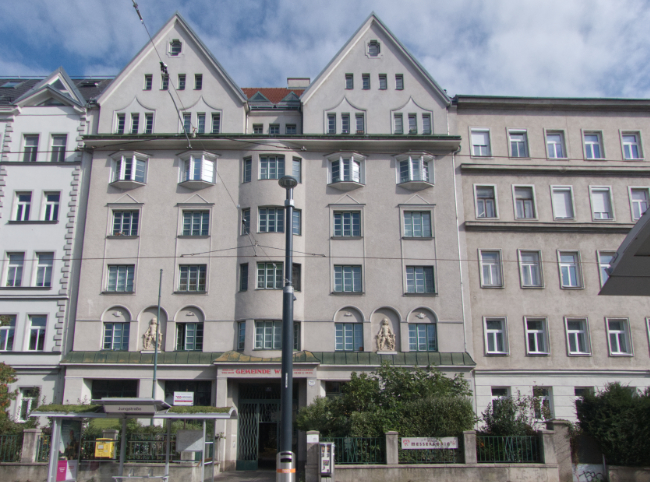
There is rich detail and ornamentation at the main entrance. The ceramic relief above the entrance is ‘Two Scouts’, a biblical motif from the Wachau coat of arms. Wachau is a region in Austria after which the estate is named. The design of the entrance way building with the roof parallel to the street is pure Beidermeier. Fantastic.
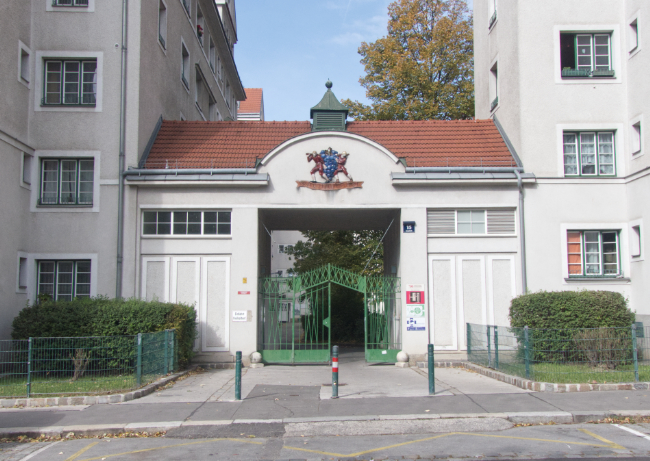
There are reliefs on either side of the main entrance. The ‘Four Ages of Life’ outlines a grape harvest. ‘Light and Darkness’ shows the signs of the Zodiac and includes a sundial.
All the artworks, including the statutes of the two boys on the Vorgartenstrasse side were by Josef Franz Riedl.
I really think it’s worth walking the whole perimeter of the building (in fact I would recommend this for all the housing buildings).
Zola Palais de Boheme
This is now a hotel but was originally built as a ‘private palace’. I’ve tried a few things to find out more (even ChatGPT) but there’s not much of its history on the world wide web. That’s a pity because I for one am intrigued as to where it came from and what’s it been used for over time.
Continue along Vorgartenstrasse and then turn left into Kafkastrasse
Eldersch Hof, Kafkastrasse
More impressive modernity by the architect Ludwig Davidoff. This is the only municipal building he designed. He was Jewish and forced to leave Vienna for England in the 1930s where he becomes lost from view.
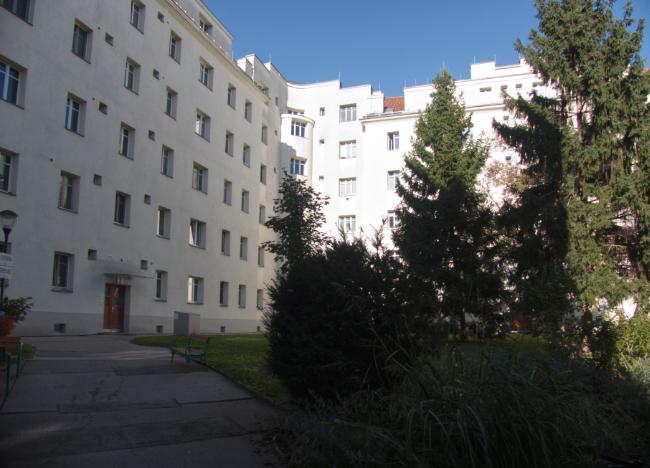
This is a well designed building on a triangular site with a landscaped courtyard and iron gateway. There were originally 128 apartments.
It is on an open site but the design is intimate and a great deal of privacy is provided by the trees and the arrangement of the building mass.

Matthias Eldersch came from a poor working class family and was apprenticed as a carpenter. Between 1901 to 1911 he was a member of the Reichsrat. During the Republic of 1918 he became the first Director of People’s Food Office and in 1919 he was a member of the Constituent National Assembly.
Continue along Kafkastrasse until you reach Kafkastrasse 11.
Kafkastrasse 11
Here is another example of how the buildings of Red Vienna were generally designed to support and yet develop the existing street-image. The quality of the design and materials of the buildings has meant that they have continued to realise their use-values over the best part of 100 years.

Contrast this to the huge amount of public housing in Britain that was built in the 1950s and 1960s and was demolished after 20 years or so.
Now turn round and walk back the way you’ve just come – it’s only a few metres – and then turn left into Engerthstrasse.
Engerthstrasse
There is a large military barracks on one side of the road and a lot of housing from the 1950s and later. I think this is worth seeing in it’s own right.
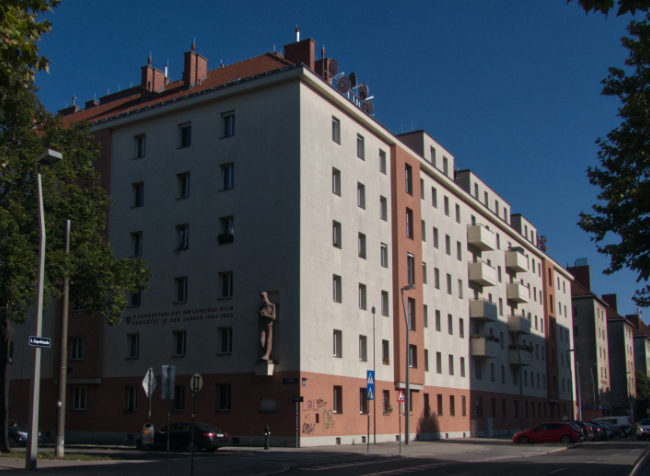
This whole area (including what you’ve walked through so far) was developed from the mid 1870s onwards following the construction of infrastructure of prevent the Danube from flooding. This coincide with large-scale and rapid industrialisation.
The housing after the Red Vienna period is beyond my current research. Next time I will study that too.
Sturhof
Sturhof has a confidence of both mass and style. This is a dream in modernism. Every specific feature and aspect of the building works to support the general design, the individual components combine to create a harmonious whole.

The architect Joseph Kuhn was influenced by Adolf Loos and this shows throughout with the understated symmetries, the the powerful lines and the totality of the mass of materials. It is reminiscent of the Looshaus in Michaelerplatz 3.
Like all good modernism of the 1920s and 1930s it continues to look modern. Imagine if this was built today in somewhere like east London, instead of the ticky-tacky flat-pack blocks that now dominate the area.
How is this so modern? How has it survived? Why does it continue to exhude such style and quality without appearing dated?
One critical factor is that Sturhof, and all the housing of Red Vienna, was build with the central purpose of housing people, based on the principles of light, air, space and nature.

The housing was paid for through taxation in which the rich proportionately paid more. This is how the capital was raised. The capital costs were written off. There was never an expectation that the housing was there to make profits for capitalist interests. Rents were used for maintenance, repairs and the provision of services.
These are very different starting and end points to the provision of housing were the main purpose is the production of profit. To understand this it is necessary to study the urban development of cities, the political history of capital and the impact of revolutions, reforms, oppositional currents and class formations.
Walk through Sturhof to get a sense of the building and it’s central, communal garden. And when you come out the other side you will be at the Krieau U-Bahn station.
Here is a new modernism, one of capital accumulation, glass, concrete and steel. Is this still Vienna? It could be any city anywhere in the world. There is nothing distinctive, nothing that connects with the history of the people or the city. Here’s what an urban landscape looks like when profit is the central aim.
I retraced the walk one Saturday morning in the early Autumn. The sky was bright, the air cool, the city slowly waking up.
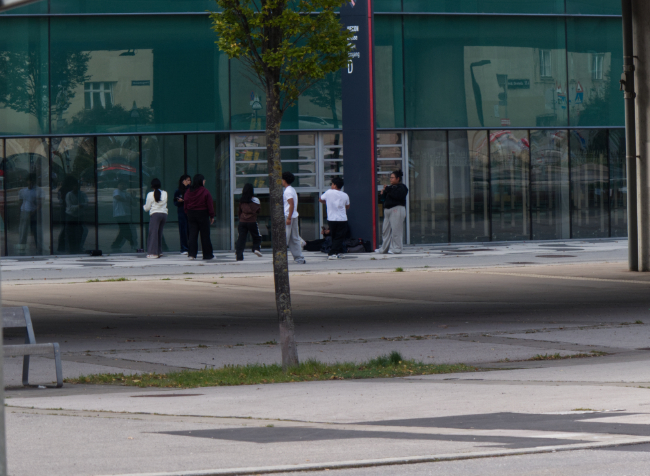
On the other side of the road near the entrance to the U-Bahn station a large group of teenagers were playing music and practicing dancing in formation. They were good dancers and expressed life, vitality, hope. They would stop and laugh and talk and then started dancing once again. Housing should be designed around such things.
If we want good buildings then there needs to be quality of design and quality of materials. There needs to be space, air, light and nature. The effort must be concentred on people not on profit. The future needs to be based on people like those teenagers.
I strongly suspect they have better ideas of modernity and how to live and what a building should be like than the land speculators and property developers.
And when they dream of modernity it is a better dream than ever captured in spreadsheets, finance databases and management reports.
For there are better dreams than these.
This is part of a series of seven Red Vienna Radical Walks.
1. Ella Briggs, Karl Marx & Modern Housing
2. The Radical Housing of Meidling, Vienna
3. Favoriten and the end of Vienna
4. A Walk along Währinger Strasse
5. A Modern Dream in Sturhof
6. Rabenhof, Vienna: A Radical Walk
7. Red Vienna: A Radical Walk
And here’s an eclectic Red Vienna reading list
 Commodity Fetishism
You must be logged in to post a comment.