
Währing – District 18
The walk starts at the Währinger Strasse Volksoper U-Bahn station and can be finished at Antonigasse where there’s a tram stop. The walk is about 3km in length. How long in time this walk will take will depend on how much you stroll and wander and look at things along the way. Perhaps a couple of hours? Or a little more? There’s no rush.
I would suggest doing this walk on a weekday or Saturday when the shops are open. There are lots of them, including some junk shops, and they can be fun to browse.
Währing was developed as a middle class area before 1914. That’s reflected in the architecture and design and shopping character. The streets also show how Vienna was beginning to change with the impact of the Secession, Art Nouveau and Modernism and ideas of Garden Cities and how we might live.
And yet the city officials, socialist politicians, urban planners and architects of the Red Vienna period were able to successfully integrate the new public housing, built for the working classes, into the existing urban fabric. This was not just about architecture but social positions and class power.
This will become apparent on the walk itself.
The titles below generally provide the address of the building, the date of construction and the name(s) of the architects
Staring Point – Währinger Strasse Volksoper Station
This is the suggested starting point. Come out of the station and follow the signs to Währinger Strasse. You will cross over a main road, Währinger Gürtel. Now look back at the station.
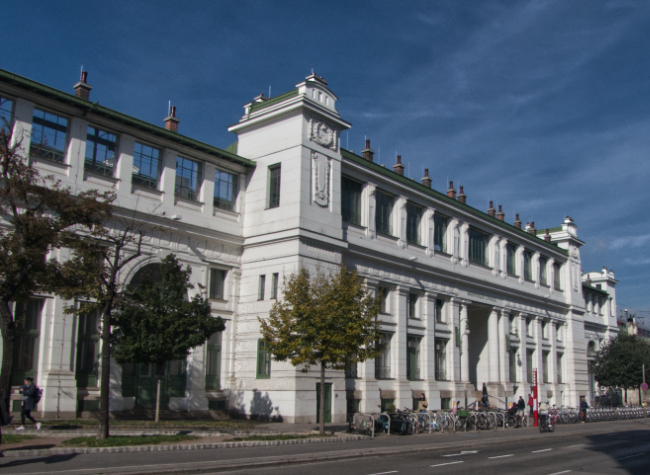
This is part of the Stadtbahn designed by Otto Wagner and built between 1893 – 1901. Wagner was a practising architect who also taught at the Academy of Fine Arts in Vienna. Many of the architects of Red Vienna were his pupils and he had a huge influence on their ideas.
The Stadtbahn represents a totality of design in which everything was considered. The typeface, the wrought iron work, layout, colour scheme, plaster work and much else. By taking this approach the Stadtbahn created its own distinctive image.
There were originally 36 stations and this new urban railway was a significant development of the transport and communications systems of the city. Communications in that people could travel further and more easily; and people are great carriers of all sorts of messages.
Eve Blau writes in The Architecture of Red Vienna:
‘it placed those parts in a new relationship with each other and the city as a whole, radically changing the character, internal rhythms, and underlying structure of Vienna – without, however, substantially altering its outward appearance. This aspect of the Stadtbahn ….had considerable significance for the Social Democrats ‘building program in the 1920s’. (The Architecture of Red Vienna – Eve Blau p76).
The Stadtbahn was large-scale infrastructure built across the city, appearing in different places and linking them together. The railway, with its bridges, arches, viaducts and stations was a new form, a new type of construction with specific ‘organizational functions’. This was also the case with the housing.
Both the Stadtbahn and the Gemeindebauten (municipal housing) were solutions to new questions; these questions being social, political, architectural and spatial. How to build mass transport systems, how to build good quality and low cost housing for the working classes?
Hold those thoughts as we now start to explore this area.
Währinger Strasse
Walk slowly and enjoy window-shopping and occassionaly gazing up at the variety of buildings and architectural styles. I’ve just picked out a few examples, there are lots more.
Währinger Strasse 79
A dainty Beidermeier building that adds a historical footnote.
Corner of Canongasse and Währinger Strasse
Perhaps find a local coffee shop and dig out Adolf Loos’s book Ornament and Crime (a must read) and contemplate the excess of ornamentaion.
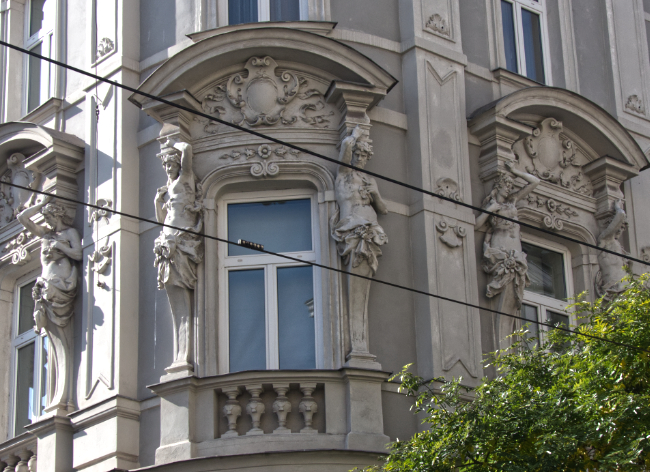
These are not hand made sculptures. It was all factory made and the factories produced their own catalogues full of images; an Atlas figure wrestling with a large balcony, curvy women revealing their bosom, grotesque heads and much else. Once you start seeing all this through the perspective of Loos, the absurdity will never leave you.
Keep your eyes up at that level and note Wilden zum Mann.
Turn right into Riglergasse
It’s a short street with a cobble stone pavement.
Turn left into Gentzgasse and look out for 45 Gentzgasse on your left hand side
Gentzgasse 45 1926 Siegmund Katz
One of the starting points for the housing of Red Vienna was the principles of air, light, space and nature. All housing was to be built to ensure the maximum reception of sunlight.
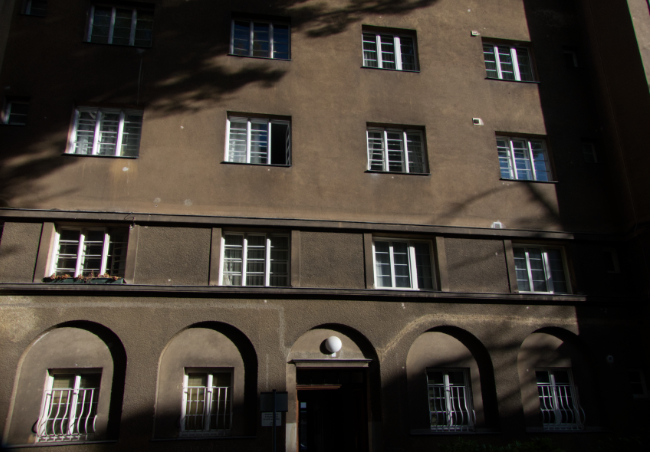
I initially thought that this block broke the sunlight rule. However, I visited early one morning and the door to the courtyard was open. The back of the building was bathed in bright sunshine.
There is something enigmatic about this building, as if it’s just slipped through a tear in the space-time continuum and that if you can find that tear you will find yourself in Vienna in 1926. The building seems so old and yet continues to travel through time. Architecturally it is a subtle blend of traditional and modern.
The architect Siegmund Katz was the son of a Ukrainian Jew and deported to the Lodz ghetto and into the horror of the Holocaust.
One of the inhabitants of the building was Gustav Vogelhut a jazz musician who played in the Piccadilly Dance Band. As a young boy he had wanted to join the circus. His parents dissuaded him and instead encouraged him to learn the clarinet.
He was deported to the Polish town of Nisko on 27 October 1939. It is likely that he was driven to the Nazi-Soviet demarcation zone, handed over to the Red Army and then disappears from view.
Keep walking in the same direction, turn left into Martin Strasse
Town Hall
Built in 1890 – 91 in a neo-Renaissance Baroque-ish ‘historical’ style. I don’t mind this stuff in small doses but if the whole of Vienna (or anywhere for that matter) was built like this it would create an over powering hallucogenic effect. It would be impossible to live in such a place for any length of time.
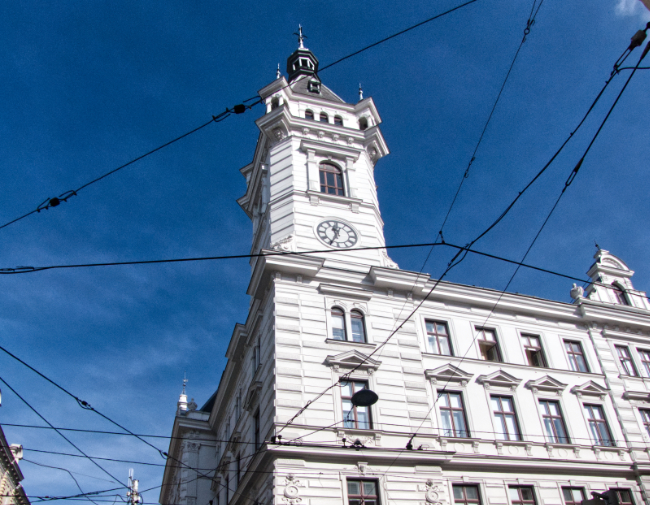
The history of the political composition of the district councils in Vienna in the 1920s deserves serious study. The tensions that played out nationally across Austria between the right wing and reactionary Christian Social Party and the Social Democrats also played out at a local level in the town halls.
I would very much like to know what debates took place, in what tone and voice and language, and how they were recorded, particularly when the socialists proposed the building of public housing in this area.
From Martin Strasse turn right into Währinger Strasse. Cross the road at the traffic lights. Look out for number 115
Währinger Strasse 115
On the pavement outside number 115 is a Stolperstein, a record of the fate of the Jewish people who once lived here. It seems impossible that in such bright surroundings such evil and horror could be created. The world is turning into darker space and the history of the Holocaust seems closer now than it did even 20 or 30 years ago.
Above the door, a stained glass window. On the ground, the stains of innocent blood.
Turn left into Weimarer Strasse
Weimarer Strasse
The street was renamed to Weimarer Strasse in 1919 to show solidarity with the new Weimar Republic. The monarchies of Russia, Germany and Austro-Hungary all disappeared between February 1917 and November 1918. For a generation of socialists who were active before 1914 – often in illegal and difficult environments – this must have felt wonderfully liberating.
The gains of the revolutions in Russia, Germany and Austria were substantial. The introduction of the eight hour working day, universal suffrage, the freedom of speech, association and protest, improvements in housing, education and health services; which began to be considered as rights.
Weimarer Strasse 8 – 10 1928 – 29 Konstantin Peller
This is a striking building with an expressive use of bricks. This style had been developed in Amsterdam by Michel de Klerk and Piet Kramer from the 1910s onwards. This building almost subverts class relations; here the proletariat appears to be the top of class hierarchies.

It’s not really possible to have a distinct ‘proletarian’ modernism without a thorough going revolution that breaks the political power of the bourgeoise state and the social power of capital; but this comes as close as it gets within the existing order.
The grand doorway leads to a entrance area which has the visual impact and permanence of a cathedral. Down some steps to a well stocked and properly maintained public library.

I always go out of the door on the left into the landscaped garden and walk round in a clock-wise direction. Art deco balconies, stairways in towers, light, air, space and nature. This would not be out of place in the most well to do parts of many cities.
Note the gated, more bourgeois building, on the other side of the street. Continue along Weimarer Strasse. There’s a fork in the road, it’s the road on the right hand side.
Weimarer Strasse 1 1924-25 Karl Dirnhuber
I first visited Vienna a few years ago in a cold February winter and spent hours just walking around the city, vaguely aware of something called ‘Red Vienna’, something about a revolution, a history of Empire. It was more a walk based on emotional responses and sensations than any form of systematic study. This was one of the first buildings I discovered; this was one of the sparks to the imagination.
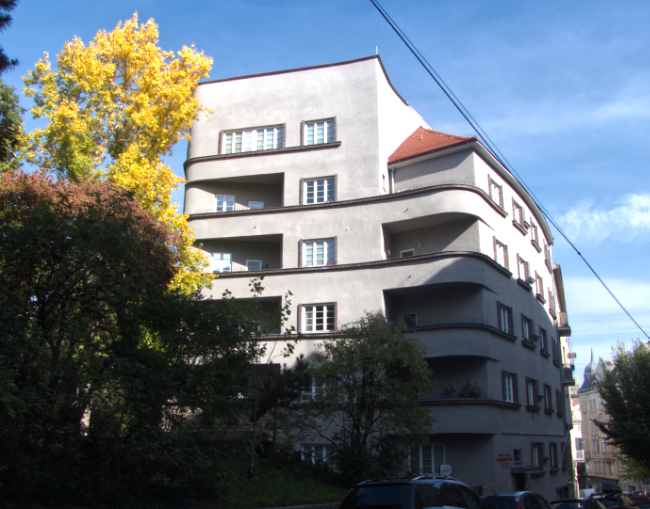
It is an engaging and intelligent design and provides the perfect book-end to separate the street from the park. The waves and curve of the roof and of the balconies provide a great deal of movement, adding to the sense of flow created by the slope of the hill. It is tempting you to turn its corner and into the park.
Karl Dirnhuber, the architect, was married to Annie Stern, a bookseller. Her business was ‘Aryanised’ in 1938 and the family emigrated to England. They established themselves in Birmingham were Dirnhuber continued to work as an architect.
The Viennese architect, interior designer and writer Ella Briggs was one of the first tenants. She rented a top floor apartment and studio there in the 1920s. She designed Pestalozzi Hof which can be visited on the walk, ‘Ella Briggs, Karl Marx and Modern Housing‘
Now walk into Schubert Park. Note the memorials to Beethoven and Schubert on the right hand side. The park was once a cemetery and Dirnhuber was commissioned to redesign it as a park. Beethoven and Schubert were both originally buried here but there remains are now in Wiener Zentralfriedhof (Vienna Central Cemetery).
On the opposite side of the park is Cottage Hof which you will see through the tree tops.
Cottage Hof
This is part of ‘Cottage Quarter’ an area planned and built for the wealthy middle classes at the end of the 19th century. This is beyond the scope of today’s walk but if you want to find out more, take a look at this resource.

It’s in German but there are plenty of free translation resources on the web. There are also links at this website for walking tours around the Cottage Quarter.
Turn left into Währinger Strasse. Cross the road and turn right into Arguagasse. Then turn left into Gentzgasse.
Gentzgasse 79 1926 – 27 Ludwig Schöne
Ludwig Schöne was on the conservative side of the architectural movement in Vienna in this period. He was largely a designer of Protestant churches. The building is in a more traditional style, perhaps to deliberately reference, and fit into, the nearby Cottage Quarter.

I don’t mind this sort of approach. In fact I prefer it to the shouting ‘look-at-me’ type of architecture which pays no regard to its neighbours. That sort of approach generally just creates noise and discord. And the only question it seems to be an answer to is ‘what’s the point?’
I rather like the decorative effect on the building. It’s simply not the case that only socialist-minded people can create culture. There is all sorts of music, literature, architecture, painting, sculpture and so on created by people with a wide range of ideas, personalities and backgrounds. And long may that continue.
Continue along Gentzgasse. Go through, or past Aumann Platz.
Aumann Platz
This borders the Cottage Quarter and there’s a good range of buildings around it. Take your time to look around.
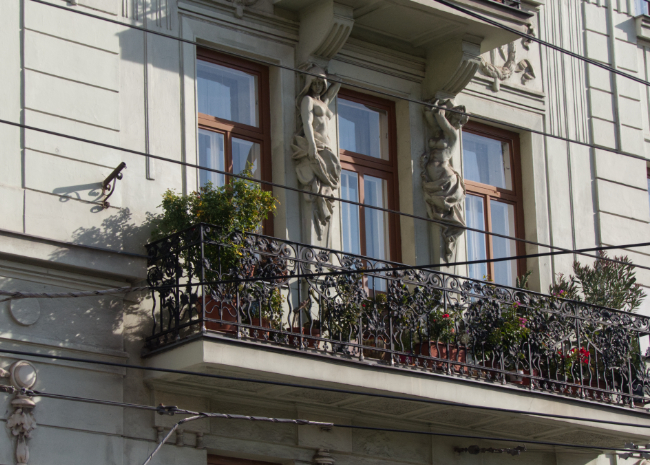
More florid ornamentation and some loud use of colour.
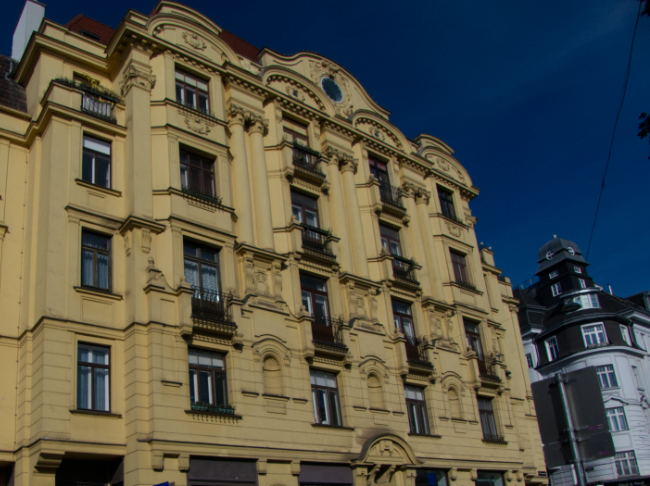
Turn right once again into Währinger Strasse. Continue until Köhlergasse. On the corner of Köhlergasse and Währinger Strasse is….
Köhlergasse 1 – 3 1929 – 1930 Heinrich (Heinz) Siller and Paul Fischel
Clear lines, geometric shapes, a bold corner. A shop was planned, it is now a kindergarten. Now I think about it I don’t think I went to have a look at the courtyard. You can perhaps do that and send me a report. Perhaps the gate was locked?

Here is another good example of public housing making a confident statement without domineering or making a contrarian challenge to what was already there.
Part of the success of the housing of Red Vienna was founded on controls and building regulations on what could be built and how. What happens when building regulations are loose and not enforced? Well just look around at parts of modern England.
When this housing was first built the attic included a studio used by the sculptor Anton Grath.
Continue along Währinger Strasse. You will notice Toeplerhof on the right side. But hold fast! We’ll come back to that in a moment. First, go and have a look at Währinger Strasse 188 – 190 which is about 100 metres further along on the right hand side.
Währinger Strasse 188 – 190 1926 – 1928 Michael Rosenauer
Public housing with a sunken garden. Who would have thought? This is a medium to large sized estate on what must have been a difficult site to design housing for.

There are plenty of good things to see here. The aspect of the flats with their balconies, the mature trees, the mosaic paving in the passageways and courtyard, the wrought iron gates, the feeling of space and the air, light and nature.
Michael Rosenauer emigrated to London in 1928. One of his commissions was the Time Life building in Bond Street which opened in 1953. It is now a Hermes store and if you can get inside, the interior is as good as the facades.
Rosenauer collaborated with the sculptor Henry Moore whose work can still be seen (from Bond Street). In 1955 he wrote the book Modern Office Buildings.
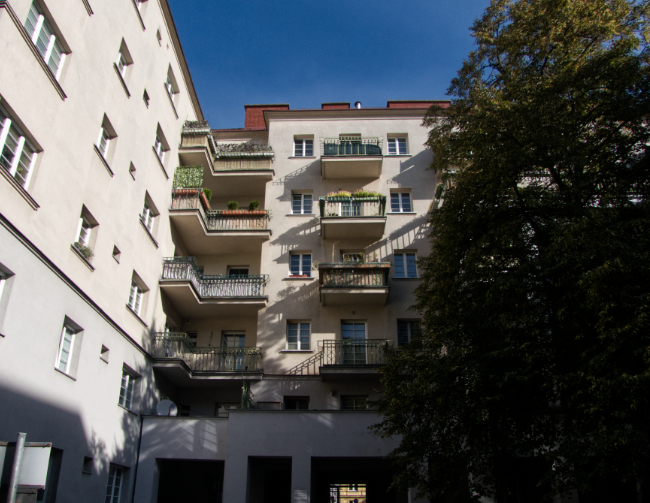
Go through the estate and come out at Innozenz Lang Gasse. It feels like a trick; a very clever one. Where have you just come from and how?
Turn left into Grentzgasse. Note St Joseph’s church on the other side of the road with two red brick buildings on either side. Turn left into Weinhausergasse and then left again into Währinger Strasse. Now walk back to have a closer look at Toepler Hof.
Toepler Hof 1927 – 28 Konstantin Peller
Rosa Toepler was a philanthropist who died in 1916. She bequeathed this plot of land on which Toepler Hof was built.

Note the wrought iron work, attractive sculpted elements, floral window frames, elegant balconies.
There are some curious shops at the ground level on Währinger Strasse. Carpets, old toys, commodities that seem so absurd it is difficult to imagine anyone buying them new, let alone second hand. Now the cheap plastic is scratched, the garish colours have faded, a wooden car has lost a wheel, the thick clay jug has a chipped lip and the book on the Secret History of Everyday Objects has lost its cover.
The architect Joseph Dex lived here which suggests that the housing helped to create a mixed community of residents.
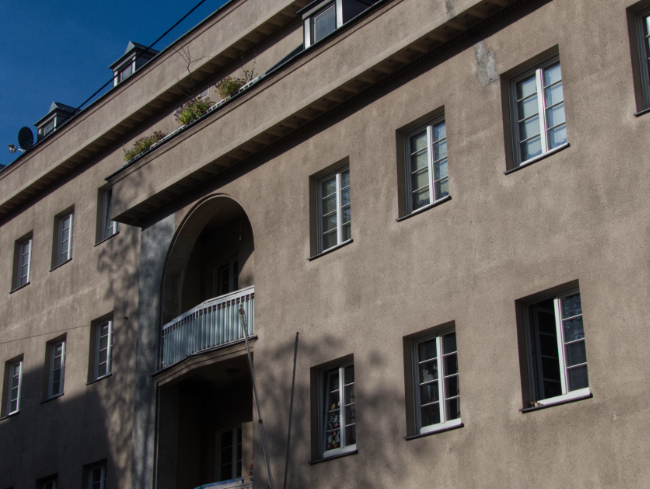
Another resident was the socialist writer and journalist Else Feldmann. She was captured by the fascists on 14 June 1942, deported and murdered.
Walk along Paulinengasse until you reach Linden Hof. It’s about 300 metres.
Linden Hof Paulinengasse 9 1924 – 25 Karl Ehn
Karl Ehn was the architecture of Karl Marx Hof. He obviously had the ability to produce well designed large-scale housing as is shown here.
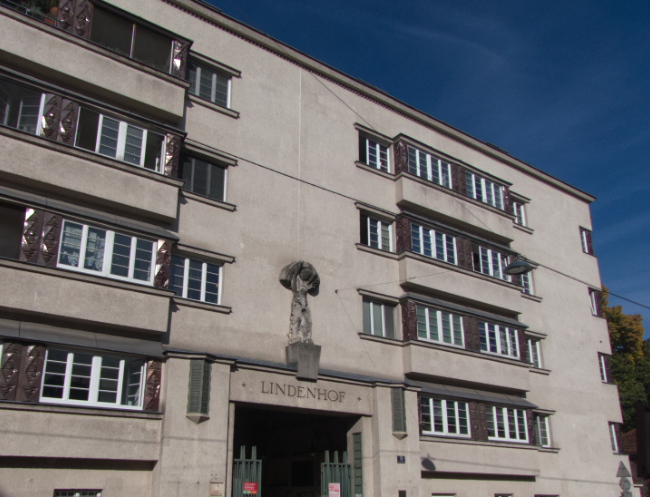
Linden Hof is more intimate than his later work. The central courtyard is enclosed and the sense of privacy is further enhanced by the ground layer being on three different levels.

There are two kindergartens on the estate, both within the enclosed mass of the housing. They are both supported with their own large play areas.
If you visit at certain times of the day the air is full of the sounds of young children playing. It’s a pleasant sound; something exuberant, joyful and human. It’s a sound that enhances the community feel to the estate.
As you come out of the other side of the estate look out for the plaque which records the names of some of those involved, not just in this estate, but the gemeindebau in general.
Karl Seitz (Mayor of Vienna), Hugo Brietner (Director of Finance), Anton Weber (Head of the Housing Department).
Many of the estates have these plaques and sometimes they include the names of other officials and the architects.

On one of the walking tours I organised of the housing of Red Vienna someone made the remark that all buildings should contain a list of the officials involved as a means of accountability. ‘They should be proud to put their name to it’.
They referenced the Grenfell tragedy in London in which 72 people were killed and yet, as of October 2025, there has not been a single conviction for negligence, shoddy work, bad decision making or the pursuit of profit rather than the safety of people. Who was responsible? No one in authority seems to know.
In Vienna of the 1920s, people were not only proud to add their names, but many of the estates prominently displayed text that described how the community housing had been built with the funds from the property tax.
Turn right into the estate and walk through until you come out the other side (please note there are steps).
Turn left and left again into Kreuzgasse. Walk along about 100 metres and on the opposite side of the street you’ll see Pfannensteil Hof
Pfannensteil Hof Kreuzgasse 87 – 89 1924 – 25 Erich Franz Leischner
This is one of the few housing estates I’ve ever visited that has a tram running through it. Follow that tram!
As we’ve seen above with Linden Hof, particular types of noise can enhance a living environment. Never motorbikes and cars with modified and extra loud engines or exhaust whistles; these are just selfish, moronic egoism and anti-social.
But children playing, trams, bird song, church bells, wind chimes, the sound of someone playing a piano from an open window; these all add to the aural sensations of urban areas.
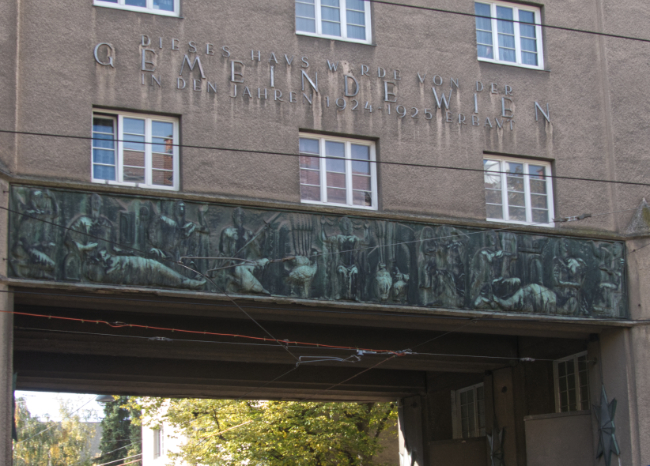

The passage way that the tram runs through is Chamissogasse. Above the entrance is a frieze created in a copper repoussé (hammered metal) by Angela Stadherr entitled ‘Life’.
Her father was a tinsmith and when he died in 1915 she took over his business. In 1917 she started studying at the Vienna School of Applied Arts where her tutors included Oscar Strnad.
Stadherr became the first woman in Austria to receive a master craftsman’s (sic) certificate. She was a committed Social Democrat and one of the areas of Simmering, where she grew up, is named after her.
The estate is named after Franz Pfannensteil, a resident and resistance fighter.
As you walk through the passage note the doorway with ‘Milch’ written above it; presumably once a milk bar?
Walk through Chamissogasse. Turn left into Antonigasse
Antonigasse 100 1926 – 27 Ernst Franz Leischner
This is a small in-fill building by Ernst Franz Leischner who also designed Pfannensteil which we’ve just come from. A different style is used and this creates a clear distinction between the two buildings. Antonigasse holds its own rather than being a poor relation.
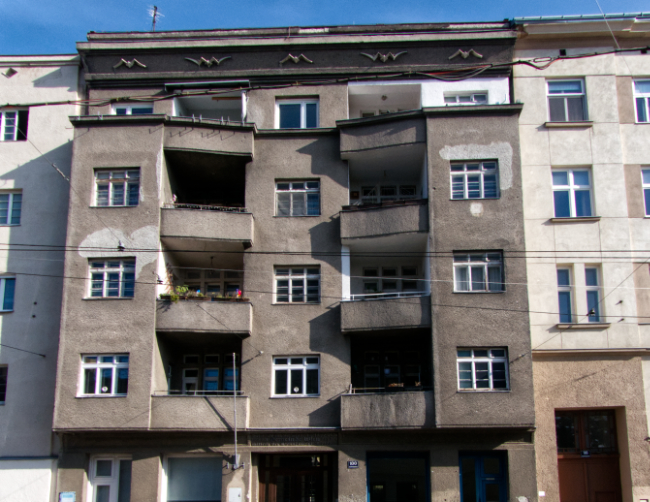
Balconies, bay windows and a striking symmetry express a thoughtful and well designed ensemble of design forms. The vestibule at the front door with cut glass is original.
And that’s the end of today’s walk. You will see the tram stop nearby. And that tram could be the start of a journey around the world.
There may seem to be a lot of ‘turn left, and left again, go across the road, turn right’, and so on. I have created some notes on Google maps which may be helplful.
I have limited resources and don’t live in Vienna. There may be glaring errors here and great buildings nearby which I’ve simply missed. Sorry if that’s the case. And this is not intended to be a comprehensive guide. Hopefully you will discover all sorts of things not mentioned here. It’s eclectic, as are all journeys through urban spaces.
Please contact me if you have suggestions for improvements or additions or both. You can use this contact form.
I hope you enjoyed the walk, there are others that you could try too…
1. Ella Briggs, Karl Marx & Modern Housing
2. The Radical Housing of Meidling, Vienna
3. Favoriten and the end of Vienna
4. A Walk along Währinger Strasse
6. Rabenhof, Vienna: A Radical Walk
7. Red Vienna: A Radical Walk
And here’s an eclectic Red Vienna reading list
 Commodity Fetishism
You must be logged in to post a comment.