The starting point for this walk is the tram stop at Laxenburger-Troststraße. Both the O and number 11 trams stop there. I caught the O tram from Ungargasse.
It rattled past the Hauptbahnhof with its large ice-blocks of cold glass and steel and areas of non-space where concrete viaducts carry the railway lines.
The landscape changed from corporate capital to the incohate landscape of where the labour power lives. A jumble of garages, martial arts centres, hotels with creaking beds, empty and neglected buildings and those curious shops that Vienna has. They never appear to open but neither are they completely closed.
The area becomes more working class, and as with working class districts in many cities it becomes more culturally and racially mixed. Here can be seen all grades of labour. The reserve army that cannot find employment, the unorganised in the gig economy and service sector, skilled workers who maintain digital networks and construct complex buildings, workers in offices, factories, warehouses, the means of production, workers in transport and communications, the means of distribution, those who no longer work because of age or sickness or disability.
Here too the class of the proletarian poor; older people with cheap clothes, thin anoraks, plastic shoes; nothing substantial to shield the person from the snow, rain, wind and chill of central European storms and winters.
Laxenburger straße/ Troststraße
This is the tram stop to head for. It’s a large road junction of Laxenburgerstraße and Troststraßeraße.
Laxenburgerstraße has long been a key route out of the city; once as a route to the palaces of the Habsburgs in Laxenburg itself, as a trade route of the Empire. After 1945, part of the Soviet zone of occupation. This junction has a lot of psychic energy.
Imagine a film of the past 300 years of such traffic and what that might reveal. There are always things in physical environments that you don’t pick up in books, atmosphere, air, senses, smells, noises, the way the shadows of trees play across a facade; the latent consciousness of passers-by.
From the tram stop, walk along Troststraße towards Laxenburgerstraße and turn right. Note the new housing from 1981-92.
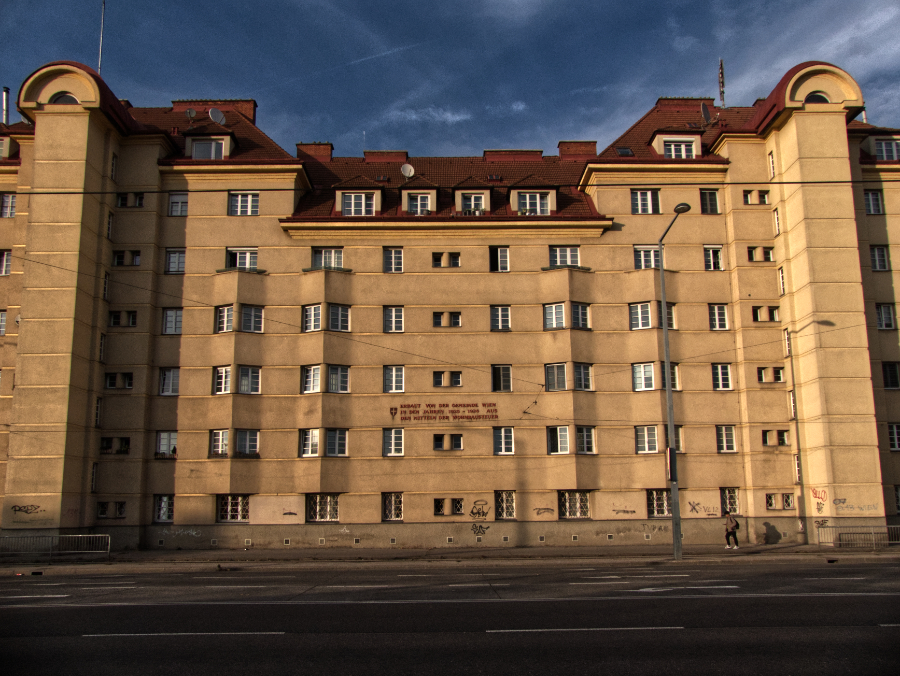
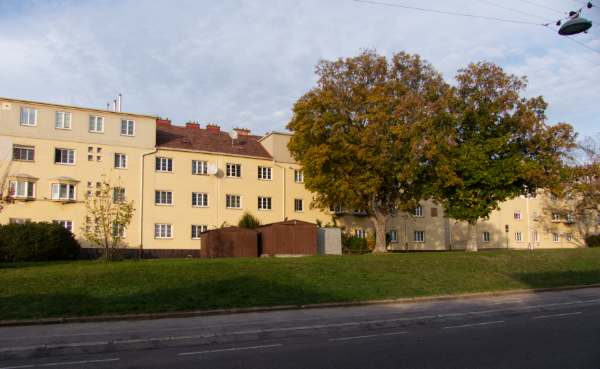
The first stop is Laxenburgerstraße 92 which is on the right hand side as you’re walking south.
Laxenburgerstraße 92 1931 32 Joseph Hahn
This is best seen from the other side of the wide, busy road. Be careful if you cross here; but note the way that people have created their own tracks and paths through the central strip of grass and trees.
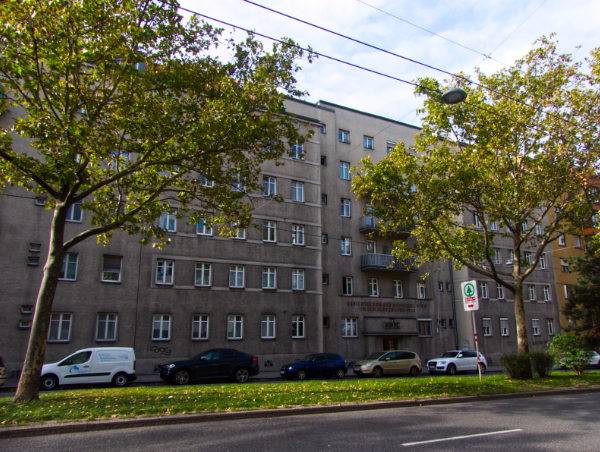
This is a modern building yet nearly 100 years old. A century of time; that’s at least four generations of people. It’s part of the long-now where time is stretched in unlikely ways.
Capital expands where ever it can and because of the immense power of capital, it is able to constantly reconfigure urban space in its own interests. In the process it intensifies the social phenomena of alienation and atomisation.
Part of the expansion of capital is the huge increase in vehicle traffic. Like all buildings alongside major roads it feels bullied by motorism, noise and pollution, over rapid movements, an agitated restlessness.
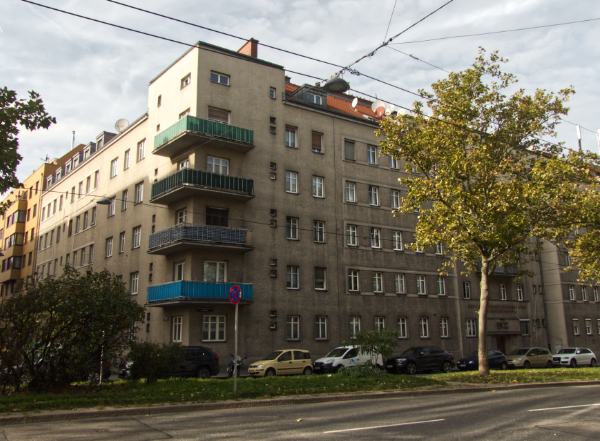
If the cars could be stopped, the clean lines and confident mass of this building would be better appreciated; and not only that, it would be more pleasant to live here. The people of the building, and the building itself, could breathe.
The road takes up a great deal of land. Space which could be used as gardens, playgrounds, play areas, meadows and allotments. But instead the disease-rash of glass boxes continues to spread. Capital expands and people and community are pushed aside.
Anton Hölzl Hof, Laxenburgerstraße 94 1931 – 32 Josef Hoffmann
You could go into the courtyard and have a look around. Or you could walk through the courtyard and then turn left and left again and go that way to see Maria and Rudolf Fischer Hof

One elevation of Anton Hölzl Hof also faces the busy Laxenburgerstraße where it presents a simple and plain form. It feels defensive and protective. The photograph above shows the southern facade which looks lived in, densely populated but with private space.

The pleasure of the building and its spatial design is in the courtyard and the side elevation in Reichenbachgasse (see above). The large jaunty balconies have been personalised in a way that is often forbidden in blocks controlled by ‘management companies’. There is a sculpted relief on the corner although the origin and creator of this are apparently unknown.
The courtyard has the standard Red Vienna characteristics of air, space and nature. There are clusters of community garden, play areas and a statue by the sculptor Otto Fenzl, ‘Figurale Gruppe’, created in 1931.
The architect was Joseph Hoffmann, one the founders of Vienna Secession (which included Otto Wagner and Gustav Klimt) and the Wiener Werkstätte. He had a significant influence on the development of the architecture of the Secession, art deco and modernism. He brings his skill of theory and practice together well in this design.

Maria and Rudolf Fischer Hof 1930 – 31 Konstantin Peller
If you went through Anton Hölzl Hof then turn left as you come out of the courtyard and left again into Reichenbachgasse, back towards Laxenburgerstraße.
If you went into Anton Hölzl Hof and came back out the same way, continue along Laxenburgerstraße. Either way you will be at Maria and Rudolf Fischer Hof.

Maria and Rudolf Fischer lived in this housing and were both communist resistance fighters who were executed by the Nazis in 1943. They were convicted on a load of blah blah blah about ‘traitors’ and ‘treason’ and no doubt ‘not being proper Austrians’. It is exactly the same language the right uses today.
And this language of rhetorical hate, lying and scape-goating is increasingly being used by politicians of the so-called centre. They seem to lack emotions and any form of political intelligence or moral bearing; Keir Starmer is a prime example.
The housing was known as Otto Planetta Hof during the fascist era. He was the assassin of Dollfus. It was renamed in 1949.
This housing in particular seems to personify those grim years from 1934 – 45 (and beyond). The rise of fascism and the destruction of Red Vienna, the Anschluss, Holocaust, air raids, the battle for the city, the Soviet occupation and sexual violence, looting and oppression.
What was life like for people during this time? For some, the grifters and the chancers, these were good times. That’s a danger today. Some people thrive with fascism.
But there was an earlier time too; of the hope and optimism of Red Vienna, improvements in working conditions, better housing and welfare, education and cultural services.
That’s what the reactionaries feared. That’s what they fear today. They are based on fear and thrive on fear.
This can be opposed with solidarity and worker’s unity. Let’s imagine the hope and optimism of Maria and Rudolph Fischer. Let’s try and build on what they set out to do; to create a better world.

The building complex itself is a solid and majestic mass with a landscaped courtyard. The balconies along Migerkastraße provide bold lines of design and pleasant outside space for the apartment tenants.

Turn right into Migerkastraße and then right again into Leebgasse.
Margarethe-Hilferding-Hof, Leebgasse 100 1928 – 29 Frank Zabza
The building is recessed behind a courtyard full of mature trees and a statue of a putto on a snail. The way in is through a large green metal gate. It creates an enigmatic rural feel, as if one has stumbled across a magic castle deep inside a forest.

Someone remarked that they believed the residents wouldn’t like the trees as they block the light. But how is this known unless people are asked?
Trees don’t block that much light and if you are in an urban area a view of trees from the living area can create a different sensation than the view of another block of flats just a few feet away (as is increasingly the case in London developments; just visit Nine Elms).

I don’t know what most, many or a few people think about them. If it was me they would be very welcome, even if the leaves and smaller branches brushed against the windows. In fact, even more so.

Margarethe Hilferding was a social democratic council for the Favoriten district and one of Vienna’s first woman physicians.
Her husband, Rudolf Hilferding wrote Finance Capital in 1910 and became the Finance Minister in Germany during the Weimar Republic.
Both of them, along with their son Karl were killed in the Holocaust. Their son Peter managed to escape with the help of Karl Popper.
Walk back to Reichenbachgasse and turn right to look at Antoine Alt Hof
Antoine Alt Hof 1951 – 52
There is a lot of housing here from the post-war period. Much of it looks to be of good quality and well maintained. However I haven’t yet ventured into this history. I sort of notice it and keep making mental notes to find out more.
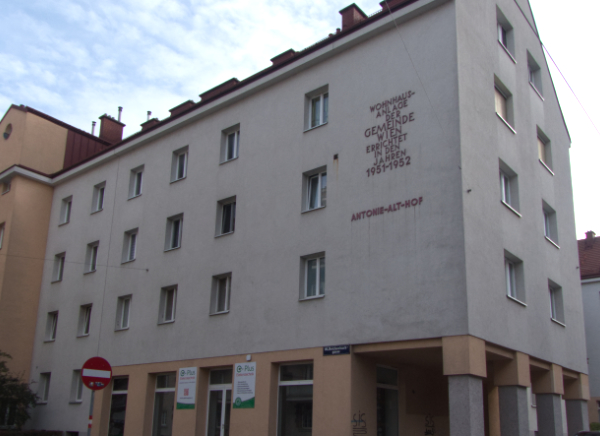
Hopefully on future researchs trips these investigations can be expanded.
Turn right again into Van Der Nüll Gasse. Note that this is the other side of Leebgasse 100. It’s an impressive street side. Turn left a few metres into Dieselgasse, and then look for Dieselgasse 22
Dieselgasse 22 1931-32 Ernst Kurt Richter
This is a standard in-fill block. Standard in the sense that there is quite a lot of this scattered around Vienna. It’s relatively small in that there are only 19 apartments. But it’s done well and with thought and care.

The balconies add not just visual attraction but also some outside living space for the residents. There is the attention to detail that the architects of Red Vienna cared so much about and which make even a relatively plain building more interesting. There is smart brick work around the recessed doors, and what is known as a ‘peeping window’.
I’ve not been able to find anything about Ernst Kurt Richter. It’s possible that the name I’m searching for is in fact a variation. More book worming required. I know which books might be helpful but I don’t have them with me in Vienna at the moment. I need a larger travelling library, more time, a larger sum of money.
Now go back to Van Der Nüll Gasse and turn left. On the right hand side of the street as you walk back to Troststraße you will see Van Der Nüll Gasse 83 – 85.
Van Der Nüll Gasse 83 – 85 / Leebgasse 94 – 96 1931-31 Rudolf Scherer
This is the rear elevation of Leebgasse 94 – 96. If the door is open you could walk through and look at the courtyard. Or if you could walk back round into Leebgasse and look at the building and courtyard from there. You will be able to work it out.
I like the modernity of this building. Bold straight lines, the symmetry of the windows and the slightly projecting central area and end points. They are book ends to the building, separating its repository of architectural and social knowledge from the buildings on either side.
I am constantly puzzling why this is done so well and yet later buildings (not just in Vienna) lack something….what is it they lack? Is it something to do with construction and materials? Or ideas? Or technique? You will notice it yourself. Perhaps you know the answer, in which case please contact me.
The buildings of Red Vienna have got it. Whatever that means, and perhaps its something personal, subjective, difficult to define, like personal taste and individual choice.
Or perhaps its because the housing of Red Vienna was based on principles, was well designed, well built, with the proper use of materials, and was defined by a socialist commitment to better housing, good quality, low cost. And influenced by intelligent ideas and designed by architects who knew their craft, and built by the workers themselves who knew they would live in what they created.
Perhaps that’s the difference.

Now continue along Van Der Nüll Gasse until you reach Troststraße. Just about opposite is Troststraße 60-62
Troststraße 60-62 1925 – 26 Ernst Egli

Look at this from the main street and note again the sharp, clean, bold lines; offset by corner turrets and arches.
The electrical tram system was created in 1925, opening the city up, expanding the possibilities of chance encounters, expressing technical innovation and a new experience of speed.
Ernst Egli was among the architects who worked with the Settler Movement which suggests he was an early exponent of good public housing.
You can then cross Troststraße and keep following Van Der Nüll Gasse. Then turn left into, and through, the estate itself.

Walk slowly through the estate and look around at the different features. Find a bench and sit down and let time dissolve and experience the space itself.
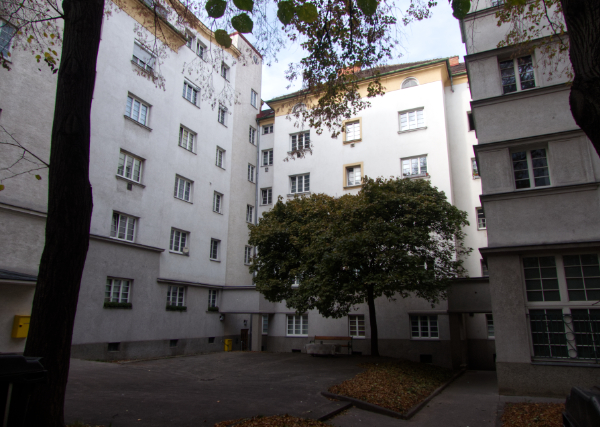
As you come out of the courtyard, note the building directly in front of you. That’s a Gemeindebau too. With the courtyard behind you, turn left into Alxingerstraße and then right into Troststraße.
Troststraße 66 – 64 1924 – 26 Alexander Graf and Klemens M.Kattner
Yes, this too is public housing. Impressive, solid, public to the street and intimate in the courtyards.
Make sure you cross Troststraße to get the full measure of the visual statement this building makes.

There’s the impressive gateway with its statue and ornamentation. And look at the large balconies with curved lines, made even brighter and bolder with splashes of flower colour. On some estates flower boxes were part of the original fittings. They make a great addition to the over all appearance.
The design of some contemporary estates in London make flower boxes impossible. And in some cases management company rules and regulations prevent them. Perhaps the same management companies that talk about ‘green’ and ‘sustainability’ and ‘carbon offsets’. And community; they say a lot about community but don’t appear to understand what this keyword means.

While I was sorting out the photographs for this walk I listened to a radio programme about post-war public housing in Britain. Some of this housing was very good and still remains in use. But some of it was shockingly bad and substantial amounts of it were blown up or demolished within 20 years.
I was incredulous listening to various talking heads go on about how it was widely known that the quality of materials was often poor, of architects banally saying that it was often only expected to last for 30 years, that the use of certain materials wasn’t properly understood (which ones? stone? brick? cement? glass? wood?).
Peter Smithson was given a great deal of broadcast time to fill with his usual garbled vacuousness. He bemoaned mistakes, experiments, the necessity of ‘the new’ (without ever defining what that meant), a half chewed Corbusierism that the dog spat back upon the carpet.
Housing ‘pressures’, the war, reconstruction, costs, were all cited as excuses. All problems that Vienna also faced (along with several serious threats of armed invasions and out of control inflation). And yet somehow Vienna managed to create the housing we’ve seen today. Could it all be down to the cost model? Or that Vienna worked because the housing was paid for through taxation and the capital costs were written off?
Could it be that the ideas that percolated through to Vienna in 1920 were socialist and socialistic? That in Vienna in 1920 the theories of Arts and Crafts and Garden Cities were taken more seriously than in Britain in 1950?
This deserves much greater research and enquiries into building trades, building unions, politicians, corruption and bribery, political power, the balance of class forces and much else. But its possible to read a lot of histories of urban development which don’t mention these things at all. And so the how’s and why’s and who’s of writing history must also be considered.

Go in to the estate and have a look around, then come out again and then turn right and continue along Troststraße until you come to the very next block which is Pernerstorfer Hof
Pernerstorfer Hof 1924 – 26 Camilo Fritz Discher and Paul Gütl
This has a grand chutzpah, an exuberance of style that announced a housing programme to be taken seriously.
I would be interested to learn how the housing was developed at a local, district level and city-wide level and what the relationship was between the organised working class, the social democrat party organisation, the trade unions and more.

What was the atmosphere on the streets like when this was being built? What were the conversations in the pubs, cafes, restaurants and markets in and around Troststraße as this housing started to fill up with the first tenants, some who were moving from slums, away from landlords with powers of arbitrary evictions and rent increases.
In this new, modern housing, the tenants had rights enshrined in law, low rents (about 4 – 7 percent of wages), kitchens, private inside toilets, running water, access to showers, baths, communal launderies, kindergartens, mother and baby clinics, dentists, play areas and in some cases cinemas and theatres. And all the time with the principles of air, light, sunshine and nature.
The conversations will have changed, people’s ideas formed in different ways, emotions uplifted, anxiety of eviction decreased. And that was a large part of the intention of this city-wide housing programme.
It wasn’t just ‘better housing’ it was about a better quality of life.

Walk into the courtyard and note the statue of the mother with children, positioned in front of the kindergarten; the mature trees, the overall design, the sense of quiet privacy while also being a part the public infrastructure of the city.

Walk through the estate courtyards heading to the opposite side. You will come to Hardtmuthgasse. Turn left and then right into Neilreichgasse. The building on the right hand side is Friesenplatz
Friesenplatz, Neilreichgasse 2- 4 1925 Erwin Böck, Friedrich Zotter, Max Theuer
The gabled roof, colour scheme and arch into the courtyard give this a more romantic feel. It is impressive as to how the architecture of Red Vienna could include such a range of styles and topologies. Here’s a nod to the hills, mountains and Vienna woods. It has the attitude of a holiday home for the workers, an Alpine rest, a place for comfortable living and socialable relaxation.
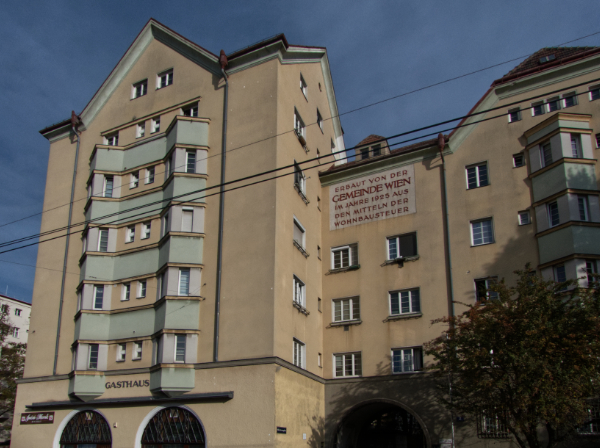
The front and side elevations are often different with the Gemeindebauten as can be seen here. It illustrates a commitment to individual places, a truth to space, particular solutions to particular spatial questions.
Part of the block is currently undergoing renovation.

Opposite the elevation above, on the corner of Angeligasse and Neilreichgass is Angeligasse 70-80
Angeligasse 70 – 80 1929 – 1930 Leopold Simony and Edmund Misterka
This corner plot must have been more tricky to build on than it looks. Rather than create something forced or with a feeling of being in the wrong place at the wrong time, Simony and Misterka have created something very smart indeed.
It looks as if the building is a slice of the cake, rather than the cake itself. The way that the attic lays itself back from the corner creates a lightness of mass rather than a heavy imposition to the street.

This building feels much younger than it’s 95 years suggest.
Leopold Simony was considered an expert in the field of public housing, both in theory and practice. I think this is shown here.
I wonder if the Smithsons and their ilk read his works? Or was it all just an indigestible word salad from Corbusier that they dined on?

The small but neat courtyard at the front of the building works well. While I was taking a photograph I heard voices and realised it was from people talking on a bench hidden by a grove of trees. They had privacy and intimacy in a public space.
Someone then came towards me on a mobility scooter (smoking a cigarette) as I took this photograph. I’m not sure which of us was the most surprised. I wish my German language skills were better as I would have explained to him what I was doing. I had the feeling he wanted to ask, out of curiousity, rather than policing.
Each time I visited this housing it was sunny and there was a lovely interplay of light and moving shadow created by the tree shapes across the facade. I wondered if this was accidental or something that the architects had consciously planned? I suspect it was the latter.
Now walk back along Neilreichgasse. You will be going slightly uphill which always suggests a northern direction (well at least to me) but you are in fact going south. This is about a 5 – 10 minute walk but it’s worth doing.
Jean Jaurès Hof 1925-26 Walter Broßmann and Alfred Kellere
This was constructed on a large scale on vacant land between 1925 – 26. There were already extensive allotment gardens nearby. But try as I might I can’t trace a history of those allotments.

The building is both impressive and attractive (they don’t always go together). It’s worth walking round the whole of the perimeter and then walking through the estate itself.
All the large Gemeindebauten have their own rhythm, harmonies and counterpoint and this is no exception.
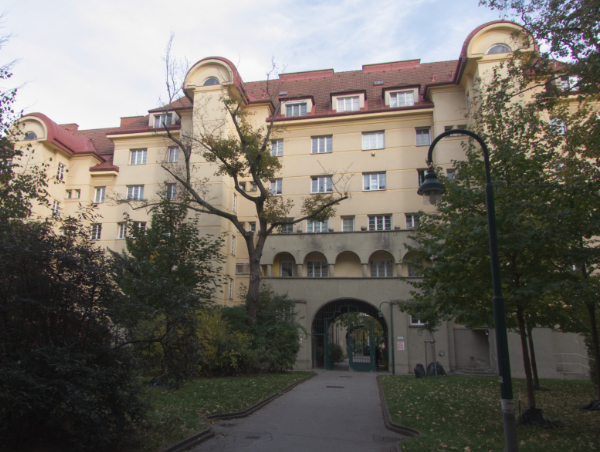
When first constructed the estate included a day care centre, retail units, restaurant, laundry and paddling pool. The design with the arched thorough fares is simple and yet adds a great deal of style.
There is attractive landscaping and places to sit and relax. Two young Muslim women were sitting on a bench chatting; they paused and we exchanged smiles as I walked past. There’s a lot of this sort of secret integration that goes on all the time. If only it could be politically organised. Solidarity is a powerful, collective social, and socialistic endeavour.
Walter Broßmann who was one of the architects here originally trained as a brick layer. It’s an interesting career progression from that of handicraft skill to the profession of architecture.
The building was named after Jean Jaurès the French socialist leader who was assassinated in 1914.
Johann Mithlinger Siedlung 1929 – 1931 Karl Schmalhofer
Some of the commentary about this development describes it as a hybrid of Gemeindebau and Garden City. I don’t really see that. To me it’s a new form.

It is not large scale Gemeindebau and it is unlike siedlung housing (where the residents generally have their own substantial gardens).
The design of the estate is similar to some of the estates built in Britain from the 1930s onwards. There is also an estate like this in Berlin which was built in the early 1930s and designed by Max Taut (Bruno Taut’s brother) . I would like to know the chronology of these developments and what exchange of notes and ideas might have taken place.
There are twenty four individual buildings laid out with a great deal of open space. At the southern end of the estate there are communal spaces and play areas. The terracotta and ceramic panels were added at the end of the thirties by which time the fascists were in power. Was this a form of culture war?
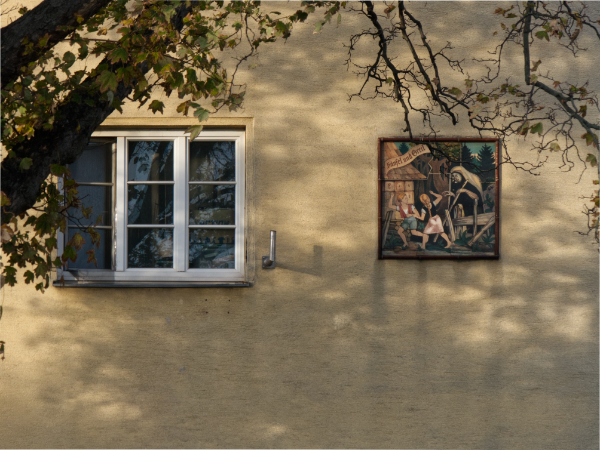
The estate became a battle ground during the Austrian Civil War in February 1934. Johann Mithlinger had lived on the estate and was a member of the resistance and executed in 1944.
I think its worth making the effort to see this. It’s different to anything else I’ve seen in Vienna and it helps to understand the other types of buildings and create a wider context.
The architect Karl Shmalhofer was from a poor background and had a difficult start in life. He persevered and studied at State Trade School in Vienna and then worked as a draughtsman.
He started working in the Vienna City Planning Office in 1908 from which he retired in 1934 as the Chief City Planning Officer. His time working for the city council spanned the monarchy and empire, Red Vienna and the beginnings of Austro-Fascism.
Along with these political changes one wonders what the changes were in terms of job functions, pay, conditions, labour processes, departmental organisation, political influences and so on.
There were also a great deal of technical changes; typewriters, telephones, radio, aeroplanes, internal combustion engines, machine guns, electrification and more.
Revolutions in the means of production, technical revolutions, political revolutions, revolutions in the means of communications. And so it goes, seemingly out of the control of the very humanity that creates it.
And that’s more or less the end of this particular Red Vienna Radical Walk. However….if you have your walking boots on today you could carry on a little further. Find August-Forel-Gasse and then cross Sahulkastraße.
In front of you is a wide track. Just follow that and you’ll come to a space with views across the woods and hills and mountains. There are benches to rest. If you look carefully you will see Alt-Erlaa, a much newer housing estate which is well worth a visit. But that’s for another day.
You could keep walking and you will leave Vienna and be in the countryside. Is this the end of Vienna? No, it’s just a pause.

This is part of a series of seven Red Vienna Radical Walks.
1. Ella Briggs, Karl Marx & Modern Housing
2. The Radical Housing of Meidling, Vienna
3. Favoriten and the end of Vienna
4. A Walk along Währinger Strasse
6. Rabenhof, Vienna: A Radical Walk
7. Red Vienna: A Radical Walk
And here’s an eclectic Red Vienna reading list
 Commodity Fetishism
You must be logged in to post a comment.