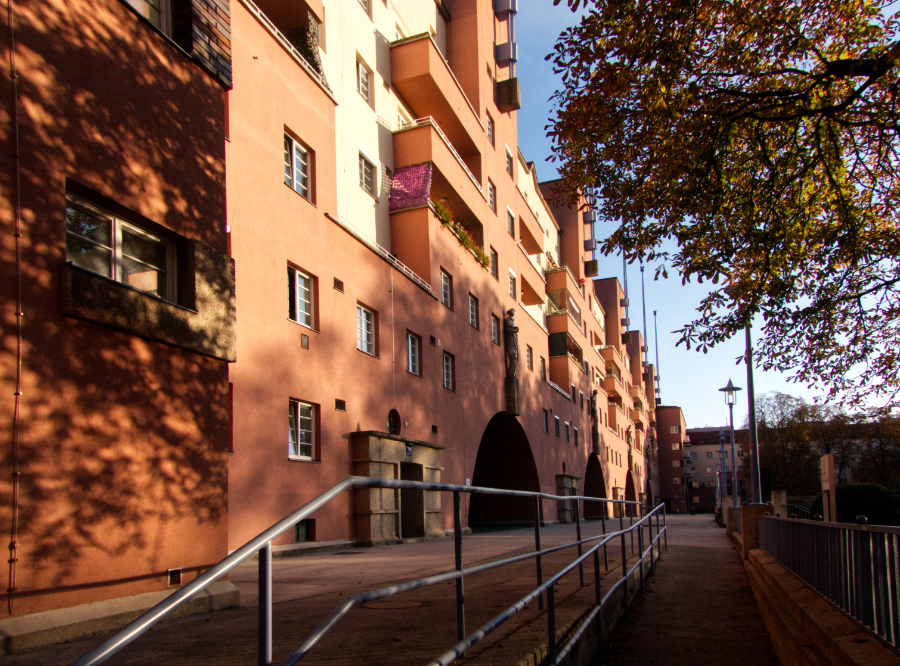
The starting point for this walk is Spittelau U-Bahn. My starting point to get to Spittelau was one of the original Stadtbahn stations designed by Otto Wagner. It was a good introduction.

If you take the U-Bahn to Spittelau look for the exit to Heiligenstädter Straße. As you approach this you will see the walkway (Skywalk Spittelau) that crosses the large tangle of roads.
This is a great modern mess. Concrete, glass, steel, confusing signage, the dominance of motorism, wide roads, car pollution, excessive motor noise, too much speed, driver depression and aggression.
If you’re interested, before you start the walk you could go and look at the Spittelau incinerator.
Cross the walkway and you will arrive at Guneschgasse. On the left is Professor Jodl Hof. Turn left into the estate along the Döblinger Gürtel.
Professor Jodl Hof 1925 – 26 Rudolf Perco, Rudolf Frass, Karl Dorfmeister
Part of the building straddles the street and overall it feels that there are separate blocks rather than one continuous mass of housing.

There are some courtyards which are part of the street-scape and another which is tucked away and more intimate and private. For the latter, turn into the estate on your right hand side as you walk along.

Part of the housing is on the top of a bank which rises from Döblinger Gürtel. It provides a ‘baroque-castle-on-a-hill’ effect. It’s rather romantic and not generally expected from public housing.
The span of the building over the Döblinger Gürtel reinforces this effect, as if there might have once been a drawbridge and portcullis. There is something benign and enlightened about it all rather than something feudal and oppressive.
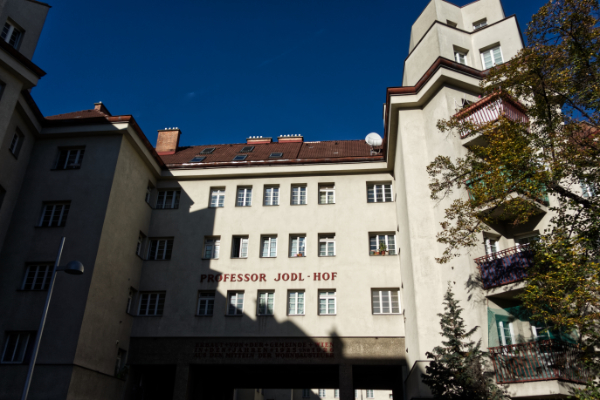
This echo of historical aesthetics is not accidental. The Professor Jodl Hof is built on the site of the former outer defensive wall of the city which was demolished in 1894. Vienna experienced several violent and near catastrophic sieges and the city walls were military necessities not ornamentation.
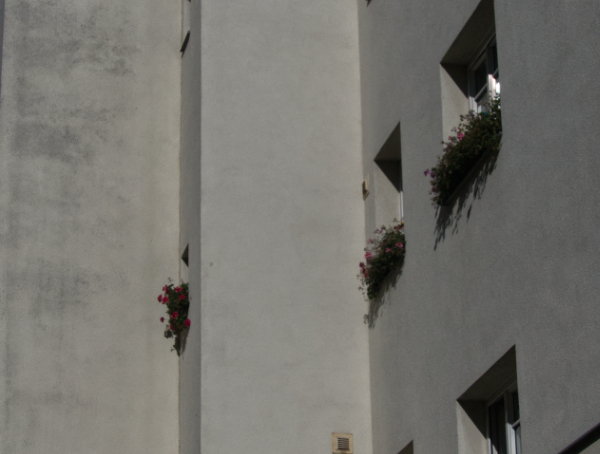
Apparently there are still remnants of these fortifications at the rear of one of the buildings, but this learning came too late for me and I personally haven’t seen them.
Once you are through the estate, keep walking along Döblinger Gürtel. On the left is a busy road and railway arches. As you walk along you will be able to see the roof of Dittes Hof on the other side of the brick viaduct.
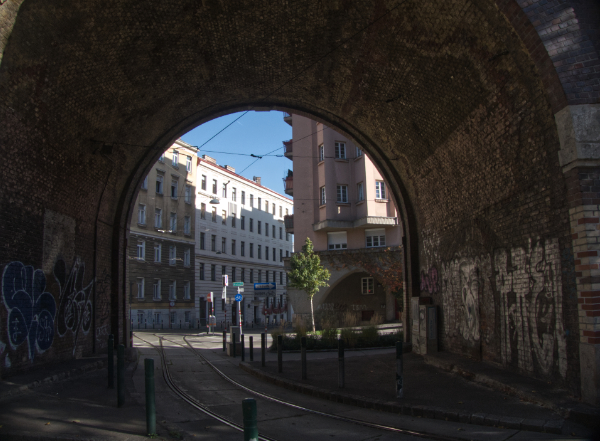
Look out for Glatzgasse on the left hand side and then turn left into this and under the railway bridge. You will now find another, separate road, also called Döblinger Gürtel. This is confusing but you should be able to work it out.
Now turn left again and you will see Dittes Hof. Turn right into Devrientgasse and Dittes Hof will be on your left hand side. Continue along Devrientgasse and turn left into Heiligenstädter Straße. Now you can look around the inner courtyard of Dittes Hof.
Dittes Hof 1928 – 29 Arnold Karplus
This feels older, as if from a different time to Professor Jodl Hof. Perhaps the heavy traffic along Heiligenstädter Straße has prematurely aged the building. This level of traffic is bad for people, animals and plants and it cannot be good for buildings.
The traffic distorts the space around the building creating a road barrier with many vehicle movements. It is a physical and psychological barrier which prevents spatial integration of Dittes Hof into the wider area.
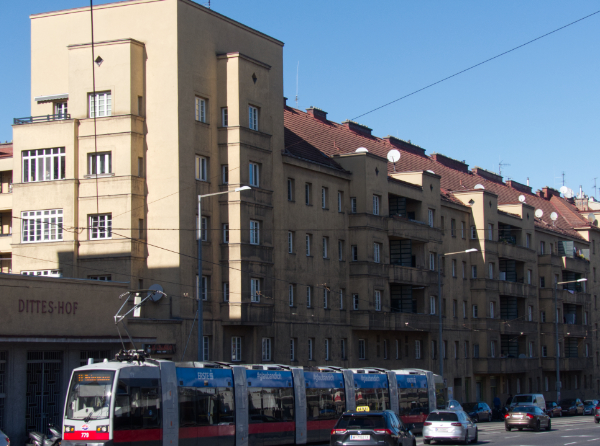
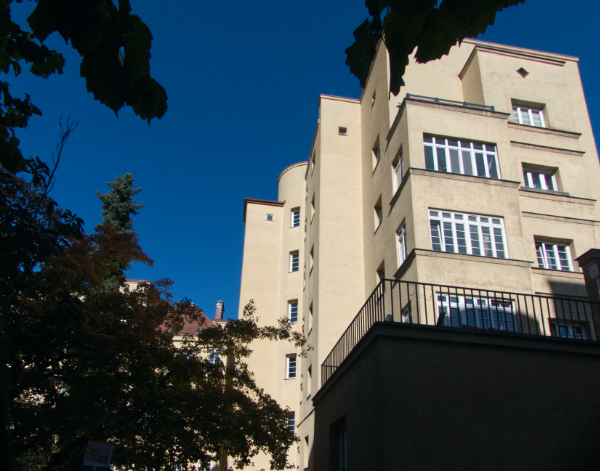
Within there is a spacious inner courtyard which tapers towards a conclusion at the northern end. The height of the buildings, the single entrance to the courtyard and the courtyard itself with mature trees and play areas creates an atmosphere of self-containment.

When the estate was originally built it included several shops (they are now mainly empty), a youth centre, social democrat offices, a meeting hall and communal baths.
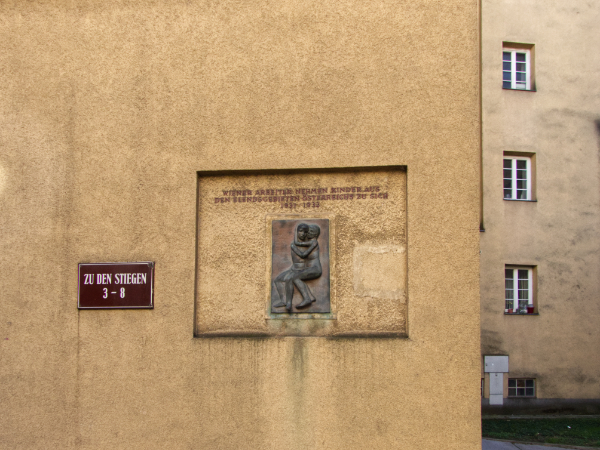
As you go through the entrance way into the courtyard look for the memorial called ‘Mother and Child’ which commemorates the hard winter of 1931-32 when residents took children from poor families into their homes. Social Democratic offices, residents taking in poor children; I should very much like to know more about the social relations within this estate.
Imagine if the political parties of contemporary Britain had offices on council estates; and perhaps also outside hospitals, busy railway stations, shopping centres, industrial estates, run down urban areas and elsewhere.
It would help everyone focus more clearly on the relationship between the empty promises of politicians and the provision of housing and heath, the cost of food and transport, wages and conditions of employment and much else.
Come out of Dittes Hof and turn right into Heiligenstädter Straße. You could go back up Devrientgasse but for a bit of variation perhaps continue for another few metres and then turn right into Glatzgasse and then left into Döblinger Gürtel.
Döblinger Gürtel 10 1928 – 29 Leo Kammel
One must control the use of superlatives but occasionally it’s fine to say; this is fabulous. It has the look and feel of a cinema, that symbol of electronic modernism that gripped people in the 1920s, 30s and 40s.
The architect of the block, Leo Kammel, had also been a cinema and factory designer. He was influenced by, and influential on, Czech cubism.
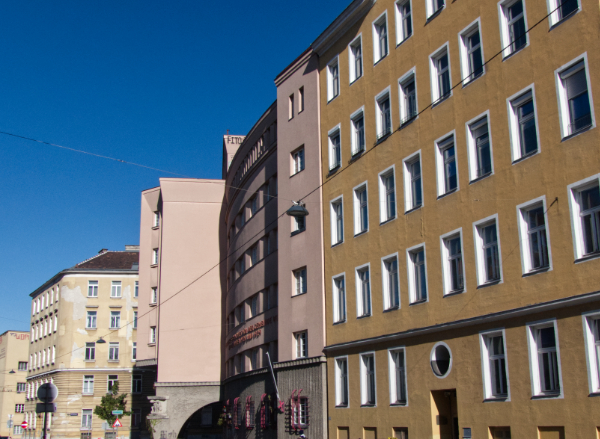
The arches and crouched statutes supporting the entrance might suggest something cloister-ish and godly, and yet as part of the overall ensemble they become modern and of the age of mass production, offices and department stores.
It hardly seems possible that the building lacked internet access when it was built in the late 1920s.

The building has a solid base of plastered concrete and an intimacy provided by the arched entrance way. This provides an entrance space which feels private even though it’s effectively on the street.

As the eye is drawn upwards, the towers and the curve of the roof seem to soar into another place altogether.
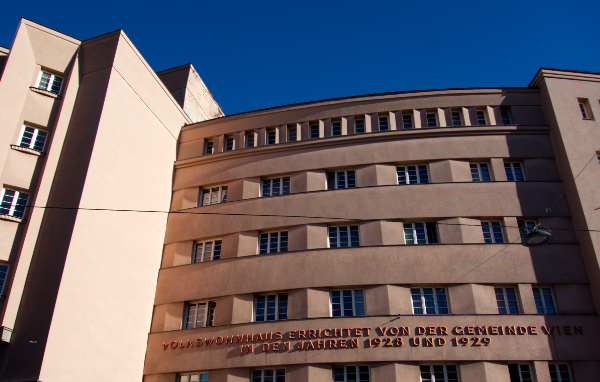
Go to the end of Döblinger Gürtel and then turn left. You will be able to see Gall Hof. It’s not really out of your way if you want a closer look.
Gall Hof 1924 – 25 Heinrich Schopper and Alfred Chalusch
Many of the Gemeindebauten on busy roads keep their gates locked and it may not be possible to see the interior of the building with its courtyard and elegant design.
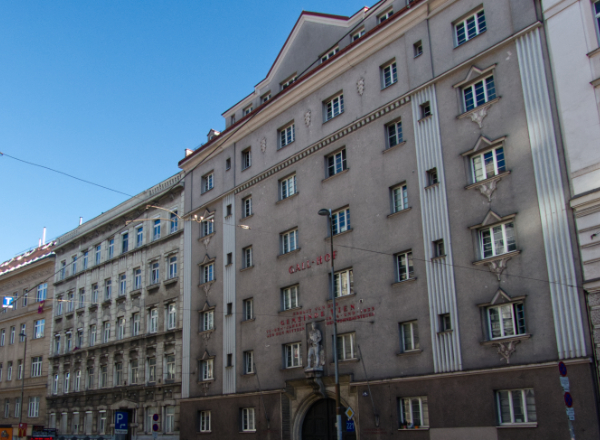
If you do get inside, this is what you will see.
The pink colour balconies are good. This could be a hotel in Brighton, the perfect place for assignations and naughty weekends away from home.
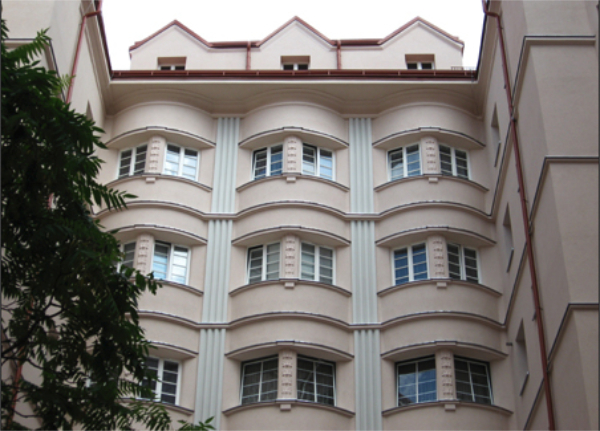
The kindergarten and day centre are still in use a century after they were built.
I wonder how much public housing in Britain has been blown up and demolished in the past 100 years? And why? Some schools in England, less than 30 years old are already falling to bits. There are similar stories about the NHS estate.
The architects Schopper and Chalusch were both pupils of Otto Wagner.
The estate is named after Matthias Gall who was murdered by fascists in Straubing prison in 1944.
Once you’ve seen Gall Hof, go back to Döblinger Gürtel and underneath the railway arches. Cross the second Döblinger Gürtel and once you’ve done that, there’s a crossing on your left hand side. Use that to cross Döblinger Hauptstraße.
Once you’re on the other side, turn right. Note the tower blocks from 1959-1960. Vienna by and large avoided the tower block mania that gripped Britain. In front of you will be Pestalozzi Hof. However, continue a few more metres until you arrive at Billrothstraße 9
At number 9 is Ledigenheim.
Ledigenheim, Billrothstraße 9 1927 Ella Briggs
This housing was built for single people. Each floor had six individual rooms, a shared communal lounge, kitchenette and shower facilities.
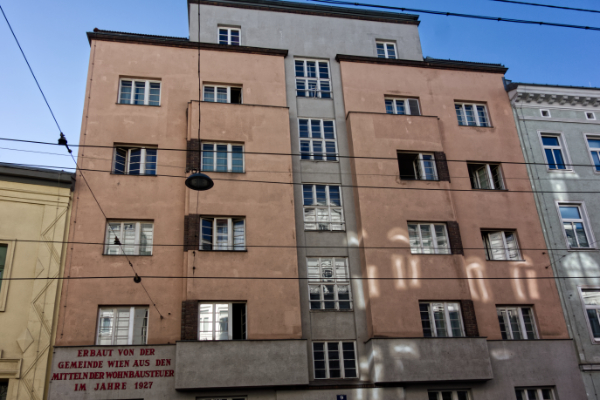
This type of plan is actually built in Britain; but generally in the form of ‘care homes’ or blocks of flats for older people. It is expensive to the tenants for what it is.
The problem isn’t the building plan or type; it’s the leasehold system, management company control and opaque service charges. Sweep away the oppressive social relations and there would be a core of usable housing.
Ella Briggs was one of only two female architectures who worked on Red Vienna housing (the other was Margarete Shütte-Lihotsky).
Briggs married, but only for a short time. For most of her adult life she was a single woman who frequently moved. This helped to shape her experience of life and architecture. She strongly believed that the needs of single people, elderly people and childless couples needed to be met just as much as the needs of families were.
When it first opened, the Ledigenheim housed students; double the number the building was designed for and they ended up sharing rooms. Even so, it was a considerable improvement over the type of accommodation which students generally had to chose from; poor quality, few if any tenant’s rights and expensive and landlord authoritarianism (this is still the case in Britain today for many students).
The Ledigenheim was solely for young men and the situation for young women students, and indeed young women in general, was poorer still.
I have also found this described as Julius Tandler-Heim and am currently trying to work what it should be called.
Now retrace your steps and walk back along Billrothstraße and turn right into Philippovichstraße
On the left is Klose Hof and on the right is Pestalozzi Hof. Let’s start with Klose Hof.
Klose Hof 1924 – 25 Josef Hoffman
This was designed by Josef Hoffman and is one of the few gemeindebau (at least of all those I’ve seen) that prominently includes the name of the architect on the inscription on the facade.
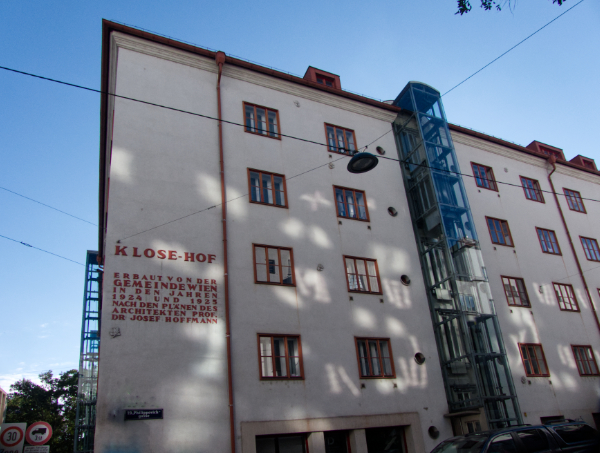
Hoffman ‘had wanted to substitute brightly coloured paint for the standard wall mouldings and to paint broad stripes across the ceilings of the living rooms, as he had done in some of his private villas. But city officials would not allow it, claiming that the inhabitants wanted, and were entitled, to personalize their own spaces’. (The Architecture of Red Vienna, Eve Blau p 193).
I think I’m with the city officials on that one. I wonder however about a bit of colour on the external facades?

It is possible to easily walk around the whole perimeter of the building.
On the other side of the street is Pestalozzi Hof
Pestalozzi Hof 1925 – 27 Ella Briggs
This was also designed by Ella Briggs. She had worked in the USA and Berlin, as a house architect, writer and interior designer. She emigrated to Britain in 1937 to escape the Nazis.
One of her commissions after the Second World War was the Stowlawn Estate, Bilston, which is now part of Wolverhampton.

There is something fantastically modern about this, a modernism for the people, not just for the architectural and design trade magazines.

The kindergarten is the most dominant feature of the street facing facade. A sign of commitment to the needs and development of the child.

The building is well-balanced and composed, the visual attractiveness amplified by the stairwell turrets. They are space-age rather than medieval.
The hedge that acts as a natural physical barrier to the street is a good touch.
Continue along Phililoppovichoppovich Straße and cross Lissbauer Straße to Ella Briggs Hof
Ella Briggs Hof 1938 – 40 Johann (Hans)Stöhr
I think this is worth going to see because it’s named to commemorate Ella Briggs and it’s next door to Pestalozzi Hof.
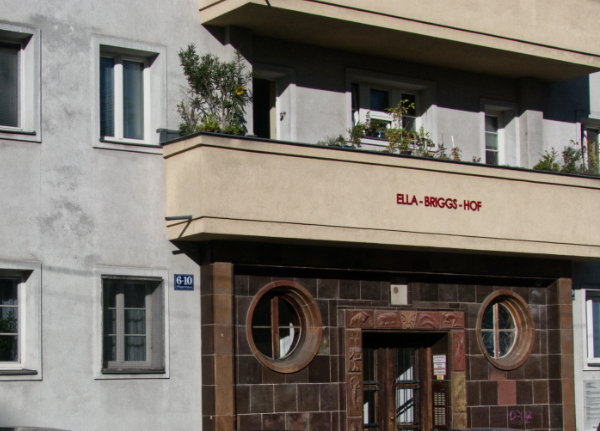
I initially wrote; “It’s a good building in its own right. In style and design it is sympathetic to Pestalozzi Hof and they share the same pleasant view over the street to Währinger Park. These two blocks and Klose Hof and the park create a liveable urban ensemble”.
And then I discovered that it was built between 1938 – 40 and that raised disquieting and disturbing questions.
The origins of the building lie in the period of Austro-Fascism and it was completed after the Anschluss. By that time Jewish people were experiencing increasing levels of abuse and violence and having their housing, assets, money, possessions, jewellery and much else taken from them.

They were forced into ‘Jewish houses’ where more and more people were crammed into ever more dilapidated accommodation.
Then the whole evil process of deportation and gassing began.
This was all going on as this was being built and the first tenants were moving in.
While I was in Vienna for this trip there was an exhibition on at the Freud museum, Documents of Injustice. The Case of Freud
I walked around with a friend who had once worked with concentration camp survivors. We became increasingly silent.
The exhibition described how pettiness and curtain twitching increasingly turned to hate and crime and then to violence and murder. All recorded with sanctimonious autocratic power. The letters signed off with ‘Heil Hitler’ and marked with swastika stamps as people’s lives were destroyed.
Three lists of people’s names. Each ticked off with a blue pen. That confirmed they were on the transports to the death camps.
Sometimes it is in the everyday objects that the banality of evil seems so powerful.
Ella Briggs herself lost many possessions and her architectural practice. She made a claim after the war in which she was reward some compensation. What money can never compensate for is the physical, emotional and psychological damage that fascism creates.
Walk back to Lissbauerstraße and turn left into this street. Note the new building next to Pestalozzi Hof and how sympathetically it’s been done.
Turn right into Schegargasse. Cross Billrothstraße and continue along Schegargasse until you arrive at number 17 which is on the left hand side of the street.
Before you get there, note the newer estate on the left hand side and the statue, ‘Zwie ballspielende knaben’, by Rudofl Schmidt from 1959.
Schegargasse 17 – 19 1923 – 24 Friedrich Jäckel
The gates here seem to be permanently locked, but now I think about it, perhaps not in the morning? I usually try and walk the routes at different times of the day; the light and direction of the sun’s rays vary and this changes the quality of photographs.
I only walked this route in the afternoon. I need to go back.

The gates were locked even on my third visit. Outside a food delivery courier was scratching his head (and cursing) about not being able to enter.
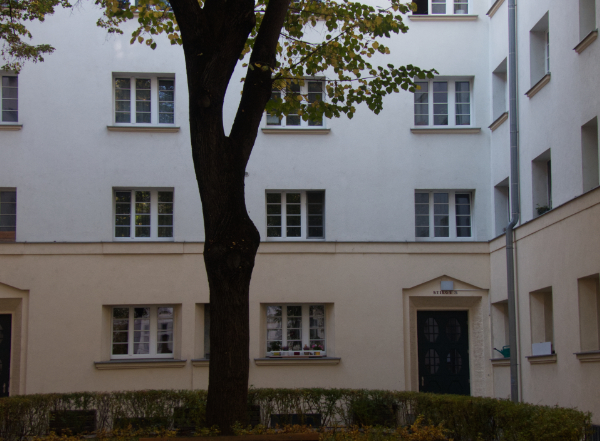
According to my notes this is one of the first municipal housing buildings to be constructed in Vienna as part of the Red Vienna programme.
The flats surround the central courtyard in a u-shape with gates and fencing to the street front. It has a Biedermeier aesthetic and atmosphere. It is a pleasant mix of city-urbanity and intimacy and privacy.
The mature trees in the courtyard create a sense of nature quite out of proportion to their actual numbers. This is how nature can be used, mutual aid rather than human ‘conquest’ of the environment.
Jäckel was involved in the redesign of the Naschmarkt during the Fin de siècle. If you haven’t been to the Naschmarkt it’s worth a visit.
One Saturday morning I bought some copies of Oesterreich Illustrierte Zeitung from the months October 1918 to January 1919.
The covers are all the same; a young woman who looks as if she can’t decide to join the various revolutions that are going on or become a flapper. If the tyranny of categories is abandoned, both would be possible.

Inside there are adverts (some with wonderful graphics) for pianos, jewellery, clocks, art books, cognac and much else. The third page is crosswords and number puzzles.
Half way through there is a regular feature of ‘photos of the week’. A mass of people are pictured by the Bismark statue in Berlin.
They turn out to be a revolutionary crowd.
There are mentions of Luxemburg, Liebknecht, Lenin, Trotsky and Karl Marx in the thick High German print.
The following week there are photos of armed workers and soldiers posing for photographs in Vienna. They too have created a revolution.

Then the pages return to offers of boxed sets of novels and humorous vignettes of a ‘Diary of a Nobody’ kind.
This is just one of the many reasons why the Naschmarkt is such a good place to mooch on a Saturday morning.
Continue along Schegargasse and then turn left into Döblinger Hauptstraße. You could get a tram from here in the general direction of Karl Marx Hof but I would suggest you walk. It’s only about 20 minutes. Döblinger Hauptstraße is a lively and interesting street and worth walking along.
There is plenty to see in Döblinger Hauptstraße. A gated community at number 15, old shop fronts (there is a good example next to the building 59), bakers for the obligatory afternoon kaffee und kuchen, bars if you prefer a beer.

There are many tempting side streets, a glance at seductive vistas, the enigma of what’s-around-the-corner. Just the presence of these side streets adds to the urban magic.
You will arrive at the church at the corner of Döblinger Hauptstraße and Hofzeile. I have included a picture here. It is part of the Convent of the Sisters of the Poor Child Jesus.
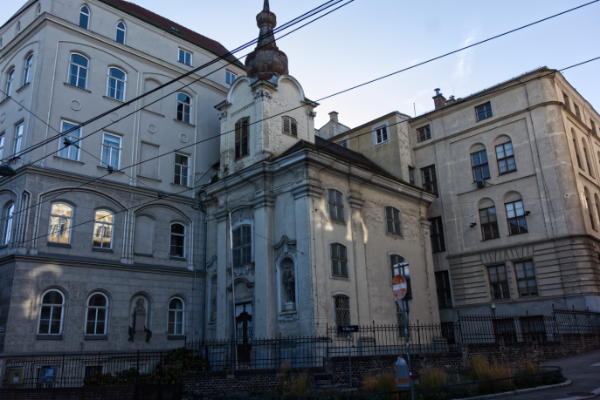
When you find this church, you will see the District Museum on the other side of the road and the entrance to Wertheimstein Park.
There are now two options.
Option One: Please note this has a large number of steps. Walk through the park until you reach Heiligenstädter Straße. If you chose this route you should head towards the far left corner of the park. When you reach Heiligenstädter Straße turn left. Just keep walking straight and you will find Karl Marx Hof. Just before that, on the right hand side is Svoboda Hof.

Option Two: Continue along Döblinger Hauptstraße, cross over Barawitzkagasse and into Hohe Ware. Note the Chinese embassy on the left hand side and the Setagayapark (the Japanese garden) on the right.
There is no shortcut through the park but it’s lovely to visit and a good place to sit down for ten minutes. From Hohe Warte turn right into Gallmeyergasse. Follow this until you arrive at Heiligenstädter Straße. Svoboda Hof is on the other side of the street, and Karl Marx Hof is next to that.
Option Two puts Karl Marx Hof into a different perspective. It is like approaching the public housing of Camden from the Hampstead direction rather than the Euston side. I thought Karl Marx Hof seemed more grand and held its own rather well with the more middle class housing.
Svoboda Hof 1926 – 27 Karl Ehn
The block was renamed in 1948 in memory of Emile Svoboda who was a member of the socialist and republican defence organisation, the Schutzbund.

He fought bravely in the defence of the neighbouring Karl Marx Hof during the civil war in February 1934.
Following capture he was subjected to a summary trial and hanged on 15 February at the age of 36, leaving a widow and two young children.
In Hungarian, Svoboda means ‘freedom’.
Karl Marx Hof 1927 – 30 Karl Ehn
This has become the monumental image of Red Vienna, the one for fridge magnets, book covers, illustration for websites, magazine articles and television programmes. It is the image most people will have of the housing of Red Vienna.
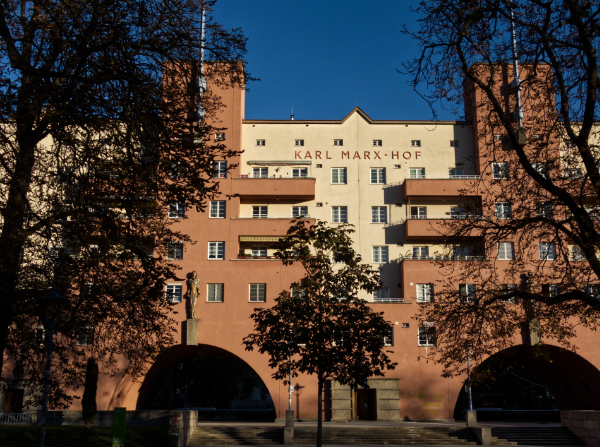
In many ways rightly so. The central block is grand and impressive. It is striking partly for its unusual design and the grand arches which make the building seem bigger than it is. At first glance it may appear that the whole building is about to march around the world with a call for worker’s revolution. It is the sort of solid leadership we so need.
Of the overall land available 20 percent was built on, the other 80 percent became open space with lawns, trees, paths and play areas.
I have a reference that needs pursuing that part of the land originally belonged to the Habsburgs and was sold to the city council at below market rates in the 1920s. The land question in the Habsburg Empire demands serious study; something for an extended period of rainy days.
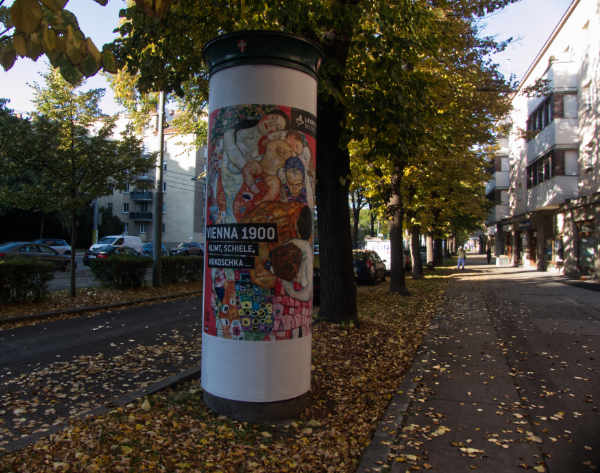
The museum is a later addition and definitely worth a visit.
When it first opened the estate was supported by kindergartens, communal laundries, baths, a library, a doctor’s surgery and retail units. It original contained 1,382 flats intended to house 5,000 people.

It may be to do with the availability of land at the time but I find the length of the housing problematic. It’s over 1,100 metres. This might sound impressive as a statistic, ‘the longest block of public housing in the world’ but to walk this sort of length in a straight line is a bit of a chore.
Little is known about the private life of Karl Ehn, let alone his inner life, and this makes me slightly suspicious as to what he was actually about.
And I can’t imagine Christopher Alexander coming up with such a layout.

Nonetheless, there is much to like here. I think the trick is not to just look at the central block, but to explore the estate as a whole.
On one such exploration I was accompanied by a friend who lives in 1930s London council housing, so more or less contemporaneous with this. He made some interesting comparisons, particularly about how much open space there is, the overall cleanliness and how well organized the rubbish collection and disposal is.
I get the feeling (perhaps wrongly) that visitors only view the central block, and perhaps a bit of the southern block; but the northern end of the estate is worth a visit too. There appear to be more functioning retail units and they provide a change in atmosphere, something more local and lived in.
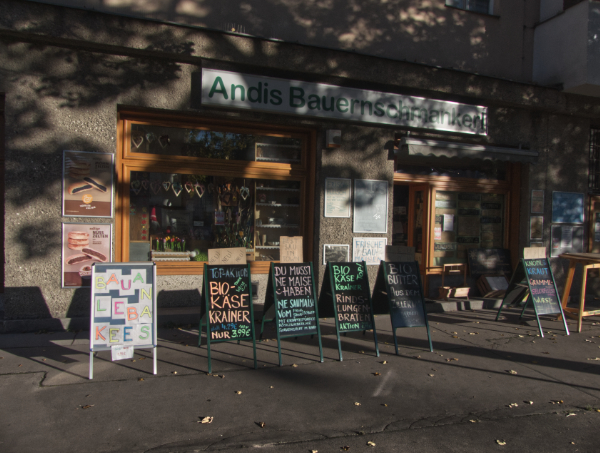
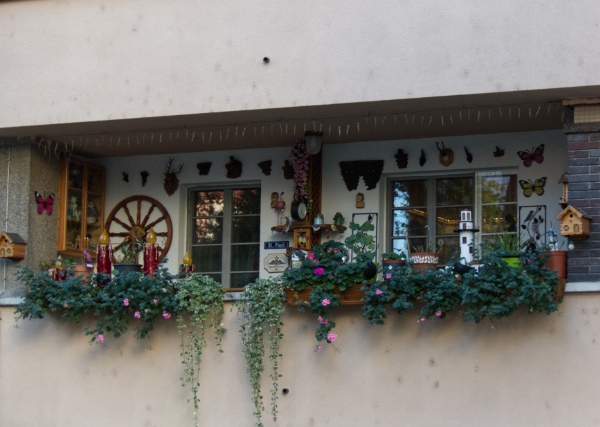
I am always pleased to see flower pots and window boxes and duvets hanging out of windows and homeliness on balconies. There were debates about all of this and how the interiors might be decorated. These were within the context of the creation of ‘new people’ and what ‘socialist’ culture might be.
Josef Frank joined in and proposed an approach which was eclectic, pluralist and partly a result of accidentalism and serendipity. He suggested that a rules approach to aesthetics (as advocated by some of the modernists) was neither essential nor particularly left-wing or socialistic.
If there is an insistence on minimalist tabular steel furniture (to satisfy some ‘design rule’ – or even worse, a political-aesthetic rule), then what happens when a Biedermeier chair comes into the home or by luck and chance one finds an early mediaeval painting in the Naschmarkt and wants to put it on the wall?
As far as Frank was concerned, if Viennese workers wanted to put cuckoo clocks on their walls that was up to them. The role of architects, designers, builders and housing officials was to produce good quality, low cost housing which was well designed and based on the principles of light, air, sun, space and nature.
It was at the end of my visit and I was very pleased to see these cuckoo clocks. They vindicated something good about the housing as a whole.
If you want the full experience of the walk, then go and have a look at Heiligenstädter Straße 146. If you don’t want any more walking, there’s a picture here and some detail.
Heiligenstädter Straße 146 1928-29 Alfred Castelliz
The architect here was Alfred Castelliz who was influenced by Theosophy, Anthroposophy and Rudolf Steiner.
When I arrived here at the end of one of the research walks I had an irresistible desire to go further, to just keep walking, along the streets until I walked out of Vienna and into the woods.

I was foot sore and hungry and didn’t. But the next time I will. There was something tempting, inticing, magnetic. That the walk should never end, it’s just a start, a movement into different time and space.
Instead I turned around, heading towards the Heiligenstadt station when I discovered a shopping centre.
Shopping Centre
Karl Marx wrote a book called Capital which starts off with the commodity. The production and characteristics of the commodity are central to Marx’s ideas and he spends a lot of time and energy explaining why.
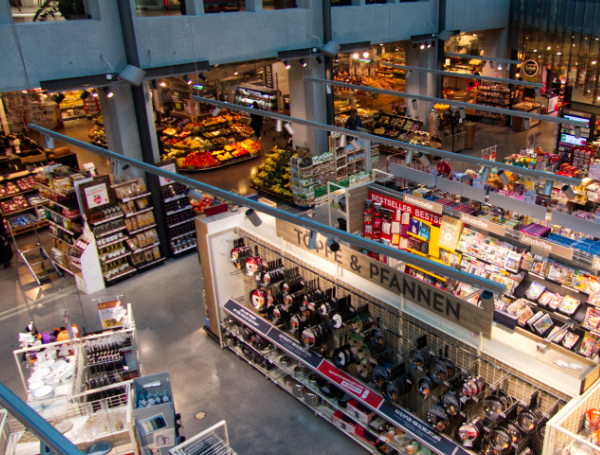
After completing this walk, and being immersed in a housing development named “Karl Max Hof’ I found the shopping centre fascinating.
It helped to illustrate the difference between the non-commodity approach to housing of Red Vienna, paid for through taxation and with the capital costs written off, with the increasing dominance of commodification in all realms of life. Commodification, and turning homes into commodities has been a disaster for housing provision.
Since Capital was published in 1867 there have been immense and accelerating developments in science and technology. Human knowledge has expanded and ingenuity increased. There has been a huge increase in the number of machines, tools and other means of production.
It seems extraordinary then that housing continues to be an endless struggle for masses of people. That even in the advanced industrial economies people struggle to pay for housing, live in damp and degraded conditions or lack housing altogether and sleep on cardboard in the streets.
Internationally the conditions are even worse. It is estimated that around 25 percent of the world’s population live in slums.
There is a huge contradiction here. The world has the physical and material means to provide good quality housing for everyone; supported by clean water, sewage disposal, power, internet connections, schools, kindergartens, clinics, hospitals, theatres, cinemas, parks, gardens, transport systems. And yet this doesn’t happen.
The housing question remains urgent and the current answers are in the main unsatisfactory.
Some of what we’re looking for can be found in the streets of the history of Red Vienna; the Gemeindebauten with their gardens, balconies and trees, The kindergartens and schools. The idea that good quality, low cost housing is a right for all. That a home should be a home, not a housing unit to be for ever bought and sold for profit making.
It was late in the afternoon of an Autumn day and I stood in front of the Karl Marx Hof for some time. Gold, yellow, brown and copper leaves slowly swirled to the ground. The shouts of kids playing. People coming home from work with tool kits, from the shops with trolleys, babies wheeled home from the park in their prams for supper and a bedtime bath.
Individuals and small groups of people would arrive and take photographs of each other with Karl Marx Hof as the backdrop. Sometimes a book would be produced and something checked.
I found myself in conversation with a housing and urban researcher from Argentina. It was casual and interesting and informed and questioning. We shook hands before we parted.
Perhaps that’s what’s needed. A human chain of solidarity around the world; that collective social energy might be the power that dissolves the increasingly paranoid auctocracy; something that puts people before profit, where homes matter more than capital.
I caught the U-Bahn back towards Landstrasse, looking out of the window at the buildings and the Donau canal and the shops and cars and bridges and viaducts and people and all the stuff a city has.
There was a lot to think about.
This is part of a series of seven Red Vienna Radical Walks.
1. Ella Briggs, Karl Marx & Modern Housing
2. The Radical Housing of Meidling, Vienna
3. Favoriten and the end of Vienna
4. A Walk along Wahringer Strasse
6. Rabenhof, Vienna: A Radical Walk
7. Red Vienna: A Radical Walk
And here’s an eclectic Red Vienna reading list
 Commodity Fetishism
You must be logged in to post a comment.