
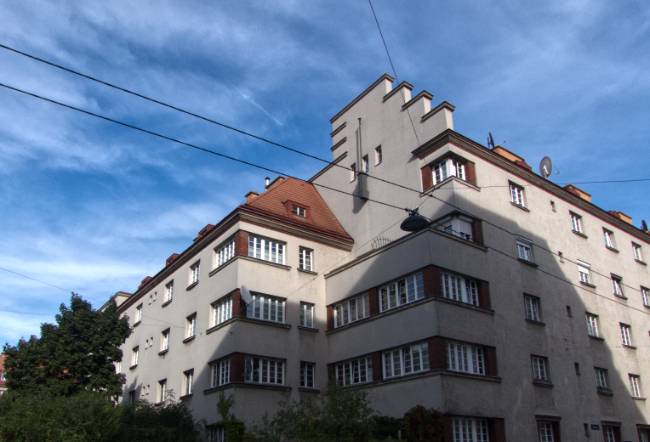
You can start where you like with a visit to the Rabenhof estate in Vienna. Walk all the way around the perimeter, explore the alleyways and passages, watch the world go by, sit and read a book, sketch the buildings; what ever you do, make sure to explore. If you need a meeting place, the Rabenhof Theatre works well.
The estate was built in two main phases from 1927 onwards and was officially opened on 15 September 1929. The early photographs suggest a monumental tranquility, something special taking place within the urban fabric of Vienna that was thoughtful, considered, intellectual, political and artistic.
The moments of detonation that led to the explosive change that produced 64,000 new homes for the workers of Vienna between 1919 – 1933 were the collapse of the Austro-Hungarian empire during the first world war, the Austrian revolution that started in October 1918, the development of workers’ councils throughout central and eastern Europe. And the revolutions in Russia, Germany and Hungary and the national liberation struggles in Poland, Slovenia, Serbia, Croatia, Czechoslovakia and elsewhere.
By the end of 1919 the cadences of the revolutionary wave slowed and the bourgeoisie across central and some of eastern Europe began to regroup and strengthen their positions (Russia was an exception at this time).

In Vienna there were real gains for the working classes; the eight hour day, paid holidays, works committees. There were large increases in people joining the socialist parties and the trade unions, class consciousness sharpened and the sense of workers’ potential power became more real.
It was armed workers who had organised to defend the new republic, it was workers committees that ensured people were fed and that transport and utilities systems operated. But there were many tensions and contradictions in this period, and political splits on the left, and within the socialist movement and trade unions.
The dominant Social Democratic Party argued that the economy must be revived and diplomatic care taken not to encourage invasion by the Entente powers. It was a type of reformism that became known as Austro-Marxism. As with all reformisms it had its limitations, but it also produced an impressive change to the lives of working people.
Even with the positive changes, some workers wanted more; greater workers’ power in the workplaces, more control over the ruling class, general socialization of industry.
With a sense of their new found power they wanted more time for themselves, rather than selling their time to their employers, a slowing of the pace of industrial production, greater liberties of the spirit and perhaps – though rarely articulated it seems – an end to the general atomisation and alienation that capitalist production generates.

In a historical period of rapid change and intense class pressures Austria slowly formed as a country, capitalist economic activity revived. A new political tension was created between the radical city of Vienna, under socialist control, surrounded by a national government and provincial assemblies that were hostile and generally right wing and reactionary.
Otto Bauer, a leader of the Social Democrats and theoretician who helped to develop the idea of Austro-Marxism and the ‘third way’ of socialist thinking, suggested that by the early 1920s neither the bourgeoisie nor the working class were strong enough to overcome the other.
But there was a political space, and a strong and relatively well organised working class with significant electoral representation that made reform possible. It was in this context that Neues Vienna, or Red Vienna as it has come to be known, was formed and developed.

Vienna had a mixture of housing provision under the Habsburg empire. The grand facades are still visible today throughout the city streets. As the city changes to suburbs there are large detached villas with generous gardens; self-important, imposing, conspicuous representations of wealth and power.
And yet the poorest and some of the middling sections of the population experienced overcrowding, bed renting, shared outside toilets, damp, mould, vermin and disease conditions. Rents were high and tenants rights either weak or non-existent. On one side the propertyless, a class with precarious shelter. On the other side the property owners, a class of landlords accumulating profit.
These contradictions, tensions and conditions were changed by the revolution. And the political control of the city changed too.

The Social Democratic Workers’ Party of Austria (Sozialdemokratische Arbeiterpartei Österreichs, SDAPÖ) became the dominant force in the city of Vienna, and for a short period in the country as a whole.
They used this position to implement a far reaching and progressive plan for the development of Vienna which included a substantial house building programme supported by an infrastructure of health, welfare, education and culture. This is the legacy that can be found all around the city today. This is what Rabenhof and the surrounding gemeindebau (community housing) represent.

There are a number of other gemeindebau in close proximity to Rabenhof and they are of varying styles and form. In a few streets, spaced closely together, there is a collection of buildings that form an interesting example of Red Vienna. They are all within the Landstrasse, the third district of the city.
To the south and east were proletarian industrial areas, the Danube canal, railway yards, a tram terminal, gas and electrical power production. And yet the centre of the city and the Naschmarkt, a popular market and eating place, are within a 30 minute walk.

A total of 1,097 apartments were constructed and housed between 4 – 5,000 people. Of the total area covered by the estate around 38 percent is built on and the rest is open space. The relationship between the build-mass and space is complex, and encourages curiosity and inquisitiveness. Margaret Gillett, a student at the Bartlett School of Architecture in the 1920s, visited in 1930. She wrote:
‘In the courtyards….a system of irregular alley ways…wears an air of adventure. The interest of a shadow round a corner is an invitation to investigate further. A hidden light at night gives an atmosphere of mystery. There are terraces at different levels, pointed archways leading to enclosed courtyards over which hang an almost monastic peace’.
(quoted in The Architecture of Red Vienna by Eve Blau, p 362)

The architects Heinrich Schmid and Hermann Aichinger were both students of Otto Wagner. The site had once been the Krimsky-Kaserne barracks, alongside workshops and slums. Everything was cleared, although the medieval street pattern of Rabengasse and Rüdengasse was retained. This continues to provide an intriguing curvaceous walking route through and around the estate.
The entrances to the estate are defined by monumental arches, and the arch motif is repeated throughout the entrances, passageways and gateways. It might be expected that this would be imposing but it isn’t. Instead it delineates the public-city space from the residential, living space without completely separating the two. Rabenhof is distinctive in its own spatial terms but it is also interwoven into the wider city-image.

Eve Blau describes the estate as Schmid and Aichinger’s masterpiece.
‘…all of these historical illusions are merged with modernist abstract neoplastic asymmetries, broad expanses of sheer wall surface slashed by horizontally extended window bands and balconies, constructivist reinforced concrete lampposts, and tensile metal flag-staffs and balcony railings’.
(The Architecture of Red Vienna, Eve Blau, p 362)
There are references to Biedermeier design and, in places, a medieval feel. It’s clever and effective without ever becoming eccentric or selfishly ‘about’ the architects.

There is considerable and subtle variation of form and material. The kindergarten has a powerful patterned brick work influenced by the Amsterdam expressionism of Michel de Klerk and Piet Kramer. Quality of labour, thoughtful expression, human but restrained and technically disciplined design have been applied. It must have impressed generations of Viennese children without intimidating them.
Otto Bauer in his book The Austrian Revolution describes the wider educational reforms which were implemented from 1920 onwards with the focus on ‘an activity school’. Children were encouraged to think for themselves, ‘From their own observations, their own activity, their own work, they generate knowledge…The children look around them on educational walks, and instruction is based on what has been observed on each walk’.
Bauer uses the example of a school walk to a railway station.
“From time to time we calculate: if there are thirty seats in a railway car, how many are there in the whole train? What does the trip to the next station cost? What would it cost if we all travelled together? In this way we learn to multiply. Where can the train take us? Through which valleys, across which rivers? In this way we learn geography. Who has already travelled by train? Now write down the story of this trip. This becomes a composition exercise. How is it that the locomotive moves the train? This brings us to physics”.
(The Austrian Revolution, Otto Bauer, p 265)
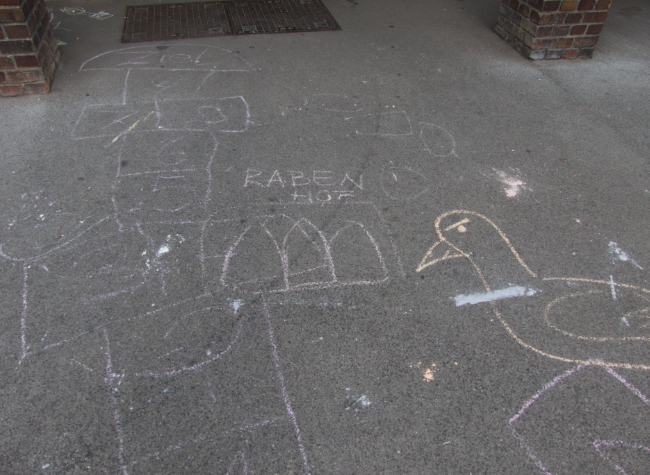
The housing programme across the city as a whole was supported by libraries, kindergartens, dentists, clinics, mother and baby clinics, play areas, theatres, cinemas, workshops, artists studios, community halls, green and open spaces, allotments and much more.
Welfare services were reformed under the direction of Julius Tandler who was appointed City Councillor for Welfare Services in November 1920. He declared, ‘If you build palaces for children you tear down prison walls’.
Tandler was a renowned clinical anatomist so had a good understanding of the human body, useful knowledge in the ambition to improve public health and introduce disease prevention measures. Incidents of tuberculosis, ‘the Vienna disease’ fell, child mortality rates fell, life expectancy increased.
A system was introduced whereby each baby born in Vienna received a layette including blankets, clothes, nappies. Hundreds of thousands of baby hats, jackets, sleeping suits and much more were distributed for free. A poster from 1932 proclaimed, ‘No Viennese child should be born on newspaper’.
Today Rabenhof continues to have a well used public library. The large community centre, built for meetings, film shows and other events, is now the Rabenhof Theatre. Many of the original shops (there were 38) are still in use.
And now, to get a wider sense of the housing and social programme, let’s explore some of the local streets.
Head towards Kardinal Nagl Platz (I’m not sure where you have ended up in Rabenhof, but this is the next stop).
Franz Silberer Hof, Kardinal Nagl Platz

Built between 1927 – 28 this is a block with 152 apartments, designed by Georg Rupprecht. The block is named after Franz Silberer who trained as a baker and became active in, and a leader of, the baker’s union. He became an editor of the Bäcker-Zeitung (the Baker’s Times) and a socialist member of the Reichstag in 1911. He died in a climbing accident in the Alps a year later.
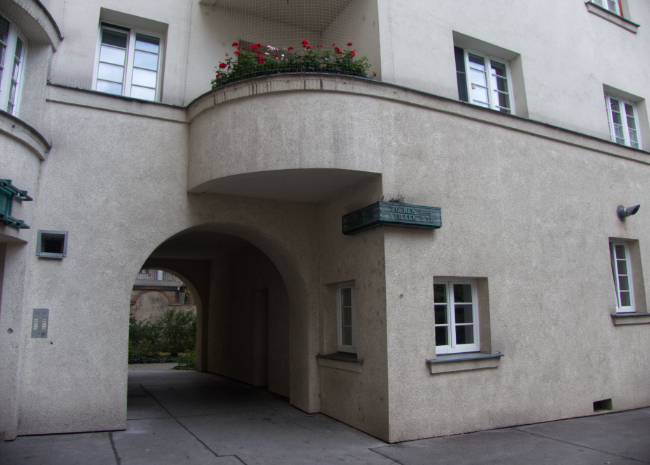
This building is bold and adventurous, both inside and out. By ‘out’, I mean the street facade, by ‘in’, the internal courtyard. Some of the larger gemeindebau such as Rabenhof effectively have roads and paths which go through them. They are part of the way that people travel through the city and they are routes in their own right. At the Franz Silberer Hof there is an enclosed inner courtyard which creates a great deal of privacy.
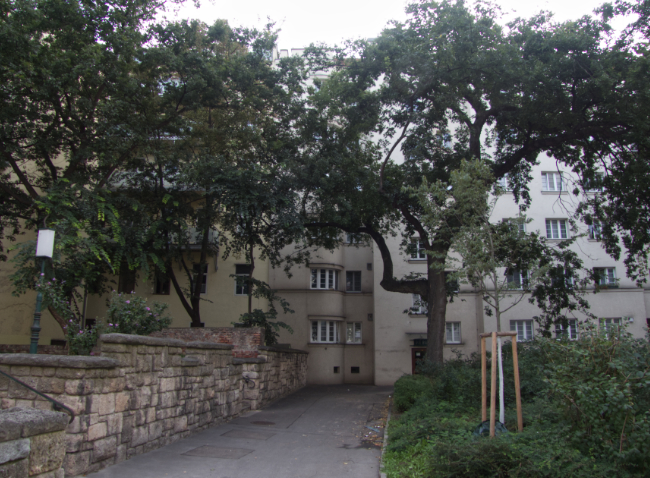
The curved balconies, the round stairway towers and the arched passage ways are very well done. There is a good tone about this building, an orchestration of forms which play together in a pleasing harmony.
Now turn left into Drorygasse
Landstrasse Hof, Drorygasse 8
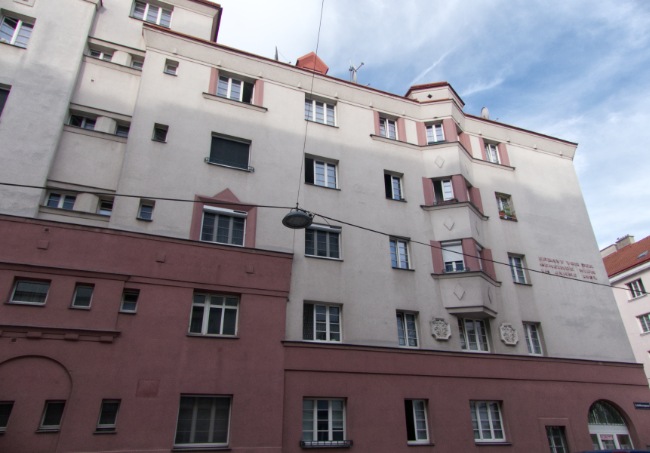
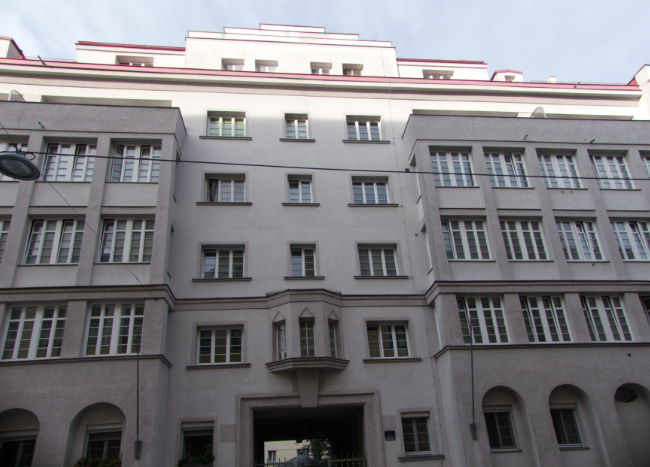
Built between 1924 – 25, the architect here was Karl Badstieber. This is a building of considerable mass but the density is broken up by the small detail; bull’s eye windows, restrained pediments, angular towers of bay windows. There are arches at the back of the block which create a spatial wave and change the dynamic between the outer, street facade, and the inner courtyard.

Ornamentation is used sparsely and yet provides a hook to the past and a previous Vienna of the Biedermeier time.

Erdberger Hof, Drorygasse 19 – 23
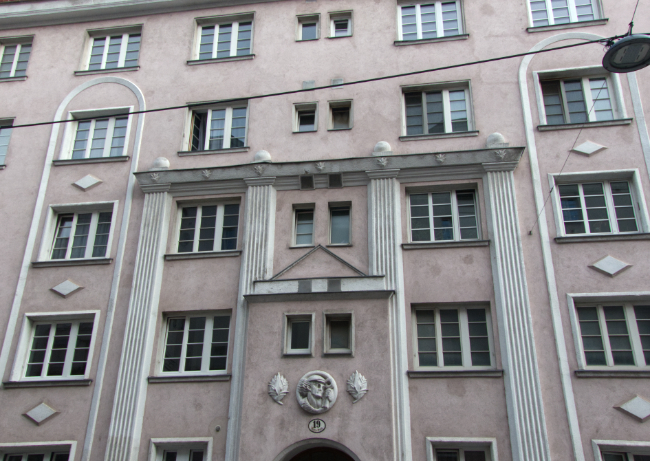
This building is part of the beginning of the history of Red Vienna and was built between 1921 – 22. Only five years earlier than most of the other buildings described here but note how different it appears. The architect was Karl Schmalhofer.
The housing programme grew organically at first and it wasn’t until 1923 that the first five year building plan was implemented and an increasing number of apartments in larger blocks were completed.
This feels more experimental, and yet gauche, as if everyone was still in the process of trying to establish what the look and feel, the idiom of Red Vienna might be. The pink colouring, the use of pilasters and the elongated decorative arches suggest a reluctance to move beyond the existing city-image of the recently departed Habsburgs.
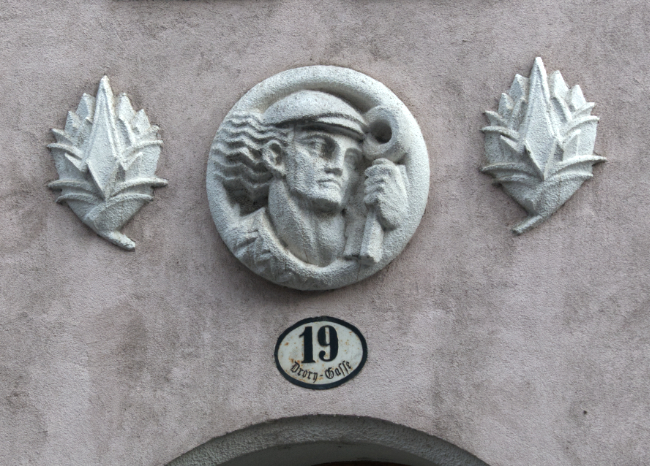
And yet a worker holding a metal tool hints at why the Habsburgs might have scarpered. This relief raises architectural and political questions; what exactly where the decorative arts going to represent and how? What should the design and ornamentation of a socialist building include and reflect and in what style?
On the corner of Drorygasse and Dietrichgasse is the next gemeindebau
Dietrichgasse 32 – 34
The block was designed by the architect Bruno Richter and built between 1926 – 27. There were originally 67 apartments.

The angular facade suggests an alpine modernism. The bay windows might be ski-lifts. Their double aspect provide good vantage points for people watching in the street below.
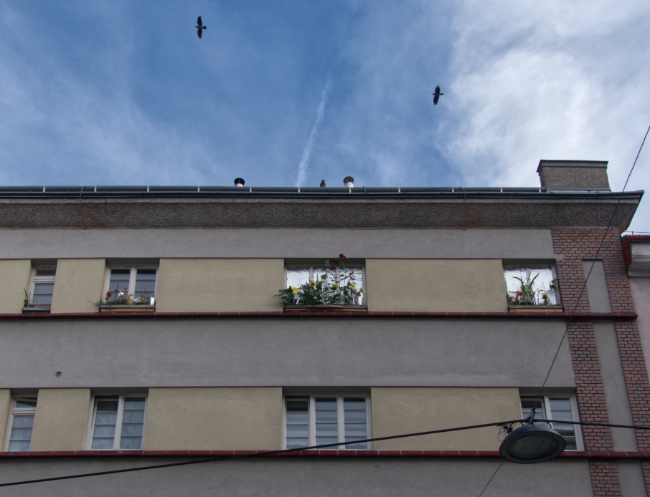
The use of red brick to bookend the building and to reinforce the corner provides a solid visual identity, both in terms of structure and aesthetics. In this way the building has also become a street landmark with its own distinctive character.

The entrance way bears an inscription which describes how the housing was built by the housing tax. This was introduced across the city and was structured so that the rich proportionately paid more. The Director of Finance, Hugo Brietner, was insistent that future generations would not be burdened by never ending debt and interest payments.
Walk along Dietrichgasse with Landstrasse Hof on your left hand side. Turn left into Rüdengasse.
Anton Kohl Hof, Rüdengasse 8

This housing was built between 1927 – 28. The architects were Camillo Fritz Discher and Paul Gütl. Discher was a student of Otto Wagner and had initially trained as a master bricklayer. The complex is in a heimatstil. I rather like it and think it provides a useful visual counterpoint to the other estates in the area.
At this time ‘tradition’ was associated with the Habsburgs; and they had helped create the chaos and murderous violence of war. If the Habsburgs couldn’t survive, how could the architecture that was associated with them survive? And what should replace it?
As it is, and because it is one type among a wide range of architecture, it appears slightly cheeky with a workerist volkish-ism. Variety of forms should be possible, indeed essential, in a confident pluralist socialist democracy. Always be suspicious of anyone dogmatic in architecture and even more suspicious of those dogmatic in politics and ideas.
The arch is both delicate and powerful and creates a bridge between the historical, classical and modern.
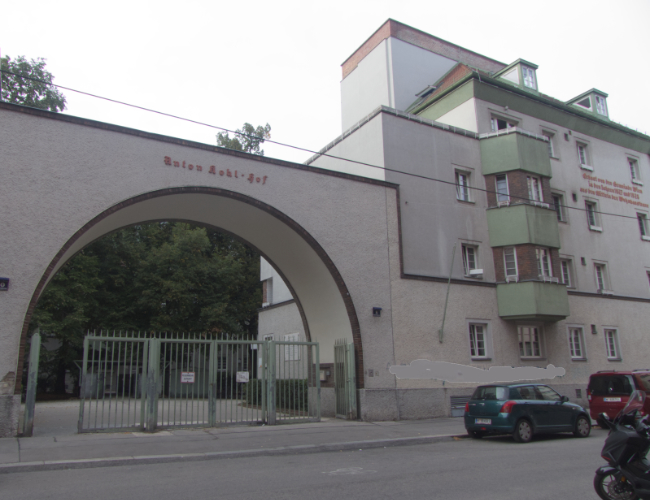
Anton Kohl was a co-founder of the metalworkers’ association and the consumer cooperative, a member of the state parliament and the chair of the Landstrasse Social Democratic Party.
I would like to know a lot more about about how the social democrats operated at a local, district level and how this influenced the house building at a local level. This will hopefully form future research.
Walk towards Göllnergasse
Göllnergasse 25
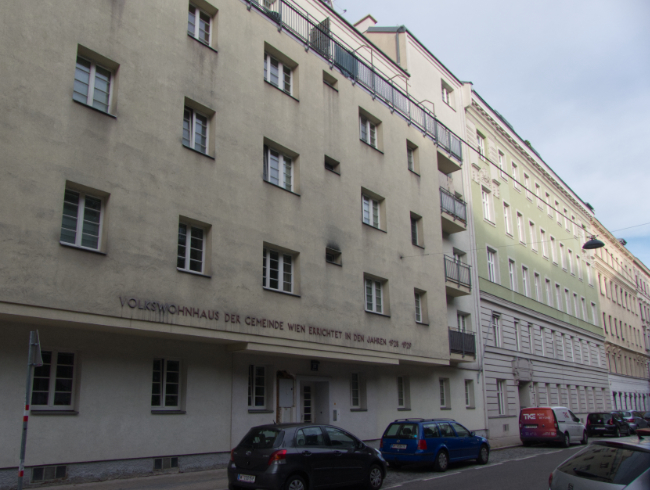
The architect here was Franz Kuhn and the building was constructed from 1928 – 29. Between 1910 – 1916 Kuhn studied at the Kunstgewerbeschule Wien (the Vienna School of Arts and Crafts). His tutors including Oskar Strnad and Heinrich Tessenow.
He was influenced by Adolf Loos and Josef Frank and his work included architecture, interior design and furniture design. He appears to have collaborated with the designer and architect Otto Prutscher.

Kuhn worked for the Wiener Werkstätten for which he designed fabrics and posters. He also became a member of the Austrian Werkbund.
The building manages to impose its modernism without dominating the surroundings. It still looks remarkably contemporary.
Now walk back towards Hagenmüllergasse
Hagenmüllergasse
There are four separate gemeindebau in this street, all constructed between 1927 – 28 and all by different architects. As a whole the street provides a good visual example of different styles and form. Some of the political history of the 1920s and 1930s is also expressed.
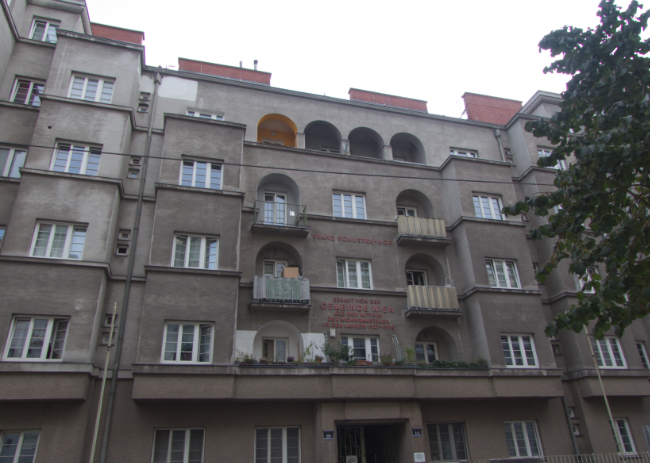
Hagenmüllergasse 14 – 16 – Franz Schuster Hof
The architect was Alfred Kraupa and the building was constructed between two existing apartment blocks.
The start of construction was 1927, a decisive year in the retreat of social democracy and the workers movement, and the development of fascism and right-wing reaction.
On the 30th January of that year, a Schutzund (socialist defence group) held a demonstration in Schattendorf in Burgenland. As the demonstration ended it was attacked by the Frontkämpfervereinigung, far-right paramilitaries. Several people were injured and Matthias Csmartis, a world war one veteran, and Josef Grössing, an eight-year-old boy, were killed. Their funerals were accompanied by a 15 minute general strike and huge demonstrations.
Three members of the Frontkämpfervereinigung who were accused of the murders were put on trial in Vienna on the 5th July. They were acquitted on the 14th. The following day there were strikes and large and furious demonstrations. Force was used and 89 demonstrators killed.
It was at this point that the balance of class forces started to shift. The Social Democratic Party, by its wavering and dithering revealed its weaknesses, and the right was strengthened. From this point onwards both democracy in Austria and the social democratic programme in Vienna faced increasing threats and hostility (which were increasingly financed by Mussolini and Hitler). And so to Austro-Fascism and then the Anschluss and then domination by Nazism.

The history is expressed by the name of the block itself. Franz Schuster was a resistance fighter who joined the Communist Party of Austria (KPÖ) in 1934. He died in Buchenwald concentration camp in 1943.

On a wall is a memorial plaque to Jewish residents of the estate. Mathilde Brückner ran a household goods store. Her licence to trade was removed in 1938 because she was Jewish. She was deported to Minsk in 1941 with 1,000 other Jews from Vienna. Mass shootings were carried out at the Minsk ghetto and thousands died.
Other names are recorded of Jewish people who were evicted from their homes. One of these, Steffi Schlesinger was 14 or 15 at the time. I cannot find her name in any of the Holocaust databases and wonder if by chance she survived and how?
The socialist ambition of developing society for the child was being destroyed in concentration camps, gas chambers, and the military destruction of towns, cities, schools, kindergartens, libraries and clinics.
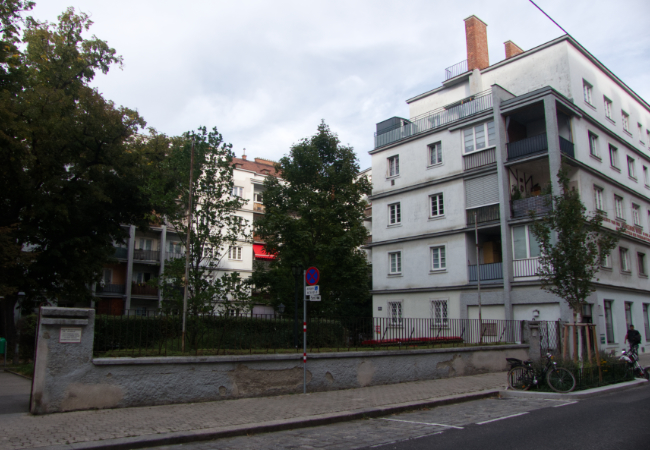
Hagenmüllergasse 21 – 23

There is something coastal about these flats; Vienna-by-the-sea. Consider how different they are from the other blocks in the area. This is more in the modernist idiom of Bauhaus than some of the more traditional designs nearby.
Some of the architecture of the Red Vienna period is criticised for its conservativism and restraint. I personally think this is unfair. There is a great deal of variety in the architecture and as always with public housing there were – even under a socialist administration – restraints imposed by time and budgets.
Public housing would be even better in Europe if it was all built to the standard and quality of middle class housing; but there were, and are, political rather than architectural reasons why this has never happened.
I am also suspicious of architecture which is driven by modishness, fashion and ego. A great deal of housing was built in Britain after the second world war, and much of it blown up after twenty years. It might have ticked a certain type of aesthetic box but it was a hopeless failure as actual housing.

The architect was Karl Dirnhuber who emigrated to England on 30 June 1939 with his wife Annie Stern, a bookseller. He also designed home furnishing and arts and crafts objects. In England he joined an architectural practice in Birmingham. Part of his legacy in Vienna was to transform the former Währing cemetery into a park.
Hagenmüllergasse 25
The architecture was Hugo Mayer who had spent time in London and England in 1912 studying the Garden City movement. It is intriguing to think how this experience influenced him because this block has a big city feel to it.
Walk into the courtyard to get a sense of how much housing there actually exists here and how well the corner space has been used.
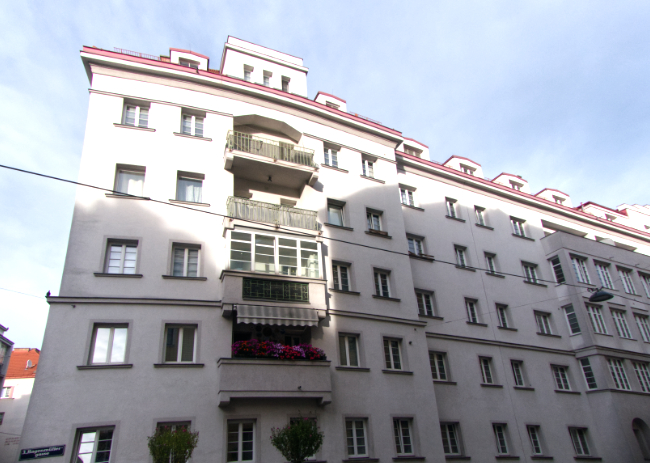
Mayer worked in the Vienna city planning office from 1907 to 1923, a relatively short period in which a great deal of change took place.
One wonders what the actual change within the city council offices was, and how recruitment, staff management, pay, pensions, holidays, benefits, work flow, work functions, organisational structures and much else were impacted; and what the differences were before, during, and after the revolutionary period.
Much is generally written about revolutions and factories, but industrial workers have never been more than around 20 percent of the workforce in capitalist societies. Large numbers of workers were, and are, in retail, services, offices, health and administration, construction and many other sectors.
How did the revolution impact upon them? In all my time working in offices, sometimes in corporate environments, I would very much have liked to experience a revolution. Obviously not just to see how the character of work itself changed, but that would have been interesting in itself.
This period of 16 years that Mayer worked in the planning office would have involved the increasing use of the typewriter (a relatively new office technology) and the introduction and functional adoption of the telephone. It would be interesting to know how the revolutions in the means of communication and means of production intersected with the political and social revolutions.

Hagenmüllergasse 32 – Felleishof

The block is named after Roman Felleis a resistance fighter. In 1934 he helped found the underground organisation ‘The Revolutionary Socialist Youth’. He was arrested and sent to Buchenwald concentration camp where he was killed in 1943 during an air raid on a nearby munitions factory.
The architect was Johann Rothmüller who had worked as a master builder before becoming an architect. He established a building firm with Alfred Mautner and one of their first commissions, in 1921, was the sets for the film Sodom and Gomorrah. They also designed the Löwen cinema in Löwengasse which is now a Billa supermarket. Mautner managed to escape the fascists in 1938 by moving to London.

I started to wonder whether the building had a film-set quality and there certainly seems to be something cinema-like about the entrance portal. The use of concrete is well done.
It is a material that can appear drab and run down as it ages but I think the atrophy is off-set by the rich terracotta colour. And for all the criticisms that can be made of the use of concrete it does give a sense of solidity and strength, something good to find in the entrance to a public housing apartment block
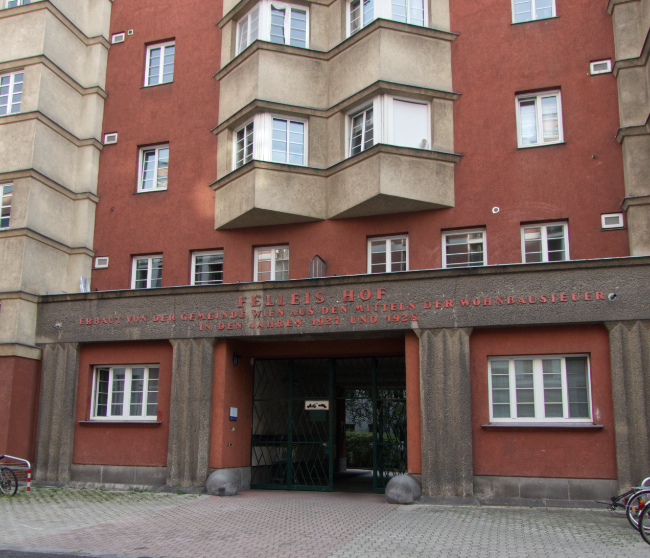
There is a great deal of visual movement with the angles and the way the triangle-bay windows look out into the street.
On the day I went to take photographs I noticed a shopping trolley in the entrance way. Shopping trollies are a feature of many of the estates, used by everyone for all sorts of reasons. Even on occasion to move groceries around. These trollies are remarkably strong and generally well built and cleverly engineered. The history of their invention deserves more attention than this brief note. But that will have to wait for another day.
You could catch the U-Bahn at Kardinal Nagl Platz, or you could go and have a look at…
Klopsteinplatz 6
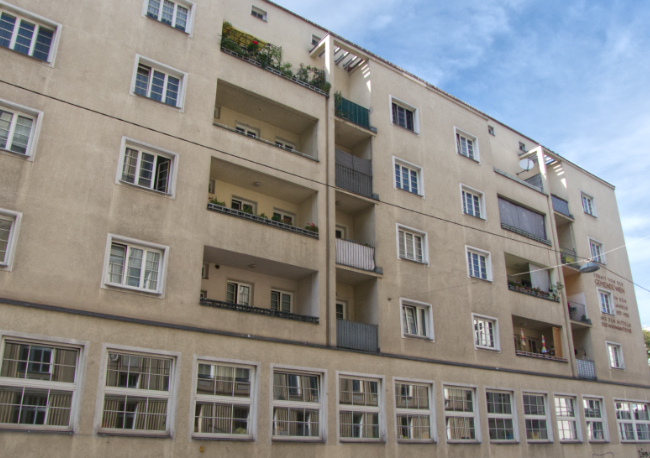
Built in 1927 – 28 to a plan and design by Walter Sobotka. It may be a little out of your way but I think it’s worth going to see. It’s a relatively plain building and yet somehow it holds its own within the imperial pretensions of some of its neighbours.
It also has an impressive kindergarten. One of the many likeable things about this is its continued existence. And this, I would argue, is because of the long-ago established principles of free education at various levels, rather than constant government poorly considered ideological intervention.
One thing I have discovered on Radical Walks is that while I like to go on and on about splits in tiny socialist groups, the intricate history of various congresses of the Second International, obscure disagreements between Pugin and his contemporaries, the technical history of construction, the finer points of Karl Marx’s Capital, long-forgotten architects and artists, books that no one else has heard of, this is not what the masses crave.
People who come along to Radical Walks often want trivia, celebrity gossip, scandal and salacious vignettes related to the people, events and streets we’re exploring.
On that note consider that Sobotka, his wife and daughter Ruth emigrated to the USA to get away from the fascists. They arrived in New York City on 7th July 1938 on the liner Saturnia (which was converted to a troop ship during the war).
In New York, Ruth became a ballet dancer and designer and married the film director Stanley Kubrick. Who could have imagined all of that in Vienna in 1927 when this block was being built?
I hope you’ve enjoyed this Radical Walk. And as they say, until the next time.
Serendipity in the Rabenhof is a Radical Walk that will take place on Sunday 28 September. More information here.

This is part of a series of seven Red Vienna Radical Walks.
1. Ella Briggs, Karl Marx & Modern Housing
2. The Radical Housing of Meidling, Vienna
3. Favoriten and the end of Vienna
4. A Walk along Währinger Strasse
6. Rabenhof, Vienna: A Radical Walk
7. Red Vienna: A Radical Walk
And here’s an eclectic Red Vienna reading list
 Commodity Fetishism
You must be logged in to post a comment.